DAILY FILM DOSE: A Daily Film Appreciation and Review Blog: Political
[go: up one dir, main page]

Showing posts with label Political. Show all posts

Friday, 7 September 2012

TIFF 2012 - Argo


The real-life mission to rescue six American hostages from Iran in 1979, previously classified by the CIA and now public knowledge, has been realized into Ben Affleck's best film as director. It's both a taut and slick political thriller, as well as a witty Hollywood farce. The film's greatest strength is its ability to switch modes on a dime providing maximum commercial entertainment value and mostly controversy-free political intrigue.


Argo (2012) dir. Ben Affleck
Starring: Ben Affleck, John Goodman, Alan Arkin, Victor Garber, Clea Duvall

By Alan Bacchus

To set things up Affleck crafts a terrific siege sequence wherein the angry Iranian mob storm the embassy in Tehran nabbing 70+ American citizens - a sequence which expertly weaves period news footage with authentically recreated scenes to put us in the time and place of the era. And before that Affleck provides us with a fine history of the background players contributing to the big picture stakes.

Affleck is as good a hero leading man as he is a director here. He plays Tony Mendez, an experienced but lonely family man who has recently split for his wife and child. After dismissing the ill-conceived schemes by the State Dept. brass to get the Americans out of the country, Mendez hatches a plan to get them out via a fake Hollywood movie being made by Canadian filmmakers.

Mendez is thus forced to ingratiate himself with the oddball eccentrics of Hollywood, specifically producer Lester Siegel (Arkin) and special effects artist John Chamber (Goodman) to build the elaborate rouse, which includes finding a real script, drawing real story boards and generating real publicity for Mendez's fake movie, entitled Argo.

Unfortunately, Argo is top-heavy with most of the tension, intrigue and humour at the beginning of the film. By the time Affleck is in the country and executing his plan it's relatively easy-going. Conflict exists between some of the Americans, who are skeptical of the ridiculous scheme. Suspense is manufactured through presumably exaggerated events of ticking-clock jeopardy. At one point the group finds themselves at the airport checking in, but they learn that their tickets have been cancelled by the White House. It's a scene conveniently cut in real-time with frantic phone calls made to the CIA colleagues at home to have their tickets reinstated into the computer system. And the final race to get on the flight and have the plane take off before the Iranian guards can catch them on the tarmac and runway feels completely false and manufactured.

And so sadly, despite the impressive beginning, Argo ends with a slight whimper. And for Canadians it's a feeling of inadequacy and embarrassment, as we discover that our great political triumph, taking credit for the heroic escape, was a sham and part of the CIA classified cover-up. These revelations also negate the 1980s Made for TV Escape From Tehran, which dramatizes the Canadian cover-up version.

But this is Ben Affleck firing on all cylinders as a new director, free of his Boston comfort zone and working with a new script that he didn't write.


***
Tuesday, 8 May 2012

Hunger

Hunger (2008) dir. Steve McQueen Starring: Michael Fassbender, Stuart Graham, Brian Milligan, Liam McMahon, Liam Cunningham

****

By Alan Bacchus

This debut feature, re-released on Blu-ray to coincide with the release of Shame, is still a magnificent introduction to the former new media artist and designer Steve McQueen (no relation to the Bullitt star) and an impassioned story about the 1981 hunger strike by Irish revolutionaries in Maze Prison.

Passion and intensity overcome the rather orthodox narrative; it's hard to ignore the misleading flow, which can confuse the casual viewer. McQueen initially introduces us to Raymond Lohan (Stuart Graham), a prison guard we watch go about his mundane morning routine: showering, getting dressed, eating breakfast and, lastly, checking under his car for bombs before going to work. Once at work, McQueen goes into the details of his exhausting task of overseeing a group of miscreant prisoners united in the name of Irish freedom against their captors. McQueen then switches to the POV of Davey Gillen, a boyish-looking, incumbent inmate identified as having a nonconforming attitude. Once in his cell, which has been grotesquely decorated with faeces by his new mate, Gerry Campbell, we realize Gillen has entered a new kind of hell. And yet, the film isn't about Gillen, Campbell or Raymond the prison guard.

Finally, after a ceremonial beat down session by the guards, we glimpse Bobby Sands for the first time, who will takeover the film from hereon in. First, we see him as a feral beast of a man, with long hair and a long beard, being dragged kicking and screaming to get his hair cut. At the end of the ordeal, we see Sands the man for the first time, cut and bruised but absolutely resolute in his determination.

In the context of cinema history, it's also a magnificent introduction to Michael Fassbender the actor and Hollywood star in the making. Fassbender's embodiment of Sands' unbelievable dedication of mind and body to the cause of Irish freedom has the same kind of visceral power as Robert De Niro's Jake LaMotta or Brando's beatings in On the Waterfront.

The final act, wherein Sands wastes away on a bed, refusing all food, is brought to life by McQueen in the most uncompromisingly painful manner. And yet, at the moment of his death it's an existential, ethereal moment, beautiful and serene.

After Sands takes over the picture we never see Gillen again, nor Campbell, nor the young Swat member who guides us through the harrowing riot sequence. As such, upon my first viewing, I was admittedly confused, not knowing who to follow. But looking back, McQueen's intentions are clear. Hunger is not a political film, but a work about the effect of the Irish conflict from all sides, sympathizing with everyone engaged in the fight, whether it's Sands' voluntary commitment or the guards just trying to make a living. Everyone suffers in Hunger, but in the process we are enlightened about the power of our resolve and commitment.

The Alliance Blu-ray is devoid of special features, which makes the Criterion Collection Blu-ray the keeper for collectors. But McQueen's immaculately controlled visual colour palette looks as beautiful in high definition and thus is worth every penny.

This review first appeared on Exclaim.ca

Wednesday, 14 March 2012

The War Room

The War Room (1993) dir. Chris Hegedus, D.A. Pennebaker
Documentary

***½

By Alan Bacchus

With film just about gone now, almost certainly in the documentary form, we probably won’t ever see a film like The War Room anymore. Documentary verite features shot on film have the true "fly on the wall" aesthetic pioneered by the co-director of this film, D.A. Pennebaker (Don't Look Back, Monterey Pop).

Cinema verite represents a style of documentary filmmaking born in the '60s, accompanying the trends of the French New Wave. It's a term traditionally associated with the films of D.A. Pennebaker and Chris Hegedus. But with The War Room, we could be even more specific and call it ‘Direct Cinema’, using a type of filmmaking that is the least intrusive and most observational documentary technique, rendering the camera and filmmakers as invisible as possible to the filmmaking process.

With the prevalence of reality television and the use of talking head interviews or confession-cams, subjects are aware of the camera. But with no sit-down interviews, very little stock footage and voice-overs, and no direct-to-camera discussions, The War Room exerts a style rarely used in such purity.

It’s a supremely entertaining and enlightening film, justly nominated for a Documentary Oscar. It follows Bill Clinton through his immensely dramatic Presidential Campaign in 1991, during which he was labelled the ‘Comeback Kid’. He overcame a tough early loss in the New Hampshire Primary, survived a sex scandal with Gennifer Flowers and managed the GOP onslaught against his controversial draft record in the Vietnam War.

And yet the film is not about Bill Clinton, but rather the youthful, aggressive and passionate campaign staff behind the scenes controlling the action like control room directors of a live television show. Now recognizable political voices James Carville and George Stephanopoulos become the stars of the picture. They are a dynamic duo of sorts - one (Carville) tall, lanky and jovial, the other (Stephanopoulos) short and handsome, but both political dynamos.

Within the nerve centre of activity, Pennebaker and Hegedus capture the improvised spin control against a number of political obstacles with the utmost of naturalism and believability. The subjects seem invisible to the camera, as they go about their work passionately and without inhibition.

Late in the film after his Presidential victory, Clinton thanks his staff for their unconventionality and revolutionizing of how campaigns are run. And before that, in an impassioned speech, Carville describes how campaigns used to be run, with compartmentalized departments working in silos and in strict hierarchy. The film shows us Carville's horizontal approach by empowering each of the workers to innovate and improvise and take their own lead. Unfortunately, if there's anything to fault in the picture, we never get to see the other side, the old guard system as described by Carville.

But this is the filmmakers' medium of choice. By using the language of direct cinema, unless we see stock footage or other manipulative devices, this information can only be implied to us. But The War Room is not meant to be a comprehensive survey of the history of political campaigning. Instead, it's a slice of time in 1991 with these specific people, and the context of history can only be implied to us.

But we get it, and the film doesn't need expository explanations to make its point. The War Room is cinematic observation, the cinema verite form at its finest.

The War Room is available on Blu-ray from The Criterion Collection.

Sunday, 12 February 2012

Missing


Missing (1982) dir. Costa-Gavras
Starring: Sissy Spacek, Jack Lemmon, John Shea, Melanie Mayron

***

By Alan Bacchus

Quick, name the Palm D’Or winner from 1982… You’re right, it’s Missing, Costa-Gavras’ American-made political drama. It also nabbed Lemmon a Best Actor trophy at Cannes and three of the major Oscar nominations that year – Best Actor, Actress and Picture. Until its Criterion Collection coronation on DVD a couple of years ago, it was a classic ‘missing’ from DVD shelves for years.

Unfortunately, the integrity of the film and its political message trumps its entertainment aspects. While there’s a passionate desire for truth, a slow pace and truncated narrative structure make it more an admirable venture then great cinema.

Before Oliver Stone, Costa-Gavras was perhaps cinema’s best known and most experienced political dramatist. Unlike Stone, Costa-Gavras is not so much a provocateur as a truth seeker. In Z with uninhibited anger he dramatizes the unjust murder and cover-up of a disguised version of assassinated Greek politician Grigoris Lambrakis.

In Missing, like Z, we never know the location of the story, but subtle clues tell us it’s Chile and an indictment of Augusto Pinochet’s military junta rule. John Shea and Sissy Spacek play Charles and Beth Horman, newlyweds who have chosen to live in the unnamed volatile South American country to get closer to the political pulse of this hot button region. One day the military presence is suddenly heightened and before they realize it the government has been taken over in a military coup. And then out of the blue Charles disappears – snatched from his home in the middle of the night.

Enter Ed Horman (Jack Lemmon), Charles’ father, who arrives in town on a mission for answers and to ensure a forthright investigation by the American consulate. When the Americans present a standoffish front, Ed takes it upon himself to lead the investigation. And so Beth and Ed become an unlikely team – Beth, the young leftist radical, and Ed, the elderly conservative father. Together they uncover clear American culpability in Horman’s disappearance as a pawn of appeasement for their participation in the coup.

Despite the political procedural details, Missing is at heart a picture about the two people who get to know each other amidst the cloud (or fog) of war. As a showcase for Lemmon Missing is a triumph, as the film is so heavily weighted to his performance. Costa-Gavras even delays this satisfaction until the second act after a lengthy and tedious opening act before Horman disappears and Lemmon enters the picture.

From then on Jack Lemmon owns the film.

His performance, like a couple of his other great late-career serious roles (The China Syndrome and Glengarry Glen Ross) is magnetic and electrifying. His glances and small mannerisms are the stuff of acting royalty. I can think of only a handful of actors with this kind of presence and power.

The actual narrative details, the movements from A to B to C and the political revelations aren’t as profound as they may have been in 1982. American participation in military coups is not even contested anymore – they are an accepted fact of their Machiavellian roles in world politics. And so the film leads to where we expect it to go, thus reducing its controversial power.

But Missing is still a film to be rediscovered merely for the presence of Jack Lemmon, one of the greatest actors ever, in an amazing Brando-worthy performance that is rarely seen and discussed today.

Wednesday, 18 January 2012

Traffic

Traffic (2000) dir. Steven Soderbergh
Starring: Michael Douglas, Benecio Del Toro, Catherine Zeta-Jones, Don Cheadle, Luis Guzman, Erika Christensen, Topher Grace, Steven Bauer

****

By Alan Bacchus

Looking back on my favourite independent films of the late ‘90s/early 2000s, some survive well and others don’t (like Magnolia - ew). Despite many imitators, Traffic has lost none of its power since 2000. It’s a film about ideas, as fresh, innovative, thrilling and emotionally satisfying now as it was then.

At this time there was a whole lot of high-profile studio dreck making big noise. But it was mostly hot air – lots of tepid Hollywood product from big names like Robert Zemeckis (Cast Away, What Lies Beneath), Ridley Scott (Gladiator), Gus Van Sant (Finding Forrester), Robert Redford (Legend of Baggar Vance), Ron Howard (The Grinch Whole Stole Christmas) and other 'forgettable' studio product.

It was an astonishing year for Steven Soderbergh, who had two critical hits that year, including Erin Brochovich. He was nominated for Best Picture and Best Director for both and won for Traffic.

Based on the British TV mini-series, Traffik (1989), Soderbergh’s opus captures the broad scope of the drug trafficking network in America, specifically the cartels in Mexico selling their wares in the United States. Arguably, much of the heavy lifting on this story was done by Simon Moore, who wrote the British series. Screenwriter Stephen Gaghan’s challenge was to transport it to America, bring it down to two-and-a-half hours and make it cinematic.

It’s a simple starting point to tell this broad story – three separate threads that converge with each other in the third act. There’s Benecio del Toro’s character, Javier Rodriguez, a soft-spoken Mexican cop, who, despite using dirty tactics, has a moral conviction at heart that will emerge throughout the picture. He’s our point of view into the Mexican cartel war, in this case the Obregon/Juarez cocaine kings, whose battle incites the action in the film.

There’s also the point of view of the DEA, including officers Montel Gordon (Cheadle) and Ray Castro (Guzman), affable undercover partners leading the case against the American distributor of the Obregon drugs, Carlos Ayala (Steven Bauer), who, following the arrest of a low-level pawn, uses him as an informant against Ayala.

And lastly there’s the government angle with Robert Wakefield (Douglas) as the Presidential-appointed drug czar, who, while navigating his way through the drug politics of the border, is also dealing with his daughter's own drug addiction.

While one of its more famous imitators, Crash, used the same gimmicky device but with a block head treatment of its sociopolitical issues, looking back Traffic feels as credible, honest and thought-provoking intellectually as it did 12 years ago. This is due to Steven Soderbergh's precise control of his tone. Many of his key turning points could have been embellished, but at all times we can feel the restraint on the reigns whenever the film threatens to spill over into melodrama.

Soderbergh continues his fascinating creative collaboration with composer Cliff Martinez, his go-to man for his serious films. Using quiet ambient tones, both synthesized and organic, a quiet intensity brews, keeping the drama to a whisper.

And despite the truncated screen time we come to love Soderbergh’s heroes, specifically the DEA agents whom we discover are in over their heads against the powerful, unstoppable force and deep pockets of the clandestine drug cartels. It’s the same with the rogue underachiever, Javier Rodriguez, who, after witnessing the horrors of the drug war at ground zero, engineers a remarkable and heroic stance against the hand that fed him.

Of the three storylines Michael Douglas’s feels the most on the nose, specifically the dramatic irony of his daughter’s addiction competing against his responsibility as drug policeman for the country as a whole. That said, it's one of Douglas's best late-career performances. And the only other false note to reference is Dennis Quaid’s obvious turn as the shady lawyer scheming against Ayala’s pregnant wife.

But these are minor blips in an otherwise perfect movie. It’s an 'important' film recognizable as a product of its time – just as All the President’s Men and its distilled conspiratory style was a product of its time.

Traffic is available on Blu-ray from The Criterion Collection. But as a note to readers, Soderbergh’s carefully crafted colour-coded cinematography doesn’t quite hold up on Blu-ray. It takes much fiddling with your contrast/brightness settings so as not to blow out the hot spots in most of the scenes.

Wednesday, 26 October 2011

The Ides of March

The Ides of March (2011) dir. George Clooney
Starring: Ryan Gosling, George Clooney, Evan Rachel Wood, Philip Seymour Hoffman, Paul Giamatti, Jeffrey Wright

****

By Alan Bacchus

George Clooney’s The Ides of March can be summed up by quoting the oddly simplistic yet precise description of Citizen Kane on its poster, ‘It’s Terrific!’ Has this film fallen off everyone’s radar already? If so, what a shame. Don’t let this fascinating, thrilling and wholly thought-provoking and cynical new millennium political thriller fall through the cracks. It’s one of the best films of the year.

Stephen Myers (Gosling) is a hot-shot assistant campaign manager for Pennsylvania Governor Mike Morris (Clooney), who is running for the Democratic nomination in the lead-up to a Presidential election. Although he is no less influential in the race, Myers is the number 2 guy behind Paul Morris (Hoffman). Like most young political whips, Myers’ idealism about his place in the political system and his faith in Morris, the DNC and U.S. politics in general is a rarity. Paul has his own equally high moral standard, yet, by experience, has a strong armour of pragmatism.

Morris has the lead in the race, and with the delegate support of Senator Thompson (Jeffrey Wright), he could seal the nomination. The wrench in the machine comes in the form of Myers’ competitor, Tom Duffy (Giamatti), campaign manager for the other side, who makes a play to bring Myers over to his candidate. This represents the beginning of a series of psychologically and morally complex issues for Myers as he attempts to spin-control the fallout of his decision. Clooney and his writers deftly play out three separate political subplots, and in the third act they snake them around each other in perfect structural screenplay form. To provide additional details about the thought-provoking plot twists would be criminal.

But by the end, Myers’ character arc – that is, where he begins the film vs. where he ends up – is so deep and profound we can’t help but think of Michael Corleone’s gradual descent into moral corruption. Yes, the same Michael Corleone from The Godfather. In almost half the running time (a refreshingly slim 101 minutes), Clooney crafts a similar tale of corruption and the effect of career ambition, jealousy and revenge on one’s moral conscience.

Aiding Clooney are the two best character actors on the planet as his trench-war fighting rivals. Hoffman and Giamatti sharing the same space is akin to the monumental occasion when Robert De Niro faced off against Al Pacino in Heat, or when Christopher Walken tortured Dennis Hopper in True Romance. Both actors match each other in dramatic weight, bringing working class grit to their roles in equal measure.

The ability of Ryan Gosling to fit himself into these two powerhouses and emerge with his head above water is testament to his abilities as well. He embodies both the optimism and cynicism of American politics.

George Clooney has successfully dipped this fine picture into the hardline, pessimistic and distrustful era of ‘70s filmmaking, matching the stone cold integrity of films like All the President’s Men. Clooney refuses to give us the Capra ending. Instead, he force-feeds the American people (not me, I’m Canadian) a healthy dose of political reality, however conniving and malicious it may be.

Tuesday, 24 May 2011

The Manchurian Candidate

The Manchurian Candidate (1962) dir. John Frankenheimer
Starring: Frank Sinatra, Lawrence Harvey, Angela Lansbury, Janet Leigh

****

By Alan Bacchus

John Frankenheimer’s The Manchurian Candidate predated the trend of cynical political films of the 1970s by eight years or more. Born from deep distrust of the actions of the American intelligence community during the Cold War, and in the 1960s, at a time when John F. Kennedy was about to be assassinated by the same establishment, it was at the time shockingly prophetic and powerful. Today, the film's skewered notion of heroism feels as dark, scathing and dangerous to the establishment now as it did then.

Frank Sinatra is Major Bennett, the leader of a platoon of soldiers captured by Korean forces. However, the platoon fights its way home, eventually winning a Congressional Medal of Honor for Raymond Shaw (Harvey). But when a recurring bad dream reveals itself to Bennett as a brainwashing experiment by the Communists while in prison, he is compelled to uncover the details of an astonishing plot of political assassination and government subversion

The picture was famously pulled and its theatrical released delayed due to the unfortunate timing of the JFK assassination. And this was even before the conspiracy theory connected with the CIA was discovered. This is just the background context and historical relevance of the film. As a movie-going experience in the present, John Frankenheimer’s cooly stylish direction is still as exciting now as it was then. At the time it was his third film after a long and successful career directing during the Golden Era of Television in the '50s. After all that experience with practically helping invent the medium, Frankenheimer brought a hip freshness to the big screen. His sharp black and white photography used the moody tones of film noir, as well as the deep focus visual aesthetic of Orson Welles. His editing was sharp and predated many of the experimental techniques used later in the decade.

Looking back, few would argue that the lasting performance of the picture belongs to Angela Lansbury, the diabolical matriarch and puppet master of the big picture conspiracy at play. We can’t help but think of Mama Islen as a mix of Nancy Reagan and Joe Kennedy.

Watch the terrific editing in the dream sequences, during which Bennett and his troops are subjected to the terrifying brainwashing ordeal. Intercutting the two realities for the troops – the audience of communist officials watching the session in delight and the troop’s point of view of the elderly ladies book club – produces a delightfully terrifying scope of horror conducted by these powers that be.

The film magnificently reveals its cards carefully over its 126 minutes, ringing all the terror and suspense up to its violent and powerful climax in the end.

The Manchurian Candidate is available on Blu-ray from MGM/20th Century Fox Home Entertainment.

Monday, 21 March 2011

Carlos

Carlos (2010) dir. Olivier Assayas
Starring: Starring: Édgar Ramírez, Alexander Scheer, Alejandro Arroyo

***1/2

By Alan Bacchus

The Blu-ray cover of this exciting new release looks like a cross between Terminator Salvation and a robot character from Transformers. It's actually the face of Edgar Ramirez as Carlos. It's a bold cover that will likely attract more mainstream Blockbuster shelf surfers or Netflicks surveyors than the retro-cool theatrical poster of this film. The title of the movie was even changed to Carlos the Jackal to exploit the nickname by which the public knows this story but is actually never mentioned in the film. I have no problem with this – the more eyes on this work the better. Assayas brings Euro-art house credibility to what is essentially a procedural action film told with maximum realism, cinematic swagger and panache.

The new Blu-ray features both the five-and-a-half-hour mini-series version, which also played out of competition at Cannes, and the theatrical cut, which runs a bit over two-and-a-half hours. Though one version is literally half the length of the other, they both feel remarkably similar. Each film is anchored by its three acts. The first covers the introduction of Carlos to the International Palestinian Liberation movement funded indirectly by the Iraqi government via white-collar terrorist Wadie Haddad.

Carlos's early movements and cocksure attitude are dramatized with great speed, as we rush through assassination attempts, parcel bombings and other smaller tasks in a whip-fast montage effect. Both films feature a remarkably similar second act. It shows the step-by-step procedural details of the notorious Vienna OPEC Raid in 1975, where Carlos led a six-person team into OPEC headquarters and took hostages from Austria to Algeria to Libya and Yemen.

After zipping through the early years, virtually the entire second chapter takes place in the two days of this hijacking. Even within this shrunken timeline, Assayas makes every movement, action and decision a nail-biting affair, ringing out genre-style suspense and thrills as good as any Hollywood crackerjack.

Where the long version departs from the short version is in the third act, which shows the last 15 years of Carlos's career. It presents the downfall that began with the fallout of the OPEC event, leading to his last days as a free man in the '90s in Africa. Arguably, after reaching the high at the midpoint of part two, the film peters out due to the excessive running time, and it never achieves the true cinematic climax it deserves. And unfortunately, neither version cracks the third act.

Narrative deficiencies aside, Carlos succeeds magnificently because of the remarkable state of realism achieved by Assayas. We never feel like we're being manipulated by cinematic conventions or "action scenes." It's distinctly un-Hollywood without the art house pretension. We're also privy to one of the best performances of anyone last year (including Colin Firth) from Edgar Ramirez, who speaks numerous languages, endures De Niro-worthy weight gain to change his appearance over time and, most importantly, conveys the swagger that made Carlos one of the most unlikely political celebrities in the world.

Saturday, 12 February 2011

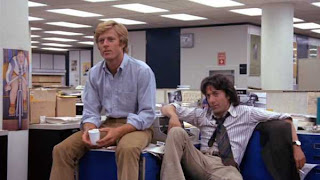
All the President's Men


All the President’s Men (1976) dir. Alan J. Pakula
Starring: Dustin Hoffman, Robert Redford

****

By Alan Bacchus

All the President’s Men is a film that will stand to the test of time as the quintessential political thriller. Yet, it’s a work of surprising matter-of-fact simplicity.

The film is based on the best-selling book by Bob Woodward and Carl Bernstein on how they broke the story of the Watergate Scandal. Woodward and Bernstein are the main characters, two young hungry journalists from the Washington Post trying to uncover a scandal involving a break-in at the Democratic National Headquarters in the famed Watergate Hotel. They quickly learn the break-in was not a simple burglary but an elaborately-planned wiretapping scheme organized by the Committee to Re-elect the President (appropriately acronymed, C.R.E.E.P.). Woodward and Bernstein unravel the conspiracy by tracing the cause and effect up the political chain all the way to the President’s office.

The title is appropriate because the film is a series of ‘connect-the-dots’ to solve the puzzle. One man’s information leads to another man, who leads to another man and so on and so on. These are the “President’s men”, whose the orders of an anxious President trickled down to his subordinates and caused such heinous crimes against the democratic system.

We learn a lot about the procedures and workmanship of journalists in a CSI-like procedural fashion. It’s fascinating. The telephone proves to be a powerful weapon for the journalists. Many of characters we don’t even see, only hear through the multitude of phone calls from Woodward and Bernstein. We learn of their techniques to gain credible information, yet keep the identities of their sources safe. It’s also a little history lesson in investigative journalism before the age of the internet and the cell phone. For a good companion piece to this, also watch Michael Mann’s The Insider.

The newsroom is exciting, the constant sound of typing, printing, ringing telephones, televisions, and news chatter permeate the working environment. Gordon Willis’ camera follows the characters across the expansive room, moving through cubicles like a football player towards the endzone.

All the actors are in top form and perfectly cast, Redford with his charm and suave good manners allows him to cut straight to the point, Hoffman portrays Bernstein like a bull, who’ll get the information he wants no matter what. The great character actor, the late Jack Warden, brings working-class humour to his role as their department head, and Jason Robards is perfect as the consummate editor-in-chief, who supports his staff to the end, but from whom he demands the absolute best work.

All the President’s Men breaks many rules of conventional filmmaking, other than telling a good story. There is no action or fighting or death, there’s no physical antagonists, no subplots, no romantic relationships, and the main characters don’t arc in traditional ways, in fact, we don’t learn anything about their lives, they are simply instruments to uncover the facts. But these facts are like daggers, because we all know the stakes and the damage caused by the actions of these men. Despite these anomalies the film is suspenseful, dramatic and gripping from beginning to end.

All the President's Men is available on Blu-Ray from Warner Home Entertainment

Wednesday, 9 February 2011

The Tillman Story

The Tillman Story (2010) dir. Amir Bar-Lev
Documentary

***½

By Alan Bacchus

At the Super Bowl last weekend among the drawn out ceremonial coverage of the big game was a tribute to the soldiers of the US military – something now commonplace for big events. The moment, orchestrated by the director of the broadcast, featured American flags hanging calmly in the background, a recent medal winner standing respectfully in the endzone, and Troy Aikman and Joe Buck praising the work of all the soldiers fighting in Iraq and Afghanistan. I understand the need to do this. After the ostracizing of the soldiers of Vietnam in the 60's, the collective American public wants to atone for the damage done to those shamed soldiers.

In The Pat Tillman Story, this need to blindly create heroes of the soldiers slides horribly to the side of egregious disrespect and contempt for the wishes of the families of those fallen men and women. The very public story of Pat Tillman, a former NFL football player who quit the league to fight for his country and who was killed by friendly fire in Iraq is comprehensively broken down and analyzed from the point of view of Tillman’s grieving family, who only the desired the truth, but instead were fed lie after lie by the military PR spin controllers.

Director Amir Bar-Lev unveils the story to us carefully, telling us the minute details of the events which led to his death.  He also approaches the events which led to Tillman’s family learning of Tillman’s death and the public hoopla which followed with the same careful consideration. The tragedy of which, considering the miscommunication of the friendly fire shootout, is heartbreaking, but soldiers admit the fog of war can easily create such havoc. The military never covered this up, and the family was even accepting of this sad reality or war, but the need to create a story of deified heroism and to parade their son's image in the name of military rabble-rousing was something they could not stand for.

The key moment of conflict which sends his parents on the two year long odyssey for justice comes when they question the military for more details on the official interpretation of events pertaining to their son’s death. With Tillman already in the public eye the family accuses the military of manufacturing a heroic spin on Tillman’s death in lieu of revealing the true grisly details none of us ever want to hear.

It’s as remarkable a character study as it is an investigative piece. Bar-Lev goes into the young life of Tillman as a rambunctious young boy, one of three brothers in a strong tight-knit family, to his feats of excellence in athletics. The connections of Tillman’s internal fortitude and his physical strength becomes a profound metaphor to his mother and father’s conviction to learn the truth.

The Tillman Story is thus both inspiring and frustrating. Inspiring for Tillman’s parents’ stubborn refusal to accept anything less than the truth, a fight which takes them all the way to a Congressional Oversight Committee hearing and frustrating for the US Government’s even more resolute stubbornness to save face and refusal to admit the lies they’ve been feeding the public – an admonition which would likely open up other old wounds from these post 9/11 conflicts.

In a year of great documentaries, this one has sadly fallen under the rradar during awards season. Don't miss it.

The Tillman Story is available on DVD from Alliance Films in Canada

Monday, 24 January 2011

SUNDANCE 2011: The Devil's Double

The Devil’s Double (2011) dir. Lee Tamahori
Starring: Dominic Cooper, Ludivine Sagnier, Raad Rawi

***

By Alan Bacchus

After the very public outing of Lee Tamahori's personal problems, it’s so very gratifying to praise his latest film, The Devil’s Double, a Belgian film made far far away from Hollywood. Though it’s not a return to the tour-de-force form of Once Were Warriors, it’s certainly a giant leap above sell outs Die Another Day or xXx 2. The true story of Uday Saddam Hussein, the spoiled rotten son of the former Iraqi dictator, a sadistic loose cannon, whose rampage of torture, rape, and murder in the pre-Gulf War days made him infamous and legendary.

Tamahori seems to channel his own now very personql hedonistic demons into his portrayal of Hussein. He turns this story into a gluttonously biopic cum action film, striving for the same shamelessly over-indulgence as say, Brian De Palma’s Scarface but grounded in the same absurd realities of The Last King of Scotland.

Dominic Cooper is simply delicious in the dual role as Uday as well as his double Latif, who in real life was an old school friend of Uday’s but was kidnapped from his family and held hostage for years to be his political double.

As Uday, Cooper plays his bombastic psychopath with high energy. And as Latif, Cooper is able to dial down his rage into an nail-biting internalization of his emotions. Though the physical difference in character is represented only by Uday’s buck teeth and combed down haircut, Cooper’s subtle differences in performance is more than enough for us to distinguish each character.

While there’s some astonishingly gory violence displayed on screen, Tamahori cranks it up so far, it spills over for comedic purposes. Mondo sex, drugs, bullets and blood taken to its extreme to counterplay the unbelievable disregard for humanity which occurred in real life. However grotesque Tamahori challenges us to treat Uday Hussein as entertainment and succeeds.

SUNDANCE 2011: Reagan

Reagan (2011) dir. Eugene Jarecki
Documentary

***1/2

By Alan Bacchus

Coming from the director of angry finger pointing documentaries such as Why We Fight, we can’t but anticipate a demythologizing of the Reagan mystique, a deliberate campaign perpetrated in the past 10 years by the Republican party to make the two term President a beacon of right wing values. And so it seems to be as much a surprise to the filmmaker himself as well as us the audience that Jarecki’s film is as conventional and reverent to the man as it is.

This is what Jarecki admitted in the Q&A following the World Premiere of his film. Using the simplified title of his last name suggests a thorough examination of the man. It's a smart decision for Jarecki to stay on the side of fair play, as a black-white vilification of the man would be as irresponsible as those Republican mythmakers.

Though it’s fair it’s no less enthralling, tracing back through 100 years of American history - from his humble childhood in Illinois to his career in Hollywood to his career as a pitch man for GE, his political career as Governor of California and finally his eight years as President which saw him preside over an amplification of the Cold War as well as beginning the process of dismantling it.

Jarecki’s metaphors successfully link the pillars of his personality to a number of key decisions in his life. Namely his success as a lifeguard in his youth, wherein, despite being poorly sighted, saved over 70 people from drowning in a lake over the course of this job. This desire to protect the innocent cleverly feeds his motivations in the Iran-Contra affair some 50+ years later when he famously broke the law in order to trade guns for the lives of the Lebanese hostages.

Same goes for his career as a pitchman for General Electric, which becomes the prevailing metaphor for his victories in politics. As a figurehead for the nation, Jarecki demonstrates Reagan’s unquestioned success in strengthening American position in the world in place of sound informed decision-making.

Like Reagan’s conservative politics, Jarecki sticks to a traditional approach to the story. A meat and potatoes film for a meat and potatoes President. Talking heads from his family and close political advisors paint the picture of the man we saw in office. Reagan comes off as both the shrewd conservative that presided over the voodoo economic policies which transferred enormous wealth from the rich to the poor as well as that flag waving friendly cowboy that patriotically united the country.

Surprises are few. Jareki confirms some of the tales of Reagan as an aloof simpleton who left much of the decision-making to either his wife or his trusted and more experienced colleagues. He also rips through the hyperbole of Reaganites such as Grover Norquist who deify him. The truth is Reagan was complex and shades of grey in all of his dealings.

Reagan is mostly rivetting stuff for its 100 minutes, capturing all the jubilation, optimism, fear and despair from his career in politics. And though the film is undoubtedly impeccably researched he's still an enigma whom no one will really ever know completely.

Monday, 17 January 2011

Casino Jack and the United States of Money

Casino Jack and the United States of Money (2009) dir. Alex Gibney
Documentary

By Alan Bacchus

***

I’m only a casual follower of American politics, and know very little of the complex system of the lobbying wherein third party organizations hire non-governmental third party firms to pressure members of Congress into voting and passing Bills and thus affecting the policies of the nation. Casino Jack attempts to make sense of this system so reliant on money and thus susceptible to corruption by telling the story Jack Abramoff, the king of the lobbyists, who was famously indicted and served time for fraud.

It’s no surprise this is a Republican story, when it comes to political controversy, for Democrats, it always seems to be sex scandals, for Republicans it’s always about money. As the most aggressively free market country in the world, success in business seems to go to those who can push the moral and ethical edge to the max in order to squeeze as much money out of the system.

Jack Abramoff squeezed a lot. It’s a head spinning first hour of information thrown at us. Like All the President’s Men or even that lengthy speech by Donald Sutherland in the middle of Oliver Stone’s JFK, Alex Gibney bombards us with names of lobbyists, politicians, dollar figures and organization names which Abramoff used to move money from place to place in exchange for political favours.

The title refers to Abramoff’s association with Native American Casinos which Abramoff exploited in order to cheat and swindle millions of dollars out of the entitlement of these native reserves. Abramoff seemd to scour the world for loopholes to exploit, including supporting sweatshop manufacturing operations in the unregulated US commonwealth nation of Sai Pan.

Casino Jack produces the same effect as watching Charles Ferguson’s Inside Job, or even Gibney’s Enron The Smartest Guys in the Room, all of which simplifies the complexities of white collar crimes. Casino Jack arrives on DVD in time with the release of the dramatic version of this story, starring Kevin Spacey and directed by former documentarian George Hickenlooper (who sadly died last year). There’s enough special features to add even more context and information, as if we didn’t get enough in the actual film. Unfortunately we’re also given a rather large pitch for ‘Take Part’ an advocate group against these heinous lobbying practices. It’s an important cause, but ironically we feel as if we’re being lobbied to ourselves by watching this DVD.

This review first appeared on Exclaim.ca

Friday, 5 November 2010

Fair Game

FairGame (2010) dir. Doug Liman
Starring: Naomi Watts, Sean Penn, Bruce McGill and Sam Shepard

****

By Greg Klymkiw

Politicians, our purported leaders, cannot be trusted. As instruments for the New World Order, they're out for themselves and their cronies. Even worse are the bureaucrats, administrators and snivelling minions below them - they're bigger whores than the elected officials since they do what their leaders want them to do either intentionally, or pathetically, because they're too stupid to know any better.

The cheapest whores of them all are the media. They're bought and paid for with junkets and dreams of exclusivity. It's a vicious circle wherein the losers are the very few amongst the aforementioned power brokers who actually want to do the right thing.

Such is the world of Fair Game, a terrific new fact-based political thriller by the estimable director Doug (Go, Swingers, The Bourne Identity) Liman.

In the tradition of such fine thrillers as The Parallax View, All the President's Men (both by Alan J. Pakula) and the best Costa-Gavras works such as Missing, Z and State of Siege, Liman's film uncovers one of the more regrettable (of the infinite) acts of deceit perpetrated by the American government against both its own people and the rest of the world.

Telling the story of former undercover CIA operative Valerie Plame (Naomi Watts) and her husband Joe Wilson (Sean Penn), the former U.S. ambassador to Niger, the film is set against the backdrop of the Bush administration as it seeks evidence that Iraq possesses Weapons of Mass Destruction (WMD). Plame works to get Iraqis to speak the truth and in return promises anonymity and protection. Her bosses want someone to get evidence, but through more diplomatic channels. The bosses ask Plame to write an assessment and recommendation that Joe, her husband, is the right man for the job.

Needless to say, there are NO weapons of mass destruction. The Bush administration chooses to ignore the espionage work by the husband and wife who risk their own lives and the lives of others to get this information.

When an irate Joe runs an op-ed piece in the New York Times that expresses his frustration and calls the American administration bald-faced liars, Bush and his sleazebag, knee-pad-adorned bureaucrats - along with the media - tar and feather Joe and his wife. Valerie remains stoic while Joe becomes openly hostile and critical towards the Bush administration.

Liman nicely balances the public and private, the political and the thriller and straight up delivers a maddening expose of a lie perpetrated by those who can't be trusted and how weasel bureaucrats deflect their fibbing and incompetence onto those who can ill-afford to withstand such an assault.

Those whom they deem expendable become the "fair game" of the title.

In reality, though, it's more than the handful of innocents who become "fair game", it's the electorate, the nation, the world as a whole who join the club of the expendables.

Both Penn and Watts sizzle in their roles and receive able support - notably from Sam Shepard as Plame's father and the fabulous character actor Bruce McGill. Liman surrounds all of them with his taut mise-en-scene which he not only directs, but photographs as well.

Watching the film will frustrate you and make you angry as hell. The exemplary filmmaking is so first-rate in clearly and simply illustrating how elected officials and their handpicked toadies in the administration and media are bald-faced incompetents, bearing little or no regard for the principles they've been chosen to uphold, but instead wade in a vat of their own fecal matter to cover their individual and collective sphincters.

And that, ladies and gentlemen, is my punditry for today.

Wolf Blitzer, move over.

"Fair Game" is currently in theatrical release via E1 Entertainment in Canada.

Tuesday, 26 October 2010

Three Kings

Three Kings (1999) dir, David O Russell
Starring: George Clooney, Mark Wahlberg, Spike Jonze, Ice Cube

****

By Alan Bacchus

David O Russell’s now legendary on set behaviour notwithstanding, he’s a fantastic filmmaker, and Three Kings, a tonally ambitious black comedy/ action film is one of the great political satires of the past 15 years.

It’s the end of the first Iraq War, an event signified by the absurd first line from Mark Wahlberg “are we shooting people?”, after which Wahlberg’s characer Sgt Troy Barlow hits a shooting duck Iraqi in the chest from far far away. After a rather fun rock and roll montage sequence portraying the victory like the US just won the Super Bowl, we’re also introduced to Major Archie Gates (Clooney), Sgt Chief Elgin (Ice Cube) and Pvt Conrad Vig (Spike Jonze) who, using a treasure map in found in a captured Iraqi soldier’s ass, go awol in search of Saddam Hussein’s secret stash of Gold.

The foursome (yeah, it should really be called ‘Four Kings’) find Saddam’s once hidden bunker and the cooperation of the freed Iraqi citizens who help them move the gold bars. But when the Saddam’s soldiers attack the citizens, the Bush-ordered cease fire prevents them from intervening. Caught been personal ethics, military duties and their own monetary greed Gates and the gang gradually turn themselves into a sort of Seven Samurai fighting for the freedom of the Iraqis.

The opening act is especially inspired. The introduction of the US presence in Iraq and the almost casuality-free easy victory on the part of the Americans over Hussein’s army is characterized with sharp absurd humour. Same with the global connectness of Iraq with American culture. The site of Iraqi soldiers helping the three Americans load gold bars into Louis Vutton bags, for example, or the room full of exotic automobiles Gates gets to choose from to help rescue Barlow from capture are examples of the pitch perfect absurdities of that war. Barlow’s absurdly comic phone call to his wife using a found junk cell in his makeshift cell typifies the measured balance between comedy, political commentary and disturbing violence and torture.

The men on a mission actually begins like a refashioning of Kelly’s Heroes – that is, a group of dissillusioned soldiers looking to score a buck to spite the war. It’s a great film to compare and contract. In 1970, politics were much different. For Heroes, it was during Vietnam and it reflects the distinctly 60’s government-hating attitude of liberals. In Russell’s film in the second and third acts the character find their heart and their principles, stripping itself of the 60’s cynicism toward new millenium global activism.

When the Kings turn good and move toward the right side responsibility to military and country, the film threatens to lose it’s edge. Miraculously the satire remains, and at the same time we’re also treated to a number of thrilling action sequences and a heartbreaking series of events in the finale. The mortar sequence sequence in particular is beautifully shot by innovative DP Newton Thomas Sigel and edited by Robert Lambert. And the final moments of Pvt Vig are surprisingly emotional.

And Cudos to George Clooney who managed to hide his well publicized displeasure with his director delivering his first real ‘George Clooney’ performance outside of ER. It was also a great year for Spike Jonze, who turned in some fine acting chops, before he went on to direct the equally wonderful Being John Malkovich that year. It's interesting to see how the satire plays in light of the new Iraqi War which by contrast is a clusterfuck of enormous proportions - an added layer of depth and poignancy to an already intellectually stimulating film.

‘Three Kings’ is available on Blu-Ray from Warner Home Video

Thursday, 22 July 2010

Storm

Storm (2010 dir. Hans-Christian Schmid
Starring: Kerry Fox, Anamaria Marinca, Stephen Dillane, Rolf LassgĂĄrd, Kresimir Mikic

***

By Alan Bacchus

If you haven’t heard of Film Movement, it’s one of the more unique film distributors around, an institution as treasured as say, the Criterion Collection. Film festival-goers know that some of the best films are the ones you have no expectations or advance knowledge about, but unfortunately, despite the quality, many of these never see the light again. Well, the mandate of Film Movement is to ensure these films find a home this side of the continent. And through its unique monthly DVD service club every month one of these films comes directly to you.

The selection for June is Hans-Christian Schmid’s Storm, a multilingual German-Dutch-Bosnian-Serbian co-pro which was lauded in Berlinale in 2009, and only now finds its audience in the US and Canada.

The title refers to the aggressive action taken against the Serbian leaders for their genocidal atrocities in the 90’s. Brit Kerry Fox plays Hannah the prosecutor for The Hague’s War Tribunal against a wily Serbian commander, a fictionalized version of Slobodan Milosevic or Radovan Karadzic. It would appear to be a slam dunk until Hannah’s key eye witness perjures himself and then dies in an apparent suicide attempt.

Hope is restored when the sister of the witness Mira (Anamarie Marinca) reluctantly reveals herself to be the real eye witness. Despite death threats and other terrorism tactics against her and her family Mira ponies up the gumption to talk about the atrocities she’s witnessed and take down the war criminals for good.

There’s a distinct Soderbergh/Gaghan neo-political tone which puts itself into the Syriana, Traffic, Michael Clayton brand of thriller. While there's some threats of violence against Mira and covert spy tactics threatening Hannah, the stakes of the film exist in the big picture demand to see the Serbian War Criminals find Justice. Unfortunately we don’t know the Serb too well, despite having the film’s entire opening sequence devoted to his capture.

For good and bad, the pacing and volume is also deliberately muted –establishing its credibility and responsibility to the struggles of the characters’ real world equivalents who to this day continue to exact justice. In an effort not to sensationalize the subject matter it also means external conflict and tension don’t quite reach the magnitude we need to truly feel the cinematic emotional punch of the story. After all its lawyers vs. lawyers as the baddies, who, for the most part are faceless suits pulling strings off screen and in the background.

That said there’s a fabulous lead performance from Kerry Fox which was virtually invisible to the world cinema landscape at large. Hell, she was better than Sandra Bullock in The Blind Side, but I doubt Oscar ever crossed any Academy member's mind. The other added attraction is seeing 4 Month, 3 Weeks, 2 Days’ Anamaria Marinca on screen again. She has such remarkable eyes and reactions, and with very little to work with, she, as in her more famous role, is magnetic.

Storm, a 2009 Berlin IFF winner, is now available on DVD from Film Movement. For info about Film Movement Canada’s DVD of the Month Club, click HERE

Wednesday, 14 July 2010

Odd Man Out

Odd Man Out (1947) dir. Carol Reed
Starring: James Mason, Robert Newton, Kathleen Ryan, Robert Beatty, Elwyn Brook-Jones

****

By Alan Bacchus

I recently had a chance to watch John Ford’s 1935 classic The Informer, a story of a reluctant IRA informant rattled with guilt over his responsibility for the death of his compatriot. Carol Reed’s Odd Man Out makes for a great companion piece. Reed’s portrait of a wounded IRA leader stumbling through Belfast looking for refuge from the British authorities plays like a surreal Homer's Odyssey version of John Ford’s story.

At the top Jimmy McQueen (James Mason), the recently escaped leader of the clandestine ‘Organization’ of Northern Ireland, is plotting a bank heist to help fund the further activities of their war against the British. After the heist goes awry McQueen is stranded from his colleagues, stumbling away from the authorities. As McQueen’s men scramble to find him the British hunt is intensified, and one by one McQueen’s men are captured.

Throughout the day McQueen stumbles from one situation to another encountering the citizens of the town he’s sworn to help. Unfortunately his presence in the various bars, cabs, or flats he moves through is met with fear and hostility more than anything else. The only one looking after McQueen’s best interests is his girlfriend who yearns to reconnect with him and save him from British authorities or the opportunistic vultures of his own people.

While The Informer was unabashedly sympathetic to the IRA, Reed’s film is not so clear cut. The explicit non-use of the name IRA in favour of the innocuous term ‘The Organization’ suggests some trepidation on Reed’s part not to make a political statement. Despite some opinions of other critics, from these eyes Reed walks a fine line between condemnation of the IRA movement and patriotic support.

At every turn in McQueen’s journey he’s met with schemers and subverters looking to capitalize or profit on having knowledge of McQueen’s whereabouts – a particularly negative treatment of Irish nationalism. Whereas in Ford’s picture, other than the lead character’s betrayal at the beginning, there’s a familial feeling of collectivism and support for each other.

Of course, Reed’s picture could be classified tonally as a noir as opposed to Ford’s elegant melodramatic treatment of his story. Made in 1947 Odd Man Out is as tense and unsettling as the noir genre demands. Visually, Robert Kraster’s contrast and shadowy photography seems like a practise run for Reed/Krasker’s cinematic visual perfection of The Third Man a few years later.

Arguably Reed reaches farther than he did in The Third Man in terms of visual image as metaphorical storytelling. Watch the changing environment as McQueen’s state becomes more dour. At the beginning, it’s bright and cheerful, reflecting the optimism of McQueen’s plan. After he’s shot and begins to wander the city for help, sun turns into rain, then fog, then snow – the full gamut of weather conditions like a one’s life flashing before one’s eyes the moment before death.

While the narrative is directed by the movements of McQueen throughout the day, arguably his presence is a mere prop for Reed to craft his rather compartmentalized individual scenes and set pieces. Each new sequence is dominated by a new scene-stealing supporting character. The woman who betrays McQueen’s two men for instance, who at first think they’re in the company of a friendly supporter when in reality she's a backstabbing traitor. Or the crazed painter who desires to find McQueen in order to paint the emotion of man near death is as treacherous a portrayal of patriotism as anything I can think of.

Films like Odd Man Out and The Informer survive well these many years not only because of the filmmakers' superlative eye behind the camera but these complex and intellectually challenges reactions of their characters to their intense situations.

Wednesday, 2 June 2010

The Informer

Informer (1935) dir. John Ford
Starring: Victor McLaglen, Heather Angel, Preston Foster, Margot Grahame

****

By Alan Bacchus

John Ford was, of course, best known for later pictures, namely his westerns for John Wayne, in addition to his award-winning non-westerns Grapes of Wrath (1940), How Green Was My Valley (1941) and The Quiet Man (1952). These films are part of his post Stagecoach (1939) career, which is indeed remarkable. He unequivocally earns his aura as a legendary studio auteur, a director with an unmistakable style and vision . There’s also an almost fairytale like simplicity to his stories, crystal clear themes of honour, brotherhood, redemption which resulting in a remarkably consistent body of work across 50+ years of filmmaking.

I haven’t seen all of John Ford’s pictures, and it would take a lifetime to do that (he made 75 pictured BEFORE The Informer), but if there were one to recommend starting with 1935’s The Informer would be it.

What we traditionally know as a ‘John Ford’ picture, an elegant combination of pathos, machoism and sentimentality, arguably began with The Informer, a character piece set in Ireland (Ford’s homeland) during the Irish fight for Independence in 1922.

Victor McLaglen plays the larger than life brutish Gypo Nolan whom we see at the opening of the film wrestling with a decision to rat out or ‘inform’ on his best friend Frankie McPhillip to the British. What’s the only thing that could come in between brotherhood? Love. In this case £20 which was a lot of money and enough for Nolan to pay for he and his girlfriend Katie to sail abroad to America for better opportunities. And so Ford, in a matter of minutes has presented his audience with all he needs to wring out his emotionally charged personal story of redemption.

Having ratted out Frankie, and subsequently seen him killed during his capture Nolan devolves into a lengthy depression fueled by an extended drunken bender. Even though his payout money is supposed to be for his girlfriend the money quickly burns a mighty big hole in his pocket. His guilty conscience takes over and he spends wildly, buying drinks and food for his village lads, a spree which soon puts him as a key suspect in Frankie’s capture and death. The farther down Nolan goes into despair the grander his eventual redemption will become.

Through the entire film we feel the weight of repression and depression of Nolan and his people. Ford’s rendering of the poverty stricken Dublin is dripping with moody texture. Ford’s fog filled streets and cobblestone roads wet from the permanent Irish mist creates some of his most beautiful and expressive compositions. It’s gloomy and murky but there’s still a liveliness among the people, an optimism which pushes through the brutal poverty and British subjugation. I was recently in Ireland and I felt this everywhere I went. And so with this feeling of cultural pride which every Irish man and woman holds for themselves, the gravitas of Nolan’s betrayal is made even more severe. And of course, the Catholic Church provides even another and even more impenetrable layer of guilt on Nolan. Nolan is doomed, but not before a final confrontation with Frankie’s family becomes the confession he needs to ascend into heaven and be accepted by God.

Perhaps this is a flowery way to write a review, but this is the feeling Ford brings forth through Victor McLaglen's performance. Nolan’s redemption is so powerful on a fundamental level of base moral conviction, it plays out like a cathartic religious experience, a thunderstorm of deeply affecting Hollywood melodrama and perhaps THE quintessential John Ford picture.

Tuesday, 1 June 2010

Invictus

Invictus (2009) dir. Clint Eastwood
Starring: Morgan Freeman, Matt Damon, Tony Kgoroge, Patrick Mofokeng, Adjoa Andoh

****

By Alan Bacchus

I was surprised how affected I was upon second viewing of Invictus. It’s a testament to Clint Eastwood’s skills are director to not complicate a good story. In most of Eastwood films, he seems to aspire to the old adage, ‘a good story well told’. Invictus happens to be a GREAT story well told.

In keeping with Eastwood’s easygoing filmmaking attitude, in Invictus keeps his storytelling his conflicts are simple - the period of turmoil right after Nelson Mandela was freed and subsequently was elected as the President of the country. Though Apartheid was gone, the racial divide was still there due to the ingrained attitudes, and in many cases, hatred, of the other side.

Of all things, the sport of rugby becomes the symbol of this divide. For the whites, it’s an old boys game, a guts and glory game of strength and stamina and cultural pride. For the blacks, it’s the opposite, by the mere fact that the South African rugby team (nicknamed the Springboks) instils so much pride for the whites, the blacks always cheer for them too lose. Ever the astute politician, Mandela finds this contradiction an opportunity and through a new friendship with the Springbok captain François Pienaar (Matt Damon), to bring his country together.

It's inspirational cinema 101 - as my colleague Greg Klymkiw calls it, a 'meat and potatoes' story. But if you were doing a checklist of screenwriting fundamentals, you might find Invictus deficient in some of the 'essentials'. While the overall political conflict of race provides the contextual background, there’s very little intracharacter conflict pushing the story forward, and lack of a traditional 'antagonist'. Certainly this is something screenwriting guru Robert McKee would not approve of and anyone less confident and experienced than Eastwood would likely have shoehorned in another character, a tangible rival for Mandela, to beat. And herein we see the genius of Eastwood who knows when to bend the rules and in this case allow the gravitas of the real life story to surmount any of this kind of superficial conflict.

Eastwood also has the thrilling rugby matches to provide us with more than enough cinematic sports action and dramatic stakes. Eastwood’s attention to detail in directing these stunning matches is miraculous. Using old fashioned techniques and modern computer graphics Eastwood renders his rugby with complete authenticity. If anything, Eastwood might linger over his panoramic shots of the spectacle once too often, but we can easily forgive a moment or two of cinematic immodesty from Mr. Humble.

Morgan Freeman’s performance as Mandela is remarkable and wholly deserving of its acclaim. From the moment we see him appear on screen, walk and talk we believe he is Mandela. There wouldn’t appear to be much to do other than mimic his speech, his walking gate and other specific mannerisms. Freeman gets all these details right, but most importantly he inhabits the internal strength and confidence of the man with great subtlety. Matt Damon is the perfect match for Freeman, bulking up admirably to play a tough rugby player. His accent is on the mark and even his rugby skills look World Cup worthy.

The icing on the top of Invictus and the element which makes the film sore into the upper strata inspirational cinema is Eastwood's music. This time it's his son Kyle and frequent collaborate Michael Stevens doing all the work, but their simple melodies still retains the familiar tone of elegant melancholy of Eastwood’s Million Dollar Baby, or Gran Torino scores. And the native South African choral music harmonizes perfectly with this. And shame on the Academy for not giving a nod to the magnificent final theme song 9000 days which takes us out of the film and into the picture credits.

Though the collective opinion of audiences and critics seemed to be indifference, in time we should come to see Invictus as one of Eastwood’s best films, because it is.

‘Invictus’ is available on Blu-Ray and DVD from Warner Bros Home Video

Sunday, 25 April 2010

General Idi Amin Dada: Autoportrait

General Idi Amin Dada: Autoportrait (1974) dir Barbet Schroeder
Documentary

***

By Blair Stewart

In 1974 a documentary crew including acclaimed filmmaker Barbet Schroeder and cameraman Nestor Almenderos went down to Uganda and recorded a murderous fool. Said fool was General Idi Amin, a man whose reign in his prosperous land cost thousands of lives while he mugged for the camera and waved at crocodiles he'd feed his enemies to.

As we are intially charmed by Amin's charismatic presence layers are unwound of Amin's true nature beyond the joviality, the touchstone of Forrest Whitaker's performance as Amin in "The Last King of Scotland". After being put into a position of military power by president Milton Obote (himself corrupt too, sadly) despite contrary proof of his competence, Idi ousted Obote in a coup d'etat and started kicking Uganda down a few notches. Along with unabashed cronism for his military buddies receiving government positions, Amin expelled Jews and Asians (80% of Uganda's wealth and trade) and culled his countrymen while making outlandish statements to the world. Before Amin went into forced exile, Schroeder won the documentarian lottery in sitting down with the dictator in 1974 for interviews and a staged highlight tour of the land.

As the interviewer asks about bizarre love letters to fellow world leaders and his anti-semitic stance based upon crackpot theories, the General laughs and jokes. The punchline was Uganda.

During these interviews, two crucial moments play out that sees beyond the facade of Amin. In one, we sit in on a cabinet meeting as Amin blathers on about his favorite subject, the importance of Ugandans loving him, when he accuses the Minister of Foreign Affairs of dissent. On the reaction shot of said Minister, Schroeder uses a freeze-frame to tell us this man will be killed within a fortnight. The effect on the viewer is no different than the Minister being executed right in his seat. In another passage Amin is lecturing Ugandan surgeons on profiteering amongst their ranks when a brave fellow representing the surgeons corrects him on who he should direct his concerns to. The expressions on the faces surrounding this man, along with the unsettling close-up of Amin listening, is ghoulish.

Barbet Schroeder has led a charmed life in cinema. Notable stateside for his critical and box office successes with "Reversal of Fortune" and "Single White Female", Schroeder had previously found international acclaim in the 1970's with the the Pink Floyd alligned "The Valley (Obscurred by Clouds)" and "More". He was a contemporary of the French New Wave directors as he has produced numerous works of Eric Rohmer, and now still finds time to act in films like "The Darjeeling Limited". His direction in "Idi Amin" is invisible outside of a few moments due to the control granted to his subject.

Unsurprisingly upon viewing an early cut of the documentary Amin had a group of French citizens in Uganda held hostage until Schroeder made changes to please the General. Only after Amin was run out of Uganda in 1979 did the film return to its correct version. Idi Amin spent his last days secluded in Saudi Arabia beyond justice, driving luxury cars and eating fast food. This film remains as meagre punishment.