Love and Pain and the Whole Damn Thing (1973) Dir. Alan J. Pakula
Starring: Maggie Smith and Timothy Bottoms
***By Greg Klymkiw“Love and Pain and the Whole Damn Thing” is a terrific title and, because of its length, a challenge for most marquee displays, video box covers and TV listings. It’s also, save for those who saw the picture in 1973 and loved it, a relatively forgotten picture from one of the best American directors of the 70s.
During the last 17 years of his life, filmmaker Alan J. Pakula was prolific enough to generate the overrated Holocaust-themed-Oscar-bait “Sophie’s Choice” and a clutch of competent, watchable thrillers of the John Grisham/Scott Turrow variety. If one were to watch – back-to-back – all nine films he made between 1981 and 1997, one might conclude he was little more than a hack. In fact, the most interesting thing about Pakula during this period might well have been how his life ended – a freak car accident wherein a steel pipe sailed through his dashboard and into his head.
However, if one could erase the abovementioned years and focus solely on his output during the 60s and 70s, one would be faced with the work of a good, if not great filmmaker. In the early 60s, Pakula established himself as one of the best creative producers in Hollywood.
Allied as a producer with director Robert Mulligan, the pair generated seven fine feature films during the 60s. Of these seven pictures, two were bonafide masterpieces – the powerful film adaptation of Harper Lee’s “To Kill A Mockingbird” and the brilliantly acted (Anthony Perkins and Karl Malden) biopic of baseball player Jimmy Piersall and his domineering father, "Fear Strikes Out". This was surely one of the great producer-director relationships in American cinema. Pakula and Mulligan tackled a wide variety of important social issues with taste, intelligence and most, importantly, a fabulous sense of showmanship. The pictures they made together were as supremely entertaining as they were thought provoking.
Pakula’s talent as a filmmaker became even more apparent when the team split up. Mulligan’s work got worse - a pale shade of his past successes, while Pakula went on to direct some of the most important films of the 70s. Ironically, it’s Pakula’s last years as a director that resemble the mediocrity of Mulligan’s career WITHOUT Pakula as a producer. But from his directorial debut in 1969 with the quirky Liza Minnelli vehicle “The Sterile Cuckoo” and through to the elegiac post-war western “Comes a Horseman” and the tremendous romantic comedy “Starting Over”, Pakula delivered the goods - and then some.
Pakula is, perhaps, always going to be best known for his unofficial trilogy of 70s paranoia-infused thrillers “Klute”, “The Parallax View” and “All the President’s Men” – and rightly so, since all three pictures clearly display a strong voice, an impeccable command of film craft and solid delivery of some of the most intelligent thrills committed to film.
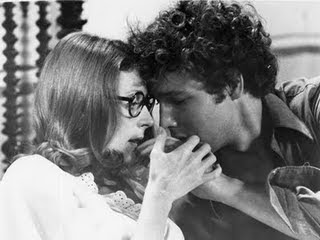
Nestled between the paranoid world of a call girl being stalked and a corporation devoted to political assassination is Pakula’s imperfect, but still lovely and mostly forgotten bittersweet romantic comedy “Love and Pain and the Whole Damn Thing”. Working from a terrific script by Alvin (“Paper Moon”, “Ordinary People”, “Spiderman 2”) Sargent, the picture tells the tale of a May-December romance between two lonely, seemingly mismatched people. Lila Fisher (Maggie Smith) is a forty-something spinster dying of an incurable disease who takes a trip to Spain to experience the beauty and adventure that has eluded her. Walter Elbertson (Timothy Bottoms) is a twenty-something slacker packed off by his over-achieving father to the same sunny Spanish climes for a bike tour. When Walter abandons the rigorous journey for the relative comfort of a bus tour, he finds himself sitting next to Lila in the only empty seat. At first, the unlikely pair keep their distance, but after a couple of meet-cute-ish moments – one involving Walter’s underwear, the other involving a locked outhouse door – the loners are drawn to each other: first as friends and eventually as lovers.
Sargent’s scenario is a largely familiar romance, but he peppers his tale with a series of genuinely funny set pieces and some terrific dialogue for the two attractive stars. Most importantly, he creates two lovely, diverse characters for two equally diverse actors.
Timothy Bottoms, no stranger to the May-December romance by virtue of his turn as Sonny Crawford in Peter Bogdanovich’s 1971 classic “The Last Picture Show” where the sensitively studly Bottoms beds down the sex-and-love-starved housewife played by Cloris Leachman. Made the same year as “Love and Pain…”, rhe Bogdanovich picture went through the roof while Pakula's effort saw its release delayed until 1973. Bottoms is great in both. In “Love and Pain…”, he's initially and alternately aloof and whiny, but his performance is truly a marvel as he slowly becomes charming and likeable as his relationship with Lila deepens.
Maggie Smith is especially wonderful in her role. Often portrayed as pinched and matronly in films like “The Prime of Miss Jean Brodie” and the seriously neglected “The Lonely Passion of Judith Hearne”, she is full of life, vim, vigour and romance in “Love and Pain…” and happily, Pakula lavishes the kind of pictorial attention to her that was so rare for Smith. She is a downright sexy in this movie – a mature, but enticing middle-aged babe. With her gorgeous red hair, long legs, delectably prim manner and beautiful smile flashing a nice set of pearly whites, Smith is – without question a MILF-extraordinaire!
Most amazingly, the script allows her to engage in some really funny physical humour. Smith is not above taking more than one pratfall and a scene wherein she has an entire roll of toilet paper wrapped around her legs and unfurling an ever longer trail of bum-wipe as she scrambles towards her tour bus is the stuff of comic genius.
The movie is not without clunky moments – many of the scenes involving minor supporting players seem oddly forced and the “Love Story” disease-o-rama in the final third is a bit much, but Pakula injects such warmth and humour that one tends to overlook these flaws in favour of watching two great actors devouring their roles and on-screen relationship with relish.
Add to this mix a lush, romantic score from Michael Small and stunning location photography from Geoffrey (“A Night To Remember”, “2001: A Space Odyssey”, “Tess”) Unsworth and one has a quirky, sparkling and moving romance from a director at the peak of his powers.
“Love and Pain and the Whole Damn Thing” is available on Sony’s “Martini Movies” DVD brand. How and what a “Martini Movie” is supposed to be is still beyond me. How this bittersweet romantic comedy can be considered a “Martini Movie” is especially beyond me.