BSEBSE
bullish trend is Showing on the chart.
technical indicators and
cup with handle & ascending triangle chart pattern.
Community ideas


BAJAJHIND (Bajaj Hindusthan Sugar) — Weekly Structural View🔵 PRIMARY SCENARIO (Base-building within a long correction)
The stock is in a very long-term corrective structure after a secular top.
Recent rise appears counter-trend, meeting supply near the declining trendline.
As long as price holds 15–16, the current move can be treated as base formation rather than trend resumption.
If stability persists above this zone, scope exists for a gradual upward rotation toward:
23–25 (trendline / supply)
29–31 (range resistance)
Extension toward 35–45 only on sustained acceptance above 31.
Primary bias: Neutral → cautiously constructive while above 15
🔴 ALTERNATE SCENARIO (Corrective structure resumes lower)
Failure to hold 15–16 would imply the recent rise was a corrective rally.
In that case, price may resume its broader corrective trend with downside risk toward:
11–12
7–8
A move below these levels keeps the stock trapped in a value-erosion phase.
Alternate bias: Defensive below 15
📉 Momentum / Behavioural Read
Weekly RSI remains below the equilibrium zone, indicating weak long-term momentum.
No clear bullish divergence yet — rallies may continue to face supply unless structure improves.
🧭 Structural Summary
“BAJAJHIND remains in a long-term corrective phase. 15–16 is the key pivot. Holding above it allows base development; failure below it revives downside risk.”
⚠️ Disclaimer
This analysis reflects structural and technical observations only and is not a buy/sell recommendation. Markets involve risk. Please do your own analysis and manage risk accordingly.

#CHENNPETRO#CHENNPETRO
bullish trend is Showing on the chart.
buy signals in
technical indicators and
Retest cup with handle chart pattern.
Buying Range 830/840
Watch for a breakout above 770/780 to sustain the bullish trend. If the resistance holds, there could be a retest towards 640/650 and an uptrend from here.

SILVER (XAGUSD) — Key Levels & Scenarios🔵 PRIMARY SCENARIO (Bullish Continuation)
Price remains in a strong rising channel.
As long as 98–100 holds, pullbacks are corrective.
Upside targets:
106–108 (channel resistance)
111–113 (extension / reaction zone)
Momentum remains supportive; trend structure intact.
Bias: Buy-the-dip above 98
🔴 ALTERNATE SCENARIO (Deeper Pullback)
Failure to hold 98–100 may trigger a broader correction.
Downside levels to watch:
94–95 (trend support)
88–90 (major structural support)
A sustained move below 88 would weaken the bullish structure.
Bias: Caution below 98 | Defensive below 88
“Silver remains bullish within an up-channel. Holding above 98 keeps higher levels open; below 88, structure weakens.”
⚠️ Disclaimer
This analysis is for educational and informational purposes only. It reflects technical structure, not a recommendation to buy or sell. Markets involve risk and volatility. Do your own analysis and manage risk accordingly.

Weekly analysis of XAUUS/Gold with buy and sell scenarios...Gold has reached to Level 2 as we analysed few weeks back.
Gold has created a strong weekly momentum candle showing positive sentiment. But there is divergence with volume. Candle is strongest amongst last four weekly candles while volume is lowest. On daily time frame there are consecutive 5 buy candles. RSI is also over 80 and oversold All these brings a caution
So, price may take a pause or pull back to adjust pricing. Now we need to be cautious and plan for rangebound pull back.
1. Price has created higher highs in lower time frames and created micro structures.
2. Now price may pull back with some delivery change in lower time frames.
3. Still, we should be positive till delivery changes at 4H/1H TF.
4. Most probably price will take liquidity of FVG/RDRB level and create MSS/CISD/TS/iFVG in LTF.
5. Price should show rejection/reversal in respective LTF (4H/1h/15m) at FVG zone.
6. Take the trade only once clear entry model i.e. turtle soup. iFVG break, CDS or MSS happens on LTF
All these combinations are signalling a high probability and high RnR trade scenario.
Note – if you liked this analysis, please boost the idea so that other can also get benefit of it.
Also follow me for notification for incoming ideas.
Also Feel free to comment if you have any input to share.
Disclaimer: This analysis is for educational purposes only and does not constitute investment advice. Please do your own research (DYOR) and check with your financial advisor before making any trading decisions.

Multiple time frame RSI bearish diversion Tata steelMultiple time frame RSI bearish diversion Tata steel. This content is for educational and informational purposes only and does not constitute financial, investment, or trading advice. Trading financial markets involves significant risk of loss, and past performance does not guarantee future results. Users are responsible for their own investment decisions and should consult a certified financial advisor.

MRPLMRPL
bullish trend is Showing on the chart.
buy signals in
technical indicators and
Ascending Channel chart pattern.
cup and handle pattern
BUYING RANGE 150/155
Watch for a retest 150/155 to sustain the bullish trend. If the resistance holds, there could be a retest towards 120/125 and an uptrend from here.

GOLD (XAUUSD) — Key Levels & Scenarios🔵 PRIMARY SCENARIO (Bullish Continuation)
Trend remains strongly bullish within a rising channel.
As long as 4,850–4,900 holds, dips are corrective.
Upside targets:
5,100–5,150 (channel resistance)
5,350–5,400 (extension zone)
Momentum remains strong; no major divergence yet.
Bias: Buy-the-dip above 4,850
🔴 ALTERNATE SCENARIO (Deeper Pullback)
Failure to hold 4,850–4,900 may trigger a broader correction.
Downside levels to watch:
4,700–4,750 (trend support)
4,245–4,300 (major structural support)
A daily close below 4,245 would shift the structure from impulsive to corrective.
Bias: Caution below 4,850 | Defensive below 4,245
“Gold remains bullish, but the move is maturing. Holding above 4,850 keeps higher levels open; below 4,245, structure weakens.”
⚠️ Disclaimer
This analysis is for educational and informational purposes only. It reflects technical structure, not a recommendation to buy or sell. Markets are subject to risk and volatility. Do your own analysis and manage risk accordingly.

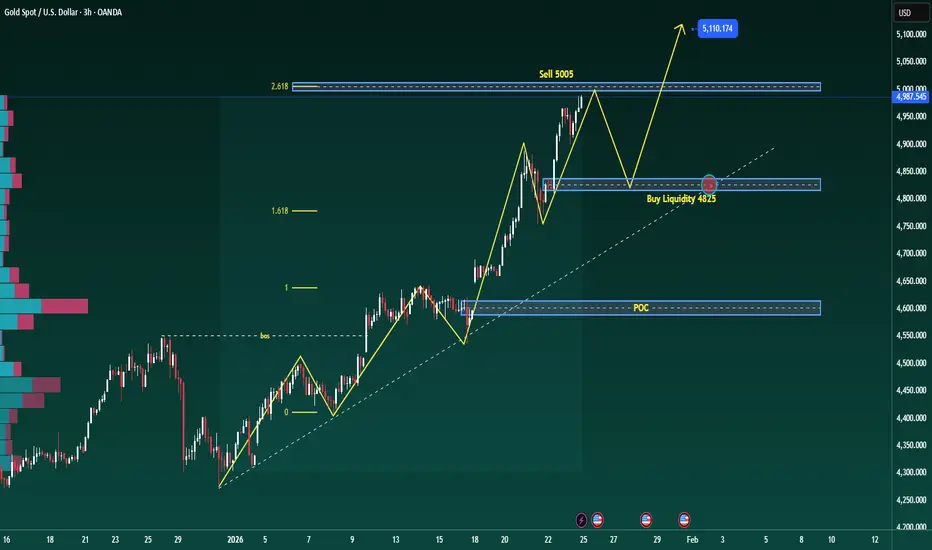
XAUUSD – Brian | H3 Technical AnalysisGold continues to trade within a well-defined bullish structure on the H3 timeframe, supported by strong technical momentum. Price action remains orderly, with impulsive advances followed by controlled pullbacks — a characteristic of a healthy trending market.
From a macro standpoint, geopolitical uncertainty remains elevated after recent comments from President Trump regarding increased U.S. control over strategic military areas in Greenland. While not implying direct occupation, the development adds to broader risk sensitivity and continues to support gold’s role as a defensive asset.
Market Structure & Technical Context (H3)
On the H3 chart, XAUUSD remains firmly above its rising trendline, with market structure defined by higher highs and higher lows. A prior break of structure (BOS) confirmed bullish continuation and opened the door for further expansion.
Key technical areas highlighted on the chart:
A strong impulsive leg followed by corrective pullbacks, consistent with trend continuation.
Fibonacci expansion with the 2.618 extension near the 5005 zone, acting as a major reaction area.
A liquidity pullback zone around 4825, aligned with trendline support and suitable for continuation scenarios.
A lower POC / value area acting as deeper support if volatility increases.
As long as price holds above these demand zones, the broader bullish structure remains intact.
Liquidity & Forward Expectations
Upside liquidity remains available above recent highs, while short-term pullbacks are likely driven by profit-taking rather than structural weakness. The 5000–5005 area represents a key decision zone where price may pause or consolidate before the next directional move.
Trading Bias
Primary bias: Bullish continuation while structure holds
Key zones to monitor:
4825 – liquidity pullback / trend continuation
5000–5005 – major extension & reaction zone
Preferred timeframe: H1–H4
Risk management remains essential, particularly in a market sensitive to sudden news flows.
Refer to the accompanying chart for a detailed view of market structure, liquidity zones, and Fibonacci extensions.
Follow the TradingView channel to receive early updates and join the discussion on market structure and price action.
Weekly Analysis of BTC - Detailed Another week and price still moved as expected in same range. No major view change since last prediction for long term trades.
Further short-term view.
Week is closed bearish and may target recent draw on liquidities of ~84K. Price may move in choppy mode for some time. So, the best idea is to look for small trade rather than long swing trades.
As the market in rangebound/Choppy, so we should keep eye on both side Opps but focus on down side as next high-level draw on liquidity is at downside.
Refer previous details below for larger perspective…
We analysed three weeks back that BTC would be in range for some time before taking any further move, And BTC is following same analysis and trapped within a small range since then. BTC prediction of last week also worked perfectly well and market kept in consolidation mode itself. BTC is still in consolidation zone and may spend some more days. It may develop ABC pattern or reversal at identified daily FVG level, if price has to change its delivery and take turn from here. This zone is kind of make or break. If price is not able to sustain and breakdown, then it may witness ~65-70K levels as well.
We hope for reversal from this level as price is developing the pattern at higher time frame.
1. Price has taken liquidity or 82K and almost touched 80K.
2. It has inversed 1Day FVG and now price is consolidating in the range between EMAs.
3. We may expect price retracement till 1D iFVG and then reversal.
4. Before to that we may see sweep of 92900 (1D CISD) level and then a retracement short trade till 1D FVG
5. Most probably price will take liquidity of FVG/RDRB level and create MSS/CISD/TS/iFVG in LTF.
6. Price should show rejection/reversal in respective LTF (5m/15m) at FVG zone.
7. Take the trade only once clear entry model i.e. turtle soup. iFVG break, CDS or MSS happens on LTF
All these combinations are signalling a high probability trade scenario.
Note – if you liked this analysis, please boost the idea so that other can also get benefit of it.
Also follow me for notification for incoming ideas.
Also Feel free to comment if you have any input to share.
Disclaimer: This analysis is for educational purposes only and does not constitute investment advice. Please do your own research (DYOR) and check with your financial advisor before making any trading decisions.

Nifty weekly analysis - Detailed Last week Nifty had strong downfall of ~3% because of various factors including global events and selling of FIIs. Week closed with a strong bearish candle with heavy volume showing further downside pressure targeting near draw on liquidity of ~24600. This level has highest volume, which will act as magnet for price.
Order flow is also downside creating lower highs.
Currently price is inside weekly price imbalance zone and at a psychological number of 25000. So, we can expect a pause at this level for few days. So next week may go in range bound mode to bearish.
Over all sentiments are bearish until there is a big positive change appears in global politics.
Critical points ……………….
• Support zone: 24,580–25,050
• Resistance zone: 25,550–25,600
• Bias: Range-bound to mildly bearish for the coming week.
1. If breakout support with volume we may see 24600 levels soon.
Note – if you liked this analysis, please boost the idea so that other can also get benefit of it.
Also follow me for notification for incoming ideas.
Also Feel free to comment if you have any input to share.
Disclaimer: This analysis is for educational purposes only and does not constitute investment advice. Please do your own research (DYOR) and check with your financial advisor before making any trading decisions.

BTCUSD Daily Chart – Corrective Phase with Potential Trendline BPrice Structure:
Bitcoin is trading around $88,800, coming off a strong rejection from the $95k–$97k area. The broader structure since November shows a downtrend transitioning into consolidation, with recent price action respecting a rising diagonal trendline support (blue dashed line). Price is currently testing this trendline, making this a decision zone.
Trend & Key Levels:
Immediate Support: $87,500 – $88,000 (trendline + recent swing lows)
Major Support: $83,000 – $85,000 (range bottom / demand zone)
Immediate Resistance: $91,000 – $92,500
Major Resistance: $95,000 – $100,000
RSI (14):
RSI is around 41.7, below the 50 midline but above oversold. This suggests weak momentum, yet not exhaustion. No strong bullish divergence is confirmed yet, but downside momentum is slowing.
Awesome Oscillator (AO):
AO remains negative, though histogram bars are flattening. This indicates bearish momentum is losing strength, not yet reversed.
MACD (12,26,9):
MACD is still below the zero line with a bearish crossover, but the histogram is contracting. This often precedes either sideways consolidation or a potential bullish reversal if price holds support.
Overall Bias:
Neutral to cautiously bullish if the trendline holds.
A daily close below $87k would invalidate the trendline and open the door toward $83k–$80k.
A strong bounce with volume could target $92k → $95k initially.
Scenario Outlook:
Bullish Scenario: Trendline holds → RSI curls up → MACD histogram flips positive → move toward $95k+
Bearish Scenario: Trendline breaks → increased selling pressure → retest of $83k support zone
Conclusion:
BTC is at a critical inflection point. Momentum indicators are weak but stabilizing, suggesting a possible short-term bounce, though confirmation requires a strong bullish daily close above $91k. Until then, expect choppy price action near support.

Vedanta Weekly Breakout Possible soon -- Targets 2XVedanta Weekly Breakout possible on charts from descending triangle pattern.
Targets coming 2x in 2 Years.
Happy Investing.

How to Control Trading Risk1. Understand That Risk Is Inevitable
Risk cannot be eliminated; it can only be managed.
Every trade has uncertainty
Losses are part of the business
Winning traders accept losses calmly and systematically
The goal is not to avoid losses, but to keep losses small and controlled while allowing profits to grow.
2. Risk Only a Fixed Percentage of Capital
One of the most important rules in trading is position sizing.
Risk 1–2% of total capital per trade
Never risk more than 5% on a single trade
Smaller risk ensures survival during losing streaks
Example:
Capital = ₹5,00,000
Risk per trade = 1% = ₹5,000
No matter the setup, your maximum loss must stay near ₹5,000.
This rule prevents emotional decisions and large drawdowns.
3. Always Use a Stop-Loss
A stop-loss is non-negotiable.
Defines maximum loss before entering the trade
Protects against sudden volatility and news
Removes emotional decision-making
Types of stop-loss:
Fixed stop-loss – based on price level
Technical stop-loss – below support or above resistance
Volatility stop-loss – based on ATR or price range
Trailing stop-loss – locks profits as price moves
A trade without a stop-loss is gambling, not trading.
4. Maintain a Positive Risk-Reward Ratio
Risk-reward ratio (RRR) compares potential loss vs potential gain.
Ideal minimum: 1:2
Professional traders prefer 1:3 or higher
Even with 40% win rate, positive RRR keeps you profitable
Example:
Risk = ₹1,000
Reward = ₹3,000
Win 4 out of 10 trades → still profitable
Never enter trades where reward is smaller than risk.
5. Avoid Overtrading
Overtrading is one of the biggest silent account killers.
Causes:
Revenge trading
Fear of missing out (FOMO)
Trading out of boredom
Chasing losses
Solutions:
Trade only high-probability setups
Set daily and weekly trade limits
Stop trading after reaching max daily loss
Quality of trades matters far more than quantity.
6. Control Leverage Carefully
Leverage magnifies both profits and losses.
High leverage reduces margin for error
Small price moves can wipe out capital
Beginners should use minimal leverage
Risk rules with leverage:
Reduce position size when using leverage
Never increase leverage to recover losses
Understand margin requirements clearly
Leverage should be used as a tool, not a shortcut to riches.
7. Diversify, But Do Not Over-Diversify
Diversification reduces risk, but excess diversification dilutes focus.
Avoid putting all capital in one stock or sector
Trade different instruments cautiously
Avoid correlated trades (same direction, same sector)
Bad diversification:
Long multiple banking stocks during sector weakness
Good diversification:
Different sectors, timeframes, and strategies
8. Follow a Written Trading Plan
A trading plan is your risk management blueprint.
It should include:
Entry rules
Exit rules
Stop-loss method
Position sizing
Risk per trade
Daily and weekly loss limits
Without a plan, emotions control decisions.
With a plan, risk becomes measurable and repeatable.
9. Keep Emotions in Check
Emotional trading increases risk drastically.
Common emotional risks:
Fear → premature exits
Greed → ignoring stop-loss
Anger → revenge trading
Overconfidence → oversized trades
Ways to control emotions:
Accept losses as business expenses
Take breaks after losing streaks
Avoid trading during stress or fatigue
Emotional discipline is a risk management skill.
10. Limit Daily, Weekly, and Monthly Losses
Professional traders use drawdown limits.
Example limits:
Daily loss limit: 2–3%
Weekly loss limit: 5–6%
Monthly loss limit: 8–10%
Once the limit is hit:
Stop trading
Review mistakes
Reset mindset
This prevents a bad day from becoming a disastrous month.
11. Avoid Trading During High-Risk Events
Certain periods carry abnormal risk:
Major economic data (CPI, GDP, Fed decisions)
Earnings announcements
Budget and policy announcements
Unexpected geopolitical events
If trading:
Reduce position size
Widen stop-loss carefully
Expect slippage and volatility
Sometimes not trading is the best risk management.
12. Maintain a Trading Journal
A trading journal helps identify hidden risks.
Track:
Entry and exit reasons
Risk-reward ratio
Emotional state
Mistakes and improvements
Over time, patterns emerge:
Which setups fail most
When emotions affect performance
Where risk management breaks down
What gets measured gets improved.
13. Protect Capital First, Profits Second
The golden rule of trading:
“Don’t focus on making money; focus on not losing money.”
Capital preservation ensures:
Longevity in markets
Ability to exploit future opportunities
Psychological confidence
Without capital, even the best strategy is useless.
14. Adapt Risk to Market Conditions
Market volatility changes constantly.
High volatility → smaller position size
Low volatility → tighter stops
Trending markets → wider targets
Range-bound markets → quicker exits
Rigid risk rules without adaptation increase losses.
15. Accept That Not Every Trade Will Work
No strategy has 100% accuracy.
Losses do not mean failure
Stick to process, not outcomes
Evaluate performance over a series of trades
Consistency in risk control beats occasional big profits.
Conclusion
Controlling trading risk is more important than predicting market direction. Successful traders survive long enough because they master capital protection, discipline, and consistency. Risk management turns trading from gambling into a structured business.
If you can:
Limit losses
Maintain positive risk-reward
Control emotions
Protect capital
Then profits become a natural by-product over time.

Mastering Technical Analysis1. Understanding the Foundation of Technical Analysis
Technical analysis is based on three core assumptions:
Price discounts everything – All known information, including fundamentals, news, and market sentiment, is already reflected in the price.
Prices move in trends – Markets tend to trend, and once a trend is established, it is more likely to continue than reverse.
History tends to repeat itself – Human behavior in markets is consistent, leading to recurring patterns.
Mastering technical analysis starts with internalizing these principles and learning to trust price behavior over opinions or predictions.
2. Market Structure and Price Action
At the heart of technical analysis lies price action—the direct study of price movement without excessive indicators. Understanding market structure involves identifying:
Higher highs and higher lows (uptrend)
Lower highs and lower lows (downtrend)
Sideways or range-bound markets
Support and resistance levels are crucial. Support is where demand overcomes supply, while resistance is where selling pressure dominates. These levels often act as decision zones where price reacts sharply.
Candlestick analysis enhances price action reading. Patterns such as doji, engulfing, hammer, and shooting star reveal shifts in market sentiment. Mastery comes from observing these candles in context—not in isolation.
3. Chart Patterns and Their Psychology
Chart patterns visually represent market psychology. Some of the most powerful patterns include:
Trend continuation patterns: flags, pennants, rectangles
Reversal patterns: head and shoulders, double top/bottom, rounding formations
Consolidation patterns: triangles and ranges
Each pattern reflects a battle between buyers and sellers. For example, a head and shoulders pattern signals weakening buying pressure after repeated attempts to push price higher. Mastery lies in recognizing these patterns early and confirming them with volume and price behavior.
4. Technical Indicators: Tools, Not Crutches
Indicators are mathematical calculations derived from price and volume. While useful, over-reliance can create confusion. Mastery means choosing a few complementary indicators:
Trend indicators: Moving averages, ADX
Momentum indicators: RSI, MACD, Stochastic
Volume indicators: Volume profile, OBV
Volatility indicators: Bollinger Bands, ATR
For example, RSI helps identify overbought and oversold conditions, but it works best when aligned with trend direction. Indicators should confirm what price action already suggests, not contradict it.
5. Time Frame Analysis and Top-Down Approach
Professional traders analyze multiple time frames. This top-down approach begins with higher time frames to identify trend direction and key levels, then moves to lower time frames for precise entries.
Higher time frames show trend and structure
Lower time frames show entry and exit precision
This alignment reduces false signals and improves consistency. Mastery involves respecting the dominant trend while timing trades efficiently.
6. Volume and Market Participation
Volume validates price movement. A breakout supported by strong volume has higher reliability than one without participation. Key volume concepts include:
Volume expansion during breakouts
Volume divergence during trend exhaustion
Accumulation and distribution phases
Understanding volume reveals whether institutions are entering or exiting positions. Master traders follow volume because it reflects real commitment, not just price fluctuations.
7. Risk Management: The Core of Mastery
No technical analysis system works without solid risk management. This includes:
Defining risk per trade (usually 1–2% of capital)
Using stop-loss orders logically (below support or above resistance)
Maintaining favorable risk-reward ratios (minimum 1:2)
Mastering technical analysis is less about winning every trade and more about controlling losses. Consistency in risk management separates professionals from amateurs.
8. Trading Psychology and Discipline
Even the best analysis fails without emotional control. Fear, greed, and impatience distort decision-making. Master traders develop:
Discipline to follow rules
Patience to wait for confirmation
Emotional neutrality after wins and losses
A trading journal is a powerful tool. Recording setups, emotions, and outcomes helps identify behavioral patterns and refine strategy over time.
9. Backtesting and Continuous Improvement
Technical mastery requires constant refinement. Backtesting strategies on historical data builds confidence and highlights weaknesses. Markets evolve, and strategies must adapt.
Learning from losses, adjusting parameters, and staying aligned with market conditions ensure long-term growth. Mastery is not a destination—it is a continuous learning process.
10. Integrating Technical Analysis with Market Context
While technical analysis focuses on charts, awareness of broader market context enhances accuracy. Economic events, sector trends, and inter-market correlations influence price behavior. A technically strong setup aligned with favorable market conditions carries higher probability.
Conclusion
Mastering technical analysis is a blend of art and science. It requires deep understanding of price behavior, disciplined risk management, emotional control, and continuous learning. There is no perfect indicator or pattern, but there is consistency in approach. Traders who respect probability, manage risk, and stay adaptable ultimately succeed. Technical analysis is not about predicting markets—it is about preparing for them with clarity, structure, and confidence.
Trading with an Automated System (Algorithmic Trading)1. What Is an Automated Trading System?
An automated trading system is a software-based framework that automatically places buy and sell orders in the market without manual intervention. The trader or developer defines a strategy, converts it into a set of logical rules, and programs these rules into the system. Once activated, the system continuously monitors market conditions and executes trades whenever the predefined criteria are met.
For example, a simple automated strategy might be:
Buy when the 20-day moving average crosses above the 50-day moving average.
Sell when the reverse crossover occurs.
The system follows this logic exactly, without emotions or hesitation.
2. How Automated Trading Works
Automated trading generally follows a structured workflow:
Strategy Design
The trader defines a trading idea based on technical analysis, fundamental analysis, quantitative models, or statistical patterns.
Rule Definition
The idea is converted into precise rules, such as entry price, exit price, stop-loss, position size, and time filters.
Backtesting
The strategy is tested on historical data to evaluate performance, drawdowns, win rate, and risk metrics.
Optimization
Parameters are adjusted carefully to improve performance without overfitting to past data.
Deployment
The strategy is connected to a broker or exchange through APIs and runs in real-time.
Monitoring and Risk Control
Even automated systems require supervision to handle errors, slippage, or abnormal market conditions.
3. Types of Automated Trading Strategies
Automated systems can be classified into several categories:
Trend-Following Systems
Use moving averages, breakouts, or momentum indicators to ride market trends.
Mean Reversion Systems
Assume prices revert to an average and trade overbought or oversold conditions.
Arbitrage Systems
Exploit price differences between markets, exchanges, or instruments.
High-Frequency Trading (HFT)
Execute a large number of trades in milliseconds, focusing on very small price movements.
Statistical and Quantitative Models
Use probability, correlation, and mathematical models to identify trading opportunities.
AI and Machine Learning Systems
Adapt strategies dynamically using pattern recognition, sentiment analysis, and predictive modeling.
4. Advantages of Automated Trading
Automated trading offers several powerful benefits:
a. Emotion-Free Trading
Human emotions like fear, greed, and hesitation often lead to poor decisions. Automated systems follow rules strictly, ensuring discipline and consistency.
b. Speed and Efficiency
Computers can scan multiple markets and execute trades in fractions of a second, something impossible for manual traders.
c. Backtesting and Validation
Strategies can be tested on years of historical data, helping traders understand potential risks and returns before risking real capital.
d. Scalability
One system can trade multiple instruments, timeframes, and markets simultaneously.
e. Consistency
The same strategy is executed in exactly the same way every time, removing randomness in decision-making.
5. Risks and Limitations of Automated Trading
Despite its advantages, automated trading is not risk-free:
a. Over-Optimization (Curve Fitting)
A strategy may perform extremely well on historical data but fail in live markets because it was too finely tuned to the past.
b. Market Changes
Markets evolve due to regulations, liquidity shifts, or macroeconomic events. A strategy that worked earlier may stop working.
c. Technical Failures
Internet outages, server crashes, software bugs, or broker API issues can cause losses.
d. False Sense of Security
Automation can make traders complacent. Continuous monitoring and risk management are still essential.
e. Black Swan Events
Extreme events like flash crashes or geopolitical shocks can break normal market behavior, leading to unexpected losses.
6. Risk Management in Automated Trading
Risk management is the backbone of any successful automated system:
Position Sizing Rules limit exposure per trade.
Stop-Loss and Take-Profit Levels control downside and lock profits.
Maximum Drawdown Limits pause or shut down the system if losses exceed acceptable levels.
Diversification across strategies, assets, and timeframes reduces overall risk.
Kill Switches allow traders to immediately stop trading during abnormal conditions.
Without strong risk controls, even the best algorithm can fail.
7. Automated Trading vs Manual Trading
Manual trading relies on human judgment, discretion, and experience. Automated trading relies on logic, data, and execution speed.
Manual trading is flexible but emotionally vulnerable.
Automated trading is disciplined but rigid.
Many professionals use a hybrid approach, where humans design and supervise strategies while machines execute them.
8. Who Uses Automated Trading?
Automated trading is used by:
Retail traders using platforms like MetaTrader, NinjaTrader, or Python-based systems.
Hedge funds and proprietary trading firms.
Investment banks and market makers.
Exchanges and liquidity providers.
With advancing technology, automated trading is no longer limited to institutions; retail participation is growing rapidly.
9. Technology Behind Automated Trading
Key components include:
Programming Languages (Python, C++, Java, Pine Script)
Trading Platforms and APIs
Market Data Feeds
Cloud and Low-Latency Servers
Databases and Analytics Tools
The quality of data and execution infrastructure plays a crucial role in long-term success.
10. Future of Automated Trading
The future of automated trading lies in:
Greater use of AI and machine learning
Integration of alternative data like news, social media, and satellite data
More adaptive and self-learning systems
Increased regulation and risk oversight
Wider adoption among retail traders
Automation will not eliminate human traders but will continue to augment human decision-making.
Conclusion
Trading with an automated system represents a powerful evolution in financial markets. By combining logic, speed, and discipline, automated trading can enhance consistency and efficiency while reducing emotional errors. However, it is not a “set and forget” solution. Success depends on robust strategy design, realistic expectations, continuous monitoring, and strong risk management. When used wisely, automated trading can be a valuable tool for traders and investors seeking systematic and scalable participation in modern markets.

Intraday Trading vs. Swing Trading: A Detailed Comparison1. What Is Intraday Trading?
Intraday trading, also known as day trading, involves buying and selling financial instruments within the same trading session. All positions are closed before the market closes, and no trades are carried overnight.
Intraday traders profit from small price fluctuations using high volume, leverage, and precise timing. The focus is on short-term momentum, liquidity, and volatility.
Key Characteristics of Intraday Trading
Trades last from a few seconds to a few hours
No overnight risk
High frequency of trades
Requires continuous screen monitoring
Strong dependence on technical indicators
Sensitive to news and market sentiment
2. What Is Swing Trading?
Swing trading aims to capture short- to medium-term price swings over several days to a few weeks. Positions are held overnight and sometimes across market cycles.
Swing traders rely on trend analysis, support and resistance levels, and market structure rather than minute-to-minute price action.
Key Characteristics of Swing Trading
Trades last from 2 days to several weeks
Positions are held overnight
Lower trade frequency
Less screen time required
Combination of technical and fundamental analysis
Focus on broader market trends
3. Time Frame and Trade Duration
Intraday Trading
Time frames used: 1-minute, 5-minute, 15-minute charts
Trades aim to capture quick price movements
High pressure due to fast decision-making
Traders must act instantly on signals
Swing Trading
Time frames used: Daily, 4-hour, and weekly charts
Trades allow time for trends to develop
More patience required
Decisions can be planned after market hours
4. Capital Requirement and Leverage
Intraday Trading
Often requires higher capital
Leverage is commonly used
Brokers offer margin benefits for intraday trades
Small adverse moves can cause quick losses
Swing Trading
Lower leverage compared to intraday
Less dependence on margin
Suitable for traders with moderate capital
Lower risk of forced liquidation
5. Risk Exposure and Volatility
Intraday Trading Risks
Sudden price spikes
Slippage during high volatility
Emotional stress due to rapid price movement
Overtrading risk
Swing Trading Risks
Overnight gap risk
News and earnings impact
Broader market risk
Requires wider stop-losses
Despite overnight risk, swing trading often has better risk-to-reward ratios than intraday trading.
6. Profit Potential and Consistency
Intraday Trading
Smaller profits per trade
Requires many successful trades for consistency
High transaction costs (brokerage, taxes)
Suitable for traders seeking daily income
Swing Trading
Larger profit targets
Fewer trades, higher quality setups
Lower transaction costs
Better suited for wealth building
7. Technical Analysis Tools Used
Common Intraday Indicators
VWAP (Volume Weighted Average Price)
Moving Averages (9, 20 EMA)
RSI (short-period)
MACD (fast settings)
Order flow and volume profile
Common Swing Trading Indicators
Support and resistance
Fibonacci retracement
Trendlines and channels
RSI (14-period)
Moving averages (50, 100, 200)
Swing traders rely more on price action and structure, while intraday traders focus on speed and momentum.
8. Psychological Demands
Intraday Trading Psychology
High stress and pressure
Requires emotional discipline
Fear and greed act faster
Quick recovery from losses is essential
Swing Trading Psychology
Requires patience and trust in analysis
Managing uncertainty overnight
Avoiding panic due to short-term noise
More suitable for calm personalities
Psychology often determines success more than strategy.
9. Lifestyle and Time Commitment
Intraday Trading
Full-time commitment
Requires presence during market hours
Not suitable for working professionals
Highly demanding mentally
Swing Trading
Part-time friendly
Ideal for professionals and students
Analysis can be done after market hours
Better work-life balance
10. Market Conditions Suitability
Intraday Trading Works Best When:
Market is highly volatile
Strong intraday trends exist
Liquidity is high
News-driven moves occur
Swing Trading Works Best When:
Clear trends are present
Markets are stable
Volatility is moderate
Broader market direction is defined
11. Taxation and Costs (General View)
Intraday trading usually attracts higher taxes and transaction costs
Frequent trading increases brokerage expenses
Swing trading is more tax-efficient due to lower turnover
(Tax rules vary by country and should be checked locally.)
12. Who Should Choose Intraday Trading?
Intraday trading is suitable for traders who:
Can dedicate full market hours
Handle high stress and fast decisions
Have strong discipline and execution skills
Prefer daily profit opportunities
13. Who Should Choose Swing Trading?
Swing trading is suitable for traders who:
Prefer planned trades
Have limited time during market hours
Aim for higher risk-reward trades
Want consistent growth with lower stress
14. Intraday vs. Swing Trading: Key Differences Summary
Aspect Intraday Trading Swing Trading
Holding Period Same day Days to weeks
Risk High, fast Moderate
Screen Time Very high Low
Leverage High Low
Stress Level High Moderate
Suitable For Full-time traders Part-time traders
Conclusion
Both intraday trading and swing trading are effective trading styles when practiced with discipline, proper risk management, and a clear strategy. Intraday trading offers faster feedback and daily opportunities but comes with higher stress and execution risk. Swing trading provides more flexibility, better risk-reward potential, and a balanced lifestyle but requires patience and the ability to handle overnight uncertainty.
There is no universally superior trading style. The best approach is the one that matches your personality, capital, time availability, and psychological comfort. Many successful traders even combine both styles, using intraday trades for short-term opportunities and swing trades for broader market moves.
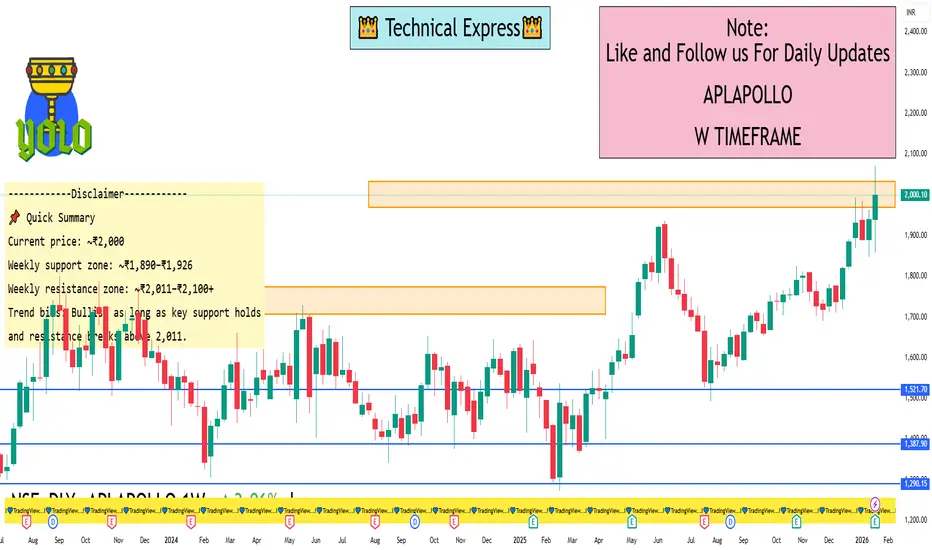
APLAPOLLO 1 Week View🔎 Current Price Snapshot
🟢 Last close: ₹2,000.10 (23 Jan 2026) — near a 52-week high zone.
📉 Weekly Technical Levels (1-Week Time Frame)
🧱 Support Levels (Key Floors)
These are levels where price is likely to find buying interest if the price pulls back:
S1: ~₹1,913 – ₹1,926 — first strong support band.
S2: ~₹1,890 – ₹1,911 — secondary support base from pivot structure.
S3: ~₹1,850+ — deeper support from broader weekly structure and previous pivot base.
Note: Above ~₹1,890 zone is a key defence level in weekly charts — losing this could signal short-term weakness.
📈 Resistance Levels (Key Ceilings)
These are weekly upside barriers where price may struggle initially:
R1: ~₹2,011 – ₹2,050 — first resistance cluster from weekly pivots.
R2: ~₹2,080 – ₹2,100 — next overhead resistance from extended levels.
R3: ~₹2,128 – ₹2,140+ — broader technical pivot resistance.
Bullish bias continues only above ~₹2,011–₹2,050.
📌 Weekly Trading Scenarios
🟢 Bullish Case (Upside)
Trigger: Sustained weekly close above ~₹2,011–₹2,050
Targets:
→ Short-term: ~₹2,080–₹2,100
→ Extended: ~₹2,120–₹2,140+
Outlook: Strength above R1 opens path to higher weekly highs.
🔵 Neutral / Range
Range: ₹1,890–₹2,050
Behavior: Price oscillates as buyers/sellers balance.
🔴 Bearish Case (Downside)
Trigger: Weekly close below ~₹1,890
Downside key support: ~₹1,850+
Outlook: Weekly momentum weakens if key support breaks.
WAAREEENER 1 Week View📍 Live Price Snapshot (Approximate)
The stock is trading around ₹2,590–₹2,600 on the NSE in recent sessions.
📊 1-Week Timeframe Levels
🔼 Resistance (Upside)
These are levels where price may face selling pressure:
₹2,606 – ₹2,610 — Immediate resistance / pivot-R1 zone this week.
₹2,659 – ₹2,660 — next resistance above pivot.
₹2,690 – ₹2,700 — higher weekly resistance zone.
👉 A sustained breakout above ₹2,660–₹2,690 could suggest short-term strength on the weekly chart.
🔽 Support (Downside)
Key support zones where buyers may step in:
₹2,554 – ₹2,550 — first support zone for the week.
₹2,467 – ₹2,470 — next support if the first breaks.
₹2,374 – ₹2,375 — deeper support level below.
📌 Weekly Trend Notes
Current weekly indicators (RSI/MACD etc.) lean bearish or neutral, with RSI low and MACD negative — indicating short-term downward momentum.
The chart is showing below key moving averages (20/50 day) — typically short-term bearish pressure.
Recent news showed a strong earnings rally around Jan 22, 2026, lifting the stock near higher levels, but price remains below longer-term averages.

XAUUSD – Monday Focus: Buy the Dip Toward 5,020–5,043Market Context
Gold remains firmly supported by a bullish risk environment. The recent impulse leg confirms that buyers are still in control, while pullbacks are being absorbed rather than extended.
This is continuation behavior, not distribution.
The question for Monday is not if Gold is bullish —
but where the dip becomes opportunity.
Technical Structure (H1)
Market has already confirmed bullish BOS
Strong impulsive leg created multiple stacked FVGs below
Current price is consolidating above structure, not breaking it
Pullback is corrective in nature
This is a classic impulse → retracement → continuation setup.
Key Zones to Watch
Immediate resistance / BOS level: 4,969 – 4,970
Intraday BUY zone: 4,933 – 4,940
Upper FVG support: 4,920 – 4,899
Deeper demand (HTF): 4,860 – 4,880
As long as price holds above the upper FVG, bullish bias remains intact.
Scenarios (If – Then)
Scenario 1 – Bullish Continuation (Primary)
If price pulls back into 4,933 – 4,940 and holds
Buyers step in → continuation toward:
5,020
5,043 (1.618 extension)
Scenario 2 – Deeper Pullback (Alternative)
If price loses 4,933
Expect mitigation toward 4,920 – 4,899
Only a sustained H1 close below 4,899 would weaken the bullish structure
Summary
Gold is not overextended — it is rebalancing within a bullish trend.
The structure favors buying pullbacks, not chasing highs.
This is a dip-buying market until structure says otherwise.

EURUSD HTF BIAS CLARITYThe dollar is free falling as we can see , the eurusd on the other hand is also close to its closest liquidity and major high,
As there is a smt divergence, we can clearly look at eurusd as it didn't make a low but Gbpusd had it , eur/usd is clearly more strong component.
I've made a path , besides it the trade idea will invalidate.
Aligned Timeframes - 3months<1day<4hour.
