

Stuffed Crocodile
@gmkeros.wordpress.com@gmkeros.wordpress.com
A blog (mostly) about tabletop roleplaying games
397 posts
89 followers
A blog (mostly) about tabletop roleplaying games

This is a 28 page “temple-crawling adventure” written by Munkao ostensibly for Into the Odd and Cairn (but actually largely system-agnostic), and set in the South-East Asian inspired world of Kala Mandala. I don’t think transferring it into other settings should be that much of an issue, as long as one can come up with a reason why there’s a vaguely Asian-coded monastic community around to set this at. My personal setting is set around a sort of crossroads of cultures so I have absolutely no issue with that), and this might fit in great in some of the areas I haven’t worked out that much yet.
The mission as it is is not one that lends itself to the usual loot and pillage gaming: Het Thamsya is a fledgling temple school in a larger collective, dedicated to the path of Automata. The founder of this school has nearly finished a decade long meditation, but giant (belying the title) wasps have created a nest in the back of the building while everyone else was busy not disturbing the meditator. Your mission now, if you should accept it, is to carry the meditating monk out of there, without waking him.
The complications arise from the guards set by your mission objective (automata of various kinds), the wasps, and a bunch of other intruders that have entered without anyone knowing. Interestingly the wasp nest is detailed much more than you’d think, and there are things going on in there that are way more complicated than what you’d expect, as there’s some bizarre bio-horror twist lying in wait. Which makes for a fascinating chart of faction relations based on the instincts of the wasps and the commands left for the automata and how they interact with one another.
I do feel like I am missing some context for the world of Kala Mandala, as I am not quite sure what some of the things reference. On the other hand it’s easy to just plug in whatever association comes up and go with it. The scenario offers a compelling mission and plenty of complications to make for some interesting play. I think this might be interesting to play with multiple groups to see how either of them make it through.
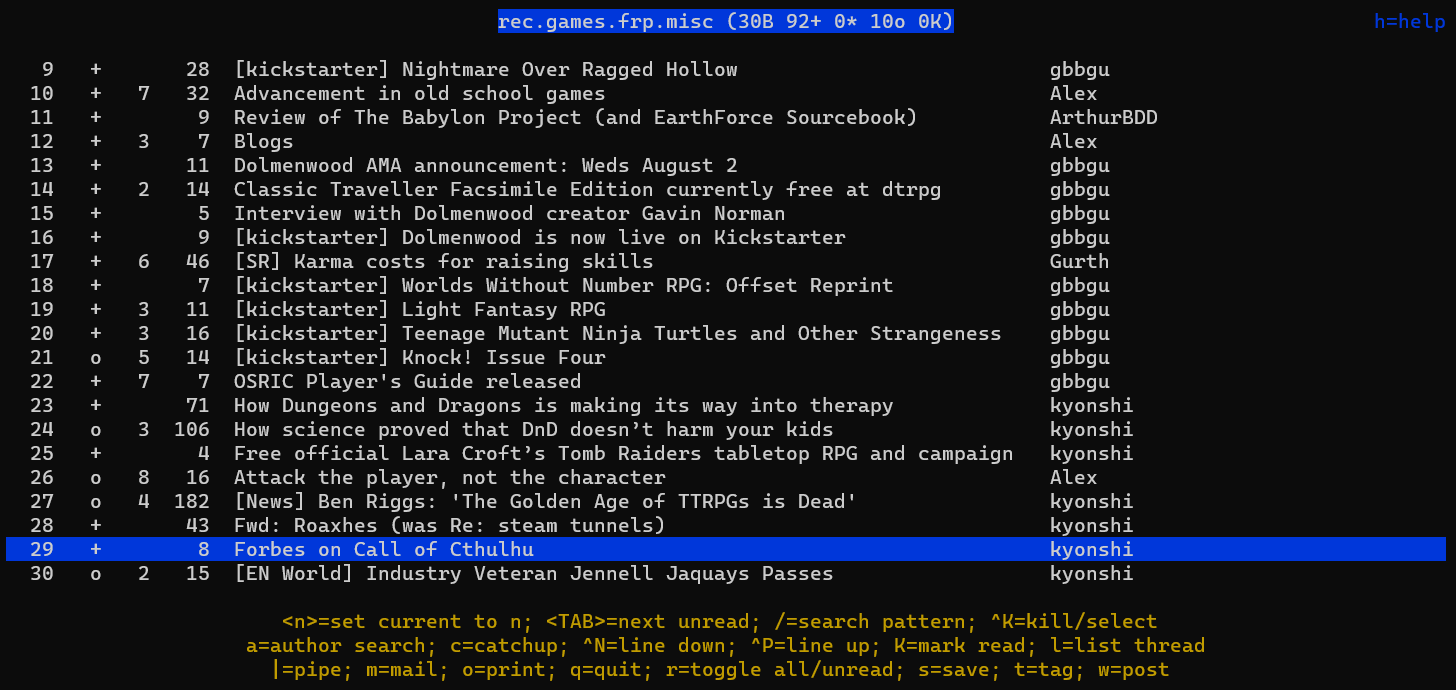
Did you know there is an online forum for tabletop role-playing games that has been around since the early 80s, and which still is active and operating?
Admittedly in a much diminished state than at it’s heyday.
I don’t know if you ever heard the term Usenet before, and even if you did, if you don’t just connect it with data piracy. Because that’s what it is mostly used for nowadays.
What it started out as were discussion forums.
Back in the late 70s, after ARPANET had been created and email had been invented, a few programmers came up with an idea for an electronic bulletin board that could be read asynchronously. This was the time when computers still were only in big institutions like universities, big companies, and the military, and the whole idea was to create “a poor man’s ARPANET”. Connections between computers were rare and expensive , but possible. So these “news” started as a way to propagate articles and messages along servers that were not constantly connected to the internet. Some of the servers involved would only connect once a day to the network to transfer messages in and out (often at night because charges were lower then). A message might travel for multiple days before it reached all nodes in the network, and some of the earliest were messages about a nascent hobby popular among the people using this network: fantasy role-playing.
From what I can see the first two messages on the brand new group net.games.frp were sent out on the 12th of January 1982.
To give you an idea just how early this was: it was before the abbreviation RPG became common, people were still talking about Fantasy RolePlaying instead, so even today the group-names use the abbreviation FRP.
It’s quite a fascinating system that over time has become ever more complex and popular, before the ascent of html, hyperlinks, and the world wide web pushed it into the seedy corners of the ‘net.
Instead of having websites, Usenet is organized in newsgroups, and those groups are organized in hierarchies. There are the so called Big Eight that have a certain standard for group creation and posting (e.g. rec. for recreational topics, and comp. for topics concerning computers), and there are others, organized in one way or another (famously alt. which had lower standards for the creation of new groups).
Messages are sent to one or more groups (crossposted), distributed around the network, and people respond to these posts. Interesting discussions and arguments ensue, people get angry, flame wars ensue, other people learn something new, weird in-jokes develop, stuff happens.
All that can be read via archives, the biggest of which is Google Groups, which both is a boon and downfall of the service: Google purchased the old newsgroup archives of DejaNews back in the 90s, and integrated it in it’s Google Groups service. In a picture-perfect example of Embrace, Extend, Extinguish the users of Groups had a web interface that allowed them access to their old newsgroups, access to new groups that only existed on Google, but also allowed spammers to flood the connected newsgroups with loads of unmoderated spam. Spam that recently was quoted by them as a reason to cut the connection with Usenet, bringing this phase of the network to an end.
But Usenet still is running, and most likely will be running as long as there are people willing to run servers for it. But the biggest Usenet servers nowadays are piracy servers that keep the text-part of the Usenet as more of an afterthought. At one point someone came up with a way to use the text-only format of Usenet in a way to distribute data that was binary, i.e. not purely text. And this took over most of the system.
But I am not really interested in that and never was. What I am interested in are the fantasy roleplaying parts of that network.
rec.games.frp.*
I said that the forum has been running since the late 70s, but that’s not quite correct. The original structure of Usenet grew organically from the beginning. People were creating new groups when it suited them and it seemed logical. Which soon caused some hierarchies (specifically the net. hierarchy) to swell with groups that could barely be maintained. In a great upheaval in 1987 all the groups were renamed and restructured.
Some old hands are still angry about it and will bitch about it for days. That also is Usenet.
One can argue that the fantasy roleplaying group has existed since before that time. One also could argue that it only exists since 1987. Which still is older than the World Wide Web.
Usenet is divided into hierarchies, and the frp-hierarchy is part of the rec. (recreation-hierarchy) and .games. sub-hierarchy.
There are currently 11 .frp. groups in that hierarchy:
| rec.games.frp.dnd | of course… it’s the hierarchy for Dungeons and Dragons. Always one of the biggest topics of the whole FRP forums this one got it’s own group. |
| rec.games.frp.misc | for basically all other kinds of discussions about roleplaying games |
| rec.games.frp.cyber | for cyberpunk systems (e.g. Cyberpunk 2020 or Shadowrun). |
| rec.games.frp.super-heroes | for superhero games |
| rec.games.frp.live-action | anything LARP goes here. |
| rec.games.frp.announce | announcements and news about products go here |
| rec.games.frp.industry | for all kinds of discussions about the rpg industry |
| rec.games.frp.storyteller | yes, this was created when the World of Darkness was big enough to demand it’s own forum |
| rec.games.frp.gurps | For GURPS, this part was created because while never the most popular game, it’s fans flooded the main group with so many messages about builds that it was decided to give them their own place. |
| rec.games.frp.advocacy | all kinds of discussions about roleplaying games as such and how they work. This is where the Forge came from back in the day |
| rec.games.frp.market | I guess this is for selling stuff. I have literally never seen a message in there. |
Most of these lay fallow right now, with me and a few others being the only ones posting there every once in a while. I do have to admit part of it is because I don’t want to lose the that part of ttrpg history to a random deletion request for non-use.
Other TTRPG groups
The main hierarchies are not the only ones. Most normal Usenet servers carry at least the Big Eight, but most also carry others. The big other hierarchy is alt. (…definitely not named for Anarchists, Lunatics, and Terrorists, all evidence to the contrary…), which makes it easier to create groups. This means there are a few other groups here that might be of interest, if they ever would get someone to post in them. Their structure though is not as organized as the ones in the Big 8.
| alt.games.frp.adnd-util | about utilities for playing ADnD. I would say, a general groups for RPG utilities. |
| alt.games.adnd | for ADnD. I am not sure why this exists, maybe because the main one was too stodgy, or it was created because someone thought ADnD was sufficiently different than DnD to warrant it’s own group |
| alt.games.earthdawn | for Earthdawn. Remember Earthdawn? |
| alt.games.x-files.rpg | For the X-Files RPG. Remember that? |
| alt.games.whitewolf | I guess a group for White Wolf games, which is also already covered in rec.games.frp.storyteller |
| alt.games.tolkien.rpg | a group about playing in Tolkien’s Middle-Earth |
There are also local and language dependent groups around. Many languages and regions have their own hierarchies for exchanges between locals and/or in other languages.
| uk.games.roleplay | group for roleplaying in the UK |
| de.rec.spiele.rpg.misc | general group for discussions of RPGs in German |
| z-netz.freizeit.rollenspiele.dsa | originally this was an Echo in a mailbox network, by now z-netz. is a small alternative German Usenet hierarchy. This particular one about Das Schwarze Auge/The Dark Eye |
| pl.rec.gry.rpg | Polish-language group |
| es.rec.juegos.rol | Spanish-language group |
| se.spel.rollspel | Swedish-language group |
| dk.fritid.rollespil | Danish-language group |
| fr.rec.jeux.jdf | French-language group |
| it.hobby.giochi.gdr | Italian-language group |
| hr.rec.igre.rpg | Hungarian-language group |
| aus.games.roleplay | Australian group |
There are more, some of which I might not even find that easy because they are not on the servers I frequent (not all servers carry all groups) or are so specialized they might not be of interest to anyone but locals (e.g. saar.rec.rollenspiele exists, but I doubt many people in Saarland (the smallest of Germany’s federal states) still know Usenet exists)
Ok, ok, but how do you actually ACCESS this Usenet thingy?
That’s a bit more difficult, but not much. It used to be ISPs were all running their own news servers, this was actually the REASON you might want internet access as a private person, but that isn’t the case anymore. Google Groups is also going away, so that’s not a real option.
An easy way to check out what is being talked about on the FRP-hierarchy is campaignwiki.org/news. This server makes it possible to read and post on his own small server via a web-interface. The server is only running roleplaying-related groups, including the global FRP-hierarchy, and a few local ones that do not get carried in many other places.
Another way to access it via web browser is via web gateways. There are a few around, e.g. NovaBBS. There are a few of those around, but they might not carry all the groups (NovaBBS e.g. only rec.games.frp.dnd and .misc, because those are the ones with most activity).
The proper way to use it is of course by getting an account on a news server and adding it to your feed reader of choice. True hardcore users use terminal-based readers like tin or Gnus, but many Email programs like Mozilla Thunderbird allow you to subscribe to newsgroups.
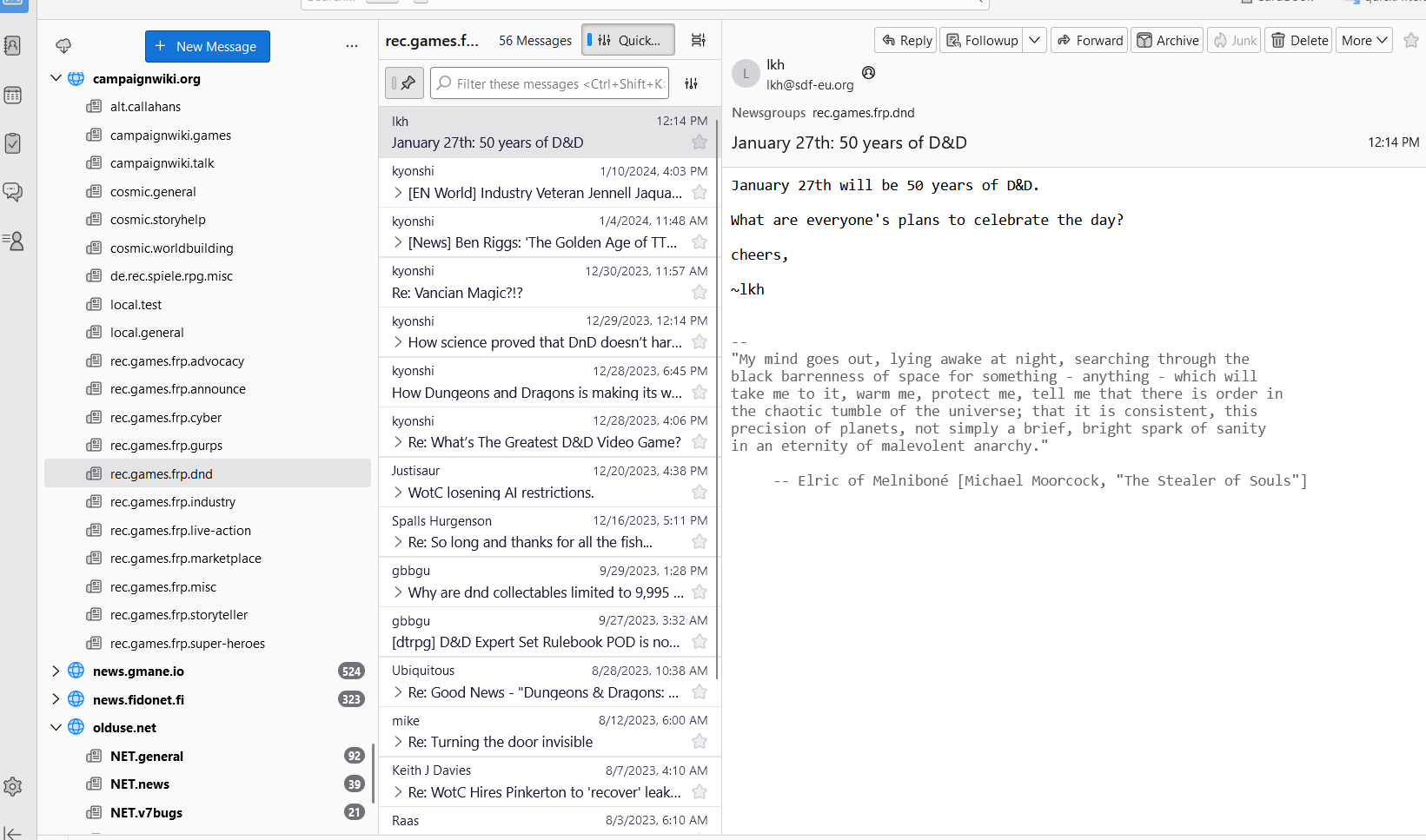
But where do you get a news server?
Well, there are multiple free options (these are all technically text-only, although a few have some basic binary groups that allow pictures):
| campaignwiki.org/news | (Switzerland) very small server, focused on ttrpg groups, also has simple web-portal |
| Eternal September | (Germany) popular free access server with wide range of groups |
| I2PN2 | simple text server |
| NovaBBS | text server, as mentioned above also has web-portal |
| Solani | (Germany) server |
| dotsrc | (Denmark) focused on Danish users |
| Agency News | (New Zealand) server |
| Chmurka | (Poland) basic server focused on Polish users |
| CSIPH | basic server |
| Open News Network | (Germany) focused on German users |
| Gegeweb | (France) focused on French users |
| Hispagatos | (Spain) focused on Spanish users |
| Pasdenom | (France) focused on French users |
| NNTP4 | (Germany) basic server |
Most of these have instructions on how to connect on their websites.
Note: This is a redo of an article I wrote 13 years ago. Originally I thought I could just let that one stand like that, but just briefly reading through it I noticed things had changed dramatically in some areas. So I rewrote the whole thing from scratch.
This time a few more links than last week. Maybe even too many this time.
News
Reprint of Shadowrun 1st edition in the works (enworld)
Random Tables
d100 – Weird and Whimsical Wants for Fickle Fey (d4 Caltrops)
100 Interesting Rumors (Or Potential Plot Hooks!) (OSRVault)
Cult generator – D66 Cult names, heraldry and goals! (Dawnfist Games)
Thought
“Played by friends, not strangers” (Grognardia)
I Love Underused Monsters (Tales of the Lunar Lands)
The Ten Commandments of D&D (Grognardia)
My original fantasy sandbox: ICE’s Middle-earth (Akratic Wizardry)
What Choose-Your-Adventure Books Can Teach Game Masters About Pacing and Decisions (DMDavid)
GMing with Joy: GM Tools That Can Last a Lifetime (enworld)
On Hobby Best Practices – Part 1 and Part 2 and Part 3 (Gorgon Bones)
Rereading OD&D: Back to the Start (Coins & Scrolls)
Mystifying and Dangerous (Grognardia)
GM Aid
The Quantum Goodbye Letter (Dice Goblin)
Writing Dungeons Without Dice (Playful Void)
Dolmenwood Dozen (d4 Caltrops)
The BECMI reaction table (Methods & Madness)
Scribes (Dice Goblin)
Magic
Yet another magic system: Chaotic Spells and Strange Charms (Tabletop Curiosity Cabinet)
Encounters
D66 Astral plane encounters (Dawnfist Games)
Friday Encounter: Peryton Party (Tales of the Lunar Lands)
Friday Encounter: Mistaken Identity (Tales from the Lunar Lands)
Terrain
Dungeon Stackers and Triangular Dungeon Stackers (The Might Be Gazebos!)
Monsters
CYTHRONS (from 2000AD’s Slaine) – Monster for Old School Fantasy & Horror (Shuttered Room)
Traveller
Right On Commander! (Elite ships for Traveller)
Papercraft
Niederkassel Dice Tower (papermau)
Sericulture Farmhouse At The Foot Of Mount Gassan (papermau)
Other Stuff
Dungeon Running Sheets (The Alexandrian)
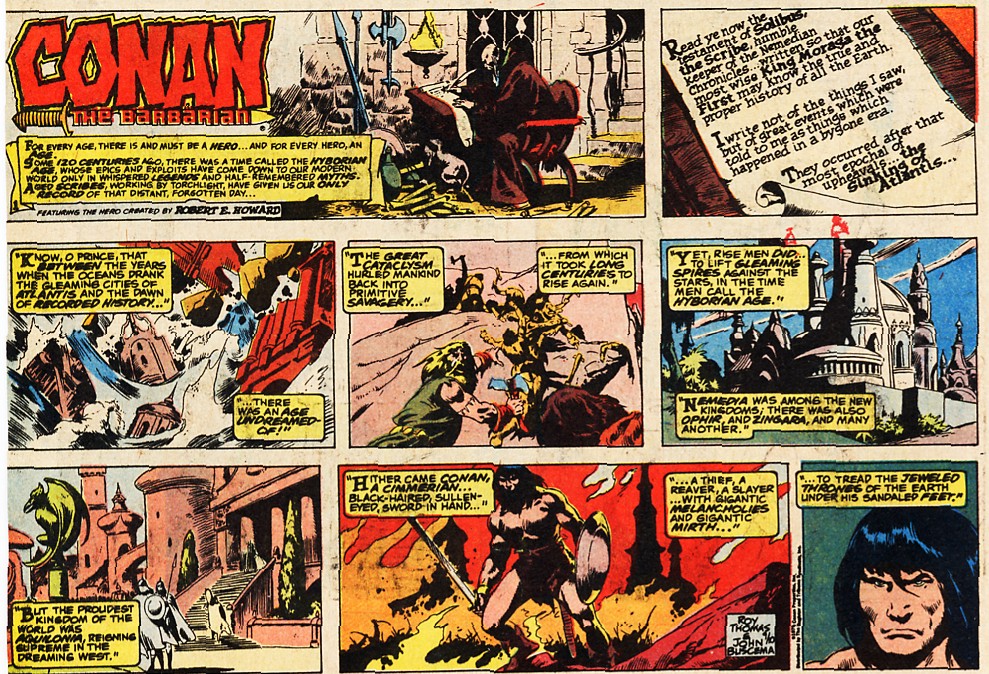
Conan the Barbarian (Newspaper Comic Strips Blog)
Some Observations on Science Fiction Names (From the Sorceror’s Skull)
Notes from Reading “The Prairie Traveler: A Handbook for Overland Expeditions” (Whose Measure God Could Not Take)
I am currently going through a lot of trainings, and specifically I am doing something to work on my SQL knowledge. I only have hovered around the edges of the topic before. Some of my previous jobs involved making some basic database queries, but I never really looked further than basic database structures and simple queries.
But that got me thinking about doing a campaign database in SQL, with a better way to track all those elements that might be interesting to know for a campaign.
Now to be fair, I am not thinking about the usual wham bam 20 levels in a campaign thing 5e seems to have going on, I am talking about a multiplayer campaign in the OSR/West Marches vein where every single session might be played by different players. I think I should actually write about this ideal of a campaign I have.
“YOU CAN NOT HAVE A MEANINGFUL CAMPAIGN IF STRICT TIME RECORDS ARE NOT KEPT” (Gygax DMG p37) and all that stuff.
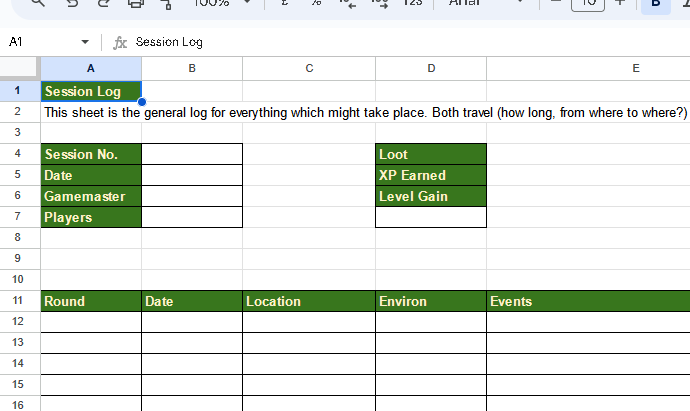
But anyway… when thinking about it I remembered that years ago for my idea of a Harnworld campaign in my own Harnworld B/X derivative that got derailed quickly by parenthood and everything involved in that I made a campaign tracker spreadsheet in Google Sheets that was supposed to do a lot of this already. This was inspired by multiple other sheets I found, e.g. the old ADnD ones or the Hackmaster one. I found it a bit cumbersome to use, but mostly I was waiting for the campaign to continue which it never did, and forgot about the existence of the spreadsheet. I fully intended to improve on it, but haven’t gotten around to it for years now. It mostly is a layout without any formulas.
I did put some thought into it though, it has some Harn specific things (e.g. a tab about Godstones, which are dimensional gates in the setting), so if someone else might find it useful have a look. Maybe give me some feedback while you’re at it.
People don’t really differentiate between authors’ voices when discussing roleplaying game scenarios. There’s a bit of it when people are really into it. They will talk about Gygaxian naturalism, or Jaquaysing Xandering dungeons [note check this Alexandrian post regarding the name change]. If it’s a Hickman scenario there’s gonna be railroads. That stuff.
Stephen Bourne is not one of those greats, but I feel like his scenarios have authorial voice dripping from their pages. He has a style. And all his adventures have similar feel that lean into it. He likes to mix heavy medievalism into his scenarios, even the clear fantasy ones, and use a limited palette of monsters for specific purposes.
When it works it’s pretty brilliant, when it doesn’t you feel like you just lost the money you spent.
I especially notice it in his early Role Aids scenarios: he tries to mix historical facts with D&D’s approach to fantasy worlds, and in some places this absolutely doesn’t fit. The Throne of Evil is the worst of the lot, being a weird mix of a political intrigue scenario in medieval England and a bog standard dungeon crawler for early D&D at the same time. A pretty horrid scenario altogether. I know it was supposed to me rules for medieval wargames, but no.
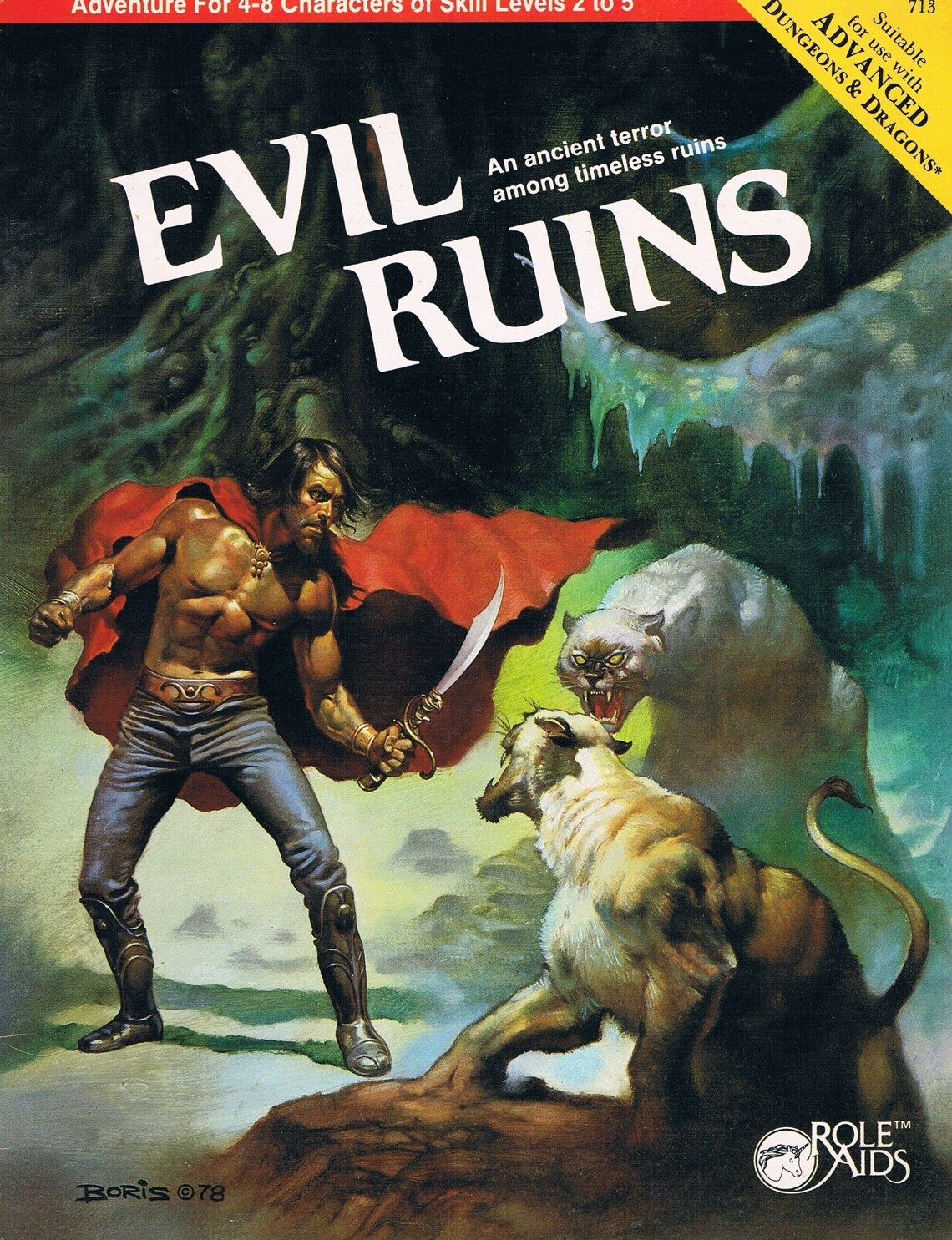
Evil Ruins is much less so, even though I am still bothered by how disjointed the setting is in places. On the one hand he establishes the setting as Castle Tintagel, which is a real world place in Cornwall, and even establishes that it has some connections to Arthurian myth. Then he proceeds to create an elaborate backstory without any obvious ties to Arthurian myth at all, but featuring Saxon kings and vikings. Fair enough.
Maybe I am just not knowledgeable enough about Arthur and his myth cycle.
But then the adventure basically is a generic AD&D scenario, and the maps don’t fit the real world location of Tintagel at all.
It would have been better if he either took care to play into the medieval fantasy situation and actually present it coherently, or just replace all the real world references with some generic fantasy terms. The way it is right now feels disjointed.
Why the hell is there a priest of Zeus in medieval England trying to establish a temple?
Why is Tintagel on the East Coast?
Sigh.
That said, that’s the setting.
I actually always have liked the rest of the scenario, even though, or maybe because… it is incredibly generic. But it is generic in a naive way you just don’t see done that often.
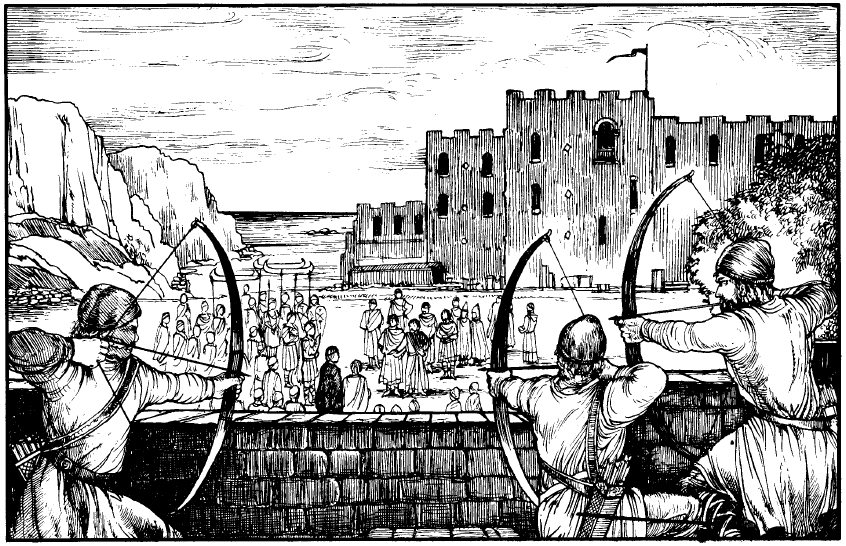
The backstory is too long (2pg for a 36 page scenario), but the basic situation is this: there were two brothers born to the same mother, one the son of the king, one the result of an affair with the king’s brother. The first son was supposed to inherit the throne, but when he came back from a journey his brother murdered him and took the throne. Then stuff went belly up, the usurper basically lost the kingdom and established a death cult in the castle (…as you do…), and his murdered brother came back as a wraith out for revenge. So there’s two separate evil forces in the ruins, and the struggle between both comes to a head just at the same time as a bunch of adventurers come to clear out the castle because it keeps the property values down or something.
There’s a bit of subterfuge going on. First the heroes have to travel to the castle with a guide, but he intentionally misleads them for his own goals, and they have to rescue the heart of the forest. Who is a giant spider.
I love that. There are potentially friendly natives in the forest that will gladly help the party, as long as the group doesn’t immediately murder them for just happening to be giant arachnids.
The guide also will steer them towards a different location than they want, so they take care of a lycanthrope for him (not actually a werewolf) while he steals the treasure. The idea is a bit railroady, but ok.
By the way, did you know the term black panther actually refers to two different variants of big cats of different species? I didn’t know until I read this adventure, and then only after I read the statblocks of the lycantrope and his pet leopard properly. The term black panther is never used in the text, but that’s what they both are supposed to be. The text introduces him as a were-leopard. A term that evokes different images in me than black panther would.
I assume the reason for the black panthers in here was because they got the rights for a Boris Vallejo painting for their cover and they needed something in the scenario that fit to that. Or they chose the painting because the were-leopards were in the scenario and missed what color they were supposed to be.
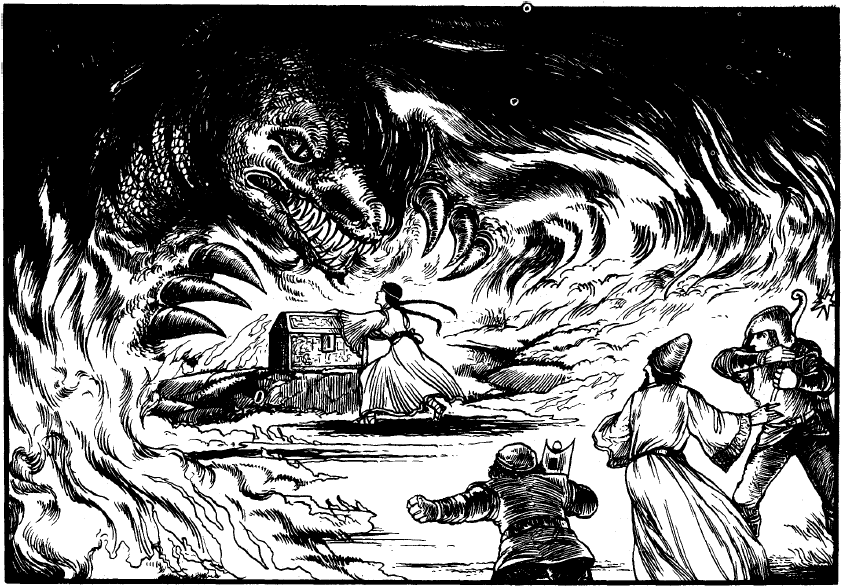
Then when one finally arrives at the castle one has to deal with death cultists and monsters maddened by the wraith, but it’s not necessarily clear that both are against one another from the outset.
The dungeon is a bit lackluster, but the author took care to put a sort of investigative scenario in there. One can find out the backstory for what happened when following the clues, and find out there is a second evil influence at large. If one cares to do so at least.
The castle itself is presented as a 4 level dungeon, but the 1st level is just the castle yard (also doesn’t seem to resemble the actual Castle Tintagel), and level 4 is rather short.
One interesting bit is that the short boxed text that is given seems to assume the players do indeed not know what these creatures they encounter are. So orcs are “ugly brutes”, hobgoblins are “rather large and ugly creatures” and ghouls are “terrible figures”. Which is nice in that way. It doesn’t give away what they are, one easily could play this as an actual fantastic medieval scenario in a fantasy Britain, and have them all encounter these creatures for the first time.
And that’s actually the way I would run this adventure: as a slightly longer introductory module, to get some people into the game. Maybe not necessarily really in the fantasy Britain environment the module supposes, but one easily could find at least some equivalent region in another world. Or just, you know, keep that little duchy it takes place in it’s own self-contained world.
This scenario was released by Role Aids, a line of supplements by Mayfair games that were more or less compatible with Advanced Dungeons and Dragons. There were a few lawsuits involved, but they were rather cheeky about it. This module claims it is suitable for use with ADnD, and the stat blocks are roughly equivalent, but not the same. Certainly enough to run it just like that, mapping to the ADnD rules nearly 1:1.
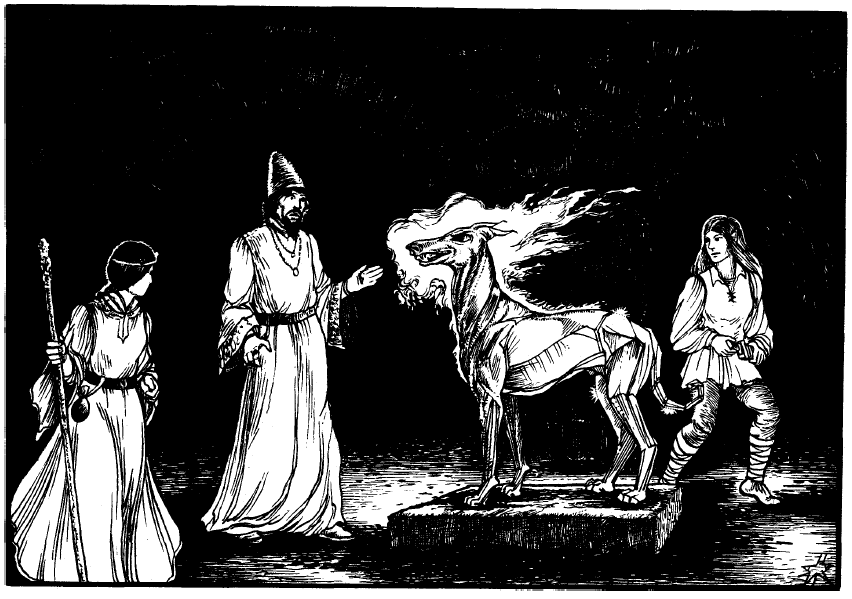
The illustrations in the text were by Hannah Shapero. I don’t know if she did so much more work in RPGs, but I like the illustrations we get in here. They have a very dark quality, and manage to get over the whole feel of the place perfectly. I am not quite sure if they were actually made for this particular scenario though, or if the author just had to use some illustrations they had lying around.
An aside about the German edition
The first time I came across this scenario was in the German translation. This one was published by Truant Spiele (Truant is the owner’s last name) in 1989 as Ruinen des Schreckens (Ruins of Terror). So at least the title got an improvement. I got it more than ten years after, when Truant and Welt der Spiele decided to get rid of some unsold stock by bundling them together in anthologies. Actually I got that one even later, because it took a few years for me to actually get my hands on it when that anthology ended in the bargain bin.
I find this translation interesting: unlike the original English version this is not compatible with AD&D. The scenario was translated faithfully, but a page about “Universalabenteuer” (generic adventures) was added with adaption notes. All the stats in the scenario have changed to a weird percentile system that does not seem to be directly mapped to anything. Midgard was the first German roleplaying game, and it used a percentile system (it was derived from Empire of the Petal Throne), so that might have been a reason for that. Some characters also have skills that sound very much like Das Schwarze Auge skills from that game’s 2nd edition. What it doesn’t resemble at all is Dungeons and Dragons, which at the time was barely a blip on the German roleplaying market.
Also interesting:

Thought
Loose Ends from Written Modules (Seed of Worlds)
Surprising Surprise rules (Cave of the Dice Chucker)
Hobgoblin Monks the Erasers of Afterlife Identity (I cast light!)
Be a Creator, Not a Consumer (Grognardia)
Dungeon Design
Doors on 3d8 (Clerics Wear Ringmail)
A Pattern to Arnesonian Dungeons? (Wanderer Bill’s New Journal)
Random Tables
100 Mundane Settlement Encounters (OSRVault)
d100 – Tells for the Impavid Potion Taster (d4 Caltrops)
Stuff
Star Wars – TIE- Fighter Paper Model (papermau)

Here’s a few ideas about Vancian magic in my setting:
Magic is rare
Wizards know they know only a tiny amount of the spells that their predecessors knew. Their response to this is typical wizard-like: they guard their existing spells even closer. Only the 1st level spells are easily available and commonly taught as the Canon of spellcraft. People know stronger spells exist, they either can be found in ancient ruins or reconstructed in tedious research occasionally, but few wizards that gain a 2nd level spell or above will be willing to share them with other magic users. Unless paid very well for this, and not necessarily in money. Many will only ever teach them to their apprentices, who often will be willing to serve as the magician’s punching bag for a year and a day just to receive a spell. Even higher spells might be closely guarded special powers only available to a specific arch-mage, their status often based on the mastery of multiple otherwise forgotten spells.
This leads to a few issues:
Outside of the canon of spells known to everybody (the first level spells, some 2nd level spells), many of the spells on the spell lists will be very specialized knowledge. Magic-users might know these spells exist due to historical sources, they will not be able to gain them easily. Spell research often is a tedious process intended to recreate previously known spells from old grimoires and historical references.
The shortcut is to go into the dungeon, abandoned ruins, or other unsavory places, find the stash of a deceased wizard, and learn new spells that might be available here either in spell books or in the form of scrolls. Unfortunately this is a dangerous endeavor.
One might think that making and selling scrolls would be a lucrative business, and it is. Unfortunately the margins for this are less good than one might imagine (materials being high in price, buyers being far and in between except for some of the low grade spells). It also is a wonderful way to draw the ire of the local arch-mages who often are not very happy about someone basically giving away trade secrets. One better knows what they are doing when starting to deal in spells.
Magic is dangerous
Spells are prepared by magic users by almost casting them, leaving just a last phrase or gesture to actually cast it. This means the magic users have the spell ready to go, but they have to carry around what is effectively a loaded weapon in their brain.
A loaded weapon that also is quasi-sentient, as spells are minor daemons with the whole purpose of being cast. The longer they stay in a mind (or actually a scroll or a book), the more they start having their own ideas of when and where they want to be cast.
Killing a magic user has a chance of releasing the spells they have been holding. This can lead to them trying to cast themselves, sneaking away and puffing away in a small cloud of magic, or them trying to find another empty mind to occupy until they feel the time is ready to be cast. This might include the people who just killed the magic user.
They also do not like to exist with copies of themselves in the same mind, it makes them quite queasy and likely to either start arguing or have whatever spells have when they get sick. This is one reason why variations even of known spells are highly prized. It might be a magic missile spell that shoots green missiles instead of red, but it likely is so different for the already known spell to allow putting it into the magic user’s memory with no magical mishaps in between.

I never had such a great opinion on NPC classes as they were published in supplementary material for Dungeons and Dragons. Chiefly magazines, but in 3rd edition at least they also managed to get into the Dungeon Master’s Guide and I found these to be just another level of complexity to shove onto unsuspecting DMs.
Over time I was reading a lot of them in various magazines, Dragon and White Dwarf mostly, and none of them really seemed convincing in the end. The OSR was the wild west of new character classes when I started getting into old school roleplaying, and my first version of my houserules had a ton of classes in there which were intended for players. Remarkably few of the older classes from various magazines though.
And the reason was simple, they just were either too simplistic (think the Sage) or too powerful (think the Witch). They just didn’t fit in with the other classes.
Now, I don’t think too many people were playing a Sage, but think about a Witch (which had three different versions) or a Necromancer, and that would be a different matter.
So I was reading them out of historical interest, but I never thought they’d be actually useful.
But the last few days a rather innocent comment by Lew Pulsipher on a review of his Necromancer class (he made it available on his website) made me rethink that opinion somewhat.
It’s a bit embarrassing to think it took me so long to get it, but a lot of them are exactly what it says on the tin: NPC classes. They should not be compared to player classes as much as they should be to monsters. Maybe it would be easier to see if we had them presented in a similar way to monsters instead of player characters. If we flip the whole frame of reference from “these are the goodies only the DM has access to” to “this is a monstrous individual and if we don’t defeat him now he’s gonna be a bigger problem later”.
And that necromancer class even gives you a reason to get into conflict, because it needs progressively more and more deranged sacrifices over time, causing a disturbance to local communities.
In fact even if you defeat Pulsipher’s necromancer for example, the character will curse you and then come back as an undead a week later. Oh I love it. It creates at least two more adventure hooks on its own.
Come to think of it, that’s a similar thing I just was writing about…
Which makes me think about ways to include this in my setting.
Well, ok, besides the necromancer already in The Halls of Tizun Thane…
The description of this necromancer is I think closer aligned to warlocks in later editions. They have to make a deal and keep paying for it as long as they want to keep their power, and even in death they are not free from that. They seem to have power, but they really are just some dark power’s plaything.
Which makes me think I also should look into other NPC classes that were published over time. The witch I mentioned might have some potential.

A shorter session this time, our kid’s birthday party cut into it.
Previously the runners had found out the research center they were trying to rob had busted security sensors on the lower level, which also housed their target. With some fortuitous rolls on the contacts they had (Glimmer has exactly the right contact) they decided to do some advance scouting from the sewers.
They used Puppeteer’s contacts as an excuse to buy multiple kegs of beer for the meeting of the Association of Jewish Housewives of Seattle (his fixer’s dummy org) and had an unfortunate breakdown behind the Cavilard compound.
They entered the sewers there and soon found the right access point for the center above. Unlike the outside they found access through the pipes to be possible via remote drone.
They didn’t know where they where at first, but managed to find their way into a ventilation shaft, and from there through the pipes. Unfortunately they had to notice the target room was running on a seperate system, leaving them in front of the door.
Luckily some patient spying made them discover that the maglock at the door was busted. Still, their spider drone did not manage to make its way in.
A short joint in the astral also showed that the place was accessible on the astral via the same way, but that they also were handling (and disposing down the sewers) some very toxic materials.
The plan now seems to be to use the drone at the right time to enter the server room, while causing a distraction otherwise. Maybe not too wise, but ok.
Oh well. And that’s where we had to stop. I really can’t play with my kids around, they really make it impossible to properly play online. I have to find some other way, maybe lock myself in or go out for it. But I am also not happy having to give up on my desktop setup for it. That all is kind of stupid.
We intended to continue on the next day, but the kids were absolutely beastly that evening again.

I was browsing stuff about Casus Belli and it’s Jarandell subsetting, when I came across some scenarios they published for L’Œil noir at the time it came out.
I actually never really had thought much about the stuff that appeared for DSA in other languages. Schmidt Spiele seemed to make it a thing for a year or so, but then stopped publishing new things. And I knew there was some nostalgia from people who played it back then, but soon after first the Italian, then the Dutch, and finally the French versions stopped getting new releases.
The Dark Eye’s first edition was translated into French in 1986, which is also when this scenario appeared in Casus Belli (in the same issue as a similar Dungeons and Dragons scenario): a very short solo penned by Jean Balczesak: La dernière nuit (The last night). This was in Casus Belli 32 (1986).
I do have to assume that this was an initiative of the French publisher of the game (Gallimard) to get the game some mindshare with French players. For what it’s worth they manage to misspell the name of the German publisher in this issue. And Gallimard otherwise was mostly doing gamebooks, e.g. the Fighting Fantasy series.
It’s… not good.
Actually it’s surprisingly engaging for such a short scenario, but it really is just four pages. The player character makes the mistake to talk to the wrong person (You thought he was a guard!) in the city of Agadinmar (where?!). It turns out you have been chosen as a sacrifice to the god of the city (who?!) and will be slowly tortured to death in the most excruciating manner, before being burned. Yeah, that’s not something to look forward to, so the whole scenario is about you trying to find your way out of this predicament.
The tone of the scenario is rather jovial, with a sometimes dry sense of humor. I find it interesting that of all things Balczesak decided to emulate the mode of speech employed in the starter set. But oh well.
Unless Agadinmar is the translation of a city I know under a German name this is not actually a place in DSA lore. The red-robed priests that do human sacrifice also don’t sound like anything I am aware of in the game. But that might easily be because at that early time of the game there simply was not enough lore to go against. Well, German-language areas had the the extension set already which contained a description of the setting, but that would be translated later in the year. The scenario does fit into the vibe of early DSA somewhat. Back then not much was established yet, and over time things would go different than those first few books would show the place as.


A blog (mostly) about tabletop roleplaying games
 Stuffed Crocodile
3 responses to “[The Dark Eye] Retrospective: La dernière nuit (The Last Night, 1986)”
[…] englischsprachigen Blog Stuffed Crocodile gibt es einen Blick auf ein Abenteuer von Casus Belli für das frühe L’Œil noir. La dernière nuit ist ein […]
LikeLike
The premise of La dernière nuit Sounds like a module for Lamentations of the Flame Princess. It might even be a good one, comparable to Strict Time Records must be Kept or Big Puppet!
LikeLike
I think the concept came first, and then the author had to cut it down to 4 pages. It’s not a bad concept, but it suffers from being so short. This could have been a really good little solo if it was just a bit longer.
LikeLike