


Stuffed Crocodile
@gmkeros.wordpress.com@gmkeros.wordpress.com
A blog (mostly) about tabletop roleplaying games
397 posts
89 followers
A blog (mostly) about tabletop roleplaying games

Y…eah. I mean, I have been doing these things for old DSA scenarios already, so now I get to do them for old Shadowrun ones as well. And Dreamchipper definitely is one of the oldest ones on the block, technically the second of independent scenarios after DNA/DOA (and the fourth after the venerated Food Fight in the rulebook and Silver Angel which was a pack in with the GM screen).
And it’s not even such a bad start. Unlike the previous scenarios this one is the first REAL Shadowrun scenario. Meaning: this is the first one that has all the common tropes that would become the stock in trade for future Shadowrun scenarios. Silver Angel already had part of this, but was organized differently, while DNA/DOA was very railroady in some parts, more so than a lot of later scenarios. It also tried too hard. Not that Dreamchipper…
But no, lets go through other parts first.

The main topic in Dreamchipper are dreamchips, or what later would be mostly known as BTLs (Better-Than-Life SimSense chips) in the setting. The chips in this case are a specific prototype of chips for military use that override the user’s personality with another, i.e. they are what later canon would come to know as persona-fix chips.
Here we have this part of Shadowrun canon in it’s infancy, these chips are meant to be some of the first ones in the setting, and to show off the possibilities of the technology they have been fixed with three very distinctive personalities: Genghis Khan, Cleopatra, and Jack the Ripper. I think it makes sense if you just assume these never were intended to be actually used and only there to show prospective buyers how and how well the technology works.
In any case the chips have been stolen as part of some internal power struggle, and the runners are hired to retrieve them. We get some basic information about where to start investigating, and then we are let loose at the world. Of course the chips are currently in use. While they were stolen, the reason for the theft was to give bad press for the CEO of the company, so the chips stayed with the thieves.
There are a lot of interesting things in this scenario that have not been kept for later scenarios. Some of this makes for intriguing design, some of it just comes across as annoying.

There are “random” encounters/rumors which we can encounter when traveling from location to location. There is a very interesting story progression happening where the different story lines are slowly revealed in small encounters. Early on one might find a guy spraying over a gang tag with a new one, while later a whole bunch of gangers from different gangs might pass by together without fighting. Both indicate how the guy with the Genghis personafix slowly is uniting the biker gangs of Seattle.
There are some real possibilities for giving the world additional texture. Unfortunately the way it is presented (every journey outside gets a random encounter) doesn’t feel very natural. Not to speak about the way the encounters tend to take away player agency. An encounter might tell you what happens, but also how the player character reacts. In game I also simply didn’t get around presenting them as they were intended.
Obviously outside a dungeon, descriptions of actions have a tendency to assume too much. You are given some leeway in how players might want to approach the scenario, i.e. there’s no actual fixed order how to get back the chips from the people that have them, but once you get into the details I found I got tripped up by descriptions that simply assumed too much. The PCs enter an apartment, and the descriptions tell you exactly how the characters are doing it. You enter a party and the text will tell you how the characters feel and behave. That’s… not good. This also shows up with the encounters mentioned above. Your character meets a ganger doing something illegal. You just watch. Then you walk on.
I mean, yes, most likely a runner would do that to keep out of trouble, but what if they don’t want to keep out of trouble?

The descriptions also don’t fit some of the maps we get in my opinion. The later section with the party for example shows a flat that is at odds with what is written in the text. Here we have the feeling of a big crowded place with hundreds of people milling about, with distinct types clustering in certain places, and the flat… is a flat. Just a normal flat. In no way is there space enough for what is described in the text unless everybody is really, really cuddly or there’s way less people at the party than what the text claims.
The mystery part is all a bit thin, and most of it is cleared up in the middle when the person you thought was the big bad tries to kill you in a meeting with your Johnson, and his personal pocket secretary contains evidence for someone behind the scenes. There is a good story in there, but the way it was presented just wasn’t it.
Altogether a valiant attempt for such an early adventure, but it really could have been better. I think this needs someone putting a lot of cuts in before it really is usable.
Random Notes:

Last week I found Wanderer Bill’s Grenzland 5 in my mailbox. Topic “Science Fantasy”. The zine costs 5 Euros for a hardcopy, but can be downloaded for free.
As the topic goes into the realm of science fiction there’s plenty of that in this issue. Most of the articles are in German, some are English though.
In the appropriately titled article “Piu piu!!” Alex Schroeder gives stats and rules for laser weapons in DnD.
In 46.656 Psychedelic Landscapes lkh gives a table for generating appropriately alien landscapes.
The Mini-OSR-Con Manifesto is a manifesto/advice on organising small mini conventions, some of which the authors of the article have tried to stomp out of the ground by themselves lately.
The German-language article Technosaurier talks about science fictionized dinosaurs, Aus dem Steinbru.ch gives three appropriate random tables, and The Droyne and Update Grenzland Kampagne are giving a faction sheet of the Droyne (from Traveller) as presented for the PBM game in lkh’s home campaign setting (in English), and an update and status report on the same campaign.
Definitely worth a look.
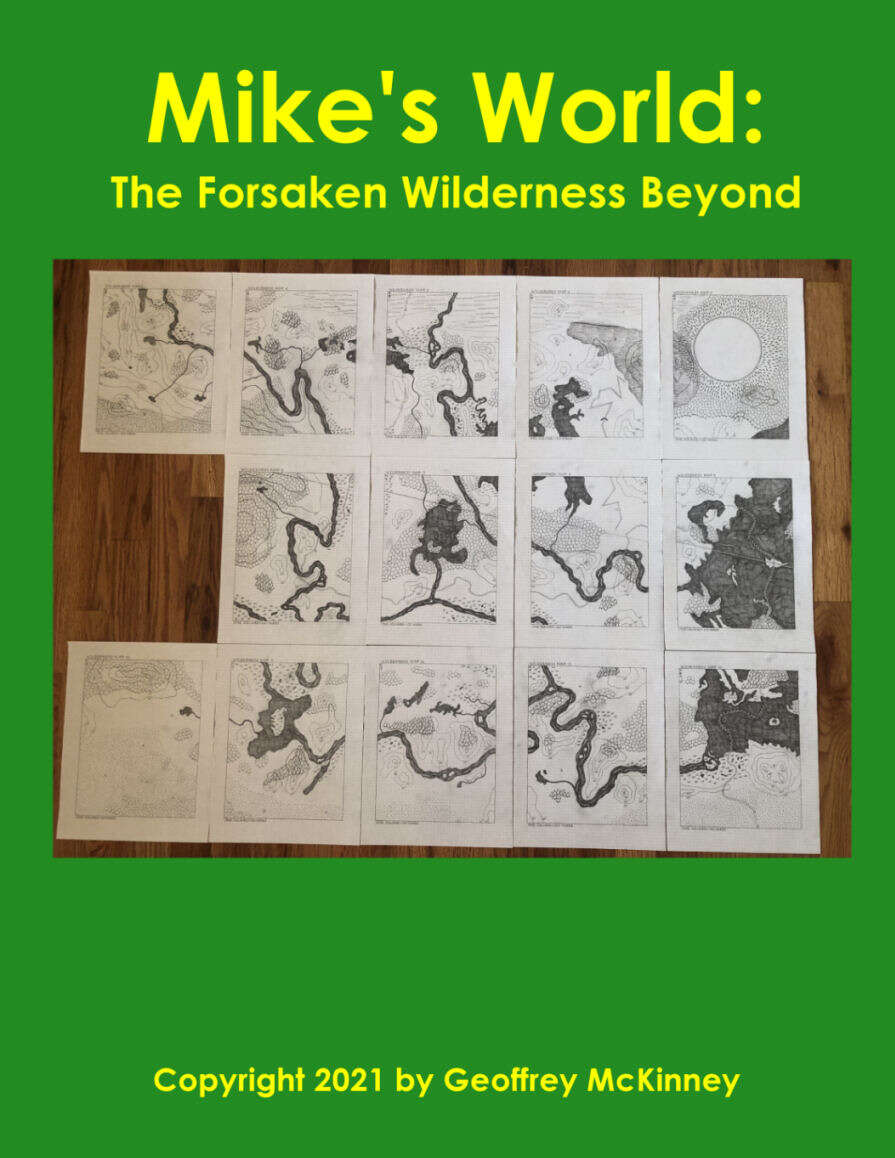
Lately I have been gearing myself up to run the venerable Keep on the Borderlands for my son, as I still think it’s pretty good as a starter adventure. And while prepping it again (or rather, moving it between Google Docs and Zim Desktop Wiki, because I found the latter to be working fine on my current computers), I found Geoffrey McKinney’s Mike’s World on drivethrurpg.
There is a particular genre of writing for roleplaying games that is concerned not so much with generic usefulness, but instead with expanding on one particular scenario or other supplement that is just so well known it has an (likely very small) audience, despite that. And Mike’s World fits into that. I guess the biggest sub-subgenre of this subgenre is the expansion of Keep on the Borderlands. The module was after all one of the most played scenarios in the history of Dungeons and Dragons, and shines by the sheer applicability towards all kinds of settings. So there have been multiple attempts at expanding and emulating the module, from simply working out the Caves of the Unknown (which were left to the referee to work out in the original) to complete reworkings, as in Barkeep on the Borderlands. Mike’s World is closer to the former than the latter.
Now you might be familiar with McKinney’s name for writing the old OSR classics Carcosa and Isle of the Unknown, now already decades back. His Mike’s books are not quite as high-concept as these, but also hardly as controversial. Their central conceit is that they are dungeon and wilderness area expansions of B2 Keep on the Borderlands, as designed by a 12-year old DM named Mike in 1982. You can check out those three supplements for free on drivethrurpg, as McKinney decided to put the whole document behind the preview link. Which is good, as I was not quite convinced about the two Mike’s Dungeons and Mike’s Dungeon: The Deep Levels supplements which expand the Cave of the Unknown and the Caves of Chaos into a 117 level megadungeon that has been (generously) described as lo-fi: It effectively is combat encounter after combat encounter, in level after level of same-looking geography. I could maybe see a use for it as a very lazy, video gamey expansion of the Caves, but on the other hand…
nah.
On the other hand Mike’s World expands the brief original Wilderness section of the original beyond the surroundings of the Keep into a wilderness crawl in the same dimensions of the B2 Wilderness. This still annoyingly leaves the area west of the Keep frustratingly blank, but it does some interesting things for the areas past the fens and up the road.
The Wilderness we encounter here has been described as B/X filtered through ODnD and the ADnD monster manual. It is not too worked out. Every single of the additional maps, all in the style of B2, faithfully emulates a 12 year old working that all out for himself, smudges and all, and has about 2-5 new encounters, progressively harder the further you get away from the Keep.
According to McKinney the idea is that our 12 year old DM took the map of the Keep from B2, and worked out encounter areas roughly based on concentric circles, spreading out from there. Which means that the maps right next to original map might be appropriate for about level 2-3, with the danger increasing the further one gets into the unknown wilderness beyond the Keep, up to encounters appropriate for about level 14 in the eastermost sections.
Soon enough certain themes will become apparent: The area was until recently the scene of a rather bitterly fought war between dwarves (called dwarrows for some reason), gnomes, hobgoblins, and giants over the so called Glimmerstones (which clearly came from Carcosa as they glimmer in Ulfire, Dolm, and Jale), which caused multiple elemental upheavals and changes in the landscape. Some areas are situated on an elemental fracture, while the so-called serpent path snakes it’s way (hehe) through the setting, empowering ophidian beings.
The encounters are not quite as weird as one would expect, but McKinney’s trademark focus on all kinds of colors holds sway even in this world. Sure there might be an Ulfire stone from outer space, but there are also blue harpies, a clear river running over amber-colored gravel, rainbow colored hippogriffs (I suspect a My Little Pony connection with those), pinto centaurs, and white apes (that might transport you to a red planet). It’s all a bit jumbled together, one could even call it a gallimaufry of themes (a word I learned from the trading post on map 4), but it can serve it’s use as an expansion of the module quite nicely. I do think it needs to be expanded by your own ideas a bit more. As it is it sometimes appears just a bit too barebones and generic. Which, to be fair, is exactly what it sets out to be.
The whole setting is supposedly the untamed wilderness. So the DM takes his inspirations from his reading material. The woods in the untamed wilderness are as dark as Mirkwood, with spiders to match. But the place is also somewhat… small… Using the scale from B2 we have an area here that fills about a 20 mile hex, filled to the brim with weird encounters, and a level scale from 1 to 14. That all seems a tad over the top, but it might just be what a starter campaign needs.
I do have to admit that there are things that bug me about the whole thing: yes, the scale is one thing, but it fits what it sets out to do. But I somewhat dislike just how low-fi the presentation of the product is. And I know it’s part of the aesthetic the author is going for, but I think I’d really love to have the whole map in a cleaner format. (at least there is a 3rd party overview of the whole setting available somewhere…)
I decided to use this expansion, and locate some of the dungeons I had planned for my starter sandbox further into the area. The Caverns of Thracia fit well closer to the Serpent Path, Quasqueton somewhere into the northern parts, and The Tomb of the Serpent Kings… I guess also somewhere in the hills close to Thracia. I am wondering if I can get the monastery from B5 anywhere as well. Maybe in the south.

This is a 28 page “temple-crawling adventure” written by Munkao ostensibly for Into the Odd and Cairn (but actually largely system-agnostic), and set in the South-East Asian inspired world of Kala Mandala. I don’t think transferring it into other settings should be that much of an issue, as long as one can come up with a reason why there’s a vaguely Asian-coded monastic community around to set this at. My personal setting is set around a sort of crossroads of cultures so I have absolutely no issue with that), and this might fit in great in some of the areas I haven’t worked out that much yet.
The mission as it is is not one that lends itself to the usual loot and pillage gaming: Het Thamsya is a fledgling temple school in a larger collective, dedicated to the path of Automata. The founder of this school has nearly finished a decade long meditation, but giant (belying the title) wasps have created a nest in the back of the building while everyone else was busy not disturbing the meditator. Your mission now, if you should accept it, is to carry the meditating monk out of there, without waking him.
The complications arise from the guards set by your mission objective (automata of various kinds), the wasps, and a bunch of other intruders that have entered without anyone knowing. Interestingly the wasp nest is detailed much more than you’d think, and there are things going on in there that are way more complicated than what you’d expect, as there’s some bizarre bio-horror twist lying in wait. Which makes for a fascinating chart of faction relations based on the instincts of the wasps and the commands left for the automata and how they interact with one another.
I do feel like I am missing some context for the world of Kala Mandala, as I am not quite sure what some of the things reference. On the other hand it’s easy to just plug in whatever association comes up and go with it. The scenario offers a compelling mission and plenty of complications to make for some interesting play. I think this might be interesting to play with multiple groups to see how either of them make it through.
People don’t really differentiate between authors’ voices when discussing roleplaying game scenarios. There’s a bit of it when people are really into it. They will talk about Gygaxian naturalism, or Jaquaysing Xandering dungeons [note check this Alexandrian post regarding the name change]. If it’s a Hickman scenario there’s gonna be railroads. That stuff.
Stephen Bourne is not one of those greats, but I feel like his scenarios have authorial voice dripping from their pages. He has a style. And all his adventures have similar feel that lean into it. He likes to mix heavy medievalism into his scenarios, even the clear fantasy ones, and use a limited palette of monsters for specific purposes.
When it works it’s pretty brilliant, when it doesn’t you feel like you just lost the money you spent.
I especially notice it in his early Role Aids scenarios: he tries to mix historical facts with D&D’s approach to fantasy worlds, and in some places this absolutely doesn’t fit. The Throne of Evil is the worst of the lot, being a weird mix of a political intrigue scenario in medieval England and a bog standard dungeon crawler for early D&D at the same time. A pretty horrid scenario altogether. I know it was supposed to me rules for medieval wargames, but no.
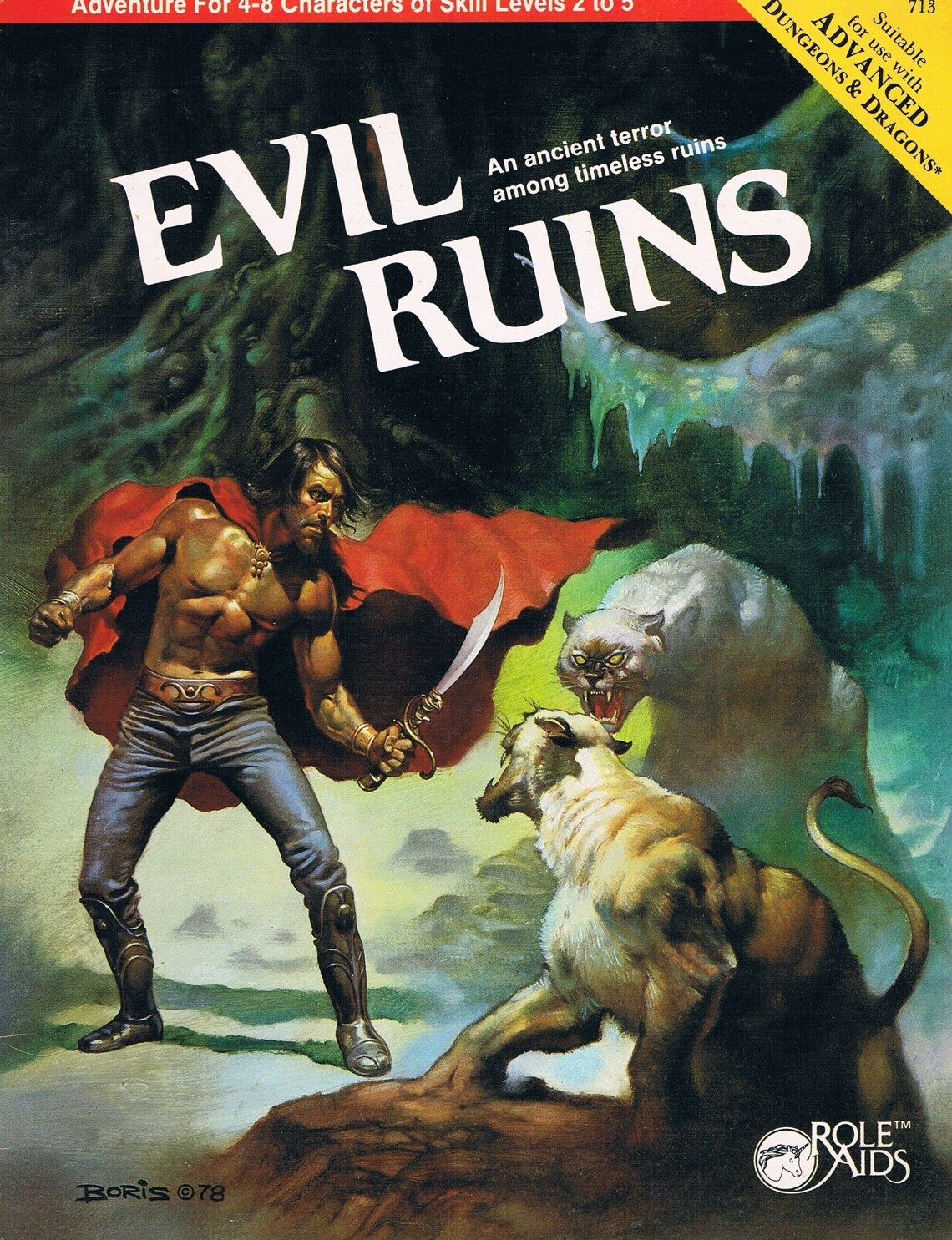
Evil Ruins is much less so, even though I am still bothered by how disjointed the setting is in places. On the one hand he establishes the setting as Castle Tintagel, which is a real world place in Cornwall, and even establishes that it has some connections to Arthurian myth. Then he proceeds to create an elaborate backstory without any obvious ties to Arthurian myth at all, but featuring Saxon kings and vikings. Fair enough.
Maybe I am just not knowledgeable enough about Arthur and his myth cycle.
But then the adventure basically is a generic AD&D scenario, and the maps don’t fit the real world location of Tintagel at all.
It would have been better if he either took care to play into the medieval fantasy situation and actually present it coherently, or just replace all the real world references with some generic fantasy terms. The way it is right now feels disjointed.
Why the hell is there a priest of Zeus in medieval England trying to establish a temple?
Why is Tintagel on the East Coast?
Sigh.
That said, that’s the setting.
I actually always have liked the rest of the scenario, even though, or maybe because… it is incredibly generic. But it is generic in a naive way you just don’t see done that often.
The backstory is too long (2pg for a 36 page scenario), but the basic situation is this: there were two brothers born to the same mother, one the son of the king, one the result of an affair with the king’s brother. The first son was supposed to inherit the throne, but when he came back from a journey his brother murdered him and took the throne. Then stuff went belly up, the usurper basically lost the kingdom and established a death cult in the castle (…as you do…), and his murdered brother came back as a wraith out for revenge. So there’s two separate evil forces in the ruins, and the struggle between both comes to a head just at the same time as a bunch of adventurers come to clear out the castle because it keeps the property values down or something.
There’s a bit of subterfuge going on. First the heroes have to travel to the castle with a guide, but he intentionally misleads them for his own goals, and they have to rescue the heart of the forest. Who is a giant spider.
I love that. There are potentially friendly natives in the forest that will gladly help the party, as long as the group doesn’t immediately murder them for just happening to be giant arachnids.
The guide also will steer them towards a different location than they want, so they take care of a lycanthrope for him (not actually a werewolf) while he steals the treasure. The idea is a bit railroady, but ok.
By the way, did you know the term black panther actually refers to two different variants of big cats of different species? I didn’t know until I read this adventure, and then only after I read the statblocks of the lycantrope and his pet leopard properly. The term black panther is never used in the text, but that’s what they both are supposed to be. The text introduces him as a were-leopard. A term that evokes different images in me than black panther would.
I assume the reason for the black panthers in here was because they got the rights for a Boris Vallejo painting for their cover and they needed something in the scenario that fit to that. Or they chose the painting because the were-leopards were in the scenario and missed what color they were supposed to be.
Then when one finally arrives at the castle one has to deal with death cultists and monsters maddened by the wraith, but it’s not necessarily clear that both are against one another from the outset.
The dungeon is a bit lackluster, but the author took care to put a sort of investigative scenario in there. One can find out the backstory for what happened when following the clues, and find out there is a second evil influence at large. If one cares to do so at least.
The castle itself is presented as a 4 level dungeon, but the 1st level is just the castle yard (also doesn’t seem to resemble the actual Castle Tintagel), and level 4 is rather short.
One interesting bit is that the short boxed text that is given seems to assume the players do indeed not know what these creatures they encounter are. So orcs are “ugly brutes”, hobgoblins are “rather large and ugly creatures” and ghouls are “terrible figures”. Which is nice in that way. It doesn’t give away what they are, one easily could play this as an actual fantastic medieval scenario in a fantasy Britain, and have them all encounter these creatures for the first time.
And that’s actually the way I would run this adventure: as a slightly longer introductory module, to get some people into the game. Maybe not necessarily really in the fantasy Britain environment the module supposes, but one easily could find at least some equivalent region in another world. Or just, you know, keep that little duchy it takes place in it’s own self-contained world.
This scenario was released by Role Aids, a line of supplements by Mayfair games that were more or less compatible with Advanced Dungeons and Dragons. There were a few lawsuits involved, but they were rather cheeky about it. This module claims it is suitable for use with ADnD, and the stat blocks are roughly equivalent, but not the same. Certainly enough to run it just like that, mapping to the ADnD rules nearly 1:1.
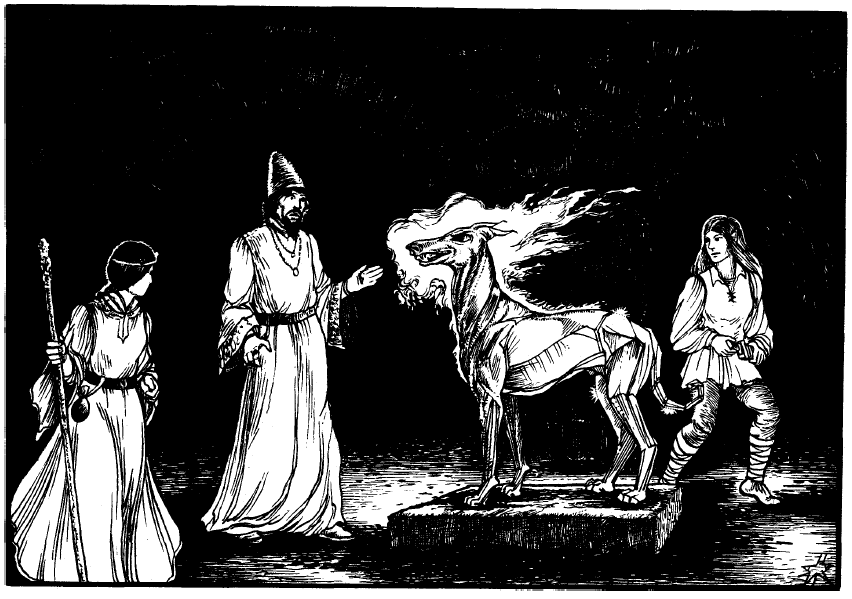
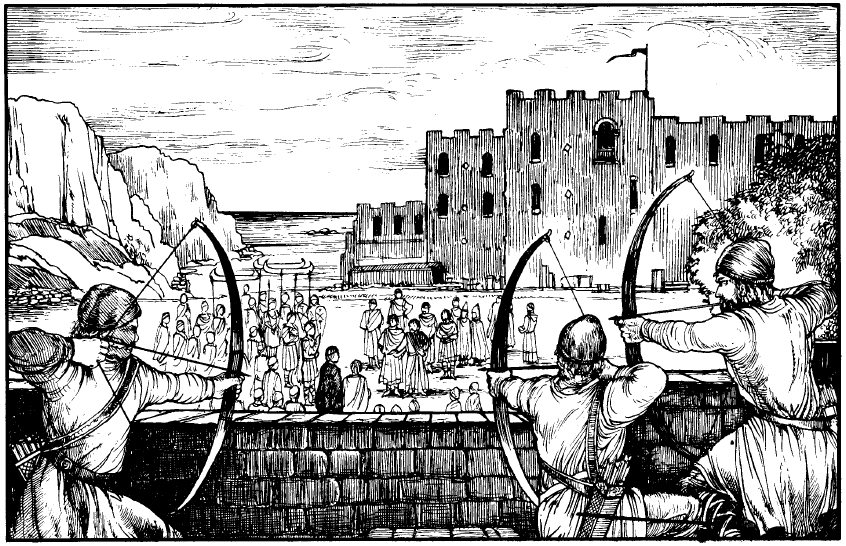
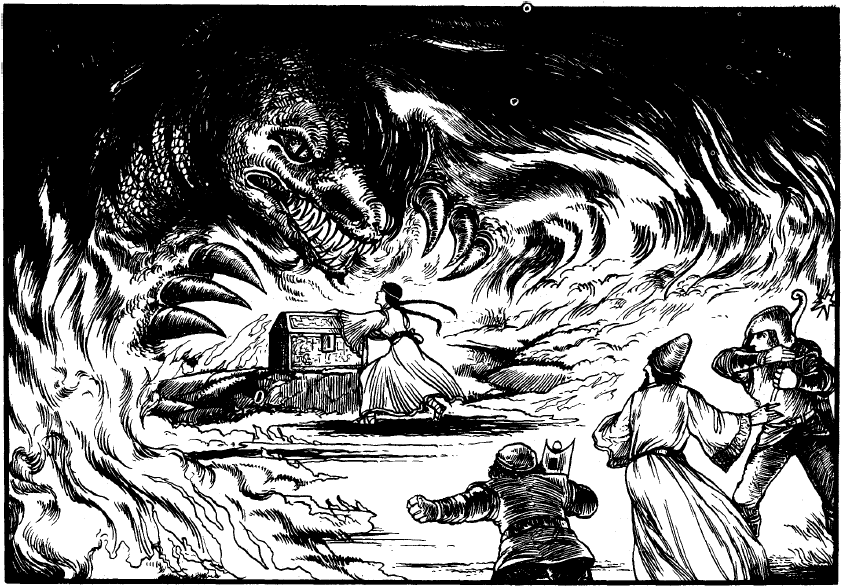
The illustrations in the text were by Hannah Shapero. I don’t know if she did so much more work in RPGs, but I like the illustrations we get in here. They have a very dark quality, and manage to get over the whole feel of the place perfectly. I am not quite sure if they were actually made for this particular scenario though, or if the author just had to use some illustrations they had lying around.
An aside about the German edition
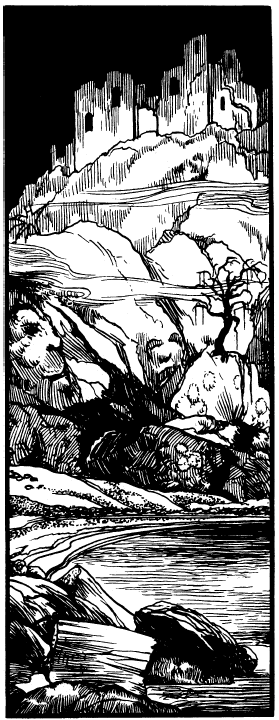
The first time I came across this scenario was in the German translation. This one was published by Truant Spiele (Truant is the owner’s last name) in 1989 as Ruinen des Schreckens (Ruins of Terror). So at least the title got an improvement. I got it more than ten years after, when Truant and Welt der Spiele decided to get rid of some unsold stock by bundling them together in anthologies. Actually I got that one even later, because it took a few years for me to actually get my hands on it when that anthology ended in the bargain bin.
I find this translation interesting: unlike the original English version this is not compatible with AD&D. The scenario was translated faithfully, but a page about “Universalabenteuer” (generic adventures) was added with adaption notes. All the stats in the scenario have changed to a weird percentile system that does not seem to be directly mapped to anything. Midgard was the first German roleplaying game, and it used a percentile system (it was derived from Empire of the Petal Throne), so that might have been a reason for that. Some characters also have skills that sound very much like Das Schwarze Auge skills from that game’s 2nd edition. What it doesn’t resemble at all is Dungeons and Dragons, which at the time was barely a blip on the German roleplaying market.
Also interesting:
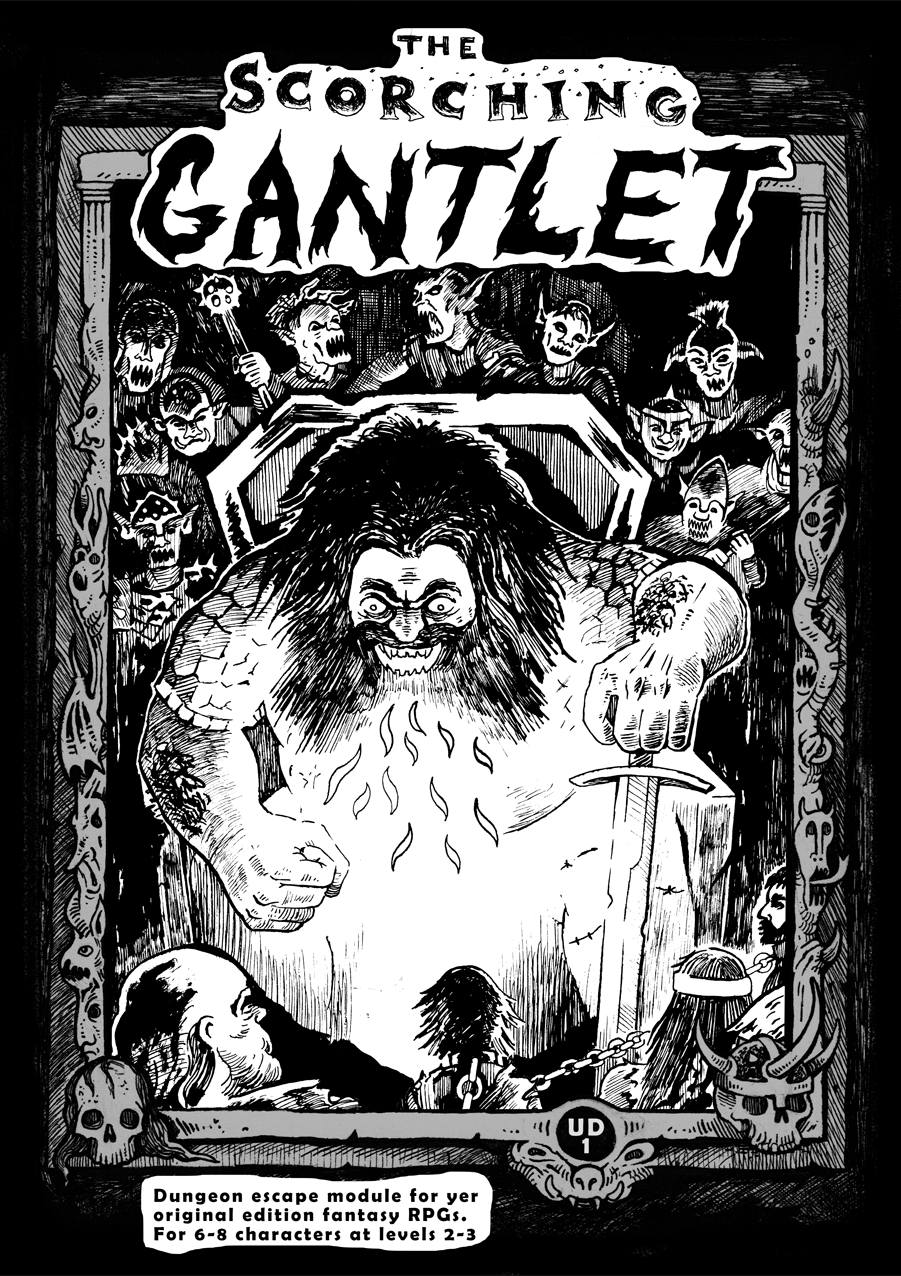
It turns out “Gantlet” is an archaic form of “Gauntlet”, still technically in use, but I assume most people coming across this might not recognize this. Not even native speakers.
I got this module for free as a community copy, which puts me into a bit of a bind. Can I really review it unbiased? Complaining too much about it sounds a bit like beggars being choosers (although I didn’t really beg for it). Not reviewing it feels wrong as well. Andrew certainly put work into this, even though, at points, he might have put in a bit (or a lot) more.
I know, I know, this is supposed to be one of those punky releases that do away with artificial standards, and give you the proper gonzo experience with bad formatting and art. But the art is not even that bad, besides the maps that is, and in a lot of ways proper standards of formatting are there for a reason.
Now, I actually like this scenario. It is supposed to be an OD&D one, but I don’t quite see that. I think it might be great for a one-shot, maybe a challenge scenario you give to people multiple times. It’s a bit long for a proper tournament scenario, but is anyone really doing RPG tournaments still?
It’s not all that creative one though. The players are captured by a fire giant and his hobgoblin army. Now they are being made to run the gauntlet in his dungeon, with the giant pointing and laughing every once in a while via magic. It feels like I played this before. Or seen the movie. And the Saturday morning cartoon.
It’s been done before I mean to say.
But that might be cool as well. Everyone knows what this is about. Go through the dungeon, find the key, slay the monsters. Survive or look good trying. If you add some stuff from previous attempts every time someone tries this it might be a fun recurring scenario for different people to try.
It does have an alien mantis monk and a giant mouth on legs though, so there’s that.
Is this worth the 0 dollars I paid? Yeah, it has a some good stuff in there. Is it worth the 2.50 it normally costs? I would have to think about that. But the drivethrurpg link has the whole document as a preview, so you can check out the whole thing.
Can be found on drivethrurpg and itch.io
So this exists: “(your name) AND THE HOLY GRAIL”. A Monty Python and the Holy Grail themed adventure scenario from Space Gamer #41 (1981).


Because yes, we need even more Monty Python references in our DnD sessions.
But well, this came out in 1981 and just as a magazine scenario. so when maybe not everyone in the hobby had seen the movie. On the other hand it clearly points to some alternative endings because the players would expect the stock ending (my favorite being the black knight showing up and telling the PCs that he told them it was just a flesh wound)
The scenario is… barely playable I would say. It wants to be an extended dream sequence by itself, which is kind of a cop out.
…how fitting…
A lot of the encounters only make sense if you have watched the movie, and still it does not quite GET it.
I would say it’s only playable if you are really into the Pythons and work out some better start.
That said, there is some stuff I do like in between:
On the other hand most of the scenario is just variations of things from the movie. the damsels of Castle Anthrax are there, so is the witch burning, so is the monster dropping dead by death of animator.
Sigh.
Yeah, it tries to be the movie. so much so that there are rules on how to move the plot forward by using The Narrator, God, or even The Director (in this order) to force stuff in the right direction.
I think this could be good if one would work it out a bit more. Like this it’s just the movie forced into a scenario. But I wouldn’t mind filing the numbers off and using some encounters in another game, or going the other way and filling that hexmap with more original encounters so it’s not such a glaring rip off.

By the way the scenario never actually states it is written for DnD. Of course it is, but it’s never said.
As a matter of fact this whole issue of Space Gamer is a special D&D issue, but whenever books are mentioned it’s the newest AD&D stuff, even when Gygax pens the article. I guess this came out in that brief period where even Gygax didn’t make a difference between D&D and AD&D to cut Arneson out of the royalties.
I have the feeling this issue was largely paid for by TSR. I think Space Gamer was way more into Traveller. I mean, there’s the whole name and all.
I am tempted to just introduce coconut riding in an otherwise normal setting and leave it completely unexplained, just to see the eye rolls of the players.

This is an interesting purchase I made on Amazon lately. It’s available on there as a POD title.
It’s a late 70s/early 80s Age of Sail RPG/wargame.
Basically a Hornblower RPG, but the author of the game wrote a few books in abou
It has been in lists about this kind of genre for decades, mostly because nobody else published a game for the same setting/time period.
It’s structured as a wargame (the naval wargame Heart of Oak) and two other books with information on the RPG system and campaigning. Originally this seems to have been a boxed set published in 1982, and the blurp on Amazon still talks about three books and a box.
I find this game fascinating because it is so… limited. You have the choice of playing both sides: you can be a white, male Royal Navy officer, or you can be a white, male American Navy officer. If you feel fancy you also could play a privateer from any other nation (but the navies of those nations are not worked out).
To be fair, it does at least talk about playing other genders and races, but goes into detail of how difficult that would be.
The whole game is focused on being a Naval officer in a way that almost seems odd. The world outside of at most a port city might as well not exist. It does give you the option to buy a rotten borough though and become a member of the house of Lords, so there’s that.
There is an encounter table for portside encounters that includes eligible ladies (25% widowed) in case one wanted to dally or marry one. Shipboard doctors always are drunk and you can only determine how much when you need one.
The actual character creation rules are spurious, but unlike DnD they forego alignment for party affiliation. It’s all… laser-focused on playing a very specific kind of character. Way more than even DnD ever was.
What it does not though is information on how to run this game. I know, I mentioned campaign rules, but that’s just it. They are campaign rules. There is nothing like a scenario, or play examples, or an overview of the world outside of ships here. This is literally a game like White Box DnD, which basically just was an extension of a wargame on an individual level. And I guess like oDnD you would need someone who already played to even get into the game. I assume this was done via conventions or similar ways, or people just hunkered down and tried to make sense of the game on their own.
This game never was really that successful from what I have seen. There are three supplements/modules for it, all available on drivethrurpg, but the game has been in publication since the 1980s from what I have seen. That is, the company still exists and at one point might have dusted off the books and scanned them in.
Will I play it? Most likely not. I don’t think it’s worth it, especially as I am not really a fan of the genre. But it is a rather interesting artifact of TTRPG history.
Adam D’Amato-Neff
Writers Club Press 2002
I had a gift card!
I had to use the money somehow!
And this one was cheap!
Don’t look at me like that!
Also I bought this 5 years ago and I meant to post this review for just as long.
The Fantasy of Eight Roleplaying Game, or F8te if you want to confuse people who heard about Fate system before, is pretty much a pure fantasy heartbreaker. It mostly seems to serve as a ginormous ego trip for the author.
Frankly I doubt that it was supposed to be bought by anybody but the author and his players, but then a guy in Poland decided to spend the last bit of money on his gift card for something RPG-related. So now I can talk about it online.
According to the back cover
This is the F8S (FATES) role playing game designed by the author of the Pleides Series (Za’Varuk’s Stone), The Moonweaver Memoirs, and Pleidian Tales. It has all the information needed to begin play, including 20 character classes, a huge list of monsters and races, and example characters.
The book is thin (100pgs.), and over a fifth of it is pre-generated characters.
Which the author found necessary to include.
A further big part of the book is tables upon tables of monster stats. The approach to their stats is a bit schizophrenic. On the one hand Nymphs are split into a table with 3 entries of Nymphs of various powers. Elementals just have 3 entries as well, and aren’t even split up into different elemental classes. On the other hand there are the tables for ogres, where one can find a whopping 75 entries, diligently listing the stats for ogre axemen, priests, and necromancers up to level 25.
I kind of see what the author was going for, but I think he missed the mark somewhat.
The actual rules to play the game are surprisingly short. In fact they make up most of pages 1 to 32 of the book, and in between you find another few pages with characters from one of the author’s stories.
The rules are definitely inspired by D&D, and try to mostly improve on the model set by that game. It allows and encourages mixing and matching of classes to create just the hero one wants for a game. And it boasts 20 classes and 15 races for that. Of course in the limited amount of space it has, the difference between a Warrior, a Karateka, and a Barbarian is explained in a single paragraph, with maybe a sentence for each.
Alignment is still present, but instead of the classic model we now have Caliginous, Neutral, and Luminance. What either of these means is not explained and can only be inferred through some comments in the section on races.
Equipment is limited to a page of weapon descriptions, and a short paragraph on treasure. Interspersed between those two is the section on attacking enemies, and this is followed by the section on religion, which just tells us that the number of gods in the campaign world would be too big to list, so it lists a few of the bigger gods (including Thor, Demeter, and Orcus).
The section on attacking by the way does not contain any further explanations than the terse rules mechanics. Further explanations are provided, in two more sections a few pages further, one called “Basics for the game, Taken from the short story Nightmares Born of Bliss”, the other simply “Tomb Adventure”. Interestingly enough the second part decides to reiterate the rules on attack darts for clarity, despite the fact that these rules are at the bottom of the same page and were not mentioned beforehand.
“Tomb Adventure” also seems to be what goes for a sample scenario in this game. It is nearly 2 pages long, half of which is explanation how combat works, the rest of which is a description of a tomb in text form:
Stairs lead downt.
Landing has a hallway leading off.
Thief must make check to notice trap door in the floor.
And after “Tomb Adventure” we have the three paragraphs [!] on Attack Darts, creating Undead, and Character Death.
The book also contains one dedication, one epigraph quoting Shakespeare, a list of abbreviations, 2 pages of introduction, an afterword that promises a forth coming expansion to the tomb adventure presented in the book, a bio of the author with his msn.com email address, 4 pages of advertisement for at this point not-yet published fiction and non-fiction by the author.
Oh, and then a section headed “Bibliography” that reads
A thanks to the mythmakers of old, for without them this book would not be what it has become!
Uhm. I don’t think this word means what you think it means.
OK, this book is charming in its way. A wonderful example of DIY rpg stuff of the early 2000s. I bet the author and his players had lots of fun in their campaign. So that was good for them. I love to see this stuff sometimes.
I also love some of the design ideas here. The whole system is pared down and streamlined to allow for a quick and eventful game. E.g. it acknowledges that people will use spell components, but when playing the game this should just be ignored. It also is intended to allow a maximum of character customization… but forgets that D&D is not the only game there is and that other games might have better ways to do that. And you can still see the traces of D&D in there anyway.,
But the bad points are overwhelming: there’s no structure, no real sense of place (the author assumes you have read his novels, not all of which might have been published), and the game is barely understandable. There are barely any explanations as to how rules actually work, and lots of far-reaching assumptions on how things are supposed to go in a game.
TLDR: As a game it is basically unplayable, mired in barely understood D&Disms, structured like a Jackson Pollock painting, and completely full of itself. It’s a fantasy heartbreaker.

Kelestia Productions 2007
PDF 35$ (250 pages, large scale map, etc)
Venârivè is the larger region Harn is situated in. Previously the setting description of HarnWorld focussed mostly on the island Harn itself, and a few areas in the general vicinity. This publication changes that and pushes the known world up to the borders of the cultural region Venârivè. Some of these places were already mentioned in the Lythia article in HarnWorld, a lot of others are mentioned here for the first time.
That includes the name of the publication. The copy of HarnWorld I own just mentions the continent of Lythia, and doesn’t have a specific name for the subcontinent.
But at least Venârivè sounds like a real name.
Venârivè is the region between and around the Ivinian and the Venarian seas, and defined more by cultural coherence than geographically*. This region has been settled for a few thousands of years, and there are traces of older, most likely alien civilizations (the Earthmasters).
The predominant race in this area of the world are humans (oh, really?), splintered in thousands of smaller tribes and nations. There are some other, older races (Elves and Dwarves) that have been in decline for a long time. They used to influence human civilization, but now only a few scattered realms in remote locations remain. There also are a few other non-human races, often scatted and marginalized. The largest group here are the Gargun of Harn (the Harnic orcs), which are an economical and ecological disaster just waiting to happen.
Most of Venârivè is wilderness, with few pockets of civilization huddled around larger villages and towns, and sometimes even actual cities. Many states only effectively control the immediate area around their towns, and maybe a few strategic highways (read: wilderness trails) to other civilized areas.
The religion of the region is diverse, but the region is locked in the protracted struggle between the cults of two different war gods: the protective Larani/Varani (a goddess of chivalry), and the aggressive Agrik (with a might-is-right philosophy). The conflict between these two philosophies informs a large part of the religious and political conflicts in the setting, although other religions have their own issues.
The technology of the setting is somewhere between 10th and 15th century (so basically standard fantasy fare), with some areas more developed than others. Most of civilized Venarive is very much in the feudal, manorial mode of living. So there is not too much change for seasoned Harniacs.
Nations and states, tribes and cultural regions are described in loving detail, even if most likely no-one ever will play in these parts. There are lists of rulers, historical personages, ports, and so on.
As always with Harn products this book describes this setting at one specific point in time (the year 720 of the Tuzyn calendar), so there is no metaplot to go against, besides what is described in the book itself.
The setting veers away from the usual RPG everything-but-the-kitchen-sink setting that has become the standard over time; the setting does not go out of its way to fit one genre or another into it; the authors clearly went for internal coherence rather than actual playability. I do not really see many people wanting to play a power struggle in Quarphor (Scythia?), or courtly intrigues in Dalkesh (quasi-medieval Egypt?). Some people, yes, but not many.
This book is both one of the best RPG supplements I have come across so far, as well as one of the most frustrating. I absolutely love looking at this book. I enjoy the worldbuilding, the additional detail, the insane amount of information I can get out of it, but the setting doesn’t make it easy to put it into a game.
But maybe I should just come to grips with the fact that I did not buy this book to use it. I bought it because I enjoy reading about a well-crafted world.
Summary:
——
* if Venarive was Europe it would include not only mainland Europe but also large parts of the middle East and the parts of North Africa directly influenced by it, as well as large swathes of Asia
A blog (mostly) about tabletop roleplaying games
 Stuffed Crocodile