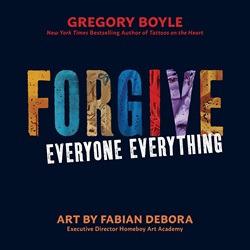
Review of Forgive Everyone Everything, by Gregory Boyle, art by Fabian Debora

Forgive Everyone Everything

by Gregory Boyle
Art by Fabian Debora

Loyola Press, 2022. 112 pages.
Review written January 2, 2026, from my own copy.
Starred Review
2025 Sonderbooks Stand-out: #5 Christian Nonfiction

When I discovered Fr. Gregory Boyle had written a new book, Cherished Belonging, I rushed to Amazon to order my own copy and discovered another book of his I hadn’t read – Forgive Everyone Everything.

It turns out that this book doesn’t contain new writings. It takes short selections from his past three books, Tattoos on the Heart, Barking to the Choir, and The Whole Language, and pairs them with poignant paintings from Fabian Debora, Executive Director of Homeboy Art Academy.

The result is a book that’s perfect for meditative devotional reading in the morning, one spread per day.

I’ll be honest – Father Greg’s books can get a little rambly. Sometimes it’s hard for me to pick out punchy quotations to post on my Sonderquotes blog. So this book full of bite-sized powerful quotations was a delight. Reading one page inevitably gave me something to mull over during the day.

I did, of course, mark up more quotations for Sonderquotes. It’s going to be interesting to see, when I go to post them, how many are already there.

This would be a fantastic introduction to Father Greg’s writings. I do think it will leave you wanting the more in-depth stories. But it’s also a nice way to review his powerful and loving teachings, leaving you with one thought to carry with you through the day.

homeboyindustries.org

Buy from Amazon.com

Find this review on Sonderbooks at: www.sonderbooks.com/Nonfiction/forgive_everyone_everything.html

Disclosure: I am an Amazon Affiliate, and will earn a small percentage if you order a book on Amazon after clicking through from my site.

Disclaimer: I am a professional librarian, but the views expressed are solely my own, and in no way represent the official views of my employer or of any committee or group of which I am part.

Subscribe for more reviews and talk about books.

Join the conversation: What did you think of this book?
Review of God Didn’t Make Us to Hate Us, by Rev. Lizzie McManus-Dail

God Didn’t Make Us to Hate Us

40 Devotions to Liberate Your Faith from Fear and Reconnect with Joy

by Rev. Lizzie McManus-Dail

Tarcherperigee, 2025. 222 pages.
Review written December 17, 2025, from my own copy, purchased via Amazon.com
Starred Review

I don’t remember which book I was looking at on Amazon when this book came up as a suggestion – but the title delighted me, and I ordered it on the spot. I liked it even more than I expected to.

This is a book of 40 devotionals, with the final one about Easter – so it would be a good choice for Lent. But I enjoyed it at a totally different time of year, reading a devotional every few days. And I’ve recommended it to my church small group to read when we start up after the holidays. We’ll stretch it out through Spring, taking a break to do a churchwide study for Lent.

The message is, as you’ll guess from the title, affirming and uplifting. The devotionals are based on Bible stories, with a large number of them being stories about women. They end with a prayer. They aren’t about striving and gritting your teeth and trying not to disappoint God – they remind you how much God loves you already.

The Introduction talks about deconstruction and disillusionment with traditional theology, so yes, that’s partly why I liked it. Here’s a section from that Introduction:

So how do we melt away the fear?

I believe it begins here: by looking at the heavens, and looking at the dandelions in the cracks, and looking at scripture, and looking at God, and trying an older and wilder way of trust. It begins by saying: God did not make me to hate me; God made me to love me. God made me out of desire. God made me out of joy.

God is not so small-minded or vindictive as to make people in order to just . . . hate them. I mean, look at the sheer multitude of galaxies in the universe. The membranes of butterfly wings. The way a toddler’s teeth make the most crooked and sublime smile when they laugh. The dreamer-upper of these things isn’t an asshole. I just don’t buy it. The Bible doesn’t sell it, either; while full of challenging and complex stories that do dip into the lament and wrath of God, scripture on the whole has an undercurrent and over-arc of God’s delight in God’s people.

Something else I liked about this book was the author’s ability to help me see old stories in new ways. One example, talking about the story where Jesus told his disciples he was giving them his blood to drink, she reminded anyone who’s given birth that our babies feasted on our blood when they were in the womb, and blood converted to milk after their birth. We know about sustaining others with our very being. And that’s an image of how Jesus sustains his followers.

And, yes, this is another book I’ve marked up to make posts on my Sonderquotes blog. It will probably take me a long time to get all of them up, but it will give me more opportunities to mull on the wisdom found here. I do highly recommend this as a devotional book that will uplift and encourage you – and help you believe that God delights in you.

revlizzie.com
penguinrandomhouse.com

Buy from Amazon.com

Find this review on Sonderbooks at: www.sonderbooks.com/Nonfiction/god_didnt_make_us_to_hate_us.html

Disclosure: I am an Amazon Affiliate, and will earn a small percentage if you order a book on Amazon after clicking through from my site.

Disclaimer: I am a professional librarian, but the views expressed are solely my own, and in no way represent the official views of my employer or of any committee or group of which I am part.

Subscribe for more reviews and talk about books.

Join the conversation: What did you think of this book?

Review of Through the Year with George MacDonald, edited by Rolland Hein

coverThrough the Year with George MacDonald

366 Daily Readings

by George MacDonald
edited by Rolland Hein
foreword by Douglas Gresham

Winged Lion Press, 2012. 406 pages.
Review written December 16, 2025, from my own copy, purchased via Amazon.com
Starred Review

I normally wait until I have finished every page of a book to write a review, but I decided to make an exception in this case, just in case someone’s looking for daily devotional readings for 2026. (Not that you couldn’t start midyear.) I’ve read a page a day from this book for all of 2025, and it has enriched my life.

I have long been a George MacDonald fan. C. S. Lewis famously said, “I consider George MacDonald my master,” and I could say the same. It was George MacDonald’s nonfiction writings, which I first encountered in Discovering the Character of God and Knowing the Heart of God, that I first grappled with the idea that God will save everyone – and it was George MacDonald’s obvious deep knowledge of Scripture and deep love for God that helped me dare to believe it.

I’ve already read MacDonald’s Unspoken Sermons and other nonfiction many times. So this book was a nice way to be reminded of his ideas with a dose each day. Each day’s reading is one page from MacDonald’s writings – mostly the nonfiction. The book also includes important events in George MacDonald’s life and a verse for each selection. Some of the selections come from his letters or other sources that were new to me.

George MacDonald, a nineteenth century Scottish preacher, firmly believed in that God is our loving Father. His writings simply drip with the perspective of that amazing love. I’ve long found that regularly reading George MacDonald’s writing lifts my perspective, builds my faith, and fills me with hope and joy. This book was a perfect way to fill that dose, and I’m planning to go through it again for 2026.

Buy from Amazon.com

Find this review on Sonderbooks at: www.sonderbooks.com/Nonfiction/through_the_year_with_george_macdonald.html

Disclosure: I am an Amazon Affiliate, and will earn a small percentage if you order a book on Amazon after clicking through from my site.

Disclaimer: I am a professional librarian, but the views expressed are solely my own, and in no way represent the official views of my employer or of any committee or group of which I am part.

Subscribe for more reviews and talk about books.

Join the conversation: What did you think of this book?

Review of Cherished Belonging, by Gregory Boyle

Cherished Belonging

The Healing Power of Love in Divided Times

by Gregory Boyle

Avid Reader Press (Simon & Schuster), 2024. 212 pages.
Review written December 2, 2025, from my own copy, purchased via Amazon.com
Starred Review

If you haven’t yet read one of Fr. Gregory Boyle’s books, I strongly recommend that you do so as soon as possible. You will be encouraged and inspired. If you have read the others, you will be as happy as I am that a new one is out.

Gregory Boyle is a Jesuit priest who works with gang members and former gang members in downtown Los Angeles (not far from where I used to live when I was in grad school at UCLA). In this book, as in his others, he tells stories of the beloved people he works with – and how their lives are transformed by having a place where they belong and where they are truly cherished.

This book challenged me. Fr. Boyle truly believes that everyone is unshakably good. That evil is a manifestation of illness, un-wholeness. And he believes that God sees us all that way, too. And seeing as God sees transforms our way of being with people.

We are invited to love what God loves, which is quite different from doing things that please God.

All his stories show the power of cherishing one another.

The moral quest has never kept us moral; it’s just kept us from each other. So maybe we should abandon the moral quest, since it’s an Old World map, and embrace instead the journey to wholeness, flourishing love, and defiant joy…. Yes, we want to do the next right thing, but what is the next right thing and who is able to choose it? Only the healthy person can. So we help each other, not to make better choices but to walk home to well-being and deeper growth in love. Cherishing leads us to this warm embrace of the journey to wholeness.

I promise that reading this book will uplift your spirit. I marked a few dozen quotations to post on my Sonderquotes blog. (It will take a long time, since I’m marking quotes more quickly than I’m posting them, but that will give me a chance to revisit this book for a long time to come.) Let me close this review with another good one:

The goal is not to save our soul but to spend it. Our authentic discipleship, then, is to grow in love, not goodness. Growth is not about becoming less sinful, but more joyful.

homeboyindustries.org

Buy from Amazon.com

Find this review on Sonderbooks at: www.sonderbooks.com/Nonfiction/cherished_belonging.html

Disclosure: I am an Amazon Affiliate, and will earn a small percentage if you order a book on Amazon after clicking through from my site.

Disclaimer: I am a professional librarian, but the views expressed are solely my own, and in no way represent the official views of my employer or of any committee or group of which I am part.

Subscribe for more reviews and talk about books.

Join the conversation: What did you think of this book?

Review of Eucontamination, by Paul Hoard and Billie Hoard

Eucontamination

Disgust Theology and the Christian Life

by Paul Hoard and Billie Hoard

Cascade Books, 2025. 221 pages.
Review written November 18, 2025, from my own copy ordered via Amazon.com
Starred Review

When I heard about this book, I preordered it eagerly because I’ve long followed Billie Hoard on Twitter. She’s a transgender Christian, and everything she posts is uplifting and encouraging.

Billie’s brother Paul is a psychology professor, and the book ends up being academic, philosophical, psychological, and a little hard to absorb. (Am I losing my ability to read academic stuff in my old age?) I will try to explain the main point of the book, and I am still trying to absorb these ideas in my life.

The first paragraph of the Introduction is provocative:

This is a book about disgust and contamination. And Jesus. We would dare to assert that few if any other texts on theology and the Way of Jesus spend as much time talking about poop as the one you are reading. However, if you are willing to move towards your disgust, we hope you just may find Jesus in the last place you expect, but the very place he said he would be.

It turns out that a big part of polarization – of dividing people into us and them – is about disgust.

We aren’t so much afraid of one another as disgusted – a much harder truth to face. We don’t resist the foreigner, orphan, and widow out of fear for our lives and well-being so much as out of a fear that they will contaminate us – change us into something we do not want to become. It’s a very human and very normal reaction but not one that Jesus seemed to follow. The Way of Jesus runs in the opposite direction of the exclusion that disgust instigates: it welcomes instead of rejecting, integrates instead of segregating, and loves instead of fearing. . . . We needed a term, a concept, to represent this anti-disgust way of engaging the other that Jesus modeled.

The term they landed on is eucontamination, contamination for good. The initial chapters explore the concepts of disgust and eucontamination, and then look at the life and teaching of Jesus from the framework of John 14:6.

How might each of these: way, truth, and life, be vectors of eucontamination – contaminants to or self-understanding and social realities that lure us back to Christ?

So that’s the main thread of the book. The “Way” is intentionally covered last of the three, so that thought will precede action. But the whole book is a powerful teaching against us-versus-them thinking and purity codes that look down on people. I love the teaching that God is not disgusted with us, and Jesus became a human because God was not disgusted.

A core vocation of the church is to stand in solidarity with the stigmatized and disgusting – remembering that it is not the people who are disgusting, but society who is disgusted. Like our Lord, we should be “reckoned with the lawless” (Luke 22:37) such that at every stage of the disgust cycle, the church is standing with the stigmatized and is leveraging any power, privilege, or influence it has on their behalf, fully knowing that this means casting our lot with a targeted and scapegoated community.

An overarching message of this book is that getting to know the “others” – the people in groups we feel alienated from – will indeed contaminate us – and that’s a good thing. It’s also about being open to listening and learning.

And they aren’t blind to boundaries.

By highlighting the beauty of eucontamination, we are not advocating the abandonment of boundaries. Recognizing the problems of disgust does not mean that threats no longer exist. Instead, we hope that recognition allows one to hold effective and humane boundaries. We are inviting you to resist the lure of dehumanization that comes from disgust, not asking you to ignore all boundaries. Dangers exist in the world. Not all people can be trusted. Power dynamics are real and must be taken into consideration. As you do though, notice how disgust may sometimes be used to make holding those boundaries easier. Jesus continually calls us back to see the image of God in everyone, even while holding them accountable.

So those are some of the beautiful and challenging ideas you’ll find in this book. Lots to think about as we attempt to follow the way of Jesus.

Added on the day I’m posting this: I’m currently reading a fourth book by Gregory Boyle, a Jesuit priest who works with gang members in Los Angeles, Cherished Belonging. Fr. Boyle models eucontamination. He sees the gang members he works with – indeed every human being – as unshakably good. That’s the opposite of disgust, and working with gang members has indeed contaminated him into a more loving and compassionate human.

wipfandstock.com

Buy from Amazon.com

Find this review on Sonderbooks at: www.sonderbooks.com/Nonfiction/eucontamination.html

Disclosure: I am an Amazon Affiliate, and will earn a small percentage if you order a book on Amazon after clicking through from my site.

Disclaimer: I am a professional librarian, but the views expressed are solely my own, and in no way represent the official views of my employer or of any committee or group of which I am part.

Subscribe for more reviews and talk about books.

Join the conversation: What did you think of this book?

Review of The Lord’s Prayer, by Adam Hamilton

The Lord’s Prayer

The Meaning and Power of the Prayer Jesus Taught

by Adam Hamilton

Abingdon Press, 2025. 176 pages.
Review written October 27, 2025, from my own copy, purchased via Amazon.com.
Starred Review

My church decided to do a sermon series on this book and encouraged all the small groups to go through the book together. I think all of us in my group were surprised how much we got out of the book, even though we were already familiar with the Lord’s Prayer.

Adam Hamilton takes one phrase in each chapter, covering the whole prayer in six chapters. Something that hit me is noticing throughout the prayer that it talks about “Our” and “Thy” instead of “Mine” and “My.” He points out that so much of the prayer is about our own need to act – to hallow God’s name, to act in accordance with God’s kingdom of love, to help others receive their daily bread, to forgive.

The book gave us a lot to think and talk about. It has deepened my experience every time I pray the Lord’s Prayer.

Buy from Amazon.com

Find this review on Sonderbooks at: www.sonderbooks.com/Nonfiction/lords_prayer.html

Disclosure: I am an Amazon Affiliate, and will earn a small percentage if you order a book on Amazon after clicking through from my site.

Disclaimer: I am a professional librarian, but the views expressed are solely my own, and in no way represent the official views of my employer or of any committee or group of which I am part.

Subscribe for more reviews and talk about books.

Join the conversation: What did you think of this book?

Review of The Myth of Good Christian Parenting, by Marissa Franks Burt and Kelsey Kramer McGinnis

The Myth of Good Christian Parenting

How False Promises Betrayed a Generation of Evangelical Families

by Marissa Franks Burt and Kelsey Kramer McGinnis

Brazos Press, 2025. 225 pages.
Review written November 8, 2025, from my own copy, preordered on Amazon.com
Starred Review

This is a book that every Christian parent should read – to equip them to evaluate other “Christian” parenting books.

I preordered this book because I was already an avid follower of Marissa Franks Burt on Twitter – as she creates reels analyzing problematic Christian parenting content, explaining what’s harmful about it in a matter-of-fact way and spotlighting teaching that’s hurtful.

This book has research behind it. It examines “the history and theological assumptions behind ‘biblical’ family-life teaching, including the resulting impact.”

Together, we decided to take our study further. We set out to read primary sources, trace how different ideas developed, identify patterns across them, and consider the dynamics of American evangelicalism, which is itself a complicated subject to write about. We wanted to offer a careful theological analysis and historical survey in order to help those touched by these resources examine the impact. We don’t aim to speak authoritatively about every individual’s experience, especially since it’s impossible to state with certainty to what extent families adopted these ideas in practice. Our goal isn’t to take down any particular figure or to suggest that there was nothing of merit in any of these resources. That said, we do think it is high time to hold the teachers, pastors, writers, influencers, and self-platformed Christian parenting “experts” accountable for propagating some sweeping myths about parenthood (and, in some cases, about Christian faith itself). We also hope this book offers access points for readers to understand their own experiences and formation.

We wanted to hear directly from people who were impacted by the principles of popular Christian parenting books, so we conducted an informal survey with open-ended questions and invited adult children and parents to share their perspectives. We also interviewed some of the respondents. One thing quickly became clear: People felt betrayed by these teachings. We have included excerpts from the survey responses and interviews throughout the book; these are published with the participants’ permission.

The authors explain how the Christian parenting industry grew, playing on parents’ fears and desires for their children:

Christian parenting resources depend on promises made to parents: If you get it right, then there will be desired results – if not now, then somewhere down the road. The potent expectation for children to be discipled into right belief and right practice from infancy on up keeps families working hard, powered by everything from board books about systematic theology to prayer guides for grandparents.

Christian “experts” – often self-credentialed and self-platformed – explain how to bring meaning to the mundane, to wrangle the chaos of family life, to “do” parenting with excellence.

The book has three parts. First, it explains how the Christian Parenting Empire was built. Then the meat of the book is in the second part, looking at the central myths of Good Christian Parenting. And the final section looks at where we go from here, looking at the data about the fruit of these parenting methods, but also giving the reader solid guidelines for evaluating parenting materials for their own families.

The central myths covered include “Umbrellas of Authority” – about authoritarian structures with the man (and often the pastor) in charge; “Who’s in Charge Here?” – more about controlling children and making them comply with instant, cheerful obedience; “Are Children Human?” – looking at these teachings from the perspective of children as fellow human beings – and particularly vulnerable ones – with their own autonomy; “Sinners from Their Mothers’ Wombs” – this one is about seeing natural childish behavior as sinful and wicked; and “Spare the Rod” – about spanking taught as God’s design or even God’s command.

I could say a lot about my reactions to each of these topics – these authors have said it for me, though! Please, if you’re tempted to hit your child, with a “rod” or anything else, take the time to read through this book – it will help you think through what you’re doing, beyond blindly being told it’s God’s one right way.

I’ve already written about my own evangelical upbringing when I reacted to the video series “Shiny Happy People” about folks brought up in the Bill Gothard seminars. I called my blog series “Shiny Happy Childhood.” Especially relevant to this book was the post I did about spanking and my own experience with it. I mentioned that I attended Bill Gothard seminars from a young age. Also, when I was a teen, my church did a film series of James Dobson’s teachings.

I have to say that by the time I was a parent myself, I was not at all a fan of James Dobson and Focus on the Family. (When they came out against the Family and Medical Leave Act during the Clinton years because it was “bad for business” it made their whole “focus” questionable to me.) My then-husband had a similar background to mine, and we had both experienced spankings from the child’s perspective, and neither of us wanted to do that to our own children. A Christian friend said that they would slap their child’s hand and say “No!” – so we tried that for a bit. I put an end to it the day my toddler hit their head on a table, looked at the table, said “No!” and slapped the table. Did I want to teach my child to hit? No, I did not. We found other ways.

I also appreciate and will never forget something my mother-in-law said. My own mother had often said that my baby brothers and sisters showed that we are born with a sin nature. (That myth about “Sinners from Their Mother’s Wombs”) My mother-in-law, though, told me about an article she’d read that said that toddlers saying “No!” are learning self-autonomy. It became a joke. When my child was being difficult, we’d chant “Self-autonomy!” This matched some other resources I was reading – I admit I was avoiding Christian parenting resources because of my own experience – but making it a phrase I would remember in the heat of the moment was thanks to my mother-in-law. The whole idea that a toddler’s defiance is a natural developmental step as they learn they are their own person – that was an important lesson for me as a young mother.

So I mostly read this book for perspective on the way I was parented. It was healing to read well-reasoned arguments about what, exactly, is unhealthy about so many of those myths.

Something that turned me off of Focus on the Family and similar organizations long ago was when they put the “Christian” or “biblical” label on something that Christians had many different opinions about. And that’s the same thing with so many of these Christian parenting resources. They try to put the authority of the Bible behind their own particular interpretation of the Bible. And then they tell parents that their kids’ eternal souls will suffer if they don’t follow their teachings exactly. They tie up heavy loads and place them on parents’ shoulders.

This book will lift the burden. For parents of young children, it can help you evaluate parenting resources, and it can help you work through thoughts and feelings about your own parents’ beliefs, and if you have older kids, it can help you think through your own parenting choices. Highly recommended.

[I’d love to say more about some of the content in this book, but am not sure even where to begin, so let me encourage anyone else who reads this book to leave a comment.]

marissaburt.com
kkramermcginnis.com

Buy from Amazon.com

Find this review on Sonderbooks at: www.sonderbooks.com/Nonfiction/myth_of_good_christian_parenting.html

Disclosure: I am an Amazon Affiliate, and will earn a small percentage if you order a book on Amazon after clicking through from my site.

Disclaimer: I am a professional librarian, but the views expressed are solely my own, and in no way represent the official views of my employer or of any committee or group of which I am part.

Subscribe for more reviews and talk about books.

Join the conversation: What did you think of this book?

Review of Hell Bent, by Brian Recker

Hell Bent

How the Fear of Hell Holds Christians Back from a Spirituality of Love

by Brian Recker

Tarcher (Penguin Random House), 2025. 253 pages.
Review written November 1, 2025, from my own copy, purchased via Amazon.com
Starred Review

A great big thank you to my friend Nathan from church for bringing this book to my attention!

In the 1990s, despite all I’d been taught growing up, I let the writer George MacDonald persuade me that God will save everyone. That there is no such thing as everlasting conscious torment after death. Because a loving God would not do such an unjust thing. There may be judgment after death, but it will be restorative and will end when every tongue gladly confesses that Jesus Christ is Lord. (See David Bentley Hart’s translation of Philippians 2.)

Since then, I’ve read many, many more books about universalism and why this view is biblical – and even historical. I’ve got a whole webpage of reviews of those books.

But this new book by Brian Recker, although, yes, explaining why we can get the message of universalism from the Bible, also explains how belief in hell has infested the message of the church and damaged our witness. And he gives a beautiful vision of changing that.

He talks about the things I slowly discovered after I first started believing universalism. That it’s harder to dismiss your neighbor when you think he’s going to wind up in heaven with you some day. That it’s easier to listen to the opinions of others when you don’t think having exactly the right opinion saves you. But most of all, that it’s easier to love yourself and enjoy your own quirks without guilt when you don’t think God is keeping accounts, making sure that every small sin you commit is confessed so that it can be paid for with Jesus’ blood. For that matter, it’s easier to think of God as a loving Father if you don’t think someone has to die before God can forgive you.

Here’s how Brian Recker puts it in his Introduction:

In this book, I’ll explain why hell is not a biblical doctrine, but I want to go further than that. I want to trace how hell corrupts our spirituality to the very core. When I refer to the spirituality of hell, I mean more than just the belief that everyone who is not a born-again Christian will burn in hell. This is a toxic theology. But this toxic theology also creates a toxic spirituality – a misshapen way of relating to God, others, and yourself. The spirituality of hell is fear-based. It is motivated by avoiding punishment and rescuing other people from a punishing God. It results in guilt, shame, judgment, alienation, condemnation, othering, superiority, and paternalism – and it calls these things righteousness. If your spirituality is animated by hell, you may feel at your most holy right at the very moment you’re behaving at your most unloving. I have had countless conversations with people whose parents disowned them in the name of saving their eternal souls. These parents literally cast their children aside and called it love. Their love is twisted by hell – it is hell bent.

Brian covers the topic in three parts. Part One talks about “how hell corrupts Christian spirituality by disconnecting us from God, ourselves, and others.”

A punishing God can only be loved in the way a child can love an abusive parent. It is a love soaked through with fear. As feminist theorist bell hooks writes in her book All About Love, “There is nothing that creates more confusion about love in the minds and hearts of children than unkind and/or cruel punishment meted out by the grown-ups they have been taught they should love and respect. Such children learn early on to question the meaning of love, to yearn for love even as they doubt it exists.” If God is both love and a punisher, we learn to question the meaning of love. We may not realize it, but we can even begin to doubt that love exists. If God is punishing, then reality is fundamentally punishing, not loving.

On the positive side:

The gospel – the good news – is that you are already loved and accepted. That’s the message of grace at the heart of Christianity. You don’t have to do anything to be loved. Not anything at all. The work is always to receive it, to believe it. You don’t need to “be saved” to be loved. Salvation is just a way of describing the moment we come to know and believe that we are already loved, that we have always been loved. And our belovedness is not in spite of who we are but simply because we are worthy of love.

In Part Two, he talks about what the Bible actually says about heaven, hell, and universal reconciliation. This part covers in four chapters what other whole books talk about, but does a nice job. (If it’s not enough, check out my Exploring Universalism webpage for more!)

He talks about the words in the original languages written in the Bible – which did not mean eternal conscious torment. He talks about what drew me to universalism after reading George MacDonald – the many, many “all” verses of the New Testament. Jesus as the Savior of the world.

But this story of ultimate reconciliation is not just a stack of Bible verses. It is a key theme of the whole Bible, and it is essential to how we relate to God. We connect to God and love God because God first loves us. God is not a punisher; God is a healer. We fail, but God’s steadfast love “endures forever” – Psalm 136 repeats this truth twenty-six times! The redundant message doesn’t make for the most subtle poetry, but some truths need to be drilled into thick skulls. Despite the way that Christian history shows how we are experts at missing the point, those who know God best have always known that at the very heart of God is unfailing love.

And we can see it all in Jesus.

The Father does not judge but entrusts judgment to Jesus. And Jesus does not judge like we judge. We’re the ones who punish. We judge by human standards of retribution. Only in the last few decades have people begun to formally study how restorative justice methods compare to those of retributive justice, and the data from these experiments in our penal systems confirm what Jesus has said all along: Retribution doesn’t work. Retributive justice is no justice at all. It is revenge.

Part Three is about “A Spirituality of Love.” He starts with questions:

What’s the point of Jesus if there’s no hell? Why did Jesus die if not to save us from hell? What does it even mean to be saved? And how should Christians think about other religions if there is no hell?

And in exploring those questions, he gives us a vision of a loving, joyful spirituality without the taint of hell.

So yes, this is a book about hell, but it’s not just about hell. In fact, it is about the beautiful possibilities that can still exist for us within Christian spirituality. I believe Christian spirituality can reflect the very love that Jesus showed – a love that connects us to the best parts of ourselves. A love that can save the world.

I was left inspired by this book. I want to reread it, but will probably wait until I have transcribed the many quotes I marked onto my Sonderquotes blog. There is a study guide on Brian Recker’s website, and I do think it would make for wonderful small group discussion.

Now is a time for excitement. Without the shroud of punishment, we are invited to explore the beautiful world that opens up before us. You are not bound to your past. Your spirituality does not have to conform to the patterns you were raised with. You are able to listen to your wild, wise heart. You are able to hear the voice of God. God is not disappointed in you and is not going to punish you for straying outside of the lines. You are invited to follow the Spirit with courage, curiosity, and compassion into a love without fear.

May it be so.

brianrecker.com

Buy from Amazon.com

Find this review on Sonderbooks at: www.sonderbooks.com/Nonfiction/hell_bent.html

Disclosure: I am an Amazon Affiliate, and will earn a small percentage if you order a book on Amazon after clicking through from my site.

Disclaimer: I am a professional librarian, but the views expressed are solely my own, and in no way represent the official views of my employer or of any committee or group of which I am part.

Subscribe for more reviews and talk about books.

Join the conversation: What did you think of this book?

Review of For Such a Time as This, by Hanna Reichel

For Such a Time as This

An Emergency Devotional

by Hanna Reichel

William B. Eerdmans, 2025. 192 pages.
Review written October 14, 2025, from my own copy, purchased via amazon.com.
Starred Review

For Such a Time as This is an opportunity for Christians to think through current events and what our role and response should be. It’s written by a scholar who has studied the Confessing Church who stood against Nazi Germany – and the book draws heavily on their writings. Yes, it was written in response to Trump’s reelection.

At the front, “How to Read This Book” explains the author’s approach:

“We’ve been here before” applies not only to the diagnosis but also to the resources. There is nothing new in the individual lessons or the trajectory as a whole. They present the very foundational assumptions and practices of Christian faith, refracted through the light of this particular situation, illuminated by this particular cloud of witnesses. But maybe, presented in this way, old practices will appear in a new light and offer a renewed promise.

The voices and illustrations are primarily those of Christians in the mid-twentieth century who resisted National Socialist ideology and politics out of their religious convictions. I draw on these voices not because they are canonical figures or flawless moral exemplars, not because they are uniquely authoritative or the most radical and faithful voices out there. They are not.

They are simply what I have to offer to the current moment, based on my biographical background and my scholarly area of expertise – the contribution I can make to the table around which we are gathering. We will need many different sources of wisdom, experience, and insight in this conversation. I hope you bring yours as well.

What I observe from where I stand is only part of the picture. What is called for in one situation might be a disaster in another.

You will even find that some of the lessons stand in tension with one another, sometimes forming complementing pairs, sometimes taking the same idea into a different, or even opposing direction. There are no unequivocal beliefs, incontestable conclusions, or cure-all recipes. I am not asking you to agree with what I say and go apply it. I am inviting you to reflect and ponder, put into perspective and complement.

Resolving all tensions is a hallmark of ideology. Easy answers and clear-cut solutions are what authoritarianism offers. Part of the task upon us today is to resist these lures.

We must build up tolerance for complexity. We must train our capacity to hold things in tension. We must exercise our communal ability for nuance and contestation. Everywhere, discernment will be needed. Only so can we do justice to reality and to one another.

The book that follows is an Introduction and 28 devotionals, each only a few pages. As you can tell from the above, they don’t tell you what to do. They do give you plenty to think about. And you’ll hear from voices of Christians who stood in the past – the likes of Dietrich Bonhoeffer and his colleagues.

Here’s how she begins the Introduction:

As a scholar, I have closely studied this nation. It prided itself in its influence in the world, its intellectual leadership, its technological innovation, its economic prowess. But as global orders shifted, its social and political system, built for simpler times, crumbled. Political and economic crises damaged trust in the government. Polarization increased and made coalition building ever less feasible. Widening gaps led to social unrest, economic instability, and even violence in the streets.

The nation was overwhelmed and disoriented. Betrayal by political opponents explained any defeats. Perceived humiliation turned into resentment, feeding a desire to “be great again.” Political rhetoric shifted into ever more belligerent registers as enemies abroad and minorities at home were scapegoated. A muscular strength was projected out of swagger, false claims, and ever more overblown claims to greatness. Special leaders – claiming for themselves special powers – rode waves of public disgruntlement against immigrants, intellectuals, and those visibly “other.” Democratic processes were manipulated, checks and balances hollowed out. Executive overreach became the order of the day.

The nation I am talking about is Germany; the time is roughly a century ago. But maybe my description sounded familiar to you today. Maybe, like me, you find yourself thinking: We have been here before.

She doesn’t apply the wisdom of those who went before blindly. I like the caveat in this paragraph:

I am not arguing that history is repeating itself. Every context is different, and we do well to attend to the complexity of our world today. But noting certain similarities directs us to models we could learn from. Those who had to navigate the breakdown of a democratic order and the rise of a fascist regime in another time and place might have some wisdom to offer us today.

I think of this as a book of resources, a book to provoke thought. There’s a Study Guide at the back with Reflection questions, “Try this” exercises, and “Dig deeper” resources. I didn’t notice the Study Guide until I was halfway through the book – which I decided was excuse enough to read it over again.

This isn’t all about activism. One of the early devotionals is about how to not get too obsessed with current news, to reflect on what spiritual practices ground you and help keep your perspective. But the whole thing gets you thinking and reflecting on what your part can be in all this before God.

This, then, is the task this little book sets for itself. It is meant for regular people who – regardless of our position on this or that policy that a current government may be advancing, and regardless of our vocation and standing in life – feel uneasy about the rising authoritarian tendencies. People who are looking for some insight as to how to live as Christians in such a time as this. The lessons are particularly for those among us who are not necessarily looking to die a hero, but who are concerned about how to keep on living as followers of Christ.

eerdmans.com

Buy from Amazon.com

Find this review on Sonderbooks at: www.sonderbooks.com/Nonfiction/for_such_a_time_as_this.html

Disclosure: I am an Amazon Affiliate, and will earn a small percentage if you order a book on Amazon after clicking through from my site.

Disclaimer: I am a professional librarian, but the views expressed are solely my own, and in no way represent the official views of my employer or of any committee or group of which I am part.

Subscribe for more reviews and talk about books.

Join the conversation: What did you think of this book?

Review of Dark Clouds, Deep Mercy, by Mark Vroegop

Dark Clouds, Deep Mercy

Discovering the Grace of Lament

by Mark Vroegop

Crossway, 2019. 223 pages.
Review written July 25, 2025, from my own copy, picked up at ALA Annual Conference 2025.

Note: I’ve decided to post this review only on the blog, not on the main Sonderbooks site. Because although I love that he’s talking about laments, because of the caveats below, I don’t want to be seen as endorsing this book.

First, I love with all my heart what this book sets out to do – encouraging Christians to pray laments. But before I talk about that, I do have some strong caveats. Fair warning: one of the early examples in this book is about a young man with a “lifelong struggle with same-sex attraction.” A later chapter talks about same-sex marriage being legal showing the wickedness of the culture. Fair warning to LGBTQ Christians – this is probably not the book for you.

Another small quibble: The author says, “There’s something uniquely Christian about lament…” This wording feels unfortunate, completely ignoring that the Psalms of lament were literally written by Jews. I would have accepted “fundamentally Christian” or “profoundly Christian” – but “uniquely Christian” ignores that we share this way of praying with Judaism. I appreciate the point that it’s okay – and indeed deeply faithful – to pray laments, though!

I have written a book, Praying with the Psalmists, that I’m trying to find a publisher for, and the chapter on laments is one of my favorites. I’m also planning a follow-up book, Laments for Lent, that will look more deeply into laments. To be fair, I have a transgender daughter I’m proud of and mention her in Praying with the Psalmists – so those who share a viewpoint with this author will probably have their own caveats about my book.

But given the author’s non-affirming viewpoint, one that plenty of Christians share – I’m glad there’s a book for those Christians about Lament. I grew up in evangelical churches, and all too often got the impression that I was supposed to put on a happy face to come before God. This author talks looks at many Psalms of Lament and the book of Lamentations. My favorite point he makes – besides simply showing people how to pray their own laments – is pointing out that the church needs to make room for lament. If we can’t bring our negative emotions to God honestly, then we’re hiding ourselves from God.

Instead of the six-part form of a lament I present in my book, this author pulls out four elements and doesn’t worry about the order. It’s essentially the same idea – I still say you can’t pray incorrectly – though I still have a preference for my approach, again, I love that there’s another book about praying Biblical Laments.

I appreciate that this author also points out how expressing your pain in a lament leads you to praise.

You might think lament is the opposite of praise. It isn’t. Instead, lament is a path to praise as we are led through our brokenness and disappointment. The space between brokenness and God’s mercy is where this song is sung. Think of lament as the transition between pain and promise.

So I have mixed emotions about this book. On the one hand, I wouldn’t normally review a book that assumes that LGBTQ people are sinning. But the main message – that God can handle our pain, that turning to God through the dark clouds will lead us to deep mercy – that is one that all Christians can benefit from.

You don’t have to put on a happy face to come before God.

When dark clouds roll in, lament is the path to find mercy – even as the clouds linger. Lament is the bridge between dark clouds and deep mercy.

markvroegop.com
crossway.org

Buy from Amazon.com

This review is only on the blog.

Disclosure: I am an Amazon Affiliate, and will earn a small percentage if you order a book on Amazon after clicking through from my site.

Disclaimer: I am a professional librarian, but the views expressed are solely my own, and in no way represent the official views of my employer or of any committee or group of which I am part.

Subscribe for more reviews and talk about books.

Join the conversation: What did you think of this book?