How Did You Count? by Christopher Danielson
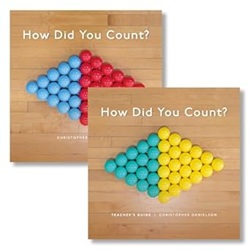
How Did You Count?

by Christopher Danielson

A Stenhouse Book (Routledge), 2025. 36 pages.
Teacher’s Guide, 2025. 135 pages.
Review written January 2, 2026, from my own copies, sent to me by the publisher.
Starred Review
2025 Sonderbooks Stand-out: #3 Children’s Nonfiction

First, my apologies to the author for not reviewing this book sooner. The publisher sent me copies of the book and teacher’s guide when they were first published, because I so loved the author’s previous books, Which One Doesn’t Belong? and How Many?.

I did order copies for my library system and talked my coworker, who selects adult nonfiction, into ordering copies of the Teacher’s Guide. I had to decide whether to write separate reviews for each book and where to put them, but I eventually decided to review the books together and post the review on my Children’s Nonfiction page.

But then I got bogged down and put off reading the Teacher’s Guide, even though I was intrigued by it. I ended up setting aside an hour to finish it off on the afternoon of New Year’s Eve, because I knew it was going to be one of my Sonderbooks Stand-outs. (And I only count books I *finish* in the previous year.) So, here, at last, is my review of this book I’m completely delighted with.

Like with his other books, as you might discern from the titles, Christopher Danielson is the master of asking kids questions that don’t have one right answer. And thus masterfully encourages children to explore and to engage in mathematical thinking.

The basic picture book here shows objects arranged in some way – rows, triangles, circles, clusters. Beside the photos, the reader is asked “How many…?” and “How did you count them?”

As usual, he starts with a simple example that helps kids understand what’s going on.

This is a book about counting, but not about right and wrong answers.
There are lots of interesting things to count. More important, there are lots of interesting ways to count them.
Once you know how many there are, count them in another way.
Turn the page to see what that means…

We see a photo of twelve tangerines arranged in a dish. The questions are asked. When you turn the page, across from the text are four smaller images of the same tangerines with lines drawn over them to show how they might have been counted.

Did you count the tangerines as four columns of three tangerines each?
Maybe you saw three zigzags of four tangerines.
Or two groups of six, or maybe you counted them one-by-one.
What other ways can you count the tangerines?

Various collections of objects follow. The most challenging to me was the tetrahedron made of basketballs. That page asked the usual questions, as well as, “Did you count any basketballs that you cannot see?”

At the back, the author says:

I made this book to spark conversation, thinking, and wonder.

It still makes my heart happy that a book about math can indeed spark those things.

Okay, all that’s in the picture book itself. I do recommend the Teacher’s Guide to elementary school teachers, to help you provoke those conversations and to start conversations with kids with genuine curiosity about their thought processes. I enjoyed the stories in the Teacher’s Guide about the conversations the author had with kids when he brought this book into classrooms.

I marked this paragraph in the Teacher’s Guide that shows the beauty of what’s going on here:

How Did You Count? is a book about structures. You can count everything in the book one-by-one. But you can also count by twos or fives, or by pairs, rows, columns, triangles, or squares. The fun is less in knowing how many there are, and much more in making and sharing new ways to know how many there are. How Did You Count? supports a virtuous cycle where the more ways you know how to count, the more new ways you can think of. All of this is in service of a rich understanding of number and operation relationships in arithmetic, which is not only a worthy goal on its own, but it also builds intuitions that support later math learning beyond arithmetic.

I love my job as Youth Materials Selector so much, it’s not often I miss working with the public. But reading the Teacher’s Guide, I got the idea for an awesome library program: Make it a Family Math program. Start by going over pictures from the book. But have a large collection of objects of various sizes and amounts. And ask the families to arrange objects to make their own “How Did You Count?” photos, and invite them to take pictures of the arrangements on their phones (or have the librarian do it for them) and submit them to the author’s website, talkingmathwithkids.com. (Since I can’t do it, maybe I can talk some of my colleagues into doing it.)

(And if that doesn’t sound like awesome, curious, exciting fun to you, I can’t help you.)

talkingmathwithkids.com
christopherdanielson.wordpress.com
routledge.com

Buy from Amazon.com

Find this review on Sonderbooks at: www.sonderbooks.com/Childrens_Nonfiction/how_did_you_count.html

Disclosure: I am an Amazon Affiliate, and will earn a small percentage if you order a book on Amazon after clicking through from my site.

Disclaimer: I am a professional librarian, but the views expressed are solely my own, and in no way represent the official views of my employer or of any committee or group of which I am part.

Subscribe for more reviews and talk about books.

Join the conversation: What did you think of this book?
Review of The Woman in the Moon, by Richard Maurer

The Woman in the Moon

How Margaret Hamilton Helped Fly the First Astronauts to the Moon

by Richard Maurer

Roaring Brook Press, 2023. 254 pages.
Review written December 15, 2025, from a library book.
Starred Review

It’s always good to read about a female mathematician who excelled in her field. Margaret Hamilton studied math in the 1950s and learned computer programming while working with the meteorologist Edward Lorenz, who discovered the Butterfly Effect in meteorology. Margaret ran his computer simulations at MIT, and later moved to the lab that worked on the computer software that would go into space with the Apollo missions. Margaret, in fact, was the person who coined the term “software engineering” to reflect that writing the computer code was as much a feat of engineering as constructing the wiring – though in fact some of that code was wired into the physical computers.

This book takes us through Margaret’s life as she was consistently the only woman in her field. It goes into lots of interesting detail about the Apollo missions, all that they were up against, and how Margaret was responsible for making the software work. An abundance of relevant photos help keep the text moving, and the whole thing captures the sense of wonder that humans actually made it to the moon – with 1960s technology.

Historians believe a key reason that American astronauts got to the Moon first (Soviet space travelers never got there at all) was America’s lead in computer technology. There were computers at the launch center, computers at Mission Control, computers at the contractors, computers at the tracking stations, and of course the miniature AGC in the spacecraft. Among all these electronic brains, the only computer that never failed was the AGC. In thousands of hours of manned spaceflight, no software errors were known to have occurred. The achievement is unique in computer history. “Nobody can believe it to this day,” Margaret noted.

Margaret was the one in charge of the software for the AGC, the Apollo Guidance Computer, which was in the command modules in flight. This was a behind-the-scenes job, so it’s good to see this entire book about her, giving some much deserved recognition (besides the Presidential Medal of Freedom she got in 2016). Now kids and teens can learn about her accomplishments.

This book is geared to a middle school audience, but there’s nothing in it that would make high school students feel it’s too young for them, so I decided to post this review on my Teen Nonfiction page instead of my Children’s Nonfiction page, even though in the library we have it as a Juvenile Biography. It’s at a much higher level than the many picture book biographies I post on that page. aLearn about the woman who wrote the software that got humans to the moon.

Buy from Amazon.com

Find this review on Sonderbooks at: www.sonderbooks.com/Teen_Nonfiction/woman_in_the_moon.html

Disclosure: I am an Amazon Affiliate, and will earn a small percentage if you order a book on Amazon after clicking through from my site.

Disclaimer: I am a professional librarian, but the views expressed are solely my own, and in no way represent the official views of my employer or of any committee or group of which I am part.

Subscribe for more reviews and talk about books.

Join the conversation: What did you think of this book?
Review of The Five Sides of Marjorie Rice, by Amy Alznauer, illustrated by Anna Bron

The Five Sides of Marjorie Rice

How to Discover a Shape

by Amy Alznauer
illustrated by Anna Bron

Candlewick Press, 2025. 48 pages.
Review written October 3, 2025, from a book sent to me by the publisher.
Starred Review

Like another book I recently reviewed, Firefly Song, The Five Sides of Marjorie Rice is a picture book biography of a citizen scientist, a woman who made a notable discovery, even though she didn’t have formal training in that field. Marjorie Rice now has a special place in my heart, because in her case, the field was math.

The biography tells us how Marjorie Rice read an article in Scientific American by Martin Gardner and then got captivated with the idea of finding more five-sided convex shapes that tile a plane. And the stellar art by Anna Bron helps make it clear to the reader what this means.

We learn how she was inspired when a new tiling was discovered – to then search for new five-sided shapes of her own that would work. And she went on to find four of fifteen pentagon types that tile the plane. (Years later, other mathematicians found two more, and then another proved that there were no more.)

This amateur mathematician’s life is especially suited for a picture book biography because her work was so visual – and the artist did a great job of using pentagon tilings throughout the book. Back matter not only tells about the pentagon discoveries after Marjorie, they also give the reader great ideas for exploring shapes, tilings, and tessellations further.

I love that this is the story of a housewife with a curious and playful mind (if perhaps a somewhat obsessive one).

Oh look! I’m ready to post this review and looked up the author’s website. She has an MFA in Creative Writing and also teaches calculus and number theory. This makes me feel like she’s a kindred spirit with me, since I have Master’s degrees in Mathematics and in Library Science – not a typical combination. This explains her excellent picture book biographies of mathematicians. I’m going to keep watching for her books.

amyalz.com
candlewick.com

Buy from Amazon.com

Find this review on Sonderbooks at: www.sonderbooks.com/Childrens_Nonfiction/five_sides_of_marjorie_rice.html

Disclosure: I am an Amazon Affiliate, and will earn a small percentage if you order a book on Amazon after clicking through from my site.

Disclaimer: I am a professional librarian, but the views expressed are solely my own, and in no way represent the official views of my employer or of any committee or group of which I am part.

Subscribe for more reviews and talk about books.

Join the conversation: What did you think of this book?
Review of Zero! The Number That Almost Wasn’t, by Sarah Albee, illustrated by Chris Hsu

Zero!

The Number That Almost Wasn’t

by Sarah Albee
illustrated by Chris Hsu

Charlesbridge, 2025. 40 pages.
Review written July 11, 2025, from a library book.
Starred Review

Fun fact: When Europeans set up the calendar we use today, they did not include a Year Zero. The year after 1 BC was 1 AD. Of course, they were given these names long, long after they happened. But because Europeans didn’t understand zero when they developed the calendar – the Twenty-first Century didn’t actually start until the year 2001. I tried to wrote a short article about this and tried to sell it to children’s magazines in 1999 and 2000, with no success. And I have to admit that switching from 1999 to 2000 feels much more momentous than switching from 2000 to 2001, even if it wasn’t actually the new century yet.

Anyway, all my thinking about when the century started sprang from the moment I learned that Europeans didn’t adopt the symbol zero or even the concept of zero until well past the Middle Ages – and that’s what this book is about.

This picture book explains the history of Zero in a way children can understand. (Yes, without touching on questions of what that means about the start of centuries.) It talks briefly about the concept of Nothing and the concept of Place Value, but it’s mostly about the history of writing numbers.

We hear about the Babylonians – who did use a place value and a mark for an “empty” place. We hear about the Greeks, who were especially strong in astronomy and geometry. The Mayans developed zero earlier than anyone else – but their knowledge was lost when Spanish invaders destroyed their records. Roman numerals came along next, which was difficult for doing complex calculations. But during the Dark Ages in Europe, mathematics thrived in India, where an unknown mathematician invented a symbol for zero.

The concept of zero spread to Baghdad, the center of the Muslim Empire – and writings from Arabic mathematicians took advantage of the concept, developing the field of Algebra.

The book chronicles all this, plus how long it took Europeans to adopt the concept. Sadly, some Christians were even then opposed to an advance of knowledge:

A few Christian leaders actually banished zero. They argued that God had created everything, so something that represented nothing must be the work of the devil.

Finally, the invention of the printing press helped the Hindu-Arabic number system spread as people came to appreciate how much it facilitates doing mathematics.

All that is present in this picture book, with engaging cartoon illustrations. There are even notes at the back about historical details present in the illustrations.

Those who read this book will get a grasp on the mind-blowing fact that Zero had to be invented, and was actually invented much later than you’d think it was. You’ll never take Nothing for granted again.

sarahalbeebooks.com
chrishsu.net

Buy from Amazon.com

Find this review on Sonderbooks at: www.sonderbooks.com/Childrens_Nonfiction/zero.html

Disclosure: I am an Amazon Affiliate, and will earn a small percentage if you order a book on Amazon after clicking through from my site.

Disclaimer: I am a professional librarian, but the views expressed are solely my own, and in no way represent the official views of my employer or of any committee or group of which I am part.

Subscribe for more reviews and talk about books.

Join the conversation: What did you think of this book?

Review of Beyond the Limit, by Joan Spicci

Beyond the Limit

The Dream of Sofya Kovalevskaya

by Joan Spicci

Tom Doherty Associates (Forge), 2002. 490 pages.
Review written June 8, 2025, from my own copy.
Originial review written September 1, 2003.
Starred Review

I’m celebrating my 25th year of writing Sonderbooks with #Sonderbooks25. My plan was to reread one book from each year’s Sonderbooks Stand-outs and post about the process. Well, things got complicated because I couldn’t confine myself to that – but the fact remains that Beyond the Limit was the one book I chose from my 2003 Sonderbooks Stand-outs to reread. And I’m writing a new review, not because that one isn’t still valid, but to include a blog post and have a review in the new phone-friendly format, while reflecting on the book after a reread.

This is still my absolutely favorite novel about a mathematician. Okay, I haven’t read a lot of novels about mathematicians – but it’s still the book I bring up any time anyone asks about mathematical books for adults, and it’s always been included on my Sondermath page.

The crazy thing about this historical novel is that it’s all true. Joan Spicci learned Russian and translated books and letters by Sofya Kovalevskaya before writing this book – and then she put what she learned into a novel. And okay, it’s not a work of nonfiction and we can’t promise she got everybody’s motivations and words correct – but oh my goodness, it’s a compelling story. And checking the Wikipedia page suggests that all the big dramatic events of the story actually happened.

The story tells the quest of Sofya Kovalevskaya to be the first woman to get a doctorate in Math. She was born in 1850, and the book begins with her a teen in Russia, studying with tutors, but not allowed to go to university at all in Russia. And she can’t leave the country without permission from her father or a husband. So her sister and a group of friends start looking for a man who will enter into a fictitious marriage with one of them, intending to sponsor the other friends as well. They find Vladimir Kovalevsky, and he agrees to enter into such a marriage with Sofya – but realizing that a fictitious marriage was considered criminal sacrilege in Russia at the time. Vladimir himself was a scientist and a publisher, having published Darwin’s books in Russian.

And then the novel shows Sofya and Vladimir falling in love. But she doesn’t dare live as his actual wife, because if she were to get pregnant, that would end any chance for studying at a university. And she faces all kinds of prejudice anyway, eventually finding a mentor who has to tutor her privately in her PhD work.

But along the way, the historical backdrop is amazing. She goes with Vladimir to London and meets Darwin and his wife. And later, her sister gets involved in the Paris commune portrayed in Victor Hugo’s work, and Sofya herself gets involved working in the hospital in besieged Paris – and her sister and her husband get arrested. This was another thing that, if it were known, could have ended her academic career.

On this second reading, I got pretty annoyed with her sister. She scorned any idea of Sofya falling in love with Vladimir – and then later married a man for love herself. But the whole novel shows us Sofya trying to please her sister, no matter how her sister treats her.

The whole story is gripping and makes me appreciate my own education much more fully – and gets you cheering for Sofya and the many obstacles she faced simply to get to exercise her brilliant mind and do mathematics. I still highly recommend this amazing historical novel.

joanspicci.com

Buy from Amazon.com

Find this review on Sonderbooks at: www.sonderbooks.com/Fiction/beyond_the_limit.html

Disclosure: I am an Amazon Affiliate, and will earn a small percentage if you order a book on Amazon after clicking through from my site.

Disclaimer: I am a professional librarian, but the views expressed are solely my own, and in no way represent the official views of my employer or of any committee or group of which I am part.

What did you think of this book?

Review of My Mechanical Romance, by Alexene Farol Follmuth

My Mechanical Romance

by Alexene Farol Follmuth
read by Amielynn Abellera and Christopher Salazar

Recorded Books, 2022. 8 hours, 46 minutes.
Review written December 14, 2023, from a library eaudiobook.
Starred Review
2024 Mathical Book Prize Honor Book, ages 14-18

My Mechanical Romance is a super fun high school romance tale about a new girl named Bel who turns out to be good at robotics. After her thrown-together egg drop project is the best performer of her class, her teacher says her grade won’t get docked if she tries out for the robotics team and joins AP Physics.

Teo is captain of the robotics team and captain of the soccer team, too. He begrudgingly allowed auditions for the team, even though they already have enough seniors. When Bel wows them with an again thrown-together project, she gets a spot on the team, even though the only other girl on the team doesn’t think she knows what she’s doing.

Bel and Teo start getting to know one another in a lovely slow-burn romance. Bel’s switched schools her senior year because of her parents’ divorce. Teo’s dad is a high-powered software developer, and Teo takes for granted the weight of their expectations.

I did not like the voice the narrator used for Bel’s best friend, a Valley girl accent. But since the book takes place in the San Fernando Valley, where that accent came from, I probably shouldn’t complain.

I loved the portrayal of what women in STEM are up against. I didn’t like, though, that a couple times Bel called herself “not a math person.” Usually I’d think math and robotics go together, and Bel’s taking Calculus, so I wish she’d gotten a little pushback for that. Bel’s portrayed as learning about robotics from tinkering with machines in her dad’s workshop and building and welding things since she was small, so it’s more of an intuitive sense of mechanics. Not to give spoilers, but I loved the way the book ended, too, and the portrayal of adjusting future plans with an epilogue set two years later.

I listened to this book on a Sick Day when I was getting obsessive about a jigsaw puzzle and listened to the whole thing in one day. Completely delightful. And go, women in STEM!

alexenefarolfollmuth.com

Buy from Amazon.com

Find this review on Sonderbooks at: www.sonderbooks.com/Teens/my_mechanical_romance.html

Disclosure: I am an Amazon Affiliate, and will earn a small percentage if you order a book on Amazon after clicking through from my site.

Disclaimer: I am a professional librarian, but the views expressed are solely my own, and in no way represent the official views of my employer or of any committee or group of which I am part.

What did you think of this book?

Review of Violet and the Pie of Life, by Debra Green

Violet and the Pie of Life

by Debra Green

Holiday House, 2021. 279 pages.
Review written December 13, 2023, from a library book.
Starred review
2024 Mathical Honor Book, Ages 11-13

When Violet’s best friend Mackenzie wants to try out for their middle school’s production of The Wizard of Oz, Violet only joins in because it would be fun to go to rehearsals with Mackenzie. Never mind that Ally, the popular girl Mackenzie says is terrible, does a wonderful audition for Dorothy.

But when Violet gets the part of the Cowardly Lion, and Mackenzie gets the part of a flying monkey, Violet has to decide if she’ll stick with it when her friend quits. And would it be disloyal to be friends with Ally, who really doesn’t seem so bad?

Meanwhile, while Violet’s navigating all this friendship stuff, her parents fight and her Dad moves out. And doesn’t answer her emails. Maybe now she has a part in the play, she can get both her parents to come and remember how much they love each other.

Through all of this, Violet looks to math as something she can count on. The pages of this book are filled with charts she makes, laying out the problems of her life like math problems — from a chart of the intensity of her parents’ fights to flow charts of her plans to email her Dad. I especially liked when her affinity for math helped her quickly understand how much commission her realtor Mom would make after selling a home in Laguna Beach.

This kids’ novel is no math text book, but it’s math-friendly, featuring a middle school kid with relatable problems who thinks in mathematical ways.

HolidayHouse.com

Buy from Amazon.com

Find this review on Sonderbooks at: www.sonderbooks.com/Childrens_Fiction/violet_and_the_pie_of_life.html

Disclosure: I am an Amazon Affiliate, and will earn a small percentage if you order a book on Amazon after clicking through from my site.

Disclaimer: I am a professional librarian, but the views expressed are solely my own, and in no way represent the official views of my employer or of any committee or group of which I am part.

What did you think of this book?

Review of Logicomix, by Apostolos Doxiadis and Christos H. Papadimitriou

Logicomix

An Epic Search for Truth

by Apostolos Doxiadis and Christos H. Papadimitriou
art by Alecos Papadatos and Annie Di Donna

Bloomsbury, 2009. 344 pages.
Review written May 12, 2025, from a library book.

Logicomix is a graphic novel fictionalized biography of Bertram Russell – but complete with a detailed explanation of the quest for a logically consistent foundation of mathematics – culminating in Kurt Gödel’s Incompleteness Theorem.

As an undergraduate math major and a graduate student in math, I had a general idea of all this, and reading it now, I appreciated the specifics and the introduction to the people (all white men) who worked on those foundations. Something about having it all laid out in a graphic novel helped me understand the people and their quest and the interactions.

The story isn’t necessarily a pretty one. Russell had four wives, and the first one was given a “rest cure” after she realized he was falling in love with his best friend’s wife. I’m not sure I appreciated all the talk of mathematicians, or at least logicians, being prone to insanity, nor the dismissal of the children of logicians who had schizophrenia. But these were real people’s lives and that shows they didn’t clean it up for the twenty-first century.

So I do think those who will find the book most interesting are those who are interested in the quest for a provable foundation of mathematics – and how that quest was stymied. But I am one of those people, and I enjoyed this book.

Buy from Amazon.com

Find this review on Sonderbooks at: www.sonderbooks.com/Nonfiction/logicomix.html

Disclosure: I am an Amazon Affiliate, and will earn a small percentage if you order a book on Amazon after clicking through from my site.

Disclaimer: I am a professional librarian, but the views expressed are solely my own, and in no way represent the official views of my employer or of any committee or group of which I am part.

What did you think of this book?

Review of 365: How to Count a Year, by Miranda Paul & Julien Chung

365

How to Count a Year

by Miranda Paul & Julien Chung

Beach Lane Books, 2023. 44 pages.
Review written October 26, 2023, from a library book.
Starred Review

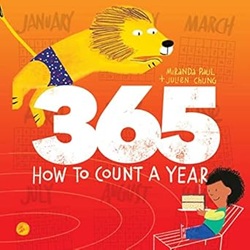
365 is a wonderful kid-friendly picture book about different units of time and how many of them make up a year. It’s bright and colorful and gives examples that will make kids laugh.

The start is basic:

It takes the Earth 365 days to spin around the sun.

But the book quickly gets more creative:

That’s 365 “Good mornings,”

365 “Good nights,”

and, hopefully, 365 clean pairs of underwear.

Then it goes on to talk about things that might happen 52 times in the 52 weeks of a year.

And next are groups of 12 things that happen monthly. Like cleaning the fish tank or getting a magazine.

And if 365, 52, and 12 are too big for you, it all comes back to 1 year, which, of course, is best measured in birthdays.

But that’s not all!

And right after that party is over,
you’ll probably start asking …

how long until next year’s celebration?

The answer —
8,760 hours —
might seem like forever.

And then they go on to minutes and seconds in a year.

A spread at the end tells us:

But the good news is that you can group those
seconds into minutes and minutes into hours and hours into sunsets and sunrises and good mornings and good nights and clean (or dirty) underwear, flavors of the day, Friday night spills, or Saturday sleep-ins, so the countdown simply becomes…

1 marvelous collage of 1 year in the life of you.

How will you count your year?

It’s all colorful and fun and directly relates the somewhat abstract concept of time to kids’ lives. There’s a bonus page at the back telling how much time or how many times certain things happen in a year.

A beautiful introduction to the mathematics of time for young children.

mirandapaul.com
julienchung.com

Buy from Amazon.com

Find this review on Sonderbooks at: www.sonderbooks.com/Childrens_Nonfiction/365_how_to_count_a_year.html

Disclosure: I am an Amazon Affiliate, and will earn a small percentage if you order a book on Amazon after clicking through from my site.

Disclaimer: I am a professional librarian, but the views expressed are solely my own, and in no way represent the official views of my employer or of any committee or group of which I am part.

What did you think of this book?

Review of Patterns Everywhere, by Lisa Varchol Perron

Patterns Everywhere

by Lisa Varchol Perron

Millbrook Press, 2023. 32 pages.
Review written November 22, 2023, from a library book.
Starred Review

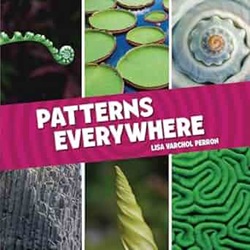
Patterns Everywhere is a beautiful nonfiction book for primary-grade kids that will get them noticing many kinds of patterns in nature.

Each spread is dominated by a large photograph of something in nature, a simple rhyme about it with the rhyme scheme AABB (another pattern!) and a factual paragraph with more detail. It’s attractively presented and shows a wide variety of things. Here’s the introductory first spread:

Step outside. Let’s find designs —
branching, cracking, spirals, lines.
Search the earth, the seas, the air.
Patterns, patterns everywhere.

WHAT IS A PATTERN?
A pattern is a sequence that repeats in a predictable way. Nature is full of them! Some of nature’s patterns are made of repeating geometric shapes. Other patterns are created by color or spacing.

The spreads after that show leaf veins, ridges and valleys, sand dunes, meandering rivers, corals, wave ripples, sea foam, layered earth, basalt columns, snowflakes, mud cracks, and spiral plants and animals. There are two pages of more information at the back, including some activities.

This is a simple introduction to patterns, attractively presented, and will open kids eyes to the patterns around them.

lisaperronbooks.com
lernerbooks.com

Buy from Amazon.com

Find this review on Sonderbooks at: www.sonderbooks.com/Childrens_Nonfiction/patterns_everywhere.html

Disclosure: I am an Amazon Affiliate, and will earn a small percentage if you order a book on Amazon after clicking through from my site.

Disclaimer: I am a professional librarian, but the views expressed are solely my own, and in no way represent the official views of my employer or of any committee or group of which I am part.

What did you think of this book?