When she was introduced to Orson Welles, Hollywood’s erstwhile prodigy remarked “Hmm. Bea Benaderet. It sounds like something you ad lib in a mob scene.”
Well, at least she didn’t finish her career bloated and trading on her reputation hawking wine on commercials.
 Last week, you read a post here about the voice of Wilma as we approach the 50th birthday of The Flintstones. It wasn’t my intention to do a post on the voice of Betty, Bea Benaderet (accept no substitutes). Most of the material that’s out there deals with her career on Petticoat Junction and her work in animation got only a cursory mention in her lifetime (and only referred to her work at Hanna-Barbera). But Bea always brought a smile whenever I saw her on TV and perhaps there are readers not too familiar with her that may want to know a bit more.
Petticoat Junction was the reward for Bea’s lengthy career as a top-tier supporting player on radio and television. It’s so unfortunate it was cut short. Cigarettes followed her from the cradle to the grave. Her father was a tobacconist in San Francisco. She was a heavy smoker and died of lung cancer. In between was a steady career, on stage, on radio, then on television.
There was a time in radio, now forgotten, when the U.S. west coast was the home of many fine regional programmes with lots of home-grown talent. The famous network shows with big stars were all in New York or Chicago. When technology made it feasible for them to pick up and move to Los Angeles in the mid-‘30s, they killed the big regional shows. Bea achieved fame in that era. K.L. Ecksan profiled her in his newspaper’s radio page on September 1, 1935: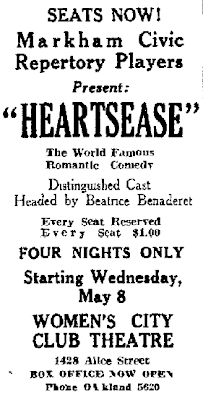
BEA BENADERET, radio comedienne, singer, character actress and mimic, refuses to trade pennies for silver and never wears a pearl necklace when broadcasting.
She joined KFRC and the Columbia-Don Lee network in 1929 and has taken part in every important air show, including the Blue Monday Jamboree, Hodge Podge Lodge, Little Theater of the Air, Happy-Go-Lucky Hour and Feminine Fancies.
Her first professional stage appearance as at the age of 16 in the role of a French maid in “Prince of Pilsen.” Radio caught up with Miss Benaderet in 1926 when she first appeared on a station in Melrose, California.
“I am still very much ‘mike’ conscious and usually have a terrible time trying to keep my script from sounding like a ‘storm at sea,’” she said, continuing to review her radio career.
As might be expected, Miss Benaderet attributes the generosity of her parents in “sacrificing something they may have needed themselves,” as she expresses it, in order that she might study the two things in which she was principally interested—drama and music.
Her early education was procured in New York and her professional debut made on the Pacific Coast.
She does not consider herself an excellent swimmer, although keenly fond of the sport; is favorably inclined towards cooking, is not married, loves new clothes, and the bigger the crowd in the studio to watch, the better she likes it.
And, strange to say, she’s mechanically inclined, although she never tried to assemble a radio transmitter or build a bridge,
Her cartoon voice work began in those wonderful theatrical days at the best studio ever created, Warner Bros. (né Leon Schlesinger Productions). Starting in the mid-‘30s, Warners hired several women on a regular basis to voice incidental adult female characters. Elvia Allman (a star on Blue Monday Jamboree) was the first, followed by dialectician Sara Berner. During the war, Bea Benaderet seems to have displaced Sara, an oddity considering the two of them appeared side-by-side on the Jack Benny radio show as telephone operators starting in the 1945-46 season. Bea also worked opposite Mel Blanc on that show as husband and wife, appropriate considering they did it all over again as Barney and Betty Rubble. One of my favourite Benny Christmas radio shows is when Jack drives Mel nuts, wife Bea takes over for him and Jack drives her nuts, too. She really let loose, far more than she ever normally got to on Benny’s show, or The Flintstones for that matter.
 At Warners, her main role was the original voice of Granny, but her role I enjoyed the most was the screechy, annoying Red Riding Hood belting out ‘The 5 O’Clock Whistle’ in Little Red Riding Rabbit (1944). Her last cartoon was The Hole Idea, Bob McKimson’s pride and joy released in 1955 (on-line sources claiming she is in Goo Goo Goliath and From A to Z-Z-Z-Z are incorrect). Whether her television work precluded her from continuing in cartoons is unclear but June Foray began appearing in releases in 1954 and quickly took over as the studio’s primary female voice artist.
Turnabout is fair play, it seems. June voiced Betty Rubble in a short ‘Flagstones’ demo reel but Joe Barbera decided not to keep her and hired Benaderet for the role instead. Either would have been a fine selection. At the time, Bea was playing a Swedish maid on the sitcom ‘Peter Loves Mary’ (which didn’t have quite the longevity of The Flintstones). By an odd coincidence, the maid was named Wilma. And another character was an agent played by a chap named Alan Reed. While she was happy to get the part because it provided steady work, she had just come from another comedy and seems to have had regrets about typecasting and the limits it placed on her career. At the time, she said:
“You'd be amazed at how many parts I lost while I was with Burns and Allen because people were afraid of my identification with that show. There were any number of parts I didn't get because people thought I’d automatically get laughs in anything I did.”
One wonders if her instant recognition on camera was behind her decision to return to cartoons. She was first hired by ex-radio actor Jerry Hausner at UPA for the TV version of Mr. Magoo. Charles Witbeck referred to her Hanna-Barbera work at the end of his syndicated column of July 28, 1963, in a lengthy piece about Junction.Bea still puts in an average 4½ hours a week as the voice of Betty Rubble on the animated cartoon series “The Flintstones.” Working by storyboard, the cast records at night, and by the time September rolls around at least half of the shows will be done, so Miss Bea won’t be working herself to death.
We’ll return to that thought in a moment.
Columnist Alan Gill had this about Bea on July 29, 1963. Cartoons? Apparently they don’t count for anything.Oil Wells to Gold MinesA man named Paul Henning struck oil this season when he created a series about a family of backwoods folks who found oil on their property (“The Beverly Hillbillies”).
Next season the man may come up with pure gold when he introduces a situation comedy about a widow woman and her three teen-age daughters who have been given a totally worthless gold mine (“Petticoat Junction”).
I dropped in on the star of “Petticoat Junction” during her visit to New York the other day, just to see whether there was any gold dust in her hair.
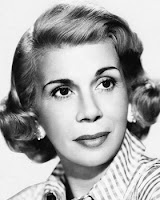
HER NAME is Bea Benaderet (pronounced Be-ne-DARE-ret and it’s Spanish); you know her best as Cousin Pearl in the “Hillbillies” and her hair is dazzlingly golden.
All her talk, though, was about Henning.
“I worked with Paul for years, on the Burns and Allen program and “The Robert Cummings Show” and let me tell you Paul Henning never forgets you,” she said.
“He had me test for Granny on ‘Hillbillies,’ which I knew was a heck of a part. But one look at Irene Ryan and I said, ‘Bye,’ Oh, Irene was so much greater in it than I could be. Paul said, ‘Well here’s Cousin Pearl, then.’ And he said, ‘Bea, I’m gonna do something for you some day.’”
THERE ARE OTHER people Henning hasn't forgotten, either. “Petticoat Junction’s” story editor is Don Quinn who, when he was writing “Fibber McGee and Molly,” gave Henning his first job and wrote in a young radio actress named Bea Benaderet as Mrs. Carstairs.
“Junction” is being filmed on the same stage that Burns and Allen used for six years and the producer—then and now—is Al Simon.
But Bea’s career antedates her meeting with Henning. A New Yorker by birth, she was brought up in San Francisco, was acting in the theater at 12, was singing in her late teens, and then exploiting her talent for dialect on radio. Radio kept her busy—“too busy to do movies, and I hope that doesn’t sound braggy,” Bea said.
WHEN the Burns and Allen TV show spent some time in New York, Miss Benaderet commuted by plane from the West Coast, where she had three radio assignments keeping her on the run.
In a New York hotel room one day, George Burns said, “Don’t open the window. Bea’ll fly out.”
Today, Bea’s life is circumscribed only by a ranch home outside L.A., a son, 23; a daughter, 16, and “Petticoat Junction.”
Where does the series take place?
“Wherever you want it to be,” she says, “a nostalgic, restful place, where the dialect isn’t too strong. I say things like, ‘We’re goin’ t’ town, me and my daughters.’ That’s not so country, is it?
“EDGAR BUCHANAN plays Uncle Joe and you’ve got to watch him like a hawk. I’m Kate Bradley, and Henning has made her a woman of warmth, humor and dignity. He based her on a lady he knew back in Independence, Mo., where he was raised.
“I run a small hotel on the spur line of the most adorable little railroad you ever saw, operating between Hooterville and Pixley. It’s an ancient, narrow-gauge affair they found up around Sonora and it’ll do 25 miles an hour tops.
"The railroad owners hardly know it exists and they keep sending around an irascible agent named Charlie Lane to check. Our hotel caters to the salesmen who are its passengers.
“We’re so out of the way, we’ve got our own well and our own generator. But the generator isn’t enough to make the elevator work—one of those old cage elevators—so we keep a mynah bird in it.
IS BEA BENADERET thrilled at being a star for the first time?
"Well,” she says, “I’m happy to get to wear nice, simple, becoming clothes for a change. The stuff I wore as Cousin Pearl I picked up at the Salvation Army for 75 cents.”
Besides, what woman can resist the glamour of stardom? When Hollywood decorates its sidewalks with bronze stars and the names of the great a few years ago, Bea heard from a friend that he was “so happy to see your star on Barnes St.”
Bea’s husband sped off in the car to have a look and reported that it was in front of the Huntingdon Hartford Theater.
The next day, Bea went over alone, parked the car a half block away, walked around the star once, walked back to the car and sped off.
And here’s what Hal Humphrey, syndicated through the Los Angeles Times, had to say in his column of July 21, 1963:Bea Heads for HillsYears ago in San Francisco the producer of a stock company doing “The Witch” shouted angrily at one of his cast, “If you don't think you can be replaced, you’re crazy!”
It turns out that he couldn’t have been more wrong. The object of his temper was a girl with the odd name of Bea Benaderet. Since then, Bea not only has never been replaced, she has never quit working.
The longest Bea is out of work is the time it takes her to pick up the telephone and tell her agent she is available. During a 20-year stint on radio and TV with Burns and Allen, Bea was next-door neighbor Blanche Morton. Six different actors had the husband role (Harry Morton), but it never occurred to George Burns to replace Bea.
Whenever anyone asked Bea if she wasn’t tired of being Blanche, her answer was, “I get down on my knees and thank God every time I play the role — it’s steady work, and any actor who discounts this is crazy.”
After Burns and Allen retired from TV, Bea took on two jobs — Wilma the housekeeper for the one and only season of “Peter Loves Mary” (Peter Lind Hayes and Mary Healy) and the voice of Betty Rubble in “The Flintstones.”
Along with “The Flintstones” and a series of other odd jobs, Bea bridged the gap until Paul Henning asked her to test for the role of Granny in “Beverly Hillbillies.” Irene Ryan got that part but Paul created Cousin Pearl Bodine for Bea.
“I know Paul from the days when he was a writer for Burns and Allen, and he always said, ‘Bea, someday I’m going to have a show for you.’ and now, by golly, he has,” says Bea, still with a tone of surprise in her voice.
Bea refers to “Petticoat Junction,” in which she stars as Kate Bradley, owner of the Shady Rest Hotel. Filming already has begun on this newest Henning production for next season, but Bea still can’t acclimate to her new status.
“Maybe I don't think I am a star; maybe it’s as simple as that,” she says, trying to explain her lack of reaction.
Or, is it possible that Bea still hears the ringing reprimand of that Simon Legree in San Francisco who threatened to replace her?
Despite her solid talent as a comedy character and a professional background that won’t stop, Bea is no ham. She is a realist, and she knows jobs for actors don’t always depend on their talents.
Also, when you’re the so-called star of a TV series, it’s like being the lead duck flying over a marsh ambushed with hunters on opening day. The sponsors, the network, the producer and the rest of the cast are all watching intently. If that first audience rating isn’t a good one, it’s your fault.
As the next-door neighbor, housekeeper or squeaky voice of a cartoon character, Bea is smart enough to know that she has the protective camouflage of the “dependable second lead,” who occasionally can steal a scene, then run for cover again.
At least one thing she won't have to worry about in her new role is a dialect. Kate, of Shady Rest, is just plain American. Shady Rest is a town 150 miles from anything and very rural.
“I had a tough time with the hillbilly dialect for Cousin Pearl,” says Bea. “But my son, Jack, helped me a lot. He’s a fine dialectician.”
Meanwhile, Bea keeps practicing the Brooklyn accent of Gertrude Gearshift, the flip telephone operator who pops up every so often on Jack Benny’s show. That’s another job Bea has had for the past 20 years.
Cartoon husband Mel Blanc was left on death’s door after a smash-up on a winding stretch of road in 1961. Bea had her own mishap, a far less serious one, but whether it kept her away from the Flintstone microphone is unclear. From September 13, 1963:Actress Breaks Leg In Accident
LOS ANGELES (AP) — Actress Bea Benaderet, known to television viewers as Cousin Pearl on the “Beverly Hillbillies” show, broke her leg Thursday when she tripped on a camera cable.
Miss Benaderet, 42, also injured both wrists in the fall.
The accident occurred while she was working on a segment of her new show, “Petticoat Junction,” to be released this fall on CBS.
Her role on the show brought her a Genie Award in 1966 from The Radio and Television Women of Southern California as outstanding woman in TV. And, as a side note, in 1961 she was honoured by the National Good Neighbors for her work with Welcome Wagon in the San Fernando Valley.
As we mentioned earlier, Bea had cancer. She took some time off from Petticoat Junction, although producers tried to make it appear she was on the show by using her voice with only the back of her character’s head seen. It looked tacky. She returned to the show and news in this wire service dispatch of February 8, 1968 looked promising.Bea Benaderet's Tumor DissolvedSTUDIO CITY, Calif. (AP) — Bea Benaderet, television star of “Petticoat Junction,” was home Wednesday after five weeks of radiation therapy in Stanford Medical Center cancer of the lung.
X-ray examinations indicate the tumor is dissolved, doctors said.
“Since you enjoy working so much, go back to it and prepare to live,” she was told by Dr. Joseph Kraut of Stanford’s department of radiology.
The actress said she wants to “put my house in order” before returning to television work next Tuesday.
Putting her house in order was an eerily appropriate choice of words. She filmed five more segments before returning to hospital.Bea Benaderet, Star Of Films, Radio, TV, Dies Of Lung Cancer
HOLLYWOOD, OCT. 13 (AP) — Bea Benaderet, matriarch of television’s “Petticoat Junction,” is dead at 62 — the victim of pneumonia and lung cancer.
The blonde, brown-eyed actress was starting her sixth season playing Kate Bradley. She had filmed five episodes for the current run when she was forced to return to the hospital Sept. 26.
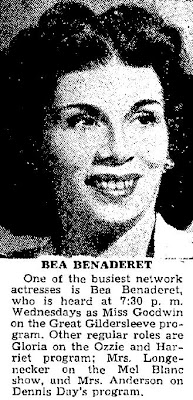
The vivacious performer underwent radiation treatment last year at the Stanford Medical Clinic in Palo Alto for a lung tumor.
Upon her release, Miss Benaderet told a newsman, while recuperating at Palm Springs—“Every day is beautiful to me ... I feel fine, better than I have felt in years.”
She died Sunday in Good Samaritan Hospital in Los Angeles.
Prior to top casting as the quick-tongued mother in “Petticoat’s” Hooterville, Miss Benaderet was Blanche Morton, wife of fastidious Harry Morton, next door neighbors in the long run of the “George Burns and Gracie Allen Show.” In this part, she excelled in repartee.
Another vehicle, “The Beverly Hillbillies,” featured her as cousin Pearl Bodine—mother of Jethro—in the first year of that show. Then the creator of the Hillbillies—Paul Henning—chose her as the operator of the Shady Rest Hotel in his “Petticoat Junction.”
Much of her early success derived from her talent at dialect. She was a part of the vocal cast of the TV cartoon show, “The Flintstones,” and played many other roles on radio and television.
She was Gertrude Gearshift, who spoke Brooklynese, telephone operator on the “Jack Benny Program”; Amber Lipscott on “My Friend Irma;” the maid, Gloria, on “The Adventures of Ozzie and Harriet;” Eve Goodwin on “The Great Gildersleeve” and Mrs, Carstairs on “Fibber McGee and Molly.”
A public funeral is planned.
She leaves her husband, sound technician Gene Twombley; a daughter, Margaret Kilfoil, 20; a son, Jack, 27, and a granddaughter.
The family home is at suburban Studio City.
Twombley, who had been Jack Benny’s sound effects man on radio, died of a heart attack four days later. He was 52.
Back to The Flintstones...
 Bea’s career at Hanna-Barbera came to an abrupt stop in 1964. It’s natural to assume either her health turned bad or she was just too busy with Petticoat Junction. But you read earlier Bea was doing the live action show by day and the cartoon at night and there was no difficulty. And she was certainly healthy enough to carry on with the grind of starring in a top-rated rural comedy for a few more years.
 No, it turns out that her departure wasn’t her own idea. On a recent broadcast on Shokus Internet Radio, cartoon writer Earl Kress revealed that Bea discovered she wasn’t being called for voice sessions any more. She called to find out why. It turns out she had been replaced by Gerry Johnson, a virtual unknown who, if we can be euphemistic, caught the eye of one Joe Barbera. Bea’s vocabulary included words that were more Slim Shady than Shady Rest. It’s perhaps safe to assume she unloaded a few of them on a real-life Uncle Joe to express her opinion of his hiring choices before a final adieu.
In the end, Bea carried on doing what she loved in the old “the show must go on tradition” until she could do it no more. Even Orson Welles could appreciate that.