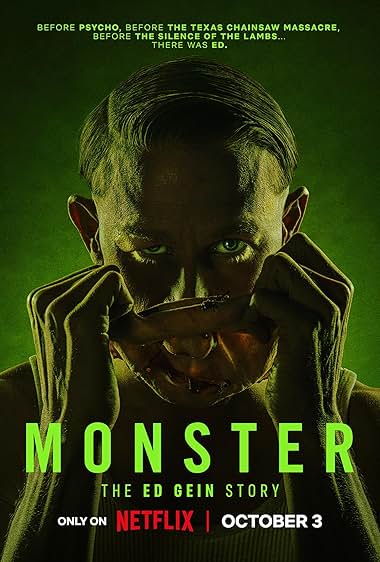

Eine Anthologie-Serie, Von die Geschichten des kannibalistischen Serienmörders Jeffrey Dahmer und der verurteilten Mörder Lyle und Erik Menendez konzentriert.Eine Anthologie-Serie, Von die Geschichten des kannibalistischen Serienmörders Jeffrey Dahmer und der verurteilten Mörder Lyle und Erik Menendez konzentriert.Eine Anthologie-Serie, Von die Geschichten des kannibalistischen Serienmörders Jeffrey Dahmer und der verurteilten Mörder Lyle und Erik Menendez konzentriert.
- 2 Primetime Emmys gewonnen
- 18 Gewinne & 81 Nominierungen insgesamt
Folgen durchsuchen




Zusammenfassung
Reviewers praise 'Monster' for its gripping storytelling, strong performances, and deep psychological exploration. However, it faces criticism for inaccuracies, narrative liberties, and a focus on shock value. Ethical concerns about dramatizing true crime and its impact on victims' families are also noted. Despite these issues, the series is often praised for its compelling character studies and the complex moral questions it presents.
Empfohlene Bewertungen
I knew very little about the Menendez brothers. I knew about the killings and about the molestation defense. But that's about it. The luridness of the story kept me at a distance but now, in this compelling Ryan Murphy series I was hooked from the very first episode. I could watch it as a work of fiction but the fact that it was a true story made me look back and read about it. Oh my God! There are no likeable characters in this saga but really good performances and that's enough to keep you glued to it. And here I discovered Cooper Koch as Erik Menendez. He took over my senses from beginning to end, including the episode that is just him. Superb performance and the humanity he finds in his monster makes you want to rethink the whole thing and believe them/him. He will make re-watch the series again, soon.
For those interested in the psychology of a serial killer, there is no more fascinating character study than Jeffrey Dahmer. He was a psychiatric enigma and a profoundly sick individual. A chronic alcoholic from a very young age. A sexual deviant with all manner of unusual fetishes. A necrophiliac. A cannibal.
A pure psychopath and the product of a perfect storm of schizotypal/borderline personality disorder, developmental toxicity (exposure to psychoactive drugs in utero), negative parental influence, neglect and childhood trauma, a morbid curiosity with the macabre, social exclusion at school and deep feelings of loneliness, sexual confusion and insecurity.
He longed to be cared about and loved by his family. He longed to be accepted by his peers. But, at the same time, knew deep down that he would inevitably disappoint his parents because of his inability to live a normal life and that he wouldn't be accepted by friends due to his odd personality.
We all tend to seek out like-minded people and make connections with those we have something in common with. The problem was that Jeffrey knew there wasn't anybody out there with the same interests or outlook as him. Left to his own devices by absent parents and socially isolated, he became increasingly withdrawn and followed a path of introversion and solitude.
He must have felt like he didn't belong in this world, and that there wasn't a place for him within society, so he abandoned all attempts to participate and pursued a voyeuristic way of life. He lacked a clear or positive self-image, meaning his perspective of other people was skewed, which resulted in him fully embracing his warped perception of pleasure and satisfaction. The men he felt attracted to were purely sex objects to him; walking, talking sex dolls. His interest was solely in their aesthetic, or physical appearance.
He appeared to have been a deeply troubled soul from the outset and his behaviours were predominantly a consequence of his genetic constitution, exacerbated by negative life experiences. If his childhood had been a more positive one then he may have been able to adapt better to his personal limitations and dysfunctions, but there is no way of knowing the extent of the damage his upbringing had on him.
It was evident from his own admissions that he felt predestined to live a peculiar and unorthodox lifestyle due to his innately bizarre persona. The conventional joys of life simply didn't float Jeffrey's boat.
I rarely, if ever, feel sorry for multiple murderers, especially ones who commit such heinous and sickening crimes as Dahmer. But I have to admit that I found his story to be tragically sad.
My usual take away from accounts of serial killers is wondering how and why someone could do that to another human being over and over again!? In Dahmer's case, I am left feeling conflicted with a strange understanding of, and empathy for, his actions. Of course I'm not condoning what he did, but I can appreciate how and why the sequence of events transpired.
In his televised interviews he was so open, frank and forthcoming which is exceptionally rare for someone in his situation. He came across as a gentle, thoughtful and articulate person who was genuinely tormented by his inner demons throughout his life. He freely admitted to his crimes in detail, demonstrated that he knew what he had done was evil and offered honest explanations for his actions. He wanted to pay the ultimate price for his sins, resisting advice to make a plea of insanity, and took personal responsibility for the choices he made.
The good part of him wanted to change and stop what the bad part had started, but he required external intervention to do so. The urges and compulsions that controlled him became an obsession and his psychosis led him down a progressively irreversible path that was impossible to resist. The dark side had an unrelenting grip on him.
My personal opinion is that he was clinically insane, due to a combination of psychiatric disorders, but at the same time I feel a legal judgement of insanity would have been an insult to the families of Dahmer's victims and an inadequate penalty for such a fiendish series of killings.
If you listen to him describe how he felt during his childhood and adolescence, it's clear that he should have been under the watchful eye of mental health professionals from an early age. His mother was so wrapped up in her own mental illness and his father preoccupied by work that he didn't receive the emotional support, medication and therapy he desperately needed. This was inexcusable given that both parents were acutely aware of their own emotional problems and the likelihood that these had been passed onto their son.
I can't help but feel pity for Dahmer, and also that the casualties of his maniacal way of life were preventable.
Between his mid-teens and early twenties he was basically a "walking cry for help" but nobody seemed to pay attention, try to understand him or find out what was wrong. In any case, because of the appalling and unspeakable nature of Dahmer's fantasies, it's unlikely that he would have felt able to share them with anyone, even those in a medical capacity. This would've made him feel trapped and that he might as well turn his fantasies into a reality because there was nobody to confide in and no way out of his spiralling mental condition. Like a lost cause.
I mean here was a guy who felt completely alone in the world. A total and utter misfit. So reckless and uncaring about what other people thought of him, making absolutely no attempts whatsoever to conform to social norms. A loner without even a rudimentary inclination or understanding of how to make friends, relate to others or find a romantic partner. He didn't seem to know what to look for or what he wanted in a partner. His perverted version of attachment and sexual arousal didn't allow him to.
I suppose all he had experienced was watching his parents at constant loggerheads and in a loveless marriage. This would have left him detached, emotionally stunted and unaware of how to express love and affection. I suspect realising that you're homosexual is a troubling and confusing time for anyone. But for someone like Dahmer, who was mentally unhinged and devoid of emotional support, it was a major dilemma and yet another psychological obstacle to contend with.
He was given such an unstable start to life by bickering, neglectful parents who appeared to be unwilling to put their children's welfare first. This obviously had a massively detrimental impact on his self-esteem and sense of security, leading to an intense fear of abandonment. Hence his preference for duping his victims into spending time with him and then incapacitating them so he could enjoy their company without that fear of rejection. That way he could exercise total control over their lifeless bodies and indulge in his fetishes to his heart's content without contest.
I expect he sank to unimaginable depths of depravity during those private moments, searching for the unachievable, ever-fleeting sense of fulfilment and satisfaction that he desperately wished to hold on to and savour.
I've read quite a lot about Dahmer online, watched a number of interviews and the brilliant film 'My Friend Dahmer'. Evan Peters portrays him with a seemingly effortless and convincing performance that is heavily nuanced and intensely creepy. He absolutely nails the flat affect, monotone voice and distinct lack of emotional expression typical of most psychopaths.
He really conveys the emptiness Dahmer had in his soul; the numbness, subdued anger and sexual frustration which engulfed him. He truly embodies Dahmer and was perfectly cast in this role.
Technically speaking this series is very well researched, skilfully put together and held my undivided attention throughout. The acting by the whole cast, especially Richard Jenkins as Lionel, is first class. The tone is pitched perfectly for such a grim and sordid story. The directors create numerous moments of highly suspenseful and tense drama including some horrifying, darkly-intimate and cringe-inducing scenes, but these are needed to tell the story of Dahmer's debauchery in full.
Episode 6 "Silenced" in particular is an exceptional and highly original piece of screenwriting with some of the most absorbing television I've seen for a long time. It was like a mini-masterpiece of melodrama.
I really feel the writers got inside the mind of Dahmer, not only giving us the facts of what happened but allowing us to feel what it was like to see things the way he did. There are a number of minor adjustments or expansions to the narrative, but equally some omissions in order to make the content more palatable for the viewer. None of this affects the credibility of the series in my opinion as we are given ample opportunity to form a mental image of what happened from the point of view of all parties concerned.
Despite having read up on the subject matter beforehand, and knowing how the events of his life unfolded, this excellent series has a real edginess and provides a fresh, unflinching and comprehensive account of the disturbing life of Jeffrey Dahmer.
If like me you're fascinated by how a monster like Dahmer is formed, you're in for a real treat.
A pure psychopath and the product of a perfect storm of schizotypal/borderline personality disorder, developmental toxicity (exposure to psychoactive drugs in utero), negative parental influence, neglect and childhood trauma, a morbid curiosity with the macabre, social exclusion at school and deep feelings of loneliness, sexual confusion and insecurity.
He longed to be cared about and loved by his family. He longed to be accepted by his peers. But, at the same time, knew deep down that he would inevitably disappoint his parents because of his inability to live a normal life and that he wouldn't be accepted by friends due to his odd personality.
We all tend to seek out like-minded people and make connections with those we have something in common with. The problem was that Jeffrey knew there wasn't anybody out there with the same interests or outlook as him. Left to his own devices by absent parents and socially isolated, he became increasingly withdrawn and followed a path of introversion and solitude.
He must have felt like he didn't belong in this world, and that there wasn't a place for him within society, so he abandoned all attempts to participate and pursued a voyeuristic way of life. He lacked a clear or positive self-image, meaning his perspective of other people was skewed, which resulted in him fully embracing his warped perception of pleasure and satisfaction. The men he felt attracted to were purely sex objects to him; walking, talking sex dolls. His interest was solely in their aesthetic, or physical appearance.
He appeared to have been a deeply troubled soul from the outset and his behaviours were predominantly a consequence of his genetic constitution, exacerbated by negative life experiences. If his childhood had been a more positive one then he may have been able to adapt better to his personal limitations and dysfunctions, but there is no way of knowing the extent of the damage his upbringing had on him.
It was evident from his own admissions that he felt predestined to live a peculiar and unorthodox lifestyle due to his innately bizarre persona. The conventional joys of life simply didn't float Jeffrey's boat.
I rarely, if ever, feel sorry for multiple murderers, especially ones who commit such heinous and sickening crimes as Dahmer. But I have to admit that I found his story to be tragically sad.
My usual take away from accounts of serial killers is wondering how and why someone could do that to another human being over and over again!? In Dahmer's case, I am left feeling conflicted with a strange understanding of, and empathy for, his actions. Of course I'm not condoning what he did, but I can appreciate how and why the sequence of events transpired.
In his televised interviews he was so open, frank and forthcoming which is exceptionally rare for someone in his situation. He came across as a gentle, thoughtful and articulate person who was genuinely tormented by his inner demons throughout his life. He freely admitted to his crimes in detail, demonstrated that he knew what he had done was evil and offered honest explanations for his actions. He wanted to pay the ultimate price for his sins, resisting advice to make a plea of insanity, and took personal responsibility for the choices he made.
The good part of him wanted to change and stop what the bad part had started, but he required external intervention to do so. The urges and compulsions that controlled him became an obsession and his psychosis led him down a progressively irreversible path that was impossible to resist. The dark side had an unrelenting grip on him.
My personal opinion is that he was clinically insane, due to a combination of psychiatric disorders, but at the same time I feel a legal judgement of insanity would have been an insult to the families of Dahmer's victims and an inadequate penalty for such a fiendish series of killings.
If you listen to him describe how he felt during his childhood and adolescence, it's clear that he should have been under the watchful eye of mental health professionals from an early age. His mother was so wrapped up in her own mental illness and his father preoccupied by work that he didn't receive the emotional support, medication and therapy he desperately needed. This was inexcusable given that both parents were acutely aware of their own emotional problems and the likelihood that these had been passed onto their son.
I can't help but feel pity for Dahmer, and also that the casualties of his maniacal way of life were preventable.
Between his mid-teens and early twenties he was basically a "walking cry for help" but nobody seemed to pay attention, try to understand him or find out what was wrong. In any case, because of the appalling and unspeakable nature of Dahmer's fantasies, it's unlikely that he would have felt able to share them with anyone, even those in a medical capacity. This would've made him feel trapped and that he might as well turn his fantasies into a reality because there was nobody to confide in and no way out of his spiralling mental condition. Like a lost cause.
I mean here was a guy who felt completely alone in the world. A total and utter misfit. So reckless and uncaring about what other people thought of him, making absolutely no attempts whatsoever to conform to social norms. A loner without even a rudimentary inclination or understanding of how to make friends, relate to others or find a romantic partner. He didn't seem to know what to look for or what he wanted in a partner. His perverted version of attachment and sexual arousal didn't allow him to.
I suppose all he had experienced was watching his parents at constant loggerheads and in a loveless marriage. This would have left him detached, emotionally stunted and unaware of how to express love and affection. I suspect realising that you're homosexual is a troubling and confusing time for anyone. But for someone like Dahmer, who was mentally unhinged and devoid of emotional support, it was a major dilemma and yet another psychological obstacle to contend with.
He was given such an unstable start to life by bickering, neglectful parents who appeared to be unwilling to put their children's welfare first. This obviously had a massively detrimental impact on his self-esteem and sense of security, leading to an intense fear of abandonment. Hence his preference for duping his victims into spending time with him and then incapacitating them so he could enjoy their company without that fear of rejection. That way he could exercise total control over their lifeless bodies and indulge in his fetishes to his heart's content without contest.
I expect he sank to unimaginable depths of depravity during those private moments, searching for the unachievable, ever-fleeting sense of fulfilment and satisfaction that he desperately wished to hold on to and savour.
I've read quite a lot about Dahmer online, watched a number of interviews and the brilliant film 'My Friend Dahmer'. Evan Peters portrays him with a seemingly effortless and convincing performance that is heavily nuanced and intensely creepy. He absolutely nails the flat affect, monotone voice and distinct lack of emotional expression typical of most psychopaths.
He really conveys the emptiness Dahmer had in his soul; the numbness, subdued anger and sexual frustration which engulfed him. He truly embodies Dahmer and was perfectly cast in this role.
Technically speaking this series is very well researched, skilfully put together and held my undivided attention throughout. The acting by the whole cast, especially Richard Jenkins as Lionel, is first class. The tone is pitched perfectly for such a grim and sordid story. The directors create numerous moments of highly suspenseful and tense drama including some horrifying, darkly-intimate and cringe-inducing scenes, but these are needed to tell the story of Dahmer's debauchery in full.
Episode 6 "Silenced" in particular is an exceptional and highly original piece of screenwriting with some of the most absorbing television I've seen for a long time. It was like a mini-masterpiece of melodrama.
I really feel the writers got inside the mind of Dahmer, not only giving us the facts of what happened but allowing us to feel what it was like to see things the way he did. There are a number of minor adjustments or expansions to the narrative, but equally some omissions in order to make the content more palatable for the viewer. None of this affects the credibility of the series in my opinion as we are given ample opportunity to form a mental image of what happened from the point of view of all parties concerned.
Despite having read up on the subject matter beforehand, and knowing how the events of his life unfolded, this excellent series has a real edginess and provides a fresh, unflinching and comprehensive account of the disturbing life of Jeffrey Dahmer.
If like me you're fascinated by how a monster like Dahmer is formed, you're in for a real treat.
I'm reading a lot of these reviews and it seems like the point of season 3 went over a lot of your heads. The majority of things that happen when Ed is on screen is in his head. It's the fanciful creation that he made up. What we're seeing on screen is the delusions of a schizophrenic mind which is why it is so jangled and weird and off-putting and not anywhere close to the truth. If you remember this as you're watching the series it'll come off as much better. You're not going to get the honest truth from Ed's perspective because he didn't see it the way we see it. The only stuff that portrays as accurate is when we switch to the movies that were inspired by Ed's life. The scenes with Hitchcock and Psycho and Texas chainsaw massacres creation. Those are the truest parts. Ed was inspired by war photos he saw in world war II in the Nazi camps and Toby Hopper and Hitchcock were inspired by what Ed actually did in real life to create what they did.
Now that we got that out of the way I just want to say that Charlie hunnam's performance is amazing although I do worry about what he had to do to get in a mental state to portray this character. He definitely needs an Emmy nomination.
The only reason this didn't get a higher rating for me was the very last episode with the various other serial killers. It's one thing to show Ed gein's crazy mind and the things he thought of but it's another thing to exploit the crimes that Ted Bundy and Richard Speck did for views and voyeurism. Plus both of their stories were pretty much untrue in their relation to Ed gein. Maybe this is just another example of him making this stuff up in his mind?
Now that we got that out of the way I just want to say that Charlie hunnam's performance is amazing although I do worry about what he had to do to get in a mental state to portray this character. He definitely needs an Emmy nomination.
The only reason this didn't get a higher rating for me was the very last episode with the various other serial killers. It's one thing to show Ed gein's crazy mind and the things he thought of but it's another thing to exploit the crimes that Ted Bundy and Richard Speck did for views and voyeurism. Plus both of their stories were pretty much untrue in their relation to Ed gein. Maybe this is just another example of him making this stuff up in his mind?
There are two monsters is this heartbreaking and compelling story, but they are not Erik (Cooper Koch) and Lyle (Nicholas Alexander Chavez), they are Jose (Javier Bardem) and Kitty (Chloë Savigny).
I don't want to delve too deeply into the legal aspects of this case, because this is not a documentary, but a dramatic series. However, let me start by saying, if Erik and Lyle had been Erika and Lyla-two daughters-they would never have spent a day in jail. That's not to say that Erik and Lyle were blameless, but the mitigating circumstances were so overwhelming and compelling that they should have been sentenced to voluntary manslaughter with a 10 year sentence.
Then there is Dominic Dunne (Nathan Lane) a despicable man who trafficked in gossip and celebrity cocktail parties. He was sort of a straight Truman Capote.
I want to highlight Episode 5 'The Hurt Man.' There are only two characters in the entire scene: Leslie Abramson (Ari Gaynor) and Erik. Director Michael Upendahl places the camera about 12 feet away from the table where the two are seated. Abramson with her back to the camera (we never see her face) and Lyle facing. Slowly, imperceptibly, the camera pushes in on Erik until it passes Abramson and ends with a close up of Erik as he explains the title of the episode. Riveting!
Cooper Koch does a tremendous job throughout, but especially in that episode. Nicholas Chavez is also terrific as Lyle. Javier Bardem and Chloë Savigny are outstanding as Jose and Kitty.
I don't want to delve too deeply into the legal aspects of this case, because this is not a documentary, but a dramatic series. However, let me start by saying, if Erik and Lyle had been Erika and Lyla-two daughters-they would never have spent a day in jail. That's not to say that Erik and Lyle were blameless, but the mitigating circumstances were so overwhelming and compelling that they should have been sentenced to voluntary manslaughter with a 10 year sentence.
Then there is Dominic Dunne (Nathan Lane) a despicable man who trafficked in gossip and celebrity cocktail parties. He was sort of a straight Truman Capote.
I want to highlight Episode 5 'The Hurt Man.' There are only two characters in the entire scene: Leslie Abramson (Ari Gaynor) and Erik. Director Michael Upendahl places the camera about 12 feet away from the table where the two are seated. Abramson with her back to the camera (we never see her face) and Lyle facing. Slowly, imperceptibly, the camera pushes in on Erik until it passes Abramson and ends with a close up of Erik as he explains the title of the episode. Riveting!
Cooper Koch does a tremendous job throughout, but especially in that episode. Nicholas Chavez is also terrific as Lyle. Javier Bardem and Chloë Savigny are outstanding as Jose and Kitty.
When I clicked to watch the "Dahmer"-release on Netflix, I thought it would be the so-many'th documentary on him. But what a surprise it was to see that it is actually a mini-series of the crimes that Dahmer committed. And what a mini-series it is!
The acting is superb. The script is top-notch! The cinematography one of the best that I have seen in a true crime series of a serial killer!
I am a big fan of Mindhunter, the show about the origins of the FBI's Behavioral Science Unit. And I must admit that Dahmer fits right into this type of shows! The show captured me from the first episode and it was a single binge from then on.
I know that there are many other movies from for instance "People's Magazine" that portray the crimes commited by notorious killers. But what Netflix has shown with Dahmer, is a complete new level of enactment! The movies from People's Magazine are just amateur hour compared to the Dahmer-series.
Netflix really surprised me big time with this great show! It deserves a solid 9 stars! And I don't easily give away a 9 star rating!
The acting is superb. The script is top-notch! The cinematography one of the best that I have seen in a true crime series of a serial killer!
I am a big fan of Mindhunter, the show about the origins of the FBI's Behavioral Science Unit. And I must admit that Dahmer fits right into this type of shows! The show captured me from the first episode and it was a single binge from then on.
I know that there are many other movies from for instance "People's Magazine" that portray the crimes commited by notorious killers. But what Netflix has shown with Dahmer, is a complete new level of enactment! The movies from People's Magazine are just amateur hour compared to the Dahmer-series.
Netflix really surprised me big time with this great show! It deserves a solid 9 stars! And I don't easily give away a 9 star rating!
Most Popular Series of 2025: #7 Monster
Discover the most popular movies, series, and stars on IMDb in 2025
Our 2025 TV Guide
Our 2025 TV Guide
Take a peek at the biggest new and returning series coming to your screens in 2025, including new seasons of "Pluribus," "Percy Jackson," and the series finale of "Stranger Things."












Wusstest du schon
- WissenswertesEvan Peters [Jeffrey Dahmer] says they had one rule, from Ryan Murphy [Creator] to follow going into the series: that it would never be told from Dahmer's point of view. "As an audience, you're not really sympathizing with him. You're not really getting into his plight. You're more sort of watching it, you know, from the outside."
- PatzerIn many episodes there is a 3M Command(TM) strip shown in Jeffery Dahmer's apartment kitchen, this takes place in 1991 by the latest. 3M debuted its first wave of Command(TM) products in 1996.
- VerbindungenFeatured in Jeremy Vine: Folge #5.195 (2022)
Top-Auswahl
Melde dich zum Bewerten an und greife auf die Watchlist für personalisierte Empfehlungen zu.
Everything New on Netflix in December
Everything New on Netflix in December
Wake Up Dead Man: A Knives Out Mystery premieres! More "Stranger Things" is here! See the entire lineup of new and returning movies and series streaming on Netflix this month.

Details
- Erscheinungsdatum
- Herkunftsland
- Offizielle Standorte
- Sprachen
- Auch bekannt als
- Dahmer - Monster: Die Geschichte von Jeffrey Dahmer
- Drehorte
- Fremont Place, Los Angeles, Kalifornien, USA(Season 2: Exteriors. As the Menendez home, specifically 113 Fremont Place.)
- Produktionsfirmen
- Weitere beteiligte Unternehmen bei IMDbPro anzeigen
- Laufzeit
- 1 Std.(60 min)
- Farbe
- Sound-Mix
- Seitenverhältnis
- 2.39:1
Zu dieser Seite beitragen
Bearbeitung vorschlagen oder fehlenden Inhalt hinzufügen