-
Die vorliegende Erfindung betrifft Wirkstoffkombinationen aus Alkylamidothiazolen und einen oder mehreren kosmetisch oder dermatologisch relevanten Duftstoffen. Weiterhin betrifft die vorliegende Erfindung kosmetische oder dermatologische Zubereitungen mit einem Gehalt an solchen Wirkstoffkombination sowie deren Verwendung zum Aufhellen der menschlichen Haut.
-
Für die Pigmentierung der Haut verantwortlich sind die Melanozyten, welche in der untersten Schicht der Epidermis, dem Stratum basale, neben den Basalzellen als – je nach Hauttyp entweder vereinzelt oder aber mehr oder weniger gehäuft auftretende – pigmentbildende Zellen vorzufinden sind.
-
Melanozyten enthalten als charakteristische Zellorganellen Melanosomen, in denen das Melanin gebildet wird. Unter anderem bei Anregung durch UV-Strahlung wird verstärkt Melanin gebildet. Dieses wird über die lebenden Schichten der Epidermis (Keratinozyten) letztlich in die Hornschicht (Corneozyten) transportiert und ruft eine mehr oder weniger ausgeprägte bräunliche bis braun-schwarze Hautfarbe hervor.
-
Melanin wird als Endstufe eines oxidativen Prozesses gebildet, in welchem Tyrosin unter Mitwirkung der Enzyms Tyrosinase über mehrere Zwischenstufen zu den braun bis braun-schwarzen Eumelaninen (DHICA- und DHI-Melanin) bzw. unter Beteiligung von schwefelhaltigen Verbindungen zum rötlichen Phäomelanin umgewandelt wird. DHICA- und DHI-Melanin entstehen über die gemeinsamen Zwischenstufen Dopachinon und Dopachrom. Letzteres wird, teilweise unter Beteiligung weiterer Enzyme, entweder in Indol-5,6-Chinon-Carbonsäure oder in Indol-5,6-Chinon umgesetzt, woraus die beiden genannten Eumelanine entstehen.
-
Die Entstehung von Phäomelanin läuft unter anderem über die Zwischenprodukte Dopachinon und Cysteinyldopa. Gesteuert wird die Expression der Melanin-synthetisierenden Enzyme durch einen spezifischen Transkriptionsfaktor (microphthalmia-associated transcription factor, MITF). Neben den beschriebenen enzymatischen Prozessen der Melanin-Synthese sind in den Melanosomen noch weitere Proteine für die Melanogenese von Bedeutung. Eine wichtige Rolle scheint hier dem sogenannten p-Protein zuzukommen, wobei die exakte Funktion noch unklar ist.
-
Neben dem zuvor beschriebenen Prozeß der Melanin-Synthese in den Melanozyten, ist bei der Pigmentierung der Haut auch der Transfer der Melanosomen, deren Verbleib in der Epidermis sowie deren Abbau und der Abbau des Melanins von entscheidender Bedeutung. Es konnte gezeigt werden daß für den Transport der Melanosomen aus den Melanozyten in die Keratinozyten der PAR-2-Rezeptor bedeutsam ist (M. Seiberg et al., 2000, J. Cell. Sci., 113: 3093–101).
-
Ferner haben Größe und Form der Melanosomen Einfluß auf ihre lichtstreuenden Eigenschaften und somit das farbliche Erscheinungsbild der Haut. So findet man bei Schwarzafrikanern verstärkt große spheroidale, einzeln vorliegende Melanosomen, während man bei Kaukasiern eher kleinere, in Gruppen vorkommende Melanosomen vorfindet.
-
Probleme mit Hyperpigmentierung der Haut haben vielfältige Ursachen bzw. sind Begleit-erscheinungen vieler biologischer Vorgänge, z. B. UV-Strahlung (z. B. Sommersprossen, Ephelides), genetische Disposition, Fehlpigmentierung der Haut bei der Wundheilung bzw. -vernarbung (postinflammatorische Hyperpigmentierung) oder der Hautalterung (z. B. Lentigines seniles).
-
Nach entzündlichen Reaktionen reagiert das Pigmentierungssystem der Haut mit teilweise entgegengesetzten Reaktionen. Es kann sowohl zu postinflammatorischen Hyper- wie auch Hypopigmentierungen kommen. Postinflammatorische Hypomelanosen treten u. a. häufig in Verbindung mit Atopie, Lupus erythematosus und Psoriasis auf. Die unterschiedlichen Reaktionsformen des Pigmentierungssystems der menschlichen Haut in Folge entzündlicher Erscheinungen sind nur sehr unvollständig verstanden.
-
Probleme mit postinflammatorischer Hyperpigmentierung treten häufig bei dunkleren Hauttypen auf. Insbesondere bei männlichen Farbigen ist das Problem der Pseudofollikulitis barbae bekannt, das mit kosmetisch unerwünschten Fehlpigmentierung einhergeht bzw. diese nach sich zieht. Auch Formen von Melasma, welche insbesondere bei Frauen asiatischer Zugehörigkeit im Gesicht und im Dekolleté – Bereich auftreten, sowie verschiedene Formen der unregelmäßigen Pigmentierung der Haut werden zu den postinflammatorischen Hyperpigmentierungen gezählt. Ferner werden auch dunkle Augenringe als eine Form postinflammatorischen Hyperpigmentierungen angesehen, wobei die zugrunde liegende Entzündung meist subklinisch abläuft.
-
In vielen Fällen werden derartige postinflammatorische Fehlpigmentierungen durch Einwirkung von Sonnenlicht (UV-Licht) noch verstärkt, ohne daß es zu einer UV-induzierten Entzündung (Sonnenbrand) kommt.
-
Es sind Wirkstoffe und Zubereitungen bekannt, welche der Hautpigmentierung entgegen-wirken. Im praktischen Gebrauch sind im wesentlichen Präparate auf der Grundlage von Hydrochinon, welche aber einesteils erst nach mehrwöchiger Anwendung ihre Wirkung zeigen, deren übertrieben lange Anwendung andererseits aus toxikologischen Gründen bedenklich ist. Von Albert Kligman et al. wurde eine sogenannte „Triformula” entwickelt, die eine Kombination aus 0.1% Tretinoin, 5.0% Hydrochinon, 0.1% Dexamethason darstellt (A. Kligman, 1975, Arch. Dermatol., 111: 40–48). Allerdings ist auch diese Formulierung wegen möglicher irreversibler Veränderungen im Pigmentierungssystem der Haut sehr umstritten.
-
Ferner finden hautschälende Methoden (chemische und mechanische „Peelings”) Anwendung, die jedoch häufig entzündliche Reaktionen nach sich ziehen und aufgrund danach eintretender postinflammatorischer Hyperpigmentierungen sogar zu stärkerer statt verminderter Pigmentierung führen können. All diese gängigen Verfahren, die auch zur Behandlung von postinflammatorischen Hypergigmentierungen angewendet werden, zeichnen sich durch entscheidende Nebenwirkungen aus.
-
Weiterhin sind diverse andere Substanzen bekannt, für die eine hautaufhellende Wirksamkeit beschrieben wird. U. a. zu nennen sind hier Hexadecen-1,16-dicarbonsäure, Kojic-Säure und Derivate, Arbutin, Ascorbinsäure und Derivate, Flavonoide, Ellagsäure und Derivate, Tranexamsäure und verschiedene Resorcinol-Derivate, wie z. B. 4-n-Butylresorcin, 4-n-Hexylresorcin und 4-(1-phenylethyl)benzen-1,3-diol.
-
J. M. Ready beschreibt in einer Publikation (Bioorganic & Medicinal Chemistry Letter 17 (2007) 6871–6875 die Wirkung von u. a. substituierten Thiazol-Derivaten zur Inhibition der Mushroom tyrosinase.
-
In der Patentanmeldung der Firma Shiseido (
WO 2009099195 ) werden substituierte Thiazolamine bzw. Hydrothiazolamine zur Hautaufhellung beschrieben.
-
Die im oben genannten Stand der Technik beschriebenen Substanzen weisen sich durch eine moderate Wirksamkeit aus.
-
Augenringe können ebenfalls als Folgen einer Pigmentierungsstörung entstehen, wobei sie ferner auch als Reaktion auf allgemeinen Stress, wie z. B. wenig Schlaf oder schlicht durch Überanstrengung der Augen erscheinen. Bei jüngeren Menschen verschwinden die Symptome nach ausreichender Nachtruhe wieder, über längere Zeiträume jedoch kann der Zustand chronisch und für die betroffenen Personen sehr störend werden: Auch gegen solche Hauterscheinungen mangelt es an genügend erfolgversprechenden Wirkstoffen und Behandlungsmöglichkeiten.
-
Ziel der nachfolgenden Erfindung war es also, dem nachteiligen Stand der Technik Abhilfe zu schaffen.
-
Gelöst wird diese Aufgabe durch Wirkstoffkombinationen aus Alkylamidothiazolen und einen oder mehreren kosmetisch oder dermatologisch relevanten Duftstoffen.
-
Vorteilhafte Verkörperungen der vorliegenden Erfindung sind auch kosmetische oder dermatologische Zubereitungen mit einem Gehalt an solchen Wirkstoffkombination sowie deren Verwendung zum Aufhellen der menschlichen Haut.
-
Vorteilhaft enthalten erfindungsgemäße Zubereitungen einen oder mehrere Duftstoffe, wobei die Gesamtmenge der Duftstoffe z. B. 0,000001 Gew.-% bis 30 Gew.-%, vorzugsweise 0,001 bis 15 Gew.-%, insbesondere 0,01 bis 5,0 Gew.-% beträgt, bezogen auf das Gesamtgewicht der Zubereitungen, um kosmetische Zubereitungen zur Verfügung zu stellen.
-
Vorteilhafte Duftstoffe im Sinne der vorliegenden Erfindung sind:
Cumarin (CAS-Nr.: 91-64-5), Iraldein alpha iff (CAS-Nr.: 127-41-3), Farnesol (CAS-Nr.: 4602-84-0), Lilial (CAS-Nr.: 80-54-6), Orangenöl bitter (CAS-Nr.: 8028-48-6), Florosa (CAS-Nr.: 63500-71-0), Hexylsalicylat (CAS-Nr.: 6259-76-3), Phenylethylalkohol (CAS-Nr.: 60-12-8), Benzylbenzoat M (CAS-Nr.: 120-51-4), Hydroxycitronellal (CAS-Nr.: 107-75-5), Macrolide Supra (CAS-Nr.: 106-02-5), Phenoxanol (CAS-Nr.: 55066-48-3), Geraniol Supra (CAS-Nr.: 106-24-1), Dihydromyrcenol (CAS-Nr.: 18479-58-8), Zimtaldehyd (CAS-Nr.: 104-55-2), Lyral (CAS-Nr.: 31906-04-4), Isoeugenol (CAS-Nr.: 97-54-1), Anisalkohol (CAS-Nr.: 105-13-5), Terpineol rein (CAS-Nr.: 98-55-5), Bergamotteöl (CAS-Nr.: 8007-75-8), Hedion (CAS-Nr.: 24851-98-7), Vanillin (CAS-Nr.: 121-33-5), Thymol (CAS-Nr.: 89-83-8), Linalylacetat (CAS-Nr.: 115-95-7), Linalool Aroma (CAS-Nr.: 78-70-6), Hexenol cis-3 (CAS-Nr.: 928-96-1), Tetrahydromuguol (CAS-Nr.: 78-69-3), Limonen D rein (CAS-Nr.: 5989-27-5), Benzylsalicylat (CAS-Nr.: 118-58-1), Benzylcinnamat (CAS-Nr.: 103-41-3), Iso E Super (CAS-Nr.: 54464-57-2), Citronellol 950 (CAS-Nr.: 106-22-9), Benzylalkohol DD (CAS-Nr.: 100-51-6), Ethylvanillin (CAS-Nr:: 121-32-4), Eugenol (CAS-Nr.: 97-53-0), Methylheptincarbonat (CAS-Nr.: 111-12-6), Citral 95 (CAS-Nr.: 5392-40-5), Hexylzimtaldehyd apha (CAS-Nr.: 101-86-0), Benzylacetat (CAS-Nr.: 140-11-4), Ethyllinalool (CAS-Nr.: 10339-55-6), Iraldein gamma Coeur 262654 (CAS-Nr.: 79-68-5), Amylzimtaldehyd (CAS-Nr.: 122-40-7), alpha-Isomethylionon (CAS-Nr.: 127-51-5), Methylbenzoat (CAS-Nr.: 93-58-3), Alpha-Methylionon (CAS-Nr. 7779-30-8), 2-tert-Pentylcyclohexylacetat (CAS-Nr.: 67874-72-0), 7-Acetyl-1,1,3,4,4,6-hexamethyltetralin (CAS-Nr.: 1506-02-1), Adipinsäurediester, Amylsalicylat (CAS-Nr.: 2050-08-0), Amylcinnamylalkohol (CAS-Nr.: 101-85-9), Amyl C Butylphenylmethylpropionalcinnamal, Benzoin (CAS-Nr.: 119-53-9, 5928-66-5, 5928-67-6), bitteres Orangenöl (CAS-Nr.: 8008-57-9), süßes Orangenöl (CAS-Nr.: 8028-48-6), Cardamomöl (CAS-Nr.: 800-66-6), Cedrol (CAS-Nr.: 77-53-2), Cinnamylalkohol (CAS-Nr.: 104-51-1), Citronellylmethylcrotonat (CAS-Nr.: 20770-40-5), Citronenöl (CAS-Nr.: 84929-31-7), Diethylsuccinat (CAS-Nr.: 123-25-1), Evernia Furfuracea Extract (CAS-Nr.: 90028-67-4), Evernia Prunastri Extract (CAS-Nr.: 90028-68-5), Guajakholzöl (CAS-Nr.: 9000-29-7), Hexylcinnamal (CAS-Nr.: 101-86-0), Lavendelöl (CAS-Nr.: 800-28-0), Lemonenöl (CAS-Nr.: 8008-26-2), Mandarinenöl (CAS-Nr.: 8016-85-1), Menthyl PCA (CAS-Nr.: 64519-44-4/68127-22-0), Methylheptenon (CAS-Nr.: 402-02-9), Muskatnussöl (CAS-Nr.: 8008-45-5); Rosmarinöl (8000-25-7), Tonkabohnenöl (CAS-Nr.: 8046-22-8) und Triethylcitrat (CAS-Nr.: 77-93-0).
-
Ganz besonders vorteilhaft sind erfindungsgemäße Zubereitungen, dadurch gekennzeichnet, daß der oder die Duftstoffe gewählt wird oder werden aus der Gruppe Cumarin (CAS-Nr.: 91-64-5), Iraldein apha iff (CAS-Nr.: 127-41-3), Farnesol (CAS-Nr.: 4602-84-0), Lilial (CAS-Nr.: 80-54-6), Orangenöl bitter (CAS-Nr.: 8028-48-6), Florosa (CAS-Nr.: 63500-71-0), Hexylsalicylat (CAS-Nr.: 6259-76-3), Phenylethylalkohol (CAS-Nr.: 60-12-8), Benzylbenzoat M (CAS-Nr.: 120-51-4), Hydroxycitronellal (CAS-Nr.: 107-75-5), Macrolide Supra (CAS-Nr.: 106-02-5), Phenoxanol (CAS-Nr.: 55066-48-3), Geraniol Supra (CAS-Nr.: 106-24-1), Dihydromyrcenol (CAS-Nr.: 18479-58-8), Zimtaldehyd (CAS-Nr.: 104-55-2), Lyral (CAS-Nr.: 31906-04-4), Isoeugenol (CAS-Nr.: 97-54-1), Terpineol rein (CAS-Nr.: 98-55-5), Vanillin (CAS-Nr.: 121-33-5), Thymol (CAS-Nr.: 89-83-8), Linalylacetat (CAS-Nr.: 115-95-7), Linalool Aroma (CAS-Nr.: 78-70-6), Limonen D rein (CAS-Nr.: 5989-27-5), Benzylsalicylat (CAS-Nr.: 118-58-1), Iso E Super (CAS-Nr.: 54464-57-2), Citronellol 950 (CAS-Nr.: 106-22-9), Benzylalkohol DD (CAS-Nr.: 100-51-6), Eugenol (CAS-Nr.: 97-53-0), Citral 95 (CAS-Nr.: 5392-40-5), Ethyllinalool (CAS-Nr.: 10339-55-6), Iraldein gamma Coeur 262654 (CAS-Nr.: 79-68-5), alpha-Isomethylionon (CAS-Nr.: 127-51-5), Methylbenzoat (CAS-Nr.: 93-58-3), Alpha-Methylionon (CAS-Nr. 7779-30-8), bitteres Orangenöl (CAS-Nr.: 8008-57-9), süßes Orangenöl (CAS-Nr.: 8028-48-6), Citronenöl (CAS-Nr.: 84929-31-7), Evernia Prunastri Extract (CAS-Nr.: 90028-68-5), Hexylcinnamal (CAS-Nr.: 101-86-0), Menthyl PCA (CAS-Nr.: 64519-44-4/68127-22-0), Rosmarinöl (8000-25-7) und Triethylcitrat (CAS-Nr.: 77-93-0).
-
Vorteilhaft enthalten erfindungsgemäße Zubereitungen einen oder mehrere Duftstoffe, wobei die Gesamtmenge der Duftstoffe z. B. 0,000001 Gew.-% bis 30 Gew.-%, vorzugsweise 0,001 bis 15 Gew.-%, insbesondere 0,01 bis 5,0 Gew.-% beträgt, bezogen auf das Gesamtgewicht der Zubereitungen, um kosmetische Zubereitungen zur Verfügung zu stellen.
-
Vorteilhaft sind insbesondere erfindungsgemäße Zubereitungen bzw. Verwendungen, dadurch gekennzeichnet, daß die Zubereitungen 0,000001 bis 10 Gew.-%, insbesondere 0,0001 bis 3 Gew.-%, ganz besonders 0,001 bis 1 Gew.-% an an einem oder mehreren Alkylamidothiazolen enthalten, bezogen auf das Gesamtgewicht der Zubereitung.
-
Vorteilhafte Alkylamidothiazole im Sinne der vorliegenden Erfindung sind Substanzen der allgemeinen Formel
bei welcher
-
R1, R2, X und Y können unterschiedlich, teilweise gleich oder völlig gleich sein und unabhängig voneinander bedeuten können:
R1 = -C1-C24-Alkyl (linear und verzweigt), -C1-C24-Alkenyl (linear und verzweigt), -C1-C8-Cycloalkyl, -C1-C8-Cycloalkyl-Alkylhydroxy, -C1-C24 Alkylhydroxy (linear und verzweigt), -C1-C24 Alkylamin (linear und verzweigt), -C1-C24-Alkylaryl (linear und verzweigt), -C1-C24-Alkylaryl-Alkyl-Hydroxy (linear und verzweigt), -C1-C24-Alkylheteroaryl (linear und verzweigt), -C1-C24-Alkyl-O-C1-C24-Alkyl (linear und verzweigt), -C1-C24 Alky-Morpholino, -C1-C24 Alky-Piperidino, -C1-C24 Alky-Piperazino, -C1-C24 Alky-Piperazino-N-Alkyl bedeutet,
R2 = H, -C1-C24-Alkyl (linear und verzweigt), -C1-C24-Alkenyl (linear und verzweigt), -C1-C8-Cycloalkyl, -C1-C24-Hydroxyalkyl (linear und verzweigt), -C1-C24-Alkylaryl (linear und verzweigt), -C1-C24-Alkylheteroaryl (linear und verzweigt), bedeutet, X = -H, -C1-C24-Alkyl (linear und verzweigt), -C1-C24-Alkenyl (linear und verzweigt), -C1-C8-CycloAlkyl, -C1-C24-Aryl (ggfs. einfach oder mehrfach substituiert mit -OH, -F, -Cl, -Br, -I, -OMe, -NH2, -CN), -C1-C24-Heteroaryl (ggfs. einfach oder mehrfach substituiert mit -OH, -F, -Cl, -Br, -I, -OMe, -NH2, -CN), -C1-C24-Alkylaryl (linear und verzweigt), -C1-C24-Alkylheteroaryl (linear und verzweigt), -Aryl (ggfs. einfach oder mehrfach substituiert mit -OH, -F, -Cl, -Br, -I, -OMe, -NH2, -CN), -phenyl, -2,4-dihydroxyphenyl, -2,3-dihydroxyphenyl, -2,4-Dimethoxyphenyl, -2,3-Dimethoxyphenyl bedeutet,
Y = H, -C1-C24-Alkyl (linear und verzweigt), -C1-C24-Alkenyl (linear und verzweigt), -C1-C8-Cycloalkyl, -C1-C24-Aryl, -C1-C24-Heteroaryl, -C1-C24-Alkylaryl (linear und verzweigt), -C1-C24-Alkylheteroaryl (linear und verzweigt), -Aryl, -phenyl, -2,4-dihydroxyphenyl, -2,3-dihydroxyphenyl, -2,4-Dimethoxyphenyl, -2,3-Dimethoxyphenyl, -COO-Alkyl, -COO-Alkenyl, -COO-Cylcloalkyl, -COO-Aryl, -COO-Heteroaryl, bedeutet,
und X, Y gegebenenfalls auch = kondensierter Aromat bedeuten können,
wobei X und Y untereinander aromatische oder aliphatische homo- oder heterozyklische Ringsysteme mit bis n ringbildenden Atomen ausbilden können, und wobei die Zahl n Werte von 5 bis 8 annehmen kann, und die jeweiligen Ringsysteme wiederum mit bis zu n – 1 Alkylgruppen, Hydroxylgruppen, Carboxylgruppen, Aminogruppen, Nitrilfunktionen, Schwefelhaltige Substituenten, Estergruppen und/oder Ethergruppen substituiert sein können.
-
Die genannten Thiazole können sowohl als freie Base wie auch als Salz vorliegen: z. B. als Fluorid, Chlorid, Bromid, Iodid, Sulfat, Carbonat, Ascorbat, Acetat oder Phoshat. Im Besonderen als Halogensalze, wie z. B. Chlorid und Bromid.
-
Weiterhin besteht eine vorteilhafte Verwirklichung der vorliegenden Erfindung in kosmetischen oder dermatologischen Zubereitungen mit einem wirksamen Gehalt an einem oder mehreren vorbenannten Alkylamidothiazolen.
-
Erfindungsgemäß ist ferner die Verwendung der vorgenannten Alkylamidothiazole zur Behandlung und/oder Prophylaxe unerwünschter Hautpigmentierung. Dabei können Behandlung und/oder Prophylaxe unerwünschter Hautpigmentierung sowohl im kosmetischen wie im pharmazeutischen Rahmen erfolgen.
-
Dabei, wird die pharmazeutische (oder dermatologische) Behandlung in erster Linie bei krankhaften Hautzuständen verstanden, wogegen die kosmetische Behandlung und/oder Prophylaxe unerwünschter Hautpigmentierung in erster Linie die gesunde Haut betrifft.
-
Vorteilhaft wird X gewählt aus der Gruppe der substituierten Phenyle, wobei die Substituenten (Z) gewählt werden können aus der Gruppe -H, -OH, -F, -Cl, -Br, -I, -OMe, -NH2, -CN, Acetyl und gleich oder unterschiedlich sein können.
-
-
Besonders vorteilhaft wird X aus der Gruppe der mit einer oder mehreren Hydroxygruppen substituierten Phenylgruppen gewählt, wobei der Substituent (Z) gewählt werden kann aus der Gruppe -H, -OH, -F, -Cl, -Br, -I, -OMe, -NH2, -CN, Acetyl und die folgende generische Struktur bevorzugt wird, bei welcher Y, R1 und R2 die vorstehend definierten Eigenschaften haben können.
-
-
Vorteilhaft sind insbesondere solche Verbindungen, bei welchen
Y = H
R1 = -C1-C24-Alkyl (linear und verzweigt), -C1-C24-Alkenyl (linear und verzweigt), -C1-C8-Cycloalkyl, -C1-C8-Cycloalkyl-Alkylhydroxy, -C1-C24 Alkylhydroxy (linear und verzweigt), -C1-C24 Alkylamin (linear und verzweigt), -C1-C24-Alkylaryl (linear und verzweigt), -C1-C24-Alkylaryl-Alkyl-Hydroxy (linear und verzweigt), -C1-C24-Alkylheteroaryl (linear und verzweigt), -C1-C24-Alkyl-O-C1-C24-Alkyl (linear und verzweigt), -C1-C24 Alky-Morpholino, -C1-C24 Alky-Piperidino, -C1-C24 Alky-Piperazino, -C1-C24 Alky-Piperazino-N-Alkyl bedeutet,
R2 = H, -C1-C24-Alkyl (linear und verzweigt).
Z = -H, -OH, -F, -Cl, -Br, -I, -OMe, -NH2, -CN, Acetyl.
-
Besonders bevorzugt sind solche Verbindungen, bei welchen
Y = H
R1 = -C1-C24-Alkyl (linear und verzweigt), -C1-C24-Alkenyl (linear und verzweigt), -C1-C8-Cycloalkyl, -C1-C8-Cycloalkyl-Alkylhydroxy, -C1-C24 Alkylhydroxy (linear und verzweigt), -C1-C24 Alkylamin (linear und verzweigt), -C1-C24-Alkylaryl (linear und verzweigt), -C1-C24-Alkylaryl-Alkyl-Hydroxy (linear und verzweigt), -C1-C24-Alkylheteroaryl (linear und verzweigt), -C1-C24-Alkyl-O-C1-C24-Alkyl (linear und verzweigt), -C1-C24 Alky-Morpholino, -C1-C24 Alky-Piperidino, -C1-C24 Alky-Piperazino, -C1-C24 Alky-Piperazino-N-Alkyl bedeutet,
R2 = H.
-
Die Verbindungen
N-(4-(2,4-dihydroxyphenyl)thiazol-2-yl)pivalamide
N-(4-(2,4-dihydroxyphenyl)thiazol-2-yl)isobutyramide
N-(4-(2,4-dihydroxyphenyl)thiazol-2-yl)butyramide
N-(4-(2,4-dihydroxyphenyl)thiazol-2-yl)heptanamide
N-(4-(2,4-dihydroxyphenyl)thiazol-2-yl)-6-hydroxyhexanamide
N-(4-(2,4-dihydroxyphenyl)thiazol-2-yl)-3-hydroxypropanamide
N-(4-(2,4-dihydroxyphenyl)thiazo1-2-yl)-2-methoxyacetamide
3-amino-N-(4-(2,4-dihydroxyphenyl)thiazol-2-yl)propanamide
N-(4-(2,4-dihydroxyphenyl)thiazol-2-yl)acetamide
N-(4-(2,4-dihydroxyphenyl)thiarol-2-yl)-4-(hydroxymethyl)cyelohexanecarboxamide
N-(4-(2,4-dihydroxyphenyl)thiarol-2-yl)cyclohexanecarboxamide und
N-(4-(2,4-dihydroxyphenyl)thiazol-2-yl)-2-(4-(hydroxymethyl)phenyl)acetamide sind die erfindungsgemäß bevorzugten.
-
Überraschenderweise konnte gezeigt werden, daß die erfindungsgemäßen Alkylamidothiazole in Kombination mit erfindungsgemäßen Duftstoffen eine gesteigerte Wirksamkeit aufweisen.
-
Methodenbeschreibung der Wirksamkeitsuntersuchungen:
-
Die Wirksamkeit der Thiazole wurde mit einem Enzymtest belegt, in der Umsatz von L-DOPA zu L-Dopachinon durch eine humane Tyrosinase gemessen wurde. Bei dieser literaturbekannten Methode (
Winder, A. J. and Harris, H., New assays for the tyrosine hydroxylase and dopa oxidase activities of tyrosinase. Eur. J. Biochem. (1991), 198, 317–26) wird das Reaktionsprodukt L-Dopaquinone mit MBTH (3-methyl-2-benzothiazoline hydrazone) zu einer pinkfarbenen Substanz umgesetzt, deren Zunahme über die Zeit durch Absorption bei 490 nm gemessen wird. In Tabelle ein sind Wirksamkeitsdaten für einige der beanspruchten Substanzen beispielhaft dargestellt. Daraus lässt sich schließen, dass die erfindungsgemäßen Substanzen äußerst effektive pigmentierungs-inhibierende Substanzen sind.
| Tabelle: Inhibition der Tyrosinaseaktivität durch die Kombination von N-(4-(2,4-Dihydroxyphenyl)thiazol-2-yl)-isobutyramid mit verschiedenen UV-Filtern |
| Substanz | Inhibition (% der Kontrolle) | Konzentration |
| N-(4-(2,4-Dihydroxyphenyl)thiazol-2-yl)-isobutyramid | 38,2 | 0,4 μg/mL |
| Iso E Super | 43,7 | 320 μg/mL |
| N-(4-(2,4-Dihydroxyphenyl)thiazol-2-yl)-isobutyramid + Iso E Super | 56,9 | 320,4 μg/mL |
| N-(4-(2,4-Dihydroxyphenyl)thiazol-2-yl)-isobutyramid | 38,2 | 0,4 μg/mL |
| Benzylbenzoat | 42,0 | 160 μg/mL |
| N-(4-(2,4-Dihydroxyphenyl)thiazol-2-yl)-isobutyramid + Benzylbenzoat | 68,5 | 160,4 μg/mL |
| N-(4-(2,4-Dihydroxyphenyl)thiazol-2-yl)-isobutyramid | 38,2 | 0,4 μg/mL |
| Hexylsalicylat | 46,3 | 480 μg/mL |
| N-(4-(2,4-Dihydroxyphenyl)thiazol-2-yl)-isobutyramid + Hexylsalicylat | 68,6 | 480,4 μg/mL |
| N-(4-(2,4-Dihydroxyphenyl)thiazol-2-yl)-isobutyramid | 38,2 | 0,4 μg/mL |
| Benzylsalicylat | 34,0 | 64 μg/mL |
| N-(4-(2,4-Dihydroxyphenyl)thiazol-2-yl)-isobutyramid + Benzylsalicylat | 41,2 | 64,4 μg/mL |
| N-(4-(2,4-Dihydroxyphenyl)thiazol-2-yl)-isobutyramid | 38,2 | 0,4 μg/mL |
| Limonen D rein | 49,3 | 320 μg/mL |
| N-(4-(2,4-Dihydroxyphenyl)thiazol-2-yl)-isobutyramid + | 51,4 | 320,4 μg/mL |
Synthesevorschriften exemplarisch ausgewählter Alkylamidothiazole: 2-Brom-2',4'-bis-methoxycarbonyloxy-acetophenon:
- Mitchell, David; Doecke, Christopher W.; Hay, Lynne A.; Koenig, Thomas M.; Wirth, David D. Tetrahedron Letters, 1995
-
Eine Lösung von 60 g (369 mmol) 2,4-Dihydroxyacetophenon and 186 ml Triethylamin in 900 ml Tetrahydrofuran wurde auf 0°C gekühlt und 93 ml Chlorameisensäuremethylester in 400 ml Tetrahydrofuran langsam zugetropft. Es bildet sich ein weißer Niederschlag. Nach 3 Stunden Rühren bei Raumtemperatur ist die Reaktion abgeschlossen (DC-Kontrolle). Der Niederschlag wurde abgesaugt und mit reichlich Tetrahydrofuran gewaschen. Das Filtrat wurde zur Trockne einrotiert, in Ethylacetat aufgenommen mit 1 N HCl und NaCl-Lösung (sat.) gewaschen und über Magnesiumsulfat getrocknet, vom Magnesiumsulfat filtriert und das Ethylacetat am Rotationsverdampfer eingeengt. Es wurden 105 g von 2,4-Bis-methoxycarbonyloxy-acetophenon erhalten. 1H NMR (DMSO-D6): 8.05 (d, 1H), 7.38 (d, 1H), 7.36 (s, 1H), 3.86 (d, 6H). Das Produkt wurde ohne weitere Reinigung eingesetzt. Zu der Lösung von 105 g 2,4-Bis-methoxycarbonyloxy-acetophenon in Chloroform (1000 ml) wurden 63 g (392 mmol) Brom in 450 ml Chloroform innerhalb von 3 h zugetropft. Danach wurde die Reaktion noch 15 min. bei Raumtemperatur gerührt, Das Lösungsmittel wurde einrotiert. Der Rückstand wurde in Ethylacetat/n-Hexan verrührt, der entstandene Niederschlag wurde abgesaugt. Umkristallisation aus Ethylacetat/n-Hexan lieferten 100 g 2-Brom-2',4'-bis-methoxycarbonyloxy-acetophenon. 1H NMR·(DMSO-D6): 8.11 (d, 1H), 7.42 (m, 2H), 4. 87 (s, 2H), 3.87 (s, 3H), 3.85 (s, 3H) ppm; m.p. 73–74°C. N-(4-(2,4-Dihydroxyphenyl)thiazol-2-yl)-pivalamid:


-
126 g (1.66 mmol) Thioharnstoff wurden in Toluol (1000 ml) vorlegt und 100 g (829 mmol) Pivaloylchlorid zugetropft. Die Reaktionslösung wurde 3 Stunden unter Rückfluss gekocht, wobei 2 Phasen entstehen. Die obere Phase wurde abdekantiert und abgekühlt. Die ausgefallenen farblosen Nadeln wurden abgesaugt und mit Cyclohexan gewaschen und im Vakuum getrocknet. Ausbeute: 64 g. 1H NMR (DMSO-D6): 10.27 (s, 1H), 9.74 (s, 1H), 9.40 (s, 1H), 1.19 (s, 9H) ppm.
-
107.7 g (310 mmol) 2-Brom-2',4'-bis-methoxycarbonyloxy-acetophenon wurden mit 49.7 g (13.6 mmol) N-Pivaloylthioharnstoff und 39.2 g (466 mmol) NaHCO3 in 1.2 l Ethanol unter Rückfluss für 0.5 h gekocht. Die Reaktionslösung wurde abgekühlt und mit 50.6 g (1.27 mol) NaOH in 250 ml Wasser versetzt. Nach 30 Min. Rühren bei Raumtemperatur wurde die Reaktionslösung mit 300 ml Wasser aufgenommen und mit 2N HCl neutralisiert. Der entstandene Niederschlag wurde abfiltriert und aus Ethanol/Wasser umkristallisiert. Es wurden 80 g Thiazol erhalten. 1H NMR (DMSO-D6): 11.77 (bs, 1H), 11.02 (bs, 1H), 9.47 (bs, 2H), 7.65 (d, 1H), 7.39 (s, 1H), 6.30 (s, 1H), 6.28 (d, 1H), 1.27 (s, 9H) ppm; m. p. 257259°C. N-(4-(2,4-Dihydroxyphenyl)thiazol-2-yl)-isobutyramid:
-
114 g (1.5 mol) Thioharnstoff wurden in Toluol (800 ml) vorgelegt und 80 g (0.75 mol) Isobutyrylchlorid zugetropft. Die Reaktionslösung wurde 3 Stunden unter Rückfluss gekocht, wobei 2 Phasen entstehen. Die obere Phase wurde abdekantiert und abgekühlt. Die ausgefallenen weißen Kristalle wurden abgesaugt und mit Toluol gewaschen und im Vakuum getrocknet. Ausbeute: 62 g. 1H NMR (DMSO-D6): 11.03 (bs, 1H), 9.66 (bs, 1H), 9.35 (bs, 1H), 2.72 (m, 1H), 1.03 (2, 6H) ppm;
89 g (260 mmol) 2-Brom-2',4'-bis-methoxycarbonyloxy-acetophenon wurden mit 37.5 g (260 mmol) N-Isobutyrylthioharnstoff und 32 g (380 mmol) NaHCO3 in 1000 ml Ethanol unter Rückfluss für 0.5 h gekocht. Die Reaktionslösung wurde abgekühlt und mit 41 g (0.93 mol) NaOH in 250 ml Wasser versetzt. Nach 30 Min. Rühren bei Raumtemperatur wurde die Reaktionslösung mit 300 ml Wasser aufgenommen und mit 2N HCl auf pH = 3 eingestellt. Der entstandene Niederschlag wurde abfiltriert und aus Ethanol/Wasser umkristallisiert. Es wurden 56 g Thiazol erhalten. 1H NMR (DMSO-D6): 12.16 (bs, 1H), 10.88 (bs, 1H), 9.47 (bs, 1H), 7.65 (m, 1H), 7.41 (s, 1H), 6.32 (m, 2H), 2.75 (m, 1H), 1.14 (d, 6H) ppm. m.p.: 243–245°C. N-(4-(2,4-Dihydroxyphenyl)tiazol-2-yl)-butyramid:
-
143 g (1.88 mol) Thioharnstoff wurden in Toluol (1000 ml) vorgelegt und 100 g (0.93 mol) n-Butyrylchlorid zugetropft. Die Reaktionslösung wurde 3 Stunden unter Rückfluss gekocht, wobei 2 Phasen entstehen. Die obere Phase wurde abdekantiert und abgekühlt. Die ausgefallenen leicht gelblichen Kristalle wurden abgesaugt und mit Toluol gewaschen und im Vakuum getrocknet. Ausbeute: 88 g. 1H NMR (DMSO-D6): 11.03 (bs, 1H), 9.65 (bs, 1H), 9.33 (bs, 1H), 2.33 (t, 2H), 1.53 (m, 2H), 0.86 (t, 3H) ppm; m.p.: 115–188°C 92 g (265 mmol) 2-Brom-2',4'-bis-methoxycarbonyloxy-acetophenon wurden mit 38.75 g (265 mmol) N-Butyrylthioharnstoff und 34 g (397 mmol) NaHCO3 in 900 ml Ethanol unter Rückfluss für 0.5 h gekocht. Die Reaktionslösung wurde abgekühlt und mit 37 g (0.93 mol) NaOH in 300 ml Wasser versetzt. Nach 30 Min. Rühren bei Raumtemperatur wurde die Reaktionslösung mit 300 ml Wasser aufgenommen und mit 2N HCl neutralisiert. Der entstandene Niederschlag wurde abfiltriert und aus Ethanol/Wasser umkristallisiert. Es wurden 67 g Thiazol erhalten. 1H NMR (DMSO-D6): 12.18 (bs, 1H), 10.89 (bs, 1H), 9.48 (bs, 1H), 7.65 (1 arom. H), 7.40 (s, 1H), 6.31 (2 arom. H), 2.43 (t, 2H), 1.64 (m, 2H), 0.91 (t, 3H) ppm. m.p.: 227–229°C.
-
N-(4-(2,4-Dihydroxyphenyl)thiazol-2-yl)-acetamid:
-
4.71 g (13.6 mmol) von 2-Brom-2',4'-bis-methoxycarbonyloxy-acetophenon wurden mit 1.61 g (13.6 mmol) N-Acetylthioharnstoff und 1.72 g (20.4 mmol) NaHCO3 in 45 ml Ethanol 0.5 h unter Rückfluss gekocht. Die Reaktionslösung wurde abgekühlt und mit 2.0 g (50 mmol) NaOH in 20 ml Wasser versetzt. Nach 20 Min. Rühren bei 0°C wurde die Reaktionslösung mit 30 ml Wasser aufgenommen und mit halbkonz. HCl neutralisiert. Der entstandene Niederschlag wurde abfiltriert und aus Ethanol/Wasser umkristallisiert. Es wurden 2.73 g Produkt erhalten. 1H NMR (DMSO-D6): 12.20 (b, 1H), 10.85 (s, 1H), 9.46 (s, 1H), 7.64 (m, 1H), 7.38 (s, 1H), 6.28 (m, 2H), 2.15 (s, 3H) ppm; m. p. 264–264°C. N-(4-(2,4-Dihydroxyphenyl)thiazol-2-yl)-4-(Hydroxymethyl)cyclohexancarboxamid:
-
Durchführung analog Literatur.
-
Ausbeute: 96%, 1H NMR (DMSO-D6): 12.03 (bs, 1H), 3.85, 3.82 (2 × d, 2H), 2.50, 2.47 (2 × m, 1H), 2.00 (s, 3H), 0.95–1.90 (m, 9H) ppm; 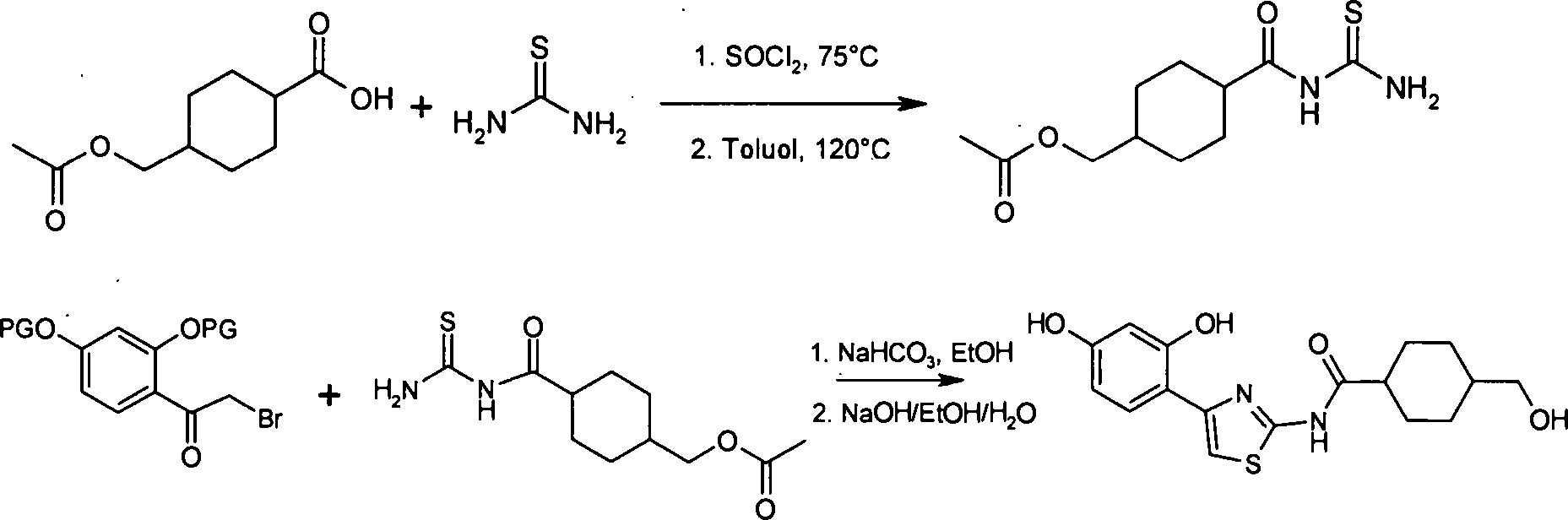
-
95 g (0.47 mol) 4-Acetoxymethylcyclohexancarbonsäure wurden in 350 ml Thionylchlorid 2 h unter Rückfluss erhitzt. Nach Entfernen des überschüssigen Thionylchlorids im Vakuum wurde der Rückstand in 11 Toluol aufgenommen und 71 g (0.94 mol) Thioharnstoff zugegeben. Die Reaktionslösung wurde 3 Stunden unter Rückfluss gekocht und anschließend heiß filtriert. Nach Abkühlen der Mutterlauge wurden die entstandenen weißen Kristalle abgesaugt, mit Toluol gewaschen und im Vakuum getrocknet. Ausbeute: 59 g. 1H NMR (DMSO-D6): 11.03, 10.97 (2 × s, 1H), 9.64 (bs, 1H), 9.35 (bs, 1H), 3.93, 3.82 (2 × d, 2H), 2.61, 2.42 (2 × m, 1H), 2.00 (s, 3H), 1.60 (m, 8H), 1.35, 0.94 (2 × m, 1H) ppm; 79 g (228 mmol) 2-Brom-2',4'-bis-methoxycarbonyloxy-acetophenon wurden mit 59 g (228 mmol) N-(4-Acetoxymethylcyclohexylcarbonyl)thioharnstoff und 29 g (340 mmol) NaHCO3 in 1000 ml Ethanol unter Rückfluss für 0.5 h gekocht. Die Reaktionslösung wurde abgekühlt und mit 73 g (1.8 mol) NaOH in 300 ml Wasser versetzt. Nach 30 Min. Rühren bei Raumtemperatur wurde die Reaktionslösung mit 300 ml Wasser aufgenommen und mit 2N HCl auf pH = 3 eingestellt. Der entstandene Niederschlag wurde abfiltriert und aus Ethanol/Wasser umkristallisiert. Es wurden 47 g Thiazol erhalten. 1H NMR (DMSO-D6): 12.15, 12.10 (2 × s, 1H), 10.96 (2 × s, 1 H), 9.47 (br, 2H), 7.64 (d, 1H), 7.39 (s, 1H), 6.29 (m, 2H), 4.40 (br, 1H), 3.32, 3.23 (2 × d, 2H), 2.65, 2.44 (2 × m, 1H), 1.90 (m, 1H), 1.78 (m, 2H), 1.50 (m, 5H), 0.94 (m, 1H) ppm. m.p.: 152–160°C.
-
N-(4-(2,4-Dihydroxyphenyl)thiazol-2-yl)-cyclohexancarboxamid:
-
52 g (0.68 mol) Thioharnstoff wurden in Toluol (500 ml) vorgelegt und 50 g (0.34 mol) Cyclohexanoylchlorid zugetropft. Die Reaktionslösung wurde 3 Stunden unter Rückfluss gekocht, wobei 2 Phasen entstehen. Die obere Phase wurde abdekantiert und abgekühlt. Die ausgefallenen Kristalle wurden abgesaugt, mit Toluol gewaschen und aus Methanol umkristallisiert. Ausbeute: 35 g. 1H NMR (DMSO-D6): 10.98 (bs, 1H), 9.65 (bs, 1H), 9.32 (bs, 1H), 2.49 (t, 1H), 1.75 (m, 4H), 1.61 (m, 1H), 1.18 (m, 5H) ppm.
-
92 g (265 mmol) 2-Brom-2',4'-bis-methoxycarbonyloxy-acetophenon wurden mit 49.4 g (265 mmol) N-Cyclohexanoylthioharnstoff und 34 g (397 mmol) NaHCO3 in 900 ml Ethanol unter Rückfluss für 0.5 h gekocht. Die Reaktionslösung wurde abgekühlt und mit 37 g (930 mmol) NaOH in 300 ml Wasser versetzt. Nach 30 Min. Rühren bei Raumtemperatur wurde die Reaktionslösung mit 300 ml Wasser aufgenommen und mit 2N HCl neutralisiert. Das Ethanol wurde weitgehend am Rotationsverdampfer entfernt. Der entstandene Niederschlag wurde abfiltriert und aus Ethanol/Wasser umkristallisiert. Es wurden 70 g Thiazol erhalten. 1H NMR (DMSO-D6): 12.14 (bs, 1H), 11.00 (bs, 1H), 9.48 (bs, 1H), 7.64 (1 arom. H), 7.39 (s, 1H), 6.30 (2 arom. H), 2.49 (m, 1H), 1.84 (m, 2H), 1.76 (m, 2H), 1.65 (m, 1H), 1.42 (m, 2H), 1.25 (m, 3H) ppm. m.p.: 262–266°C.
-
N-(4-(2,4-dihydroxyphenyl)thiazol-2-yl)-2-(4-(hydroxymethyl)phenyl)acetamid:
-
Durchführung analog Literatur.
-
Ausbeute: 76%, 1H NMR (DMSO-D6): 12.31 (bs, 1H), 7.26 (m, 4H), 5.05 (s, 2H), 3.57 (s, 2H), 2.05 (s, 3H) ppm; 
-
3.7 g (18 mmol) 4-Acetoxymethylphenylessigsäure wurden in 40 ml Thionylchlorid 2 h unter Rückfluss erhitzt. Nach Entfernen des überschüssigen Thionylchlorids im Vakuum wurde der Rückstand in 70 ml Toluol aufgenommen und 2.7 g (36 mmol) Thioharnstoff zugegeben. Die Reaktionslösung wurde 3 Stunden unter Rückfluss gekocht und anschließend wurde das Lösungsmittel im Vakuum entfernt. Die Reinigung erfolgte mittels Säulenchromatographie mit Cyclohexan/Essigester 1/1 an Kieselgel. Ausbeute: 2.7 g. 1H NMR (DMSO-D6): 11.29 (bs, 1H), 9.55 (bs, 1H), 9.40 (bs, 1H), 7.30 (m, 4H), 5.04 (s, 2H), 3.71 (s, 2H), 2.05 (s, 3H) ppm; 3.5 g (10 mmol) 2-Brom-2',4'-bis-methoxycarbonyloxy-acetophenon wurden mit 2.7 g (10 mmol) N-[2-(4-Acetoxymethylphenyl)acetyl]thioharnstoff und 1.3 g (15 mmol) NaHCO3 in 50 ml Ethanol unter Rückfluss für 0.5 h gekocht. Die Reaktionslösung wurde abgekühlt und mit 4.0 g (0.1 mol) NaOH in 20 ml Wasser versetzt. Nach 2 h Rühren bei 60°C wurde die Reaktionslösung in 100 ml Wasser aufgenommen und mit 2N HCl auf pH=3 eingestellt, Der entstandene Niederschlag wurde abfiltriert und aus Ethanol/Wasser umkristallisiert. Es wurden 1.3 g Thiazol erhalten. 1H NMR (DMSO-D6): 12.44 (s, 1H), 10.80 (s, 1H), 9.48 (s, 1H), 7.66 (d, 1H), 7.41 (s, 1H), 7.29 (m, 4H), 6.32 (m, 2H), 5.13 (t, 1H), 4.47 (d, 2H), 3.77 (s, 2H) ppm. m.p.: 254–256°C.
-
Kosmetische oder dermatologische Zubereitungen mit einem Gehalt an Alkylamidothiazolen bzw. deren Verwendung zur Behandlung und/oder Prophylaxe unerwünschter Hautpigmentierung, sind ebenfalls vorteilhafte Verkörperungen der vorliegenden Erfindung.
-
Vorteilhaft ist es insbesondere, wenn solche Zubereitungen 0,000001 bis 10 Gew.-%, insbesondere 0,0001 bis 3 Gew.-%, ganz besonders 0,001 bis 1 Gew.-% an einem oder mehreren der erfindungsgemäß verwendeten Alkylamidothiazolen enthalten, bezogen auf das Gesamtgewicht der Zubereitung.
-
Erfindungsgemäße kosmetische und dermatologische Zubereitungen können in verschiedenen Formen vorliegen. So können sie z. B. eine Lösung, eine wasserfreie Zubereitung, eine Emulsion oder Mikroemulsion vom Typ Wasser-in-Öl (W/O) oder vom Typ Öl-in-Wasser (O/W), eine multiple Emulsionen, beispielsweise vom Typ Wasser-in-Öl-in-Wasser (W/O/W), ein Gel, einen festen Stift, eine Salbe oder auch ein Aerosol darstellen. Es ist auch erfindungsgemäß vorteilhaft, die erfindungsgemäß verwendeten Substanzen und/oder deren Derivate in verkapselter Form darzureichen, z. B. in Kollagenmatrices und anderen üblichen Verkapselungsmaterialien, z. B. als Celluloseverkapselungen, in Gelatine oder liposomal verkapselt.
-
Es ist auch möglich und vorteilhaft im Sinne der vorliegenden Erfindung, die erfindungsgemäß verwendeten Substanzen und/oder deren Derivate in wäßrige Systeme bzw. Tensidzubereitungen zur Reinigung der Haut und der Haare einzufügen.
-
Die erfindungsgemäßen kosmetischen und dermatologischen Zubereitungen können kosmetische Hilfsstoffe enthalten, wie sie üblicherweise in solchen Zubereitungen verwendet werden, z. B. Konservierungsmittel, Bakterizide, Parfüme, Substanzen zum Verhindern des Schäumens, Farbstoffe, Pigmente, die eine färbende Wirkung haben, Verdickungsmittel, oberflächenaktive Substanzen, Emulgatoren, weichmachende, anfeuchtende und/oder feuchhaltende Substanzen, Fette, Öle, Wachse oder andere übliche Bestandteile einer kosmetischen oder dermatologischen Formulierung wie Alkohole, Polyole, Polymere, Schaumstabilisatoren, Elektrolyte, organische Lösemittel oder Siliconderivate.
-
Die Lipidphase kann vorteilhaft gewählt werden aus folgender Substanzgruppe:
- – Mineralöle, Mineralwachse
- – Öle, wie Triglyceride der Caprin- oder der Caprylsäure, ferner natürliche Öle wie z. B. Rizinusöl;
- – Fette, Wachse und andere natürliche und synthetische Fettkörper, vorzugsweise Ester von Fettsäuren mit Alkoholen niedriger C-Zahl, z. B. mit Isopropanol, Propylenglykol oder Glycerin, oder Ester von Fettalkoholen mit Alkansäuren niedriger C-Zahl oder mit Fettsäuren;
- – Alkylbenzoate;
- – Siliconöle wie Dimethylpolysiloxane, Diethylpolysiloxane, Diphenylpolysiloxane sowie Mischformen daraus.
-
Die Ölphase der Emulsionen, Oleogele bzw. Hydrodispersionen oder Lipodispersionen im Sinne der vorliegenden Erfindung wird vorteilhaft gewählt aus der Gruppe der Ester aus gesättigten und/oder ungesättigten, verzweigten und/oder unverzweigten Alkancarbonsäuren einer Kettenlänge von 3 bis 30 C-Atomen und gesättigten und/oder ungesättigten, verzweigten und/oder unverzweigten Alkoholen einer Kettenlänge von 3 bis 30 C-Atomen, aus der Gruppe der Ester aus aromatischen Carbonsäuren und gesättigten und/oder ungesättigten, verzweigten und/oder unverzweigten Alkoholen einer Kettenlänge von 3 bis 30 C-Atomen. Solche Esteröle können dann vorteilhaft gewählt werden aus der Gruppe Isopropylmyristat, Isopropylpalmitat, Isopropylstearat, Isopropyloleat, n-Butylstearat, n-Hexyllaurat, n-Decyloleat, Isooctylstearat, Isononylstearat, Isononylisononanoat, 2-Ethylhexylpalmitat, 2-Ethylhexyllaurat, 2-Hexyldecylstearat, 2-Octyldodecylpalmitat, Oleyloleat, Oleylerucat, Erucyloleat, Erucylerucat sowie synthetische, halbsynthetische und natürliche Gemische solcher Ester, z. B. Jojobaöl.
-
Die wäßrige Phase der erfindungsgemäßen Zubereitungen enthält gegebenenfalls vorteilhaft Feuchthaltemittel wie z. B. PropylenGlykol, Panthenol oder Hyaluronsäure sowie insbesondere ein oder mehrere Verdickungsmittel, welches oder welche vorteilhaft gewählt werden können aus der Gruppe Siliciumdioxid, Aluminiumsilikate, Hydroxypropylmethylcellulose, besonders vorteilhaft ein Polyacrylat wie beispielsweise Carbopole Typ 980, jeweils einzeln oder in Kombination.
-
Insbesondere werden Gemische der vorstehend genannten Lösemittel verwendet. Bei alkoholischen Lösemitteln kann Wasser ein weiterer Bestandteil sein.
-
Erfindungsgemäße Emulsionen sind vorteilhaft und enthalten z. B. die genannten Fette, Öle, Wachse und anderen Fettkörper, sowie Wasser und einen Emulgator, wie er üblicherweise für einen solchen Typ der Formulierung verwendet wird.
-
Gele gemäß der Erfindung enthalten üblicherweise Alkohole niedriger C-Zahl, z. B. Ethanol, PropyleGlykol, und Wasser bzw. ein vorstehend genanntes Öl in Gegenwart eines Verdickungsmittels, das bei ölig-alkoholischen Gelen vorzugsweise Siliciumdioxid oder ein Aluminiumsilikat, bei wäßrig-alkoholischen oder alkoholischen Gelen vorzugweise ein Polyacrylat ist.
-
Als Treibmittel für erfindungsgemäße, aus Aerosolbehältern versprühbare Zubereitungen sind die üblichen bekannten leichtflüchtigen, verflüssigten Treibmittel, beispielsweise Kohlenwasserstoffe (Propan, Butan, Isobutan) geeignet, die allein oder in Mischung miteinander eingesetzt werden können. Auch Druckluft ist vorteilhaft zu verwenden.
-
Vorteilhaft können erfindungsgemäße Zubereitungen außerdem Substanzen enthalten, die UV-Strahlung im UVB-Bereich absorbieren, wobei die Gesamtmenge der Filtersubstanzen z. B. 0,01 Gew.-% bis 30 Gew.-%, vorzugsweise 0,05 bis 20 Gew.-%, insbesondere 0,1 bis 15,0 Gew.-% beträgt, bezogen auf das Gesamtgewicht der Zubereitungen, um kosmetische Zubereitungen zur Verfügung zu stellen, die das Haar bzw. die Haut vor dem gesamten Bereich der ultravioletten Strahlung schützen. Sie können auch als Sonnenschutzmittel fürs Haar oder die Haut dienen.
-
Außerdem können vorteilhaft erfindungsgemäße Zubereitungen weiterhin Substanzen enthalten, die zur Konservierung dienen, wobei die Gesamtmenge der Konservierungsmittel z. B. 0,001 Gew.-% bis 30 Gew.-%, vorzugsweise 0,05 bis 10 Gew.-%, insbesondere 0,1 bis 5,0 Gew.-% beträgt, bezogen auf das Gesamtgewicht der Zubereitungen, um kosmetische Zubereitungen zur Verfügung zu stellen.
-
Die nachfolgenden Beispiele sollen die vorliegende Erfindung verdeutlichen, ohne sie einzuschränken. Alle Mengenangaben, Anteile und Prozentanteile sind, soweit nicht anders angegeben, auf das Gewicht und die Gesamtmenge bzw. auf das Gesamtgewicht der Zubereitungen bezogen. Rezepturbeispiele O/W – Emulsionen
| Rezepturbeispiel | 1 | 2 | 3 | 4 |
| Chemische/INCI-Bezeichnung | Gew.-% | Gew.-% | Gew.-% | Gew.-% |
| Stearinsäure | 2,50 | 2,00 | 2,00 | 2,50 |
| Glyceryl Stearat | 1,00 | 1,00 | 1,00 | 1,00 |
| C12-15 Alkyl Benzoat | 3,00 | 5,00 | 3,00 | 2,00 |
| Caprylsäure/Caprinsäure Triglycerid | 2,50 | 2,50 | 2,00 | 2,50 |
| Isopropyl Palmitat | 2,00 | - | - | 2,00 |
| Cetylstearylalkohol | 3,00 | - | 2,00 | 3,00 |
| Cetyl Alkohol | - | 2,00 | - | - |
| Stearyl Alkohol | - | 2,00 | 1,00 | - |
| C13-16 Isoparaffin | - | - | - | 1,00 |
| Dibutyladioat | - | - | 1,50 | - |
| Cyclomethicon | 1,00 | 1,00 | 0,50 | - |
| Dicaprylyl Carbonat | 2,00 | 2,00 | 2,00 | 2,00 |
| Dimethicon | 1,00 | - | 0,50 | 1,00 |
| Glycerin | 5,00 | 7,00 | 5,00 | 9,00 |
| Ethylhexyl Cocoat | - | - | 1,00 | - |
| Methylparaben | 0,20 | - | - | - |
| Phenoxyethanol | 0,40 | 0,50 | 0,50 | 0,40 |
| Propylparaben | 0,10 | - | - | 0,10 |
| 1,2-Hexandiol | - | - | 0,10 | 0,10 |
| Ethylhexylglycerin | - | - | 0,20 | - |
| Methylisothiazolinon | - | 0,05 | | - |
| Butylenglykol | - | - | 2,0 | - |
| Carbomer | 0,15 | 0,10 | 0,15 | 0,10 |
| Carrageenan | 0,10 | - | 0,10 | - |
| Xanthan Gummi | - | - | 0,10 | - |
| Acrylates/C10-30 Alkyl Acrylate Crosspolymer | - | 0,10 | - | 0,10 |
| Trinatrium EDTA | 0,20 | 0,20 | 0,20 | 0,20 |
| Tapioka Stärke | 1,50 | 1,00 | - | |
| Nylon-12(1,8-Diazacyclotetradecan-2,7-dion Homopolymer) | - | 0,20 | - | 0,50 |
| Polymethylsilsesquioxane | - | 1,00 | 1,00 | - |
| Aluminum Stärke Octenylsuccinat | - | - | 1,00 | - |
| Distärkephosphat | 1,00 | 1,00 | - | 1,00 |
| Butyl Methoxydibenzoylmethan | 1,00 | 2,00 | 1,00 | 1,00 |
| Phenylbenzimidazolsulfonsäure | 1,00 | 1,00 | 2,00 | 2,00 |
| Octocrylen | 2,00 | 2,00 | 1,00 | 2,00 |
| Ethylhexyl Salicylat | 1,00 | 1,00 | 2,00 | 1,00 |
| Cumarin | 0,01 | 0,20 | 0,03 | 0,07 |
| Iraldein alpha iff | 0,50 | 0,05 | 0,01 | 0,02 |
| Farnesol | 0,50 | 0,02 | 0,80 | 0,10 |
| Lilial | 0,50 | 0,01 | 0,03 | 0,60 |
| Iso E Super | 1,00 | 0,50 | 0,05 | 0,60 |
| Linalool Aroma | 0,10 | 0,35 | 0,80 | 0,25 |
| Hydroxypropyl tetrahydropyrantriol | 1,00 | 0,50 | - | - |
| Liponsäure | - | 0,50 | 0,20 | - |
| Kalium-Methoxysalicylate | 0,30 | - | 0,10 | 0,05 |
| Vitamin B6 HCl | 0,10 | 0,05 | - | 0,30 |
| Tranexamsäure | - | 0,01 | 0,25 | - |
| Pyrus Malus Stem Extract | 1,00 | 0,25 | 0,50 | 0,75 |
| N-(4-(2,4-Dihydroxyphenyl)thiazol-2-yl)-isobutyramid | 0,20 | 0.10 | 0.05 | 0.30 |
| N-(4-(2,4-Dihydroxyphenyl)thiazol-2-yl)-pivalamid | 0.01 | 0.25 | 0.15 | 0.10 |
| N-(4-(2,4-Dihydroxyphenyl)thiazol-2-yl)-butyramid | 0.25 | 0.15 | 0.30 | 0.35 |
| N-(4-(2,4-Dihydroxyphenyl)thiazol-2-yl)-cyclohexancarboxamid | 0.10 | 0.10 | 0.15 | 0.20 |
| Natriumhydroxid | q. s. | q. s. | q. s. | q. s. |
| Hydroxyisohexyl 3-Cyclohexencarboxaldehyd | 0,10 | 0,01 | 0,02 | 0,05 |
| Citronellol | 0,05 | 0,10 | 0,01 | 0,05 |
| Linalool | 0,03 | 0,05 | 0,10 | 0,50 |
| Parfüm | 0,30 | 0,20 | 0,20 | 0,20 |
| Natriumhydroxid | q. s. | q. s. | q. s. | q. s. |
| Wasser | ad 100 | ad 100 | ad 100 | ad 100 |
| |
| Rezepturbeispiel | 5 | 6 | 7 | 8 |
| Chemische Bezeichnung | Gew.-% | Gew.-% | Gew.-% | Gew.-% |
| Glyceryl Stearat Citrat | 2,00 | 1,50 | 2,00 | 2,00 |
| Behenyl Alkohol | 1,50 | 1,00 | 1,00 | 1,00 |
| C12-15 Alkyl Benzoat | 2,00 | 2,50 | 2,00 | 2,50 |
| Caprylsäure/Caprinsäure Triglycerid | 2,00 | 2,00 | 2,50 | 2,50 |
| Cetyl Alkohol | 2,00 | 2,00 | - | 2,00 |
| Cetylstearylalkohol | - | - | 2,00 | - |
| Cyclopentasiloxane | - | - | - | 1,00 |
| Cyclomethicon | 1,00 | 1,00 | 2,00 | 2,00 |
| Dicaprylyl Carbonat | - | 2,00 | 2,50 | 2,50 |
| Paraffinum Liquidum (Mineralöl) | - | - | 0,50 | - |
| Octyldodecanol | - | 2,00 | - | - |
| Isopropyl Palmitate | 1,50 | - | - | - |
| Dimethicon | 0,50 | 1,00 | 1,00 | - |
| Glycerin | 3,00 | 5,00 | 7,00 | 9,00 |
| Methylparaben | 0,20 | 0,15 | - | - |
| Phenoxyethanol | 0,40 | 0,60 | 0,50 | 0,50 |
| Propylparaben | 0,10 | - | - | - |
| Methylisothiazolinon | - | - | 0,05 | - |
| Piroctone Olamine | - | - | - | 0,15 |
| Glyceryl Caprylat | - | - | - | 0,20 |
| Carbomer | 0,20 | - | 0,15 | 0,15 |
| Natrium Polyacrylat | - | 0,40 | - | - |
| Xanthan Gummi | 0,10 | - | 0,10 | - |
| Acrylates/C10-30 Alkyl Acrylate Crosspolymer | - | 0,10 | - | 0,10 |
| Tapioka Stärke | 0,50 | - | 0,50 | - |
| Nylon-12 (1,8-Diazacyclotetradecan-2,7-dion Homopolymer) | 1,00 | - | - | 1,00 |
| Polymethylsilsesquioxane | - | 1,00 | 1,00 | - |
| Aluminum Stärke Octenylsuccinat | - | 1,00 | - | 1,00 |
| N-(4-(2,4-Dihydroxyphenyl)thiazol-2-yl)-isobutyramid | 0.25 | 0.15 | 0.30 | 0.35 |
| N-(4-(2,4-Dihydroxyphenyl)thiazol-2-yl)-pivalamid | 0.10 | 0.10 | 0.15 | 0.20 |
| N-(4-(2,4-Dihydroxyphenyl)thiazol-2-yl)-butyramid | 0.01 | 0.25 | 0.15 | 0.10 |
| N-(4-(2,4-Dihydroxyphenyl)thiazol-2-yl)-cyclohexancarboxamid | 0,20 | 0.10 | 0.05 | 0.30 |
| Glycyrrhiza Inflata Root Extrakt | 0,03 | 0,05 | 0,05 | 0,03 |
| Titandioxid | - | 1,00 | - | - |
| Octocrylene | 1,00 | 2,00 | 1,00 | 1,00 |
| Bis-Ethylhexyloxyphenol Methoxyphenyl Triazin | 1,00 | 1,00 | 2,00 | 2,00 |
| Orangenöl bitter | 0,05 | 0,10 | 0,08 | 0,30 |
| Florosa | 0,01 | 0,01 | 0,50 | 0,25 |
| Hexylsalicylat | 0,50 | 0,10 | 0,01 | 0,02 |
| Phenylethylalkohol | 0,10 | 0,50 | 0,09 | 0,15 |
| Benzylbenzoat M | 0,25 | 0,20 | 0,30 | 0,10 |
| Hydroxycitronellal | 0,01 | 0,01 | 0,10 | 0,60 |
| Natriumhydroxid | q. s. | q. s. | q. s. | q. s. |
| Trinatrium EDTA | 0,15 | - | 0,15 | - |
| 1-(1,2,3,4,5,6,7,8-octahydro-2,3,8,8,-tetramethyl-2-naphthyl)ethan-1-one | 0,1 | - | q. s. | q. s. |
| Geraniol | - | 0,05 | - | - |
| Hexylcinnamal | - | - | 0,05 | - |
| Parfüm | 0,10 | 0,20 | 0,30 | 0,20 |
| Wasser | ad 100 | ad 100 | ad 100 | ad 100 |
| |
| Rezepturbeispiele | 9 | 10 | 11 | 12 |
| Chemische Bezeichnung | Gew.-% | Gew.-% | Gew.-% | Gew.-% |
| Polyglyceryl-3 Methylglucose Distearat | 2,00 | 2,50 | 2,50 | 2,50 |
| Sorbitan Stearate | 1,50 | 3,00 | 1,50 | 3,00 |
| C12-15 Alkyl Benzoat | 2,50 | 2,50 | 2,50 | 2,50 |
| Caprylsäure/Caprinsäure Triglyceride | 2,50 | 2,50 | 2,50 | 2,50 |
| Stearyl Alkohol | 1,00 | 1,50 | 1,00 | 1,50 |
| Cyclomethicon | 3,00 | 1,00 | 2,00 | 1,00 |
| Isopropyl Myristat | - | 2,50 | 2,00 | 2,50 |
| Isopropyl Palmitat | 2,00 | - | 1,00 | - |
| EThylhexyl Stearat | - | 1,50 | - | - |
| Dimethicon | - | 1,00 | - | 1,00 |
| Decyl Oleate | - | - | 1,50 | - |
| Glycerin | 5,00 | 7,50 | 3,00 | 7,50 |
| Butyrospermum Parkii Butter | 2,00 | - | - | - |
| Squalane | 0,50 | - | - | - |
| Methylparaben | 0,20 | 0,20 | - | 0,10 |
| Phenoxyethanol | 0,40 | 0,40 | 0,40 | 0,40 |
| Propylparaben | 0,10 | - | | - |
| Benzethonium chlorid | - | - | 0,10 | - |
| Caprylyl Glykol | - | 0,20 | - | - |
| Ethylhexylglycerin | - | 0,20 | - | 0,2 |
| Carbomer | 0,15 | 0,10 | 0,15 | 0,10 |
| Ammonium Acryloyldimethyltaurate/VP Copolymer | - | 0,20 | - | 0,20 |
| Carrageenan | 0,10 | - | 0,15 | - |
| Trinatrium EDTA | - | 1,00 | - | 1,00 |
| Tapioka Stärke | - | 1,00 | 1,00 | - |
| Distärke Phosphat | - | 1,00 | - | 1,00 |
| Acrylonitrile-methacrylonitrile-methyl-methacrylate Copolymer + Isopentane + Magnesium Hydroxide | - | - | 1,00 | 1,00 |
| N-(4-(2,4-Dihydroxyphenyl)thiazol-2-yl)-isobutyramid | 0.01 | 0.25 | 0.15 | 0.10 |
| N-(4-(2,4-Dihydroxyphenyl)thiazol-2-yl)-pivalamid | 0,20 | 0.10 | 0.05 | 0.30 |
| N-(4-(2,4-Dihydroxyphenyl)thiazol-2-yl)-butyramid | 0.25 | 0.15 | 0.30 | 0.35 |
| N-(4-(2,4-Dihydroxyphenyl)thiazol-2-yl)-cyclohexancarboxamid | 0.10 | 0.10 | 0.15 | 0.20 |
| Diethylamino Hydroxybenzoyl Hexyl Benzoate | 1,00 | 2,00 | 1,00 | 1,00 |
| Ethylhexyl Methoxycinnamat | 1,00 | 1,00 | 2,00 | 2,00 |
| Macrolide Supra | 0,50 | 0,01 | 0,03 | 0,60 |
| Phenoxanol | 1,00 | 0,50 | 0,05 | 0,60 |
| Geraniol Supra | 0,10 | 0,35 | 0,80 | 0,25 |
| Dihydromyrcenol | 0,01 | 0,20 | 0,03 | 0,07 |
| Zimtaldehyd | 0,50 | 0,05 | 0,01 | 0,02 |
| Lyral | 0,50 | 0,02 | 0,80 | 0,10 |
| Titandioxid | - | - | 1,00 | - |
| Natriumhydroxid | q. s. | q. s. | q. s. | q. s. |
| Ubiquinone | 0,10 | - | - | - |
| Natrium Metabisulfit | - | 0,15 | - | - |
| BHT (tert-Butylhydroxytoluol) | - | - | 0,05 | - |
| Linalyacetat | 0,05 | 0,07 | 0,01 | 0,20 |
| Hexylsalicylat | 0,10 | 0,05 | 0,02 | 0,01 |
| Benzylsalicylat | 0,05 | 0,30 | 0,01 | 0,01 |
| Parfüm | q. s. | q. s. | q. s. | q. s. |
| Wasser | ad 100 | ad 100 | ad 100 | ad 100 |
| |
| Rezepturbeispiele | 13 | 14 | 15 | 16 |
| Chemische Bezeichnung | Gew.-% | Gew.-% | Gew.-% | Gew.-% |
| PEG-40 Stearate | 0,80 | 1,00 | 1,00 | 1,00 |
| Glyceryl Stearate | 2,50 | 3,00 | 3,00 | 3,00 |
| C12-15 Alkyl Benzoate | 2,00 | 2,50 | 2,00 | 2,00 |
| Caprylsäure/Caprinsäure Triglycerid | 2,00 | 2,50 | 2,50 | 2,00 |
| Cetylstearylalkohol | 3,00 | 3,00 | 3,00 | 3,00 |
| Cyclomethicon | 2,00 | 2,00 | 2,00 | 2,00 |
| Dicaprylyl Carbonat | - | 2,00 | 2,50 | 2,50 |
| Octyldodecanol | 1,00 | - | - | 1,50 |
| Triisostearin | - | 0,50 | - | 1,00 |
| Butyrospermum Parkii Butter | 2,00 | - | - | - |
| Octyldodecyl Myristat | 1,00 | - | 1,50 | 1,00 |
| Dimethicon | 1,00 | 1,00 | 1,00 | 1,00 |
| Glycerin | 7,50 | 5,00 | 9,0 | 7,50 |
| Methylparaben | 0,20 | - | 0,10 | - |
| Phenoxyethanol | 0,40 | 0,50 | 0,40 | 0,40 |
| Propylparaben | 0,10 | - | - | - |
| Glyceryl Caprylat | - | 0,25 | - | - |
| Pentylenglykol | - | 0,50 | - | - |
| Butylenglykol | - | - | 3,00 | - |
| Carbomer | 0,15 | 0,10 | 0,10 | 0,15 |
| Natrium Polyacrylat | - | 0,20 | 0,20 | - |
| Xanthan Gummi | 0,10 | - | - | - |
| Acrylates/C10-30 Alkyl Acrylate Crosspolymer | - | - | - | 0,1 |
| Trinatrium EDTA + Wasser (20%ige wässrige Lösung) | - | 1,00 | 1,00 | 1,00 |
| Tapioca Stärke | - | 1,00 | 1,00 | 1,00 |
| Distärke Phosphat | - | 1,00 | 1,00 | 1,00 |
| Aluminum Stärke Octenylsuccinat | 2,00 | - | - | - |
| Acrylonitrile-methacrylonitrile-methyl-methacrylate Copolymer + Isopentane + Magnesium Hydroxide | 1,00 | - | - | - |
| N-(4-(2,4-Dihydroxyphenyl)thiazol-2-yl)-isobutyramid | 0,10 | 0,15 | 0,10 | 0,01 |
| Ethylhexyl Methoxycinnamat | 1,00 | 2,00 | 1,00 | 1,00 |
| Diethylamino Hydroxybenzoyl Hexyl Benzoat | 0,50 | 1,00 | 2,00 | 1,00 |
| Diethylhexyl-Butamidotriazone | 1,00 | 0,50 | 1,00 | 0,50 |
| Drometrizol trisiloxan | 0,50 | 1,00 | 1,00 | 0,50 |
| Isoamyl p-Methoxycinnamate | 0,50 | 0,50 | 0,50 | 0,50 |
| Isoeugenol | 0,01 | 0,20 | 0,03 | 0,07 |
| Anisalkohol | 0,50 | 0,05 | 0,01 | 0,02 |
| Terpineol rein | 0,50 | 0,02 | 0,80 | 0,10 |
| Bergamotteöl | 0,01 | 0,01 | 0,50 | 0,25 |
| Hedion | 0,50 | 0,10 | 0,01 | 0,02 |
| Vanillin | 0,10 | 0,50 | 0,09 | 0,15 |
| Titandioxid | - | - | 1,00 | - |
| Glyceryl Glucoside | 3,00 | - | - | - |
| Kurzkettige Hyaluronsäure | - | 0,10 | - | - |
| Langkettige Hyaluronsäure | - | - | 0,10 | - |
| 4-Butyl-Resorcin | - | - | - | 0,30 |
| Magnolia-Rinden-Extrakt | 0,10 | - | - | - |
| Octadecen Dioic Säure | - | 0,05 | - | - |
| Folsäure | - | - | 0,01 | - |
| Carnitin | - | - | - | 0,50 |
| Kreatin | 0,10 | - | - | - |
| Alpha-Glucosylrutin | - | 0,01 | - | - |
| Taurin | - | - | 0,10 | - |
| Maulbeeren-Wurzel-Extrakt | - | - | - | 0,20 |
| Natrium Metabisulfit | 0,10 | - | - | - |
| Diethylhexyl Syringylidenmalonat | 0,13 | 0,13 | | |
| Natriumhydroxid | q. s. | q. s. | q. s. | q. s. |
| 3-Methyl-5-phenyl-1-pentanol | 0,10 | - | - | - |
| Coumarin | - | 0,05 | - | - |
| Ethyllinalool | - | - | 0,10 | - |
| Ascorbylpalmitat | 0,10 | - | - | - |
| Parfüm | q. s. | q. s. | q. s. | q. s. |
| Wasser | ad 100 | ad 100 | ad 100 | ad 100 |
| |
| Rezepturbeispiele | 17 | 18 | 19 | 20 |
| Chemische Bezeichnung | Gew.-% | Gew.-% | Gew.-% | Gew.-% |
| Glyceryl Stearate Citrat | 2,00 | 2,00 | 2,00 | 2,00 |
| Isopropyl Palmitat | 3,00 | 2,00 | 3,00 | 1,00 |
| Cetylstearylalkohol | 4,00 | 3,00 | 3,00 | - |
| Cetylalkohol | - | - | - | 4,00 |
| Caprylsäure/Caprinsäure Triglycerid | 3,00 | 2,50 | 2,00 | 3,00 |
| C12-15 Alkyl Benzoat | 3,00 | 2,50 | 2,00 | 2,00 |
| Cyclomethicon | 1,00 | - | 1,00 | - |
| Dicaprylyl Carbonat | - | - | 2,50 | - |
| Dimethicon | - | 0,50 | - | - |
| Octyldodecyl Myristat | - | 1,00 | - | - |
| Glycerin | 4,00 | 6,00 | 5,00 | 6,00 |
| Methylparaben | 0,20 | - | 0,10 | - |
| Phenoxyethanol | 0,40 | 0,40 | 0,40 | 0,40 |
| Piroctone Olamine | - | - | - | 0,10 |
| Ethylhexylglycerin | - | 0,30 | - | - |
| Glyceryl Caprylate | - | 0,30 | - | - |
| 2-Methyl-1,3-propandiol | - | 2,00 | - | 2,00 |
| Carbomer | 0,20 | 0,10 | 0,15 | - |
| Natrium Polyacrylate | - | 0,40 | - | - |
| Xanthan Gummi | 0,10 | - | - | 0,15 |
| Acrylates/C10-30 Alkyl Acrylate Crosspolymer | - | - | 0,10 | 0,20 |
| Acrylonitrile-methacrylonitrile-methyl-methacrylate Copolymer + Isopentane + Magnesium Hydroxide | 0,50 | - | 0,50 | - |
| Aluminum Stärke Octenylsuccinat | - | 1,00 | - | 1,00 |
| Methyl Methacrylate Crosspolymer | 1,00 | | - | 1,00 |
| Glycyrrhiza Inflata Wurzel Extrakt | 0,03 | - | - | - |
| Vitamin C/Ascorbinsäure | - | 3,00 | - | - |
| Glycin Soja Keim Extrakt | - | - | 0,50 | - |
| Arctium Lappa Wurzel Extrakt | - | - | - | 0,30 |
| Pimpinella Anisum Frucht Extrakt | 4,00 | - | - | - |
| Glycyrrhitinsäure | - | 0,10 | - | - |
| N-Acetylhydroxyprolin | - | - | 0,10 | - |
| Niacinamid | - | - | - | 0,20 |
| Magnesium-Ascorbylphosphat | 0,10 | - | - | - |
| Ellagsäure | - | 0,01 | - | - |
| Süßholzwurzel-Extrakt | - | - | 0,10 | - |
| Meersalz | - | - | - | 0,05 |
| Isoserinol | 1,00 | - | - | - |
| Dihydroxypropyltrimonium chloride | - | 0,80 | - | - |
| N-(4-(2,4-Dihydroxyphenyl)thiazol-2-yl)-isobutyramid | 0,25 | 0,30 | 0,01 | 0,05 |
| Titandioxid | - | 1,00 | - | 1,00 |
| Bis-Ethylhexyloxyphenol Methoxyphenyl Triazin | 1,00 | 2,00 | 1,00 | 1,00 |
| Octocrylen | 1,00 | 1,00 | 2,00 | 2,00 |
| Thymol | 0,50 | 0,02 | 0,80 | 0,10 |
| Linalylacetat | 0,50 | 0,01 | 0,03 | 0,60 |
| Linalool Aroma | 1,00 | 0,50 | 0,05 | 0,60 |
| Hexenol cis-3 | 0,05 | 0,10 | 0,08 | 0,30 |
| Tetrahydromuguol | 0,01 | 0,01 | 0,50 | 0,25 |
| Limonen D rein | 0,50 | 0,10 | 0,01 | 0,02 |
| Citronellol | 0,05 | 0,10 | 0,05 | 0,05 |
| Coumarin | 0,05 | 0,05 | 0,10 | 0,05 |
| Triethylcitrat | 0,10 | 0,02 | 0,05 | 0,05 |
| Natriumhydroxid | q. s. | q. s. | q. s. | q. s. |
| Wasser | ad 100 | ad 100 | ad 100 | ad 100 |
| |
| Rezepturbeispiele | 21 | 22 | 23 | 24 |
| Chemische Bezeichnung | Gew.-% | Gew.-% | Gew.-% | Gew.-% |
| Sucrose Polystearate + Hydrogynated Polyisobutene | 1,00 | 1,00 | 2,00 | 2,00 |
| Natrium Stearoyl Glutamat | 0,20 | 0,20 | 0,30 | 0,30 |
| C12-15 Alkyl Benzoat | 1,50 | 1,50 | - | - |
| Cetyl Alkohol | 0,50 | 0,50 | - | - |
| Cyclomethicon | 10,00 | 10,00 | 5,00 | 5,00 |
| Dimethicon | 3,00 | 3,00 | 2,50 | 2,50 |
| Glycerin | 7,50 | 7,50 | 5,00 | 5,00 |
| Isopropyl Stearat | 1,00 | 1,00 | 2,00 | 2,00 |
| Paraffinum Liquidum (Mineralöl) | 3,00 | 3,00 | 1,00 | 1,00 |
| Methylparaben | 0,10 | - | - | 0,10 |
| Ethylhexylglycerin | - | - | 0,30 | 0,10 |
| Propylparaben | 0,10 | - | - | - |
| Methylisothiazolinon | - | 0,05 | - | - |
| Phenoxyethanol | 0,40 | 0,50 | 0,40 | 0,40 |
| Ascorbylglucosid | 0,10 | - | - | - |
| Undecenoylphenylalanin | - | 0,50 | - | - |
| Kojisäure | - | - | 0,10 | - |
| Arbutin | - | - | - | 0,01 |
| Betain | 0,20 | - | - | - |
| N-(4-(2,4-Dihydroxyphenyl)thiazol-2-yl)-isobutyramid | 0,10 | 0,10 | 0,05 | 0,05 |
| N-(4-(2,4-Dihydroxyphenyl)thiazol-2-yl)-pivalamid | 0,10 | 0,25 | 0,15 | 0,10 |
| N-(4-(2,4-Dihydroxyphenyl)thiazol-2-yl)-butyramid | 0,15 | 0,15 | 0,01 | 0,06 |
| Ethylhexyl Methoxycinnamat | 1,00 | 2,00 | 1,00 | 1,00 |
| Benzylcinnamat | 0,50 | 0,05 | 0,01 | 0,02 |
| Ethylvanillin | 0,50 | 0,02 | 0,80 | 0,10 |
| Eugenol | 0,01 | 0,01 | 0,50 | 0,25 |
| Benzylalkohol DD | 0,10 | 0,01 | 0,02 | 0,05 |
| Methylheptincarbonat | 0,05 | 0,10 | 0,01 | 0,05 |
| Citral 95 | 0,03 | 0,05 | 0,10 | 0,50 |
| Acrylates/Octylacrylamid Copolymer | - | 1,00 | - | - |
| Butylenglykol | - | - | 3,00 | - |
| Polymethylsilsesquioxan | - | - | 1,00 | 1,00 |
| Prunus Amygdalus Dulcis Oil | - | - | 1,00 | - |
| Nylon-12 (1,8-Diazacyclotetradecan-2,7-dion Homopolymer) | - | 1,00 | 1,00 | - |
| Distärke Phosphat | - | 1,00 | - | 1,00 |
| Methyl Methacrylat Crosspolymer | 1,00 | - | - | - |
| Aluminum Starch Octenylsuccinat | 1,00 | - | - | - |
| Ammonium Acryloyldimethyltaurate/VP Copolymer | - | - | 0,25 | 0,25 |
| Xanthan Gummi | 0,10 | - | - | 0,10 |
| Acrylates/C10-30 Alkyl Acrylate Crosspolymer | 0,25 | 0,10 | - | - |
| Carbomer | - | 0,10 | 0,10 | - |
| Hexylcinnamal | 0,05 | 0,10 | 0,05 | 0,10 |
| 1-(1,2,3,4,5,6,7,8-octahydro-2,3,8,8,-tetramethyl-2-naphthyl)ethan-1-one | 0,10 | 0,10 | 0,10 | 0,06 |
| Linalool | 0,02 | 0,01 | 0,05 | 0,05 |
| Parfüm | 020 | 0,20 | 0,20 | 0,20 |
| Natriumhydroxid | q. s. | q. s. | q. s. | q. s. |
| Wasser | ad 100 | ad 100 | ad 100 | ad 100 |
| |
| Rezepturbeispiele | 25 | 26 | 27 | 28 |
| Chemische Bezeichnung | Gew.-% | Gew.-% | Gew.-% | Gew.-% |
| Natrium Cetearyl Sulfat | 0,15 | 0,15 | - | 0,15 |
| Glyceryl Stearate SE | 2,00 | 2,00 | - | 1,50 |
| Natrium Stearoyl Glutamate | - | - | 0,30 | |
| C12-15 Alkyl Benzoat | 2,50 | 2,50 | 2,50 | 2,50 |
| Octyldodecanol | 1,00 | 1,00 | - | - |
| Caprylsäure/Caprinsäure Triglycerid | 2,00 | 2,00 | 2,00 | 2,00 |
| Cetylstearylalkohol | 2,00 | 2,00 | 3,00 | 1,00 |
| Cyclomethicon | 1,50 | 1,50 | 2,50 | 2,50 |
| Glyceryl Stearate | - | - | 2,00 | - |
| Dimethicon | 0,50 | 0,50 | 0,50 | 0,50 |
| Glycerin | 5,00 | 5,00 | 7,50 | 7,50 |
| Cetearyl Alkohol | 1,00 | 1,50 | 1,00 | 1,00 |
| Isopropyl Stearat | 3,00 | 3,00 | 2,00 | 2,00 |
| Paraffinum Liquidum (Mineralöl) | 2,00 | 2,00 | 1,00 | 1,00 |
| Methylisothiazolinon | - | - | - | 0,05 |
| Phenoxyethanol | 0,40 | 0,50 | 0,40 | 0,30 |
| Methylparaben | 0,15 | - | - | - |
| Propylparaben | 0,10 | - | - | - |
| Piroctone Olamine | - | 0,15 | - | - |
| Benzethonium chlorid | - | - | 0,10 | - |
| N-(4-(2,4-Dihydroxyphenyl)thiazol-2-yl)-isobutyramid | 0,10 | 0,10 | 0,05 | 0,05 |
| N-(4-(2,4-Dihydroxyphenyl)thiazol-2-yl)-pivalamid | 0,25 | 0,30 | 0,01 | 0,05 |
| N-(4-(2,4-Dihydroxyphenyl)thiazol-2-yl)-butyramid | 0,10 | 0,25 | 0,15 | 0,10 |
| N-(4-(2,4-Dihydroxyphenyl)thiazol-2-yl)-cyclohexancarboxamid | 0,15 | 0,15 | 0,01 | 0,06 |
| Ethylhexyl Methoxycinnamat | 1,00 | 2,00 | 1,00 | 1,00 |
| Butyl Methoxydibenzoylmethan | 1,00 | 1,00 | 2,00 | 2,00 |
| Drometrizol trisiloxan | 2,00 | 2,00 | 1,00 | 1,00 |
| Hexylzimtaldehyd alpha | 0,50 | 0,01 | 0,03 | 0,60 |
| Benzylacetat | 1,00 | 0,50 | 0,05 | 0,60 |
| Ethyllinalool | 0,05 | 0,10 | 0,08 | 0,30 |
| Iraldein gamma Coeur 262654 | 0,01 | 0,01 | 0,50 | 0,25 |
| Amylzimtaldehyd | 0,50 | 0,10 | 0,01 | 0,02 |
| alpha-Isomethylionon | 0,05 | 0,10 | 0,05 | 0,05 |
| Pentylenglykol | - | 1,00 | 1,00 | - |
| ButylenGlykol | 1,00 | 1,50 | 3,00 | 3,00 |
| DipropylenGlykol | 0,50 | 1,00 | 0,80 | 0,10 |
| 2-Methyl-1,3-propandiol | - | - | - | - |
| 1,2-Hexandiol | - | - | - | 1,00 |
| Nylon-12 (1,8-Diazacyclotetradecan-2,7-dion Homopolymer) | 1,00 | 1,00 | 1,00 | 1,00 |
| Carbomer | - | - | 0,10 | 0,15 |
| Ammonium Acryloyldimethyltaurat/VP Copolymer | 0,20 | - | - | - |
| Chondrus Crispus | 0,10 | 0,10 | - | - |
| Xanthan Gummi | - | - | 0,10 | - |
| Acrylates/C10-30 Alkyl Acrylate Crosspolymer | - | 0,20 | 0,10 | 0,10 |
| Coumarin | 0,10 | - | 0,05 | 0,05 |
| Hydroxyisohexyl 3-Cyclohexencarboxaldehyde | 0,05 | 0,05 | 0,05 | 0,10 |
| 1-(1,2,3,4,5,6,7,8-octahydro-2,3,8,8,-tetramethyl-2-naphthyl)ethan-1-one | - | 0,05 | 0,10 | - |
| Parfüm | 0,20 | 0,30 | 0,40 | 0,20 |
| Natriumhydroxid | q. s. | q. s. | q. s. | q. s. |
| Wasser | ad 100 | ad 100 | ad 100 | ad 100 |
| |
| Rezepturbeispiele | 29 | 30 | 31 | 32 |
| Chemische/INCI-Bezeichnung | Gew.-% | Gew.-% | Gew.-% | Gew.-% |
| Natrium Cetearyl Sulfat | 0,15 | 0,15 | 0,20 | 0,20 |
| Glyceryl Stearate, selbstemulgierend | 2,00 | 2,00 | 1,50 | 1,50 |
| C12-15 Alkyl Benzoat | 2,00 | 2,00 | 2,00 | 2,00 |
| Octyldodecanol | 1,00 | 1,00 | - | - |
| Caprylsäure/Caprinsäure Triglycerid | 2,00 | 2,00 | 2,00 | 2,00 |
| Cetylstearylalkohol | 2,00 | 2,00 | 1,00 | 1,00 |
| Cyclomethicon | 1,00 | 1,00 | 2,00 | 2,00 |
| Dimethicon | 0,50 | 0,50 | 1,00 | 1,00 |
| Glycerin | 5,00 | 5,00 | 7,50 | 7,50 |
| Isopropyl Palmitat | 2,50 | 2,50 | 2,00 | 2,00 |
| DMDM Hydantoin | 0,05 | 0,05 | 0,05 | 0,05. |
| Phenoxyethanol | 0,35 | 0,25 | 0,30 | 0,30 |
| Ethanol | - | - | 3,00 | 2,00 |
| Pentylenglykol | 1,00 | - | 1,00 | 1,50 |
| Zingeron | 0,10 | - | - | - |
| Dihydromyricetin | - | 0,03 | - | - |
| Weisser Tee Extrakt | - | - | 1,00 | - |
| 4-Hexyl-Resorcin | - | - | - | 0,30 |
| Phenylethyl Resorcinol | 0,50 | - | - | - |
| Ubiquinone | - | 0,10 | - | - |
| Cyanomethylphenyl Menthan Carboxamid | - | - | 0,10 | - |
| Menthoxypropanediol | - | - | - | 0,10 |
| Menthan Carboxamid Ethylpyridin | 0,10 | - | - | - |
| Hydroxyethylurea | - | 0,50 | - | - |
| Urea | - | - | 1,00 | - |
| N-(4-(2,4-Dihydroxyphenyl)thiazol-2-yl)-isobutyramid | 0,10 | 0,10 | 0,05 | 0,05 |
| Carbomer | 0,20 | 0,20 | 0,20 | 0,20 |
| Carrageenan | 0,10 | 0,10 | - | - |
| Xanthan Gummi | - | - | 0,20 | 0,20 |
| Acrylates/C10-30 Alkyl Acrylate Crosspolymer | - | - | - | 0,15 |
| Natrium Polyacrylat | - | 0,20 | - | - |
| Diethylhexyl 2,6-Naphthalat | - | - | 1,00 | - |
| Phenylbenzimidazolsulfonsäure | 1,00 | 2,00 | 1,00 | 1,00 |
| Titandioxid | 1,00 | 1,00 | 2,00 | 2,00 |
| Iraldein gamma Coeur 262654 | 0,50 | 0,05 | 0,01 | 0,02 |
| Amylzimtaldehyd | 0,50 | 0,02 | 0,80 | 0,10 |
| alpha-Isomethylionon | 0,50 | 0,01 | 0,03 | 0,60 |
| Methylbenzoat | 1,00 | 0,50 | 0,05 | 0,60 |
| Alpha-Methylionon | 0,10 | 0,35 | 0,80 | 0,25 |
| 3,3,5-Trimethylcyclohexylsalicylat | | 1,00 | - | - |
| Distärkepjosphat | - | 1,00 | 1,00 | - |
| Methyl Methacrylate Crosspolymer | 1,00 | - | - | 1,00 |
| Polymethylsilsesquioxane | - | - | 1,00 | 1,00 |
| Acrylonitrile-methacrylonitrile-methyl-methacrylate Copolymer + Isopentane + Magnesium Hydroxid | 1,00 | 1,00 | - | - |
| 1-(1,2,3,4,5,6,7,8-octahydro-2,3,8,8,-tetramethyl-2-naphthyl)ethan-1-one | - | 0,10 | 0,10 | 0,05 |
| Hydroxyisohexyl 3-Cyclohexencarboxaldehyde | 0,05 | 0,05 | 0,10 | - |
| Linalylacetat | 0,10 | - | 0,05 | 0,05 |
| Parfüm | 0,15 | 0,15 | 0,30 | 0,30 |
| Natriumhydroxid | q. s. | g. s. | q. s. | q. s. |
| Wasser | ad 100 | ad 100 | ad 100 | ad 100 |
| |
| Rezepturbeispiele | 33 | 34 | 35 | 36 |
| Chemische/INCI-Bezeichnung | Gew.-% | Gew.-% | Gew.-% | Gew.-% |
| Natrium Cetearyl Sulfat | 0,15 | 0,15 | 0,15 | 0,15 |
| Glyceryl Stearate, selbstemulgierend | 1,00 | 1,00 | 1,00 | 1,00 |
| C12-15 Alkyl Benzoat | 2,00 | 2,50 | 2,00 | 2,00 |
| Isopropyl Palmitat | 3,50 | 3,00 | 2,50 | 3,50 |
| Dimethicon | 1,00 | 1,00 | 1,00 | 1,0 |
| Cetylstearylalkohol | 1,00 | 1,00 | 1,00 | 1,00 |
| Octyldodecyl Myristate | - | - | - | 1,00 |
| Butyrospermum Parkii Butter | - | - | 1,00 | - |
| Glycerin | 7,00 | 3,00 | 9,00 | 5,00 |
| Carbomer | 0,10 | 0,15 | 0,10 | 0,10 |
| Acrylates/C10-30 Alkyl Acrylate Crosspolymer | 0,15 | 0,10 | 0,10 | 0,15 |
| Xanthan Gummi | 0,15 | 0,15 | 0,15 | 0,15 |
| Phenylbenzimidazolsulfonsäure | 1,00 | 1,00 | 0,50 | 1,00 |
| Butyl Methoxydibenzoylmethan | 1,50 | 1,50 | 1,50 | 1,50 |
| 2-tert-Pentylcyclohexylacetat | 0,50 | 0,02 | 0,80 | 0,10 |
| 7-Acetyl-1,1,3,4,4,6-hexamethyltetralin | 0,01 | 0,01 | 0,50 | 0,25 |
| Adipinsäurediester | 0,10 | 0,01 | 0,02 | 0,05 |
| Amylsalicylat | 0,05 | 0,10 | 0,01 | 0,05 |
| Titanium Dioxide + Trimethoxycaprylylsilan | 1,00 | - | 1,00 | - |
| Aluminum Stärke Octenylsuccinat | - | 1,00 | - | 0,50 |
| Methyl Methacrylate Crosspolymer | 0,50 | - | 0,50 | - |
| Nylon-12 (1,8-Diazacyclotetradecan-2,7-dion Homopolymer) | 0,50 | - | 1,00 | - |
| Tapioka Stärke | 0,50 | 0,50 | - | 1,00 |
| Phenoxyethanol | 0,50 | 0,50 | 0,50 | 0,40 |
| Ethylhexylglycerin | 0,25 | - | 0,25 | - |
| 1,2-Hexandiol | - | 1,00 | - | 3,00 |
| Caprylyl Glykol | - | 0,30 | 0,30 | - |
| 2-Methyl-1,2-propandiol | 2,00 | 2,00 | 2,00 | - |
| N-(4-(2,4-Dihydroxyphenyl)thiazol-2-yl)-isobutyramid | 0,10 | 0,10 | 0,05 | 0,05 |
| N-(4-(2,4-Dihydroxyphenyl)thiazol-2-yl)-pivalamid | 0,25 | 0,30 | 0,01 | 0,05 |
| Ethyllinalool | 0,05 | - | 0,05 | - |
| 3-Methyl-5-phenyl-1-pentanol | - | 0,05 | - | 0,05 |
| Geraniol | 0,05 | - | 0,05 | - |
| Natriumhydroxid | q. s. | q. s. | q. s. | q. s. |
| Wasser | ad 100 | ad 100 | ad 100 | ad 100 |
| |
| Rezepturbeispiele | 37 | 38 | 39 | 40 |
| Chemische/INCI-Bezeichnung | Gew.-% | Gew.-% | Gew.-% | Gew.-% |
| Polyglycerly-10 Stearat | 0,20 | 0,20 | 0,20 | 0,20 |
| Glyceryl Stearat | 3,00 | 0,50 | 0,50 | 0,50 |
| C12-15 Alkyl Benzoat | 4,00 | 2,00 | 1,50 | 2,50 |
| Isopropyl Palmitat | 4,00 | 1,00 | 2,00 | 2,50 |
| Caprylsäure/Caprinsäure Triglycerid | 4,00 | 3,00 | 2,00 | 2,50 |
| Hydrogenated Coco-Glycerides | 3,00 | - | - | 2,00 |
| Butyrospermum Parkii Butter | 3,00 | - | 2,50 | - |
| Cetylstearylalkohol | 5,00 | 3,50 | 4,00 | 3,00 |
| Paraffinum Liquidum (Mineralöl) | - | - | - | 1,00 |
| Glycerin | 5,00 | 3,00 | 7,00 | 9,00 |
| Acrylates/C10-30 Alkyl Acrylate Crosspolymer | 0,30 | 0,20 | 0,15 | 0,20 |
| Methylisothiazolinon | 0,05 | - | - | 0,05 |
| Phenoxyethanol | 0,50 | 0,40 | 0,40 | 0,40 |
| Carbomer | 0,10 | 0,15 | 0,10 | 0,10 |
| Methylparaben | - | 0,10 | 0,10 | - |
| Propylparaben | - | 0,10 | - | - |
| Nylon-12 (1,8-Diazacyclotetradecan-2,7-dion Homopolymer) | 1,00 | 0,50 | - | - |
| Polymethylsilsesquioxane | - | 1,00 | 0,50 | - |
| Methyl Methacrylate Crosspolymer | - | - | 1,00 | 0,50 |
| Tapioka Stärke | 0,50 | - | - | 0,50 |
| N-(4-(2,4-Dihydroxyphenyl)thiazol-2-yl)-isobutyramid | 0,10 | 0,10 | 0,05 | 0,05 |
| N-(4-(2,4-Dihydroxyphenyl)thiazol-2-yl)-pivalamid | 0,25 | 0,30 | 0,01 | 0,05 |
| N-(4-(2,4-Dihydroxyphenyl)thiazol-2-yl)-butyramid | 0,10 | 0,25 | 0,15 | 0,10 |
| N-(4-(2,4-Dihydroxyphenyl)thiazol-2-yl)-cyclohexancarboxamid | 0,01 | 0,60 | 1,00 | 0,20 |
| Benzophenon-4 | 1,00 | 2,00 | 1,50 | 0,50 |
| Amylsalicylat | 1,00 | 1,00 | 2,00 | 2,00 |
| Amylcinnamylalkohol | 0,50 | 0,05 | 0,01 | 0,02 |
| Amyl C Butylphenylmethylpropionalcinnamal | 0,50 | 0,02 | 0,80 | 0,10 |
| Ethanol | 3,00 | - | 2,00 | - |
| Geraniol | 0,05 | 0,05 | - | - |
| Benzylsalicylat | - | 0,05 | 0,05 | - |
| Ethyllinalool | - | - | 0,05 | 0,05 |
| Parfüm | 0,20 | 0,15 | 0,30 | 0,30 |
| Natriumhydroxid | q. s. | q. s. | q. s. | q. s. |
| Wasser | ad 100 | ad 100 | ad 100 | ad 100 |
| |
| Rezepturbeispiele | 41 | 42 | 43 | 44 |
| Chemische/INCI-Bezeichnung | Gew.-% | Gew.-% | Gew.-% | Gew.-% |
| Polyglycerly-10 Stearat | 0,20 | 0,20 | 0,15 | 0,15 |
| C12-15 Alkyl Benzoat | 2,50 | 2,50 | 2,00 | 3,00 |
| Isopropyl Palmitat | 2,50 | 2,50 | 2,00 | 2,00 |
| Caprylsäure/Caprinsäure Triglycerid | 2,00 | 2,50 | 1,00 | 2,00 |
| Glyceryl Stearat | 1,00 | 1,00 | 0,50 | 0,50 |
| Octyldodecanol | 0,50 | - | - | 1,00 |
| Cyclomethicon | - | - | 0,50 | 0,50 |
| Butyl Methoxydibenzoylmethan | 1,00 | 2,00 | 2,00 | 1,00 |
| Octocrylene | 0,50 | 2,00 | 3,00 | 2,00 |
| süßes Orangenöl | 0,50 | 0,01 | 0,03 | 0,60 |
| Cardamomöl | 1,00 | 0,50 | 0,05 | 0,60 |
| Benzoin | 0,10 | 0,35 | 0,80 | 0,25 |
| Cinnamylalkohol | 0,01 | 0,20 | 0,03 | 0,07 |
| Citronellylmethylcrotonat | 0,50 | 0,05 | 0,01 | 0,02 |
| bitteres Orangenöl | 0,25 | 0,30 | 0,01 | 0,05 |
| Titandioxid | - | 1,00 | - | 1,00 |
| 3,3,5-Trimethylcyclohexylsalicylat | - | - | 1,00 | 1,00 |
| Glycerin | 9,00 | 5,00 | 7,00 | 7,00 |
| Tapioka Stärke | 1,00 | 1,00 | - | - |
| Acrylonitrile-methacrylonitrile-methyl-methacrylate Copolymer + Isopentane + Magnesium Hydroxide | - | 1,00 | 0,50 | - |
| Aluminum Stärke Octenylsuccinat | - | - | 1,00 | 1,00 |
| Distärkephosphat | - | - | - | 1,00 |
| Methylisothiazolinon | 0,05 | 0,05 | - | - |
| Phenoxyethanol | 0,50 | 0,50 | 0,40 | 0,40 |
| Benzethoniumchlorid | - | - | 0,10 | - |
| Ethylhexylglycerin | - | - | 0,10 | - |
| Methylparaben | - | - | - | 0,20 |
| Carbomer | 0,25 | 0,20 | 0,20 | 0,20 |
| Acrylates/C10-30 Alkyl Acrylate Crosspolymer | 0,20 | - | - | 0,15 |
| Ammonium Acryloyldimethyltaurate/VP Copolymer | - | 0,25 | - | - |
| Natrium Polyacrylat | - | - | 0,30 | - |
| Xanthan Gummi | - | - | - | 0,15 |
| N-(4-(2,4-Dihydroxyphenyl)thiazol-2-yl)-isobutyramid | 0,10 | 0,10 | 0,05 | 0,05 |
| Ethanol | 3,00 | 3,00 | - | - |
| Butylenglykol | - | - | 2,00 | 2,00 |
| Coumarin | - | 0,05 | 0,05 | - |
| Hexylcinnamal | 0,05 | 0,05 | - | 0,05 |
| Hexylsalicylat | - | - | 0,05 | 0,05 |
| Parfüm | 0,15 | 0,20 | 0,25 | 0,30 |
| Natriumhydroxid | q. s. | q. s. | q. s. | q. s. |
| Wasser | ad 100 | ad 100 | ad 100 | ad 100 |
| |
| Rezepturbeispiele | 45 | 46 | 47 | 48 |
| Chemische/INCI-Bezeichnung | Gew.-% | Gew.-% | Gew.-% | Gew.-% |
| Kalium Cetylphosphat | 0,20 | 0,20 | 0,20 | 0,20 |
| Dicaprylyl Carbonat | - | 1,00 | - | - |
| C12-15 Alkyl Benzoat | 2,50 | 2,00 | 1,00 | 3,00 |
| Isopropyl Palmitat | 2,50 | 2,00 | 3,00 | 1,00 |
| Caprylsäure/Caprinsäure Triglycerid | 2,50 | 2,00 | 1,50 | 2,00 |
| Cera Microcristallina | - | - | - | 0,50 |
| Cylcomethicon | 0,25 | | 0,50 | 0,50 |
| Diethyihexyl 2,6-Naphthalat | - | 0,50 | - | 1,00 |
| Citronenöl | 0,01 | 0,01 | 0,50 | 0,25 |
| Evernia Furfuracea Extract | 0,50 | 0,10 | 0,01 | 0,02 |
| Diethylsuccinat | 0,10 | 0,50 | 0,09 | 0,15 |
| Evernia Prunastri Extract | 0,25 | 0,20 | 0,30 | 0,10 |
| Dinatriumphenyldibenzimidazoltetrasulfonat | 0,50 | 0,50 | 0,50 | 0,50 |
| Glycerin | 5,00 | 7,00 | 9,00 | 7,00 |
| Acrylates/C10-30 Alkyl Acrylate Crosspolymer | 0,10 | 0,30 | - | 0,10 |
| Natrium Polyacrylat | 0,30 | - | - | - |
| Carbomer | - | 0,10 | 0,15 | 0,15 |
| Ammonium Acryloyldimethyltaurate/VP Copolymer | - | - | 0,25 | - |
| Chondrus Crispus Extrakt (Carrageenan) | - | - | - | 0,10 |
| Methylisothiazolinon | 0,05 | 0,05 | - | - |
| Phenoxyethanol | 0,50 | 0,50 | 0,40 | 0,40 |
| Piroctone Olamine | - | - | - | 0,20 |
| Nylon-12 (1,8-Diazacyclotetradecan-2,7-dion Homopolymer) | 0,50 | - | 0,50 | 0,50 |
| Distärkephopsphat | - | 1,00 | - | 0,50 |
| Methyl Methacrylate Crosspolymer | - | 0,50 | 0,50 | - |
| Caprylyl Glykol | - | - | 0,30 | - |
| 1,2-Hexandiol | - | - | - | 0,50 |
| Butylenglykol | - | - | 2,00 | 2,00 |
| DMDM Hydantoin | - | - | 0,15 | - |
| Glycyrrhiza Inflata Root Extrakt (Süßholzwurzel) | - | - | 0,05 | - |
| N-(4-(2,4-Dihydroxyphenyl)thiazol-2-yl)-isobutyramid | 0,10 | 0,10 | 0,05 | 0,05 |
| N-(4-(2,4-Dihydroxyphenyl)thiazol-2-yl)-pivalamid | 0,25 | 0,30 | 0,01 | 0,05 |
| N-(4-(2,4-Dihydroxyphenyl)thiazol-2-yl)-butyramid | 0,10 | 0,25 | 0,15 | 0,10 |
| N-(4-(2,4-Dihydroxyphenyl)thiazol-2-yl)-cyclohexancarboxamid | 0,01 | 0,60 | 1,00 | 0,20 |
| Hydroxyisohexyl 3-Cyclohexencarboxaldehyd | 0,05 | 0,05 | 0,05 | - |
| Citronellol | - | 0,05 | - | 0,05 |
| Benzylsalicylat | - | - | 0,05 | 0,05 |
| Parfüm | 0,20 | 0,20 | 0,20 | 0,20 |
| Natriumhydroxid | q. s. | q. s. | q. s. | q. s. |
| Wasser | ad 100 | ad 100 | ad 100 | ad 100 |
| |
| Rezepturbeispiele | 49 | 50 | 51 | 52 |
| Chemische/INCI-Bezeichnung | Gew.-% | Gew.-% | Gew.-% | Gew.-% |
| Kalium Cetylphosphat | 0,20 | 0,20 | 0,25 | 0,20 |
| C12-15 Alkyl Benzoat | 2,50 | 2,50 | 2,00 | 2,00 |
| Isopropyl Palmitat | 2,50 | 2,50 | - | 3,00 |
| Isopropy Stearat | - | - | 2,00 | - |
| Caprylsäure/Caprinsäure Triglycerid | 2,50 | 2,50 | 1,50 | 2,00 |
| Glyceryl Stearat | 1,00 | 1,00 | 1,25 | 1,50 |
| Octyldodecanol | - | - | 1,50 | - |
| Paraffinum Liquidum (Mineralöl) | - | | - | 1,00 |
| Glycerin | 5,00 | 7,00 | 9,00 | 6,00 |
| Bis-Ethylhexyloxyphenol Methoxyphenyl Triazines | - | 1,00 | - | 1,00 |
| Titandioxid + Trimethoxycaprylylsilan | - | - | 1,00 | 1,00 |
| Phenylbenzimidazolsulfonsäure | 1,00 | 2,00 | 1,00 | 1,00 |
| Lavendelöl | 0,01 | 0,01 | 0,50 | 0,25 |
| Guajakholzöl | 0,50 | 0,10 | 0,01 | 0,02 |
| Lemonenöl | 0,10 | 0,50 | 0,09 | 0,15 |
| Mandarinenöl | 0,25 | 0,20 | 0,30 | 0,10 |
| Menthyl PCA | 0,01 | 0,01 | 0,10 | 0,60 |
| Carbomer | | 0,15 | 0,20 | 0,30 |
| Acrylates/C10-30 Alkyl Acrylate Crosspolymer | 0,30 | 0,10 | 0,15 | - |
| Xanthan Gummi | | | 0,15 | 0,10 |
| Methylisothiazolinon | 0,05 | - | - | - |
| Phenoxyethanol | 0,50 | 0,50 | 0,40 | 0,40 |
| Methylparaben | - | 0,10 | - | - |
| Ethylhexylsalicylat | - | - | 0,30 | - |
| ButylenGlykol | - | - | 3,00 | 3,00 |
| Benzethonium chlorid | - | - | - | 0,10 |
| N-(4-(2,4-Dihydroxyphenyl)thiazol-2-yl)-isobutyramid | 0,10 | 0,10 | 0,05 | 0,05 |
| N-(4-(2,4-Dihydroxyphenyl)thiazol-2-yl)-pivalamid | - | 0,30 | - | 0,05 |
| N-(4-(2,4-Dihydroxyphenyl)thiazol-2-yl)-butyramid | - | - | 0,15 | 0,10 |
| N-(4-(2,4-Dihydroxyphenyl)thiazol-2-yl)-cyclohexancarboxamid | - | 0,60 | 1,00 | 0,20 |
| Coumarin | - | 0,05 | - | 0,05 |
| Linalool | 0,05 | - | - | 0,05 |
| Hexylcinnamal | 0,05 | 0,05 | - | - |
| 1-(1,2,3,4,5,6,7,8-octahydro-2,3,8,8,-tetramethyl-2-naphthyl)ethan-1-on | - | - | 0,10 | - |
| Parfüm | 0,10 | 0,30 | 0,20 | 0,30 |
| BHT (tert-Butylhydroxytoluol) | 0,05 | - | - | - |
| Tocopheryl Acetat | - | 0,10 | - | |
| Natriumhydroxid | q. s. | q. s. | q. s. | q. s. |
| Wasser | ad 100 | ad 100 | ad 100 | ad 100 |
W/O – Emulsion
| Rezepturbeispiele | 53 | 54 |
| Chemische/INCI-Bezeichnung | Gew.-% | Gew.-% |
| Polygylceryl-3 Diisostearat | 1,5 | 1,5 |
| PEG-40 Sorbitan Perisostearat | 2,5 | 2,5 |
| Lanolin Alkohol | 0,5 | 0,5 |
| Paraffinum Liquidum (Mineralöl) | 8 | 8 |
| Cera Microcrystallina | 2,5 | 2,5 |
| Cyclomethicon | 4 | 4 |
| Isohexadecan | 2 | 2 |
| Isopropylpalmitat | 5 | 5 |
| Iodopropynyl Butylcarbamat | - | 0,1 |
| Magnesiumsulfat | 0,5 | 0,5 |
| Kaliumsorbat | 0,1 | - |
| Benzylsalicylat | 0,1 | - |
| Methylheptenon | 0,10 | 0,03 |
| Muskatnussöl | 0,01 | 0,05 |
| Homosalate | 0,50 | 1,00 |
| Benzophenon-4 | 2,00 | 0,50 |
| N-(4-(2,4-Dihydroxyphenyl)thiazol-2-yl)-isobutyramid | 0,10 | 0,10 |
| N-(4-(2,4-Dihydroxyphenyl)thiazol-2-yl)-pivalamid | 0,25 | - |
| N-(4-(2,4-Dihydroxyphenyl)thiazol-2-yl)-butyramid | 0,10 | - |
| N-(4-(2,4-Dihydroxyphenyl)thiazol-2-yl)-cyclohexancarboxamid | 0,01 | - |
| Glycerin | 7 | 7 |
| Parfüm | q. s. | q. s. |
| Wasser | ad 100 | ad 100 |
Deo/AT-Beispielrezepturen
| Rezepturbeispiele | 55 | 56 | 57 | 58 |
| Chemische/INCI-Bezeichnung | Gew.-% | Gew.-% | Gew.-% | Gew.-% |
| Polyethylenglykol(21)stearylether | 2,50 | 2,50 | 1,50 | 1,50 |
| Polyethylenglykol(2)stearylether | 1,50 | 1,50 | 2,50 | 2,50 |
| Polypropylenglykol(15)stearylether | 3,00 | 3,00 | 4,00 | 4,00 |
| Trinatriumsalz der Ethylendiamintetraessigsäure (20% wäßr. Lösung) | 1,50 | 1,50 | 1,50 | 1,50 |
| Persea Gratissima Öl (Avokadoöl) | 0,10 | 0,10 | 0,15 | 0,15 |
| Parfüm | q. s. | q. s. | q. s. | q. s. |
| 1-(1,2,3,4,5,6,7,8-octahydro-2,3,8,8,-tetramethyl-2-naphthyl)ethan-1-one | 0,10 | 0,05 | - | 0,05 |
| Linaylacetat | - | 0,05 | 0,05 | - |
| Citronellol | - | - | 0,05 | - |
| Triethylcitrat | - | - | - | 0,05 |
| Diethylhexyl-Butamidotriazon | 1,00 | 2,00 | 0,50 | 1,00 |
| Rosmarinöl | 0,03 | 0,15 | 0,01 | 0,09 |
| Silber Citrat | 0,10 | - | - | - |
| N-(4-(2,4-Dihydroxyphenyl)thiazol-2-yl)-isobutyramid | 0,10 | 0,10 | 0,05 | 0,05 |
| N-(4-(2,4-Dihydroxyphenyl)thiazol-2-yl)-pivalamid | 0,25 | - | - | 0,05 |
| N-(4-(2,4-Dihydroxyphenyl)thiazol-2-yl)-butyramid | 0,10 | - | 0,15 | 0,10 |
| N-(4-(2,4-Dihydroxyphenyl)thiazol-2-yl)-cyclohexancarboxamid | 0,01 | - | - | - |
| Wasser, ad | ad 100 | ad 100 | ad 100 | ad 100 |
| |
| Rezepturbeispiele | 59 | 60 | 61 | 62 |
| Chemische/INCI-Bezeichnung | Gew.-% | Gew.-% | Gew.-% | Gew.-% |
| Isoceteth-20 | 3,50 | 3,00 | 4,00 | 4,00 |
| Glycerylisostearat | 2,00 | 2,00 | 2,00 | 2,50 |
| Dicaprylylether | - | 0,50 | 2,00 | 2,50 |
| Capryl-Caprinsäureester | 2,00 | 1,50 | - | - |
| Aluminiumchlorhydrat | 5,00 | 5,00 | - | 3,00 |
| Persea Gratissima Öl (Avokadoöl) | - | - | 0,20 | - |
| PolyethylenGlykol(150)distearat | 0,50 | 0,50 | 1,00 | 1,00 |
| Glycerin | 4,00 | 2,00 | - | 2,00 |
| Butylenglykol | - | 3,00 | 1,00 | 2,00 |
| Propylenglykol | 3,00 | - | 3,00 | - |
| 4-[(Cyclopentylhydroxyphenylacetyl)oxy]-1,1-dimethyl-piperidiniumbromid | 0,05 | 0,10 | - | - |
| N-(4-(2,4-Dihydroxyphenyl)thiazol-2-yl)-isobutyramid | 0,10 | 0,10 | 0,05 | 0,05 |
| N-(4-(2,4-Dihydroxyphenyl)thiazol-2-yl)-pivalamid | - | - | - | 0,05 |
| N-(4-(2,4-Dihydroxyphenyl)thiazol-2-yl)-butyramid | - | - | 0,15 | - |
| N-(4-(2,4-Dihydroxyphenyl)thiazol-2-yl)-cyclohexancarboxamid | - | - | 1,00 | 0,20 |
| Phenylbenzimidazolsulfonsäure | 0,50 | 1,00 | 1,00 | 2,00 |
| Tonkabohnenöl | 1,00 | 0,50 | 0,50 | 0,50 |
| Geraniol | - | 0,05 | - | - |
| Ethyllinalool | - | - | 0,05 | - |
| Linalool | 0,20 | - | - | 0,10 |
| Parfüm | 0,25 | 0,50 | 0,50 | 0,75 |
| Wasser, ad | ad 100 | ad 100 | ad 100 | ad 100 |
| |
| Rezepturbeispiele | 63 | 64 | 65 | 66 |
| Chemische/INCI-Bezeichnung | Gew.-% | Gew.-% | Gew.-% | Gew.-% |
| Polyoxyethylen(20)cetylstearylether | 3,00 | 3,00 | 4,00 | 4,00 |
| Polyoxyethylen(12)cetylstearylether | 0,50 | 0,50 | - | - |
| Glycerinstearat | 3,00 | 3,00 | 3,00 | 3,00 |
| Cetylstearylalkohol | 0,50 | 0,50 | - | - |
| Cetylpalmitat | 0,50 | 0,50 | - | - |
| Capryl-Caprinsäureester | 4,00 | 4,00 | 3,50 | 3,50 |
| Di-n-Octylether | 5,00 | 5,00 | 5,00 | 5,00 |
| PolyethylenGlykol(150)distearat | - | - | 1,00 | 1,00 |
| Glycerin | 4,00 | 4,00 | 2,00 | 2,00 |
| N-(4-(2,4-Dihydroxyphenyl)thiazol-2-yl)-isobutyramid | 0,10 | 0,10 | 0,05 | 0,05 |
| N-(4-(2,4-Dihydroxyphenyl)thiazol-2-yl)-pivalamid | 0,25 | 0,30 | 0,01 | - |
| N-(4-(2,4-Dihydroxyphenyl)thiazol-2-yl)-butyramid | 0,10 | 0,25 | 0,15 | - |
| N-(4-(2,4-Dihydroxyphenyl)thiazol-2-yl)-cyclohexancarboxamid | 0,01 | 0,60 | 1,00 | - |
| Octocrylen | 1,00 | 1,00 | 2,00 | 2,00 |
| Terpineol rein | 0,01 | 0,10 | 0,03 | 0,15 |
| Hexylcinnamal | 0,05 | 0,10 | | - |
| 1-(1,2,3,4,5,6,7,8-octahydro-2,3,8,8,-tetramethyl-2-naphthyl)ethan-1-one | | 0,05 | 0,10 | |
| 3-Methyl-5-phenyl-1-pentanol | 0,05 | | | 0,05 |
| Parfüm | 0,30 | 0,30 | 0,50 | 0,50 |
| Wasser, ad | ad 100,00 | ad 100,00 | ad 100,00 | ad 100,00 |
| |
| Rezepturbeispiele | 67 | 68 | 69 | 70 |
| Chemische/INCI-Bezeichnung | Gew.-% | Gew.-% | Gew.-% | Gew.-% |
| Steareth-100 | 1,00 | 1,00 | 1,00 | 1,00 |
| Polyglyceryl-3 Diisostearat | 1,60 | 1,60 | 1,60 | 1,60 |
| PEG-45/Dodecyl Glykol Copolymer | 0,80 | 0,80 | 0,80 | 0,80 |
| C20-40 Alkyl Stearat | 10,00 | 10,00 | 10,00 | 10,00 |
| Caprylic/Capric Triglycerid | 3,00 | 3,00 | 3,00 | 3,00 |
| Octyldodecanol | 3,00 | 3,00 | 3,00 | 3,00 |
| Dicaprylyl Ether | 4,00 | 4,00 | 4,00 | 4,00 |
| Iso E Super | 0,20 | 0,05 | 0,10 | 0,08 |
| 4-Methylbenzylidencampher | 0,50 | 1,50 | 0,50 | 1,50 |
| Butylenglykol | 4,00 | 4,00 | 4,00 | 4,00 |
| N-(4-(2,4-Dihydroxyphenyl)thiazol-2-yl)-isobutyramid | 0,10 | 0,10 | 0,05 | 0,05 |
| N-(4-(2,4-Dihydroxyphenyl)thiazol-2-yl)-pivalamid | 0,25 | 0,30 | - | 0,05 |
| N-(4-(2,4-Dihydroxyphenyl)thiazol-2-yl)-butyramid | 0,10 | 0,25 | - | 0,10 |
| N-(4-(2,4-Dihydroxyphenyl)thiazol-2-yl)-cyclohexancarboxamid | 0,01 | 0,60 | - | 0,20 |
| Hydroxyisohexyl 3-Cyclohexencarboxaldehyd | 0,05 | 0,05 | 0,05 | 0,05 |
| Parfüm | 0,35 | 0,30 | 0,25 | 0,15 |
| Wasser, ad | ad 100,00 | ad 100,00 | ad 100,00 | ad 100,00 |
| |
| Rezepturbeispiele | 71 | 72 | 73 | 74 |
| Chemische/INCI-Bezeichnung | Gew.-% | Gew.-% | Gew.-% | Gew.-% |
| Alkohol denat. | 20,0 | 20,0 | 30,0 | 30,0 |
| Hydroxyethylcellulose | 0,40 | 0,40 | 0,30 | 0,30 |
| Polyethylenglykol 400 | 3,00 | 3,00 | 2,00 | 2,00 |
| Polyethylenglykol (2000) hydriertes Rizinusöl | 2,00 | 2,00 | 3,00 | 3,00 |
| Persea Gratissima Öl (Avokadoöl) | 0,50 | 0,50 | 0,10 | 0,10 |
| 4-[(Cyclopentylhydroxyphenylacetyl)oxy]-1,1-dimethyl-piperidiniumbromid | 0,10 | 0,30 | - | - |
| Homosalate | 1,00 | 1,00 | 2,00 | 1,00 |
| Citral 95 | 0,15 | 0,01 | 0,08 | 0,10 |
| N-(4-(2,4-Dihydroxyphenyl)thiazol-2-yl)-isobutyramid | 0,10 | 0,10 | 0,05 | - |
| N-(4-(2,4-Dihydroxyphenyl)thiazol-2-yl)-pivalamid | 0,25 | - | 0,01 | 0,05 |
| N-(4-(2,4-Dihydroxyphenyl)thiazol-2-yl)-butyramid | 0,10 | - | 0,15 | - |
| N-(4-(2,4-Dihydroxyphenyl)thiazol-2-yl)-cyclohexancarboxamid | 0,01 | - | 1,00 | 0,20 |
| Coumarin | - | - | 0,05 | - |
| Benzylsalicylat | - | 0,05 | - | - |
| Butylphenylmethylpropional | 0,05 | - | - | 0,10 |
| Parfüm | 0,25 | 0,30 | 0,50 | 0,30 |
| Wasser, ad | ad 100 | ad 100 | ad 100 | ad 100 |
| |
| Rezepturbeispiele | 75 | 76 | 77 | 78 |
| Chemische/INCI-Bezeichnung | Gew.-% | Gew.-% | Gew.-% | Gew.-% |
| 2-Octyldodecanol | 0,50 | 0,50 | 0,50 | 0,50 |
| 1,2-Propylenglykol | 1,00 | 1,00 | 1,00 | 1,00 |
| 2-Butyloctansäure | 0,25 | - | 0,25 | - |
| Aluminiumchlorhydrat | 2,00 | 3,00 | - | 3,00 |
| N-(4-(2,4-Dihydroxyphenyl)thiazol-2-yl)-isobutyramid | 0,10 | - | 0,10 | 0,05 |
| N-(4-(2,4-Dihydroxyphenyl)thiazol-2-yl)-pivalamid | 0,25 | 0,30 | 0,01 | - |
| N-(4-(2,4-Dihydroxyphenyl)thiazol-2-yl)-butyramid | 0,10 | 0,25 | 0,15 | - |
| N-(4-(2,4-Dihydroxyphenyl)thiazol-2-yl)-cyclohexancarboxamid | 0,01 | 0,60 | 1,00 | - |
| Dinatriumphenyldibenzimidazoltetrasulfonat | 1,00 | 1,00 | 2,00 | 1,00 |
| Ethyllinalool | 0,02 | 0,30 | 0,01 | 0,15 |
| Linalool | 0,05 | - | 0,05 | 0,05 |
| Coumarin | - | - | 0,05 | - |
| Benzylsalicylat | 0,05 | 0,05 | - | 0,05 |
| Parfüm | 0,10 | 0,20 | 0,40 | 0,20 |
| Ethanol | ad 100 | ad 100 | ad 100 | ad 100 |
-
Die durch Zusammenmischung der jeweiligen Bestandteile erhaltene flüssige Phase wird mit einem Propan-Butan-Gemisch (2.7) im Verhältnis 39:61 in Aerosolbehälter abgefüllt.
| Rezepturbeispiele | 79 | 80 | 81 |
| Chemische Bezeichnung | Gew.-% | Gew.-% | Gew.-% |
| Alkohol denat. | 20,0 | 30,0 | 20,0 |
| Hydroxyethylcellulose | 0,40 | 0,30 | 0,40 |
| Polyethylenglykol 400 | 3,00 | 2,00 | 3,00 |
| Polyethylenglykol (2000) hydriertes Rizinusöl | 2,00 | 3,00 | 2,00 |
| Persea Gratissima Öl (Avokadoöl) | 0,50 | 0,10 | 0,50 |
| 4-[(Cyclopentylhydroxyphenylacetyl)oxy]-1,1-dimethylpiperidiniumbromid | 0,05 | - | - |
| N-(4-(2,4-Dihydroxyphenyl)thiazol-2-yl)-isobutyramid | 0,10 | 0,10 | 0,05 |
| N-(4-(2,4-Dihydroxyphenyl)thiazol-2-yl)-pivalamid | - | 0,30 | 0,01 |
| N-(4-(2,4-Dihydroxyphenyl)thiazol-2-yl)-butyramid | - | 0,25 | 0,15 |
| N-(4-(2,4-Dihydroxyphenyl)thiazol-2-yl)-cyclohexancarboxamid | - | 0,60 | 1,00 |
| Methylen-bis-benzotriazolyltetramethylbutylphenol | 1,50 | 2,00 | 0,50 |
| Vanillin | 0,01 | 0,10 | 0,06 |
| 2-Butyloctansäure | - | 0,10 | - |
| Geraniol | - | 0,05 | - |
| Citronellol | 0,05 | - | - |
| Ethyllinalool | - | - | 0,05 |
| Parfüm | 0,30 | 0,40 | 0,20 |
| Wasser, ad | ad 100 | ad 100 | ad 100 |
| |
| Rezepturbeispiele | 82 | 83 | 84 |
| Chemische/INCI-Bezeichnung | Gew.-% | Gew.-% | Gew.-% |
| Glycerinmonostearat | 5,00 | 5,00 | 5,00 |
| Polyethylenglykol(2000) monostearat | 2,00 | 2,00 | 2,00 |
| Stearylalkohol | 3,00 | 3,00 | 3,00 |
| Cyclometicon | 4,00 | 4,00 | 4,00 |
| Paraffinöl | 6,00 | 6,00 | 6,00 |
| Trinatrium EDTA | 0,20 | 0,20 | 0,20 |
| Aluminiumchlorhydrat | 2,50 | 2,50 | 2,50 |
| N-(4-(2,4-Dihydroxyphenyl)thiazol-2-yl)-isobutyramid | 0,10 | 0,10 | 0,05 |
| N-(4-(2,4-Dihydroxyphenyl)thiazol-2-yl)-pivalamid | 0,25 | - | 0,01 |
| N-(4-(2,4-Dihydroxyphenyl)thiazol-2-yl)-butyramid | 0,10 | - | 0,15 |
| N-(4-(2,4-Dihydroxyphenyl)thiazol-2-yl)-cyclohexancarboxamid | 0,01 | - | 1,00 |
| Benzophenon-4 | 0,50 | 0,50 | 1,00 |
| Benzylacetat | 0,10 | 0,01 | 0,02 |
| 2-Methylpropandiol | 3,00 | 3,00 | 3,00 |
| 2-Ethylhexylglycerinether | 0,50 | 0,50 | 0,50 |
| Benzylsalicylat | - | - | 0,05 |
| Triethylcitrat | - | 0,05 | - |
| Hexalcinnamal | 0,05 | - | - |
| Parfüm | 0,40 | 0,30 | 0,20 |
| Wasser, ad | 100 | 100 | 100 |
Haar-Shampoo
| Beispielrezeptur | 85 | 86 |
| Chemische Bezeichnung | Gew.-% | Gew.-% |
| Cocamidopropyl Betain | 2,50 | 2,50 |
| Natrium Laureth Sulfat | 9,00 | 9,00 |
| PEG-40 hydriertes Rizinusöl | 0,50 | 0,50 |
| Polyquaternium-10 | 0,20 | 0,20 |
| PEG-8 | 0,50 | 0,10 |
| Natriumbenzoat | 0,45 | 0,45 |
| Laureth-9 | 2,20 | 2,20 |
| Natrium Salicylat | 0,20 | 0,20 |
| Epsilon-Poly-L-Lysine | - | 0,25 |
| Climbazol | 0,45 | 0,45 |
| Perlglanz | 1,50 | 1,50 |
| Butyl Acrylat/Ethyltrimonium Chlorid Methacrylat/Styrol Copolymer | 2,50 | 1,00 |
| N-(4-(2,4-Dihydroxyphenyl)thiazol-2-yl)-isobutyramid | 0,10 | 0,10 |
| N-(4-(2,4-Dihydroxyphenyl)thiazol-2-yl)-pivalamid | 0,25 | - |
| N-(4-(2,4-Dihydroxyphenyl)thiazol-2-yl)-butyramid | 0,10 | - |
| N-(4-(2,4-Dihydroxyphenyl)thiazol-2-yl)-cyclohexancarboxamid | 0,01 | - |
| Lyral | 0,02 | 0,10 |
| Parfum | 0,30 | 0,30 |
| Zitronensäure | q. s. | q. s. |
| Natriumchlorid | q. s. | q. s. |
| Wasser | Ad. 100 | Ad. 100 |
Antischuppen Shampoo
| Beispielrezeptur | 87 | 88 |
| Chemische Bezeichnung | Gew.-% | Gew.-% |
| Natrium Laurylethersulfat | 9 | 10 |
| Cocamidopropyl Betain | 4 | 3 |
| Dinatrium PEG-5 Laurylcitrat Sulfosuccinat | - | 1 |
| Verdicker | 0.2 | 0,4 |
| Polyquaternium-10 | 0,3 | 0,1 |
| Guar Hydroxypropyl-Trimonium Chlorid | 0,2 | - |
| Zimtaldehyd | 0,15 | 0,02 |
| Climbazol | - | 0,5 |
| Epsilon-Poly-L-Lysine | 1 | 0,2 |
| Laureth-9 | - | 2 |
| Piroctone Olamin | 1,0 | 0,5 |
| Selensulfid | 0,2 | |
| Zinkpyrithion | 1,0 | 1,0 |
| Perlglanz | - | 2,5 |
| Trübungsmittel | - | 0,5 |
| PEG-40 hydriertes Rizinusöl | 0,5 | 0,2 |
| N-(4-(2,4-Dihydroxyphenyl)thiazol-2-yl)-isobutyramid | 0,10 | 0,10 |
| N-(4-(2,4-Dihydroxyphenyl)thiazol-2-yl)-pivalamid | 0,25 | - |
| N-(4-(2,4-Dihydroxyphenyl)thiazol-2-yl)-butyramid | 0,10 | - |
| N-(4-(2,4-Dihydroxyphenyl)thiazol-2-yl)-cyclohexancarboxamid | 0,01 | - |
| Natriumsalicylat | 0,3 | 0,2 |
| Natriumbenzoat | 0,25 | 0,3 |
| Natriumchlorid | q. s. | q. s. |
| Zitronensäure | q. s. | q. s. |
| Parfüm | q. s. | q. s. |
| Wasser | ad 100 | ad 100 |
Haartonik
| Beispielrezeptur | 89 | 90 |
| Chemische Bezeichnung | Gew.-% | Gew.-% |
| Ethanol | 30,0 | 40,0 |
| Panthenol | 0,2 | 0,1 |
| Tocopheryl Acetate | 0,2 | - |
| Florosa | 0,01 | 0,11 |
| C12-13 Alkyl Lactate | 0,2 | 0,1 |
| N-(4-(2,4-Dihydroxyphenyl)thiazol-2-yl)-isobutyramid | 0,10 | 0,10 |
| N-(4-(2,4-Dihydroxyphenyl)thiazol-2-yl)-pivalamid | 0,25 | - |
| N-(4-(2,4-Dihydroxyphenyl)thiazol-2-yl)-butyramid | 0,10 | - |
| N-(4-(2,4-Dihydroxyphenyl)thiazol-2-yl)-cyclohexancarboxamid | 0,01 | - |
| Climbazol | 0,1 | 0,1 |
| PEG-40 hydriertes Rizinusöl | - | 0,3 |
| Parfüm, Konservierungsmittel | q. s. | q. s. |
| Wasser | ad 100 | ad 100 |
-
ZITATE ENTHALTEN IN DER BESCHREIBUNG
-
Diese Liste der vom Anmelder aufgeführten Dokumente wurde automatisiert erzeugt und ist ausschließlich zur besseren Information des Lesers aufgenommen. Die Liste ist nicht Bestandteil der deutschen Patent- bzw. Gebrauchsmusteranmeldung. Das DPMA übernimmt keinerlei Haftung für etwaige Fehler oder Auslassungen.
-
Zitierte Patentliteratur
-
-
Zitierte Nicht-Patentliteratur
-
- M. Seiberg et al., 2000, J. Cell. Sci., 113: 3093–101 [0006]
- A. Kligman, 1975, Arch. Dermatol., 111: 40–48 [0012]
- J. M. Ready beschreibt in einer Publikation (Bioorganic & Medicinal Chemistry Letter 17 (2007) 6871–6875 [0015]
- Winder, A. J. and Harris, H., New assays for the tyrosine hydroxylase and dopa oxidase activities of tyrosinase. Eur. J. Biochem. (1991), 198, 317–26 [0039]
- Mitchell, David; Doecke, Christopher W.; Hay, Lynne A.; Koenig, Thomas M.; Wirth, David D. Tetrahedron Letters, 1995 [0039]