How to Make a Queer Science Fiction and Fantasy Writer Out of the Bible 

Jerome Stueart

detail from “Consider the Half-Life of Roses,” Jerome Stueart, (11 x 14) watercolor, pen and mixed media, 2025.

Craft him from Sunday School stories,
Daniel and those stoic lions, men walking in fire,
stormy Elijah, placid Elisha, prophets intimately bound
together.  Show him a God

who parts seas, walks beside his people a tornado of flame,
doles out miracles, and makes donkeys talk and angels
rescue, and bones live.  Show him giants, and Ezekiel’s wheel-
like spaceship, Elijah’s fiery chariot

in the sky. Tell him of Jonathan and David’s love,
the eunuch’s favor for Daniel, the Roman Centurion and his
boy.  But if you don’t tell him they were queer, he will queer
the stories anyway from

what he doesn’t see. Read him C.S. Lewis’ talking lion,
brave children voyaging across seas and Narnia; those satyrs
and centaurs will be his.  You tell him stories and myths,
and he will do the magic himself

to make those bones live.  They will rainbow-shield his faith from the wrath
of your Church.  When they throw stones, a hundred storied lions
will surround him, saying “I am here.”  When your waves threaten to capsize
his spirit, he will remember a friendly whale

of a way out.  And he will dive deep, and imagine a world where queer
heroes save the people, like they did in the Bible.  But he’ll have to hide
them in satyrs, starships, and lions like Lewis did, because you can’t
bear the truths of the Divine

outside of Story.  Oh, he will tell you of miracles you can perform,
of fiery chariots you can pilot, of love you can have.  He will save you,
with the Spirit you unleashed in him—and—if you’re truly blessed,
he will walk beside you, a pillar of fire

animating your very bones.

(originally published in Rock & Sling, June 2018)


My painting, “Coming Out at the Last Supper,” to be part of exhibition at L’Antiquaille in Lyon, France

My painting, “”Coming Out at the Last Supper,” will be part of an exhibition happening in July at L’Antiquaille, a museum of Early Christianity in Lyon, France, as part of a larger exhibition put on by the Archdiocese of Lyon on depictions of the Last Supper in Art. The exhibit is called “Mises en Cène” and it runs from July 1 through August 30 and then moves to another location through October, I think. My painting is in the final section of the exhibition labeled “Blasphemy? Sacrilege? Are you so sure?” This part of the exhibition asks viewers to think about how queer artists are exploring aspects of inclusion in the ministry of Christ.

I am SO honored to be part of this exhibition. My painting was found online by the person curating the exhibition and I was asked in 2025 if I wanted to be a part of it.

Many artists have depicted the Last Supper. It’s a popular tableau. It’s also been a part of marketing–since it is so famous. Anytime you have everyone on one side of a table, you have the chance of making the tableau. Try it at home!

Continue reading

My Burden Gladly Bearing

How do we protect those we love from those who question their very worth, their humanity, their right to exist? How do we protect ourselves from that constant batt-le?

Bears are pretty powerful all by themselves, but sometimes armor is called for. Bears have claws and poundage and teeth and jaws. But these are bears I found inside music–and they work differently. In the Bible, Paul talks about putting on the armor of God–and describes breastplates of righteousness, helmets of salvation, sword of the spirit, etc. Far be it from me to edit SAINT Paul– known for his perfect wisdom about what to do with women in the church, about singleness, about sexuality– but I’m going to anyway.

The bears I had didn’t defend me by attacking others; they defended me by empowering me and equipping me with better armor, better defensive structures.

They gave me a Helmet of Empathy– a way to see others struggling to see me, a way of understanding where they were coming from so that I could see them as worthy of love too; frankly, a helmet of Salvation further divides us into “saved” and “unsaved,” worthy and unworthy. Empathy makes us all worthy of being saved, protected, understood.

Continue reading

The Ascension of Jesus, Attended by Sparrows

I have to think birds came to Jesus as he ascended into the heavens. In my mind, they would have come to say goodbye, or hello, or just to be playful with the only person they’d ever seen fly. We are told many times in the Bible that Jesus cares about the fates of birds, specifically sparrows, common in Jesus’ area and time, as plentiful and as associated with humans and human habitats as they are today. People thought they were annoying. Some still do.

When I was a child I had a neighbor who killed sparrows on purpose.

He was an older gentleman with the largest house on the block. LD was his name. He had erected a purple martin house at the back of his fenced property, which adjoined the back of our unfenced property (we were living in the church parsonage while my dad was pastor at Braymer Baptist Church). When one puts up a purple martin house, I was told, you want purple martins to come and nest there–not sparrows, or any other bird. It seems to me in retrospect that it’s arrogant to think you open up free apartments and reject whatever birds they attract. He didn’t want those bird houses filled with “nasty” sparrows, so he installed cages at the bottom of the pole of the purple martin house, cages where he placed enticing food to attract sparrows.

So for the birds he wanted, he created homes; for the birds he didn’t, he created cages.

Continue reading

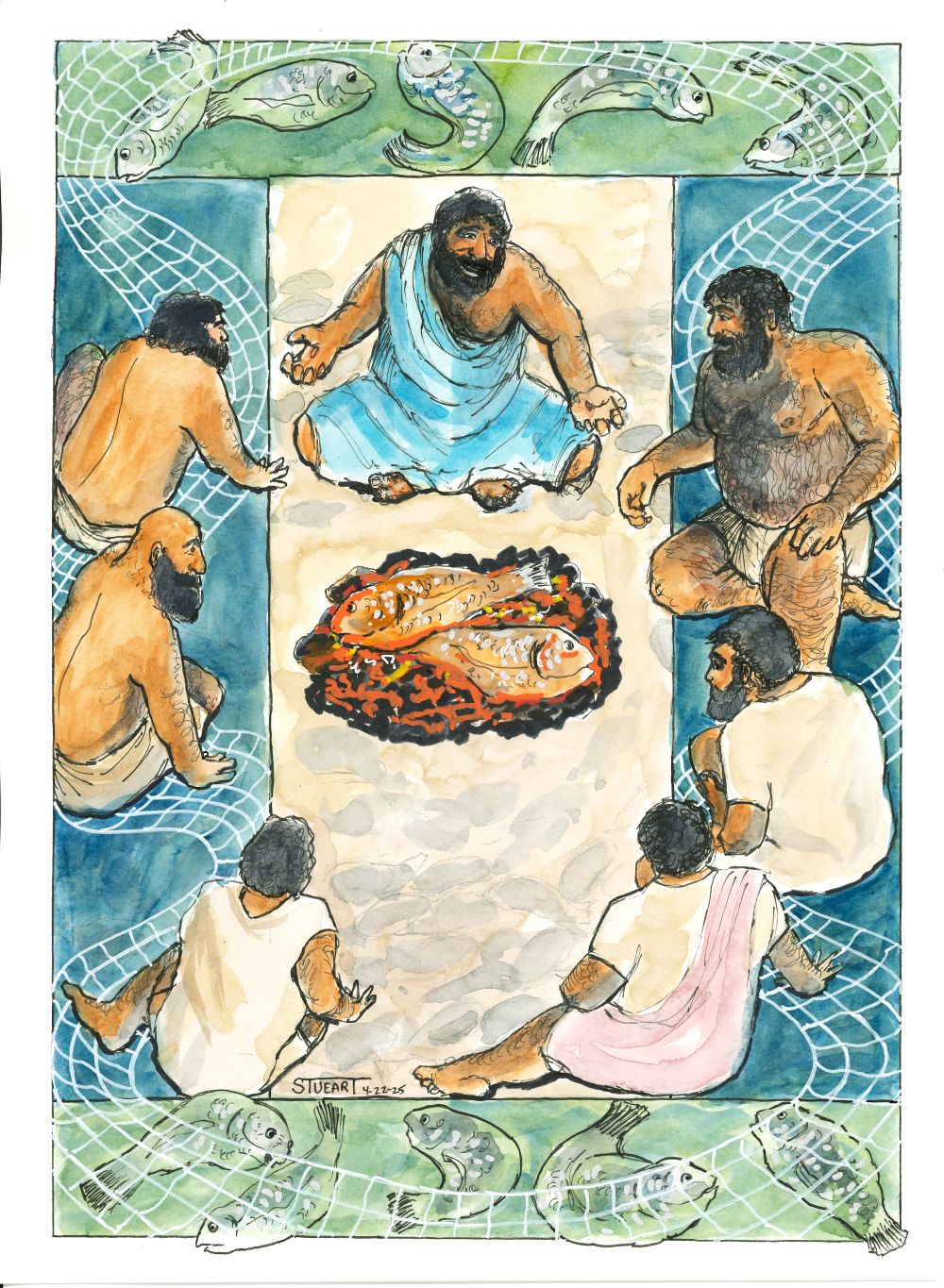
A Healing Breakfast on the Beach: Jesus and the Restoration of Peter

Peter learns to forgive himself.

“A Healing Breakfast on the Beach (After Easter Series),” Jerome Stueart, (11 x 15) watercolor and mixed media on paper. 4-22-2025.

A good meal can heal us.

This is a depiction of a beautiful story (John 21) of Jesus, after he comes back from the dead, visiting his friends. It’s not unlike stories from friends I’ve talked to who have had someone pass recently. Stories of healing conversations with loved ones who have died. These stories have a similar theme, though maybe they didn’t see their friend quite so “in the flesh,” but the idea of a healing conversation still rings true and is common. We need to have old wounds resolved and healed after someone dies. Part of grieving is healing wounds that we might be keeping alive inside ourselves.

Continue reading

Coming Out at the Last Supper

Fifteen years ago, 2009, I came out to my evangelical Baptist church in Whitehorse, Yukon, over Easter week. My last official duties as the Deacon of Worship were to lead the Maundy Thursday service—but I didn’t know they were my “last.” I wrote a poem called “Nobody called it the Last Supper” and read it during the service. I can’t find the poem right now, but the gist of it was that no one knows when the Last of anything will happen. The consequences of our actions, our revelations, may disrupt the future of Suppers with those we love. Mine did. THEN it becomes the “last” in retrospect.

I wanted to commemorate this anniversary (though it moves around according to the moon) by creating a painting of the last supper, but with the chaos that is implied in the Da Vinci painting, and the chaos that happened when I came out to each family at my church individually over dinner during Holy Week back in 2009.

Continue reading