Emerging Revolutionary War welcomes back guest historian and park ranger Eric Olsen. Ranger Olsen works for the National Park Service at Morristown National Historical Park. Click here to learn more about the park.
What do poor health, a dead mother, a need to shop for new clothes, a pregnant wife, army business, a wife’s mental illness, family financial problems, and a desire to see family and old friends all have in common?
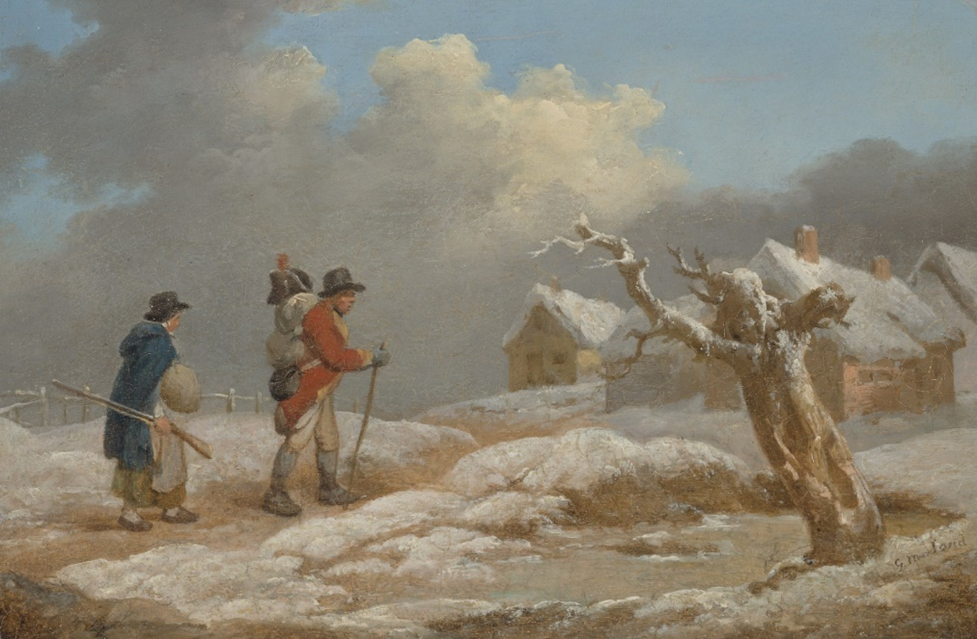
They are all reasons officers gave for asking for furloughs during the winter encampment of 1779-1780.
While the regulations and the various orders issued give us a general idea of the problems related to furloughs, we can get a different viewpoint by looking closer at the different Divisions, Brigades, and individuals who made up the army. The individual soldiers’ correspondence can also give us a more personal take on the furlough story. This paper will be far from comprehensive. It will just cover the furloughs that turn up in the surviving documentation. To make it easier to follow I have grouped the numbers and correspondence regarding furloughs by divisions and brigades.
Emerging Revolutionary War welcomes back guest historian and park ranger Eric Olsen. Ranger Olsen works for the National Park Service at Morristown National Historical Park. Click here to learn more about the park.
What do poor health, a dead mother, a need to shop for new clothes, a pregnant wife, army business, a wife’s mental illness, family financial problems, and a desire to see family and old friends all have in common?
They are all reasons officers gave for asking for furloughs during the winter encampment of 1779-1780.
While the regulations and the various orders issued give us a general idea of the problems related to furloughs, we can get a different viewpoint by looking closer at the different Divisions, Brigades, and individuals who made up the army. The individual soldiers’ correspondence can also give us a more personal take on the furlough story. This paper will be far from comprehensive. It will just cover the furloughs that turn up in the surviving documentation. To make it easier to follow I have grouped the numbers and correspondence regarding furloughs by divisions and brigades.
It’s hard to overemphasize how important Common Sense was as a tool of persuasion.
Sure, we all know about it. “The idea that Common Sense played a pivotal role in moving the nascent revolutionary movement toward independence is universally acknowledged today,” says historian Jett B. Conner.[1]
Yet I’ve found that, beyond its generally accepted place in American history, most people don’t quite “get” Common Sense. Reading the document today—like anything written 250 years ago—poses a challenge for modern readers. The language doesn’t catch for us the way it did for readers of its time. We aren’t living in the same political context they were. We marinade in a much different, much more immersive media environment. These factors all remove us from the visceral impact Common Sense had.
In the early days of my teaching career, I taught public relations classes. I had been a PR professional prior to that, enticed to the academy, but I wanted my classes to be grounded in the professional standards established by the Public Relations Society of America (PRSA). They had criteria for academic programs that wanted PRSA certification. My university didn’t qualify because we didn’t have a specific major in PR at the time, but I nonetheless used their standards as the model for my classes. One of the standards at the time advocated teaching the history of PR.
Several PR milestones sprang from the political arena: Andrew Jackson’s first use of a press secretary in the White House; Teddy Roosevelt’s bully pulpit; the WWI-era Creel Commission; FDR’s fireside chats; the WWII-era Office of War Information, etc.
Common Sense made the list as the most significant piece of American writing to that point—a track specifically aimed at public persuasion. And boy, did it succeed! “Common Sense was the most radical and important pamphlet written in the American Revolution and one of the most brilliant ever written in the English language,” assesses historian Gordon Wood.[2]
Prior to Common Sense’s publication in January 1776, John Dickinson’s Letters from a Farmer in Pennsylvania in 1767–8 held the record as the most influential piece of public writing. Published in 19 of the 23 major newspapers in the colonies—as well as appearing in England and France—the letters opposed Parliament’s Townsend Acts, which imposed tariffs. Dickinson, a lawyer rather than a farmer, became one of the most famous men in America because of his twelve letters, which did much to unify the colonies in common cause against British taxation.
“Farmer’s Letters captured the spirit of the moment and Americans’ imaginations like nothing before,” says Dickinson biographer Jane E. Calvertt, “selling more copies than any other pamphlet to date. The response was immediate and resounding, going far beyond anything Dickinson could have anticipated.”[3]
Thomas Paine’s Common Sense eclipsed Dickinson exponentially—some 100 times larger, according to historian John Ferling.[4]
Timing helped. Bloodshed on Lexington Green, at the North Bridge in Concord, and all along the road back to Boston added urgency to public discussions. Closure of the port of Boston and the October firebombing of Falmouth, Maine—and the foreboding message it suggested to other colonies—heightened tensions even more. England was no longer some abstract entity across the ocean, but an intrusive force ready to impose its will through violence if necessary. “It was successful because it came precisely the time when people were ready for its message,” says historian Alfred F. Young.[5]
“The suppressed rage that animated Paine’s writing in Common Sense was another important factor in its success,” contends historian Scott Liell, who said “Paine felt, and made his readers feel, ‘wounds of deadly hate.’”[6]
Through 1775, the Continental Congress remained undecided on a course of action, with factions pushing for independence and others pushing for rapprochement. Therefore, news from Philadelphia did little to provide clear guidance for public sentiment.
“[T]he idea of independence was familiar, even among the common people,” John Adams later pointed out.[7] The idea just hadn’t yet crystallized.
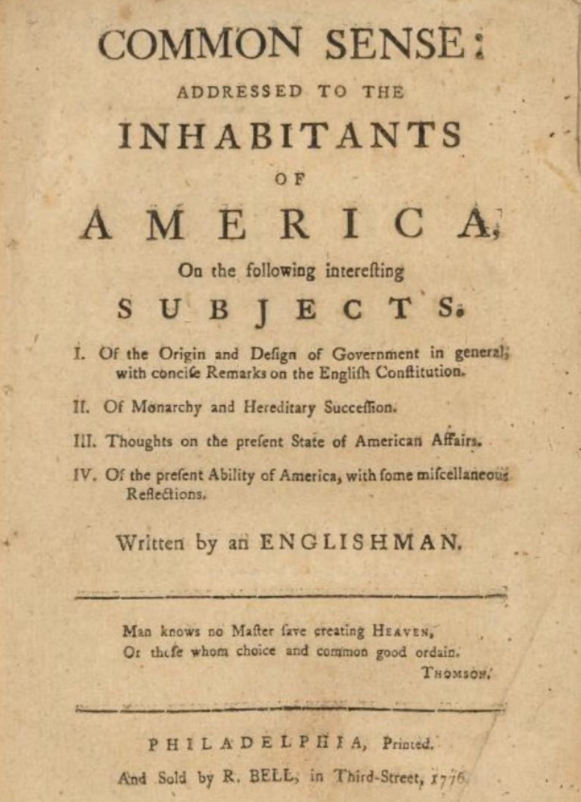
Common Sense—first published on January 10, 1776, as a 46-page pamphlet—became that crystal.
“[T]here is something absurd, in supposing a continent to be perpetually governed by an island,” Paine wrote. Paine made such sentiments seem like statements of the obvious. Of course a continent shouldn’t be ruled by an island. Of course one honest man was worth more to society and in the sight of God than all the crowned ruffians that ever lived. Of course.
That was the genius of Paine’s writing.
To read it today, one wouldn’t appreciate how accessible it was to common folks or realize how often people read it aloud in taverns and inns so that even people who could not read could hear its ideas and engage in discussions. A reader today wouldn’t grasp just how hungry readers of 1776 were for Common Sense’s ideas.
“In weighing the influence of a tract, the active role of the reader is often underappreciated,” Young points out.
Reading is an act of volition. A person had to buy the pamphlet; one shilling was cheap as pamphlets went but costly to a common carpenter who might make three shillings a day or to a shoemaker had made even less and out of the question for a common laborer who earned one-eighth of a shilling a day. Or a person had to borrow the pamphlet, seeking out an owner, or respond to someone’s blandishments to read it. When it was read aloud, as it was in taverns and other public places, a person had to make a decision to come to listen or to stay and hear it out.[8]
In other words, readers had to actively want to read it—and they sometimes went to great lengths and expense to do so.
Common Sense sold somewhere around 125,000 copies within its first three months and, within its first six months, went through thirty-five printings—an astounding success considering the population of the American colonies totaled just under 3 million people.[9] A translation appeared for Pennsylvania’s German communities, and editions appeared in England and France.
Sales figures probably only scratch the surface of the pamphlet’s total circulation. “As its reputation and popularity spread,” says historian Scott Liell, “individual copies were read and re-read to countless assembled groups in public houses, churches, army camps, and private parlors throughout the colonies.”[10]
“Its effects were sudden and extensive upon the American mind,” pronounced Philadelphia physician Dr. Benjamin Rush, a friend of Paine’s who had suggested the title. Suddenly, the pearl-clutching in Congress became open, vigorous, public debate. (See Kevin Pawlak’s January 9, 2026 post for more info on the public reactions.) “The controversy about independent was carried into the news papers . . .” Rush recalled. “It was carried on at the same time in all the principal cities in our country.”[11] Indeed, in was in early February 1776 in a New York City bookshop—on his way from Boston to Philadelphia—that Adams first found Common Sense. (Adams would have his own complicated history with the pamphlet, which I’ll explore in a future blog post.)
To this day, Common Sense has never been out of print. It exists today as an icon, a relic, a foundational text we’ve all heard of. We accept its primacy as fact. But few people actually read it, and fewer successfully tune in to its urgency and immediacy. In commemoration of its 250th birthday, I invite you to take a closer look at a document you certainly know and think you know, and see what new sense you may be able to draw from it. (Read it here!)
[1] Jett B. Conner, John Adams vs. Thomas Paine: Rival Plans for the Early Republic (Yardley, PA: Westholme, 2018).
[2] Gordon Wood, “Thomas Paine, America’s First Public Intellectual,” Revolutionary Characters (New York: Penguin, 2006), 209.
[3] Jane E. Calvert, Penman of the Founding: A Biography of John Dickinson (London: Oxford University Press, 2024), 184.
[5] Aldred F. Young, “The Celebration and Damnation of Thomas Paine,” Liberty Tree: Ordinary People and the American Revolution (New York: New York University Press, 2003), 271.
[6] Scott Liell, 46 Pages: Thomas Paine, Common Sense, and the Turning Point to Independence (Philadelphia: Running Press, 2003), 20.
[9] Young says, “Scholars have generally accepted a circulation of 100,000 to 150,000 copies (although none of them make clear how they reached their conclusions).” Liberty Tree, 270.
Virginian Landon Carter was vocal about the latest pamphlet sweeping through the American colonies in 1776. In several diary entries from the first four months of that momentous year, he commented on Common Sense, written anonymously “by an Englishman.” Carter described its contents in February as “rascally and nonsensical as possible, for it was only a sophisticated attempt to throw all men out of principles.” By April, as he continued to criticize the work, he reached a conclusion about its author: “I begin now more and more to see that the pamphlet called Common Sense, supporting independency, is written by a member of the Congress …” Carter could not have been further from the truth.
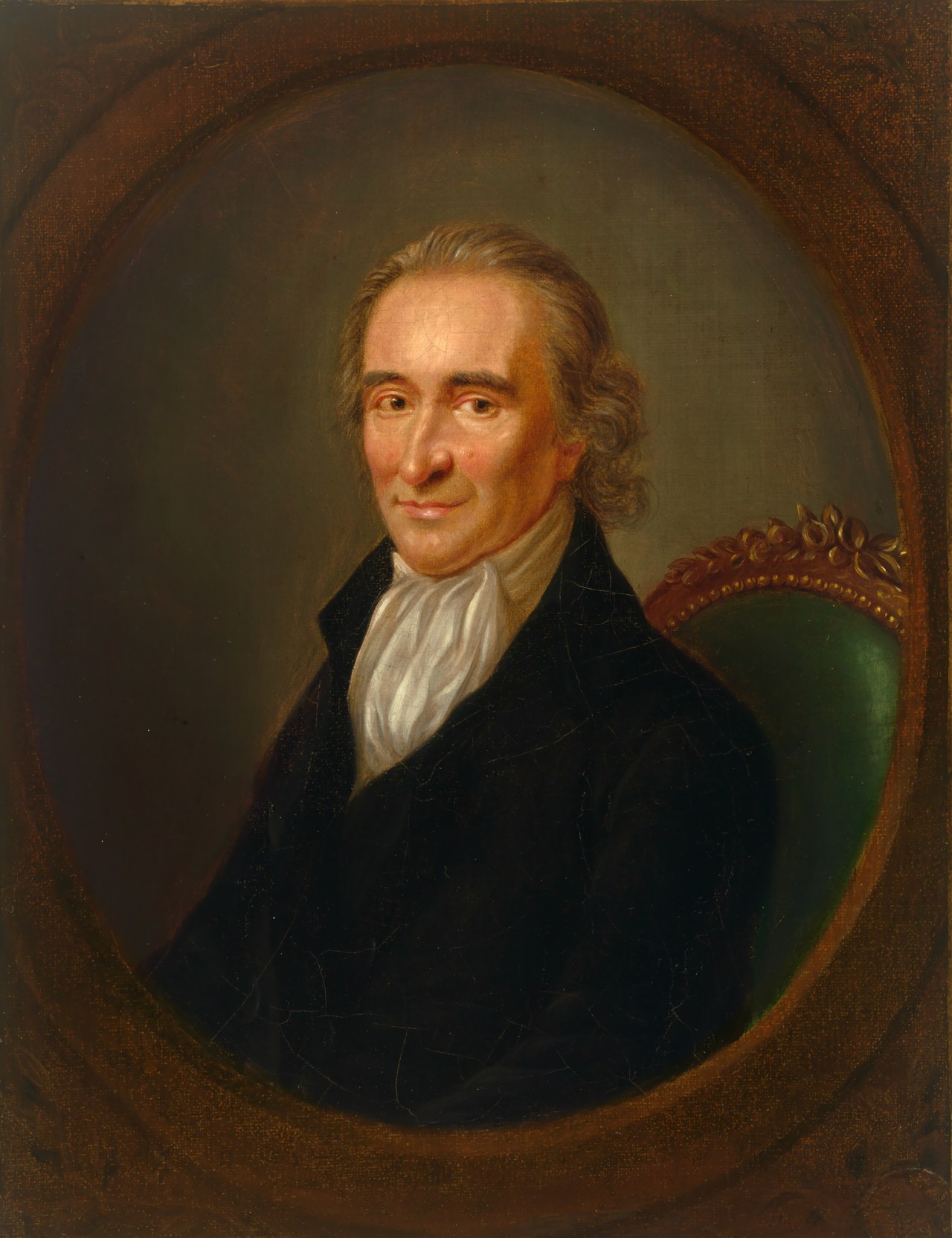
“An Englishman” was, in fact, an apt description for the author of Common Sense, first advertised to the American public on January 9, 1776, and first released on January 10. Thomas Paine was an Englishman—born there and, by most measures, matured there as a failure. He failed at his corset-making business. Teaching, collecting taxes, privateering, and working as a grocer—none of these occupations suited him either. He married twice (his first wife died in childbirth), and his second marriage collapsed. Amid this string of failures, Paine found success with the written word, which caught Benjamin Franklin’s attention in England in 1774. With little left for him in England, Paine embarked for America, arriving later that year. There, he scraped by as a writer, publishing essays in Philadelphia newspapers.
Join us this Sunday, January 11th at 7pm as we welcome back historian Patrick Hannum as we discuss the events in Virginia after the Battle of Great Bridge. The results of the British loss at Great Bridge had profound impacts on Dunmore’s plans in Virginia which led to the destruction of Virginia’s largest city. Was Norfolk burned by Dunmore as has been popularly understood or is the story more complicated? What became of the former slaves that joined Dunmore’s army? Tune in and learn about the events in Virginia in the winter 1775 – spring 1776. This Revelry is pre-recorded and will be posted to our Facebook page on Jan. 11 at 7pm and also to our You Tube and Spotify channels.
Emerging Revolutionary War welcomes back guest historian Evan Portman
It’s often said that politics makes strange bedfellows, but that’s also true of war. On a blistering December night in 1775, Col. Henry Knox found himself sharing a cabin with the unlikeliest of people: the British officer John André.
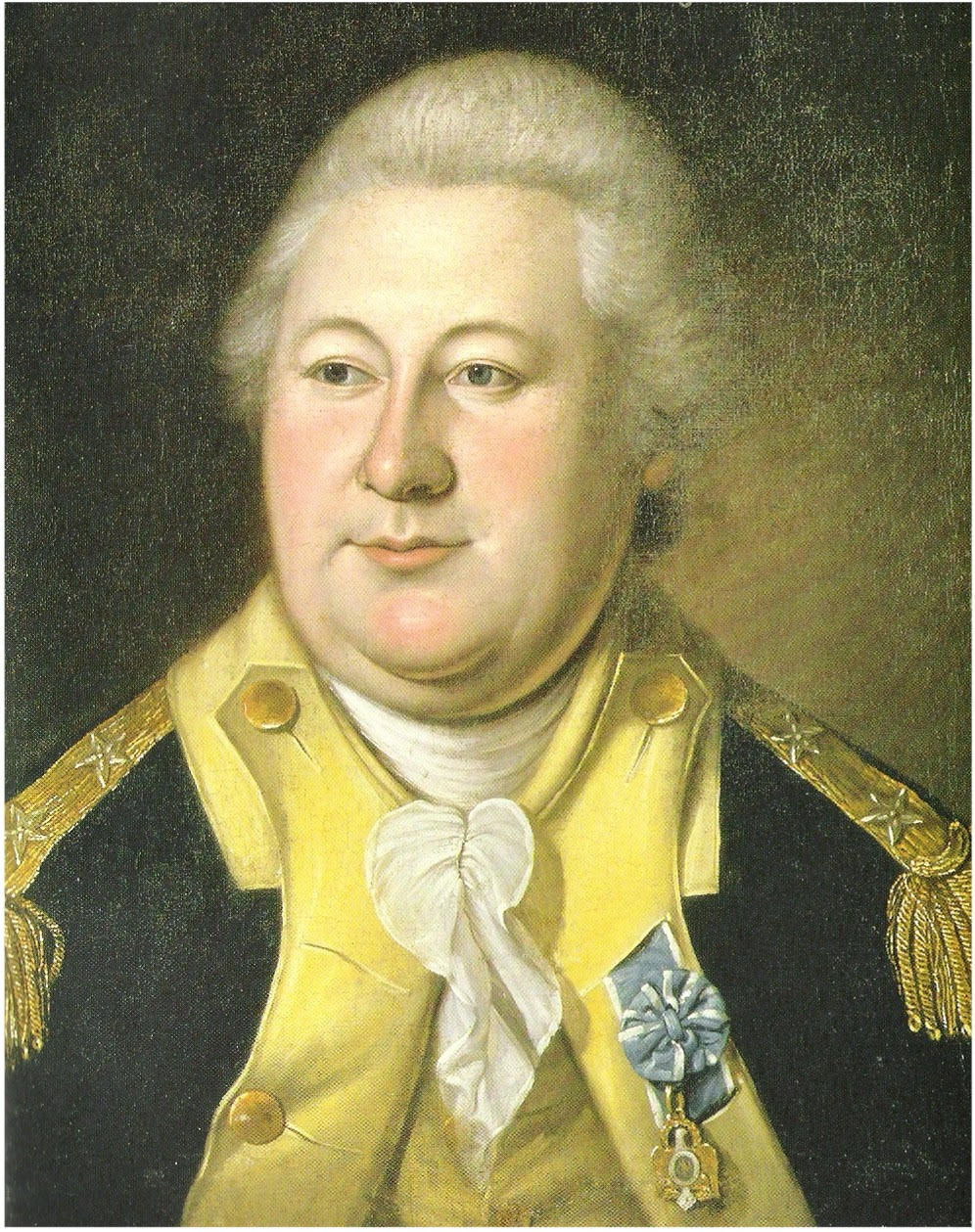
Henry Knox
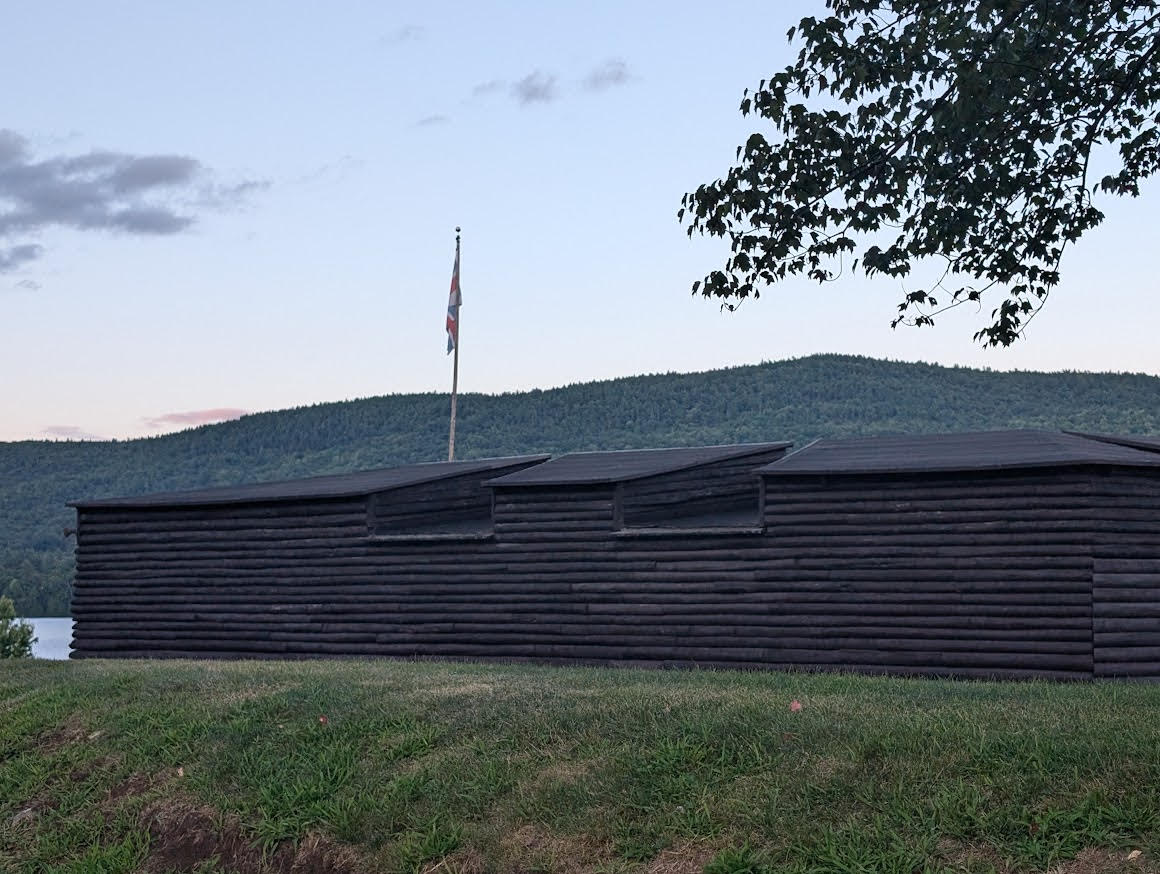
Knox was on his way to retrieve captured artillery at Fort Ticonderoga alongside his brother, William. The pair traveled up the Hudson River, facing heavy winds and harsh winter weather along the way. On December 4, a snowstorm hit just as Knox and his brother reached Fort George at the south end of Lake George, about 40 miles from Ticonderoga. Colonel Knox decided to spend the night there and sail up the lake to Fort Ticonderoga the following day.[1]
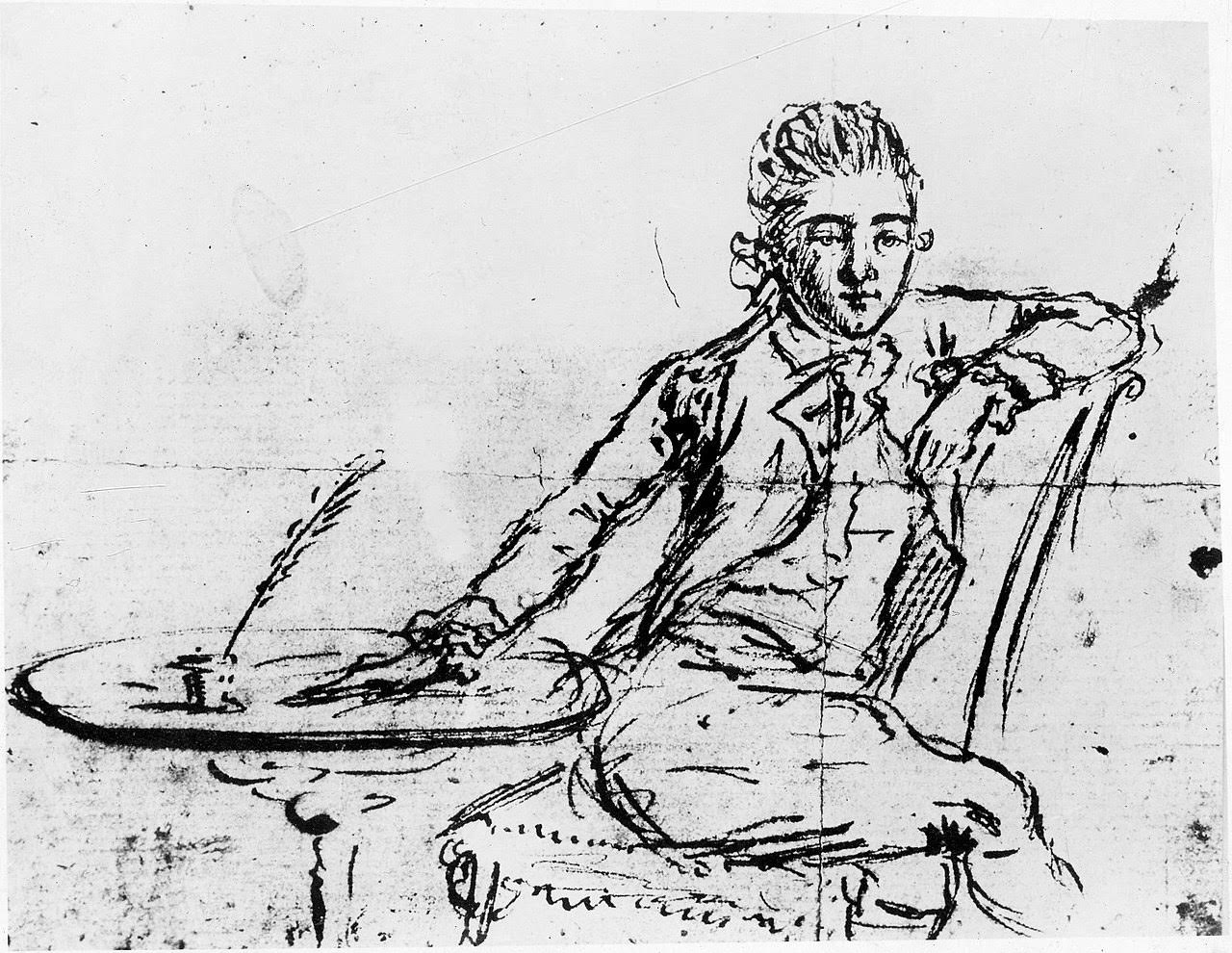
Knox received a one-room log cabin for the night, which, for lack of proper quarters, he shared with a captured British lieutenant named John André. André had surrendered during the American siege of Fort Saint-Jean in November 1775 and was being transported as a prisoner of war to Lancaster, Pennsylvania. The chance encounter sparked a brief companionship between the two men. Knox and André were the same age and shared a variety of intellectual pursuits, including a deep passion for art and literature. Both had also given up their respective trades to pursue a military career.[2]
However, Knox was careful not to betray the secrecy of his mission. The colonel, who was dressed in civilian clothes, probably did not reveal his military affiliation as a chief lieutenant of George Washington. Nonetheless, the two bedfellows passed the night by the firelight discussing their common interests. André charmed Knox, as he did most men who made his acquaintance, and the British officer’s intelligence and charisma made left a lasting impression on the artilleryman. Alexander Hamilton later recalled that “there was something singularly interesting in the character and fortunes of André” who “united a peculiar elegance of mind and manners, and the advantage of a pleasing person.”[3] The two men cordially parted ways the following day, as Knox made his way to Fort Ticonderoga and André departed for Lancaster.[4]
John André
Five years later Knox and André met again under much different circumstances. By 1780, André had risen to the rank of major and taken charge of the British spy network. It was in this role that the young officer found himself caught up in one of the great dramas of American history: the treachery of Benedict Arnold. André helped facilitate Arnold’s betrayal and eventual defection to the British army, but he was captured by American sentries in the process. Washington appointed a tribunal of 14 Continental Army officers to try André. Among them was Brig. Gen. Henry Knox.
The tribunal unanimously found André guilty of espionage and therefore ordered his death by hanging—the typical form of execution spy in the eighteenth century. Knox did not record his feelings on the matter, and André did not relate whether he recognized the portly artilleryman with whom he had once shared a cabin. Regardless, any companionship between the two men had evaporated as Knox signed André’s death warrant alongside his Continental comrades.[5]
Despite his tragic circumstances, André maintained marked civility even in the face of his execution. Knox looked on as André approached the gallows and declared, “I have said all I have to say before, and have only to request the gentlemen present to bear testimony that I met death as a brave man.”[6] With that, the cart moved out from under André’s feet, and Knox watched as his one-time companion hung.
Despite his role in André’s untimely death, Knox looked back fondly upon his one-time companion. James Thacher, who was stationed at West Point in 1780 and witnessed André’s trial, recalled that Knox “often afterward expressed the most sincere regret, that he was called by duty, to act on the tribunal that pronounced his condemnation.”[7] Though André’s life ended that October day, Knox served in the Continental army with distinction for the rest of the war. However, he never forgot his chance encounter with the charming British officer on that cold, winter night in 1775.
Fort George
[1] Mark Puls, Henry Knox: Visionary General of the American Revolution (New York: St. Martin’s Press, 2008), 37.
[2] Puls, Henry Knox, 37; Noah Brooks, Henry Knox: A Soldier of the Revolution, Major-General in the Continental Army, and Washington’s Chief of Artillery (New York: Cosimo, Inc., 2007), 42.
[3] Alexander Hamilton to Lieutenant Colonel John Laurens, 11 October 1780, The Papers of Alexander Hamilton, vol. 2, 1779–1781, ed. Harold C. Syrett, (New York: Columbia University Press, 1961), 460.
[4] Puls, Henry Knox, 37-38; Winthrop Sargent, Life and Career of Major John André (Boston: Ticknor and Fields, 1861), 85.
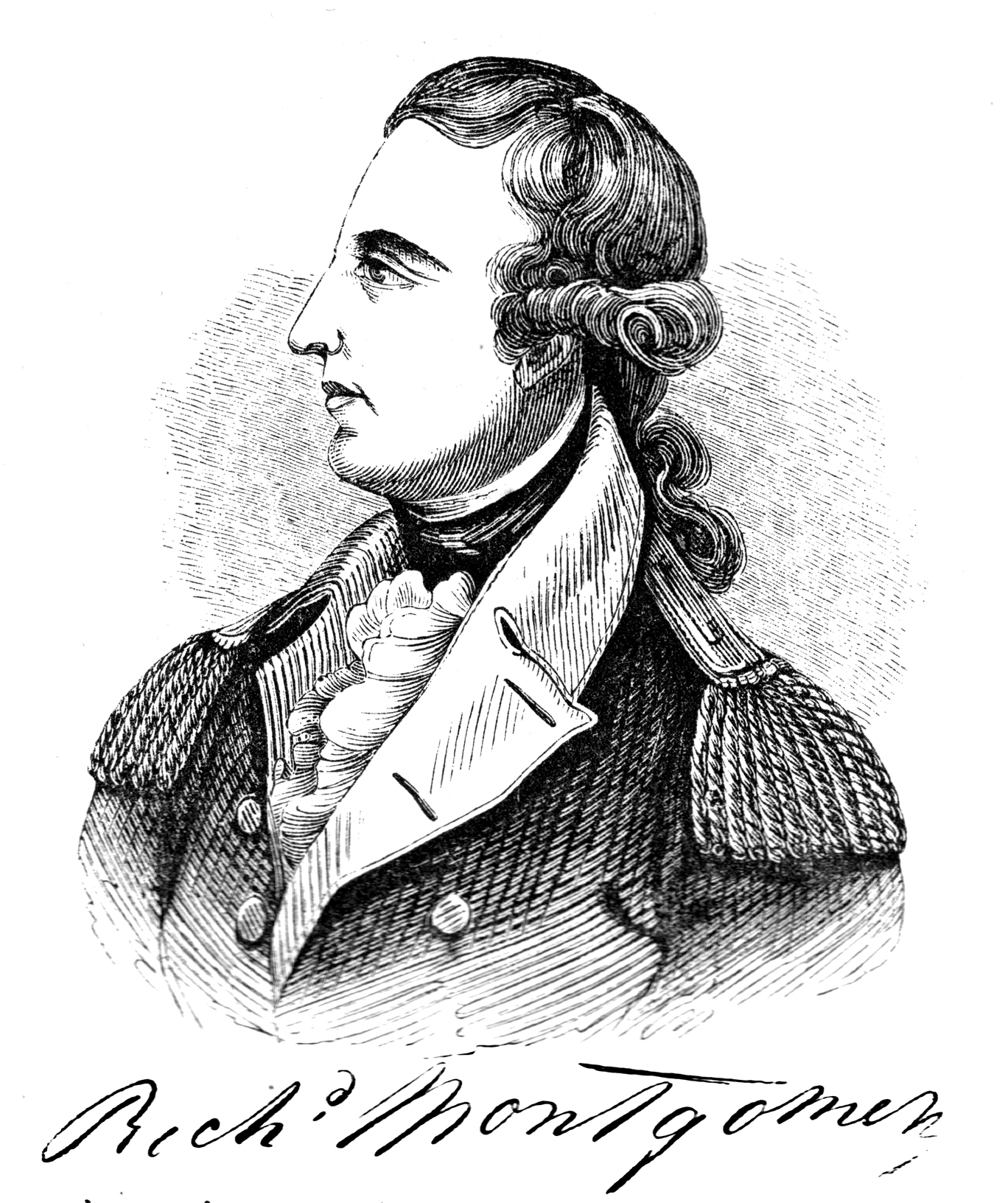
Continental General Richard Montgomery huddled over his desk outside the walled city of Quebec, clinging to candlelight as he wrote a letter to his wife. Wind howled and snow pelted the Continental forces preparing to attack the city on the St. Lawrence River. “I wish it were well over with all my heart, and I sigh for home like a New Englander,” Montgomery confessed to his wife, Janet. He had come a long way over the last few months—and even farther over the course of his life.
General Richard Montgomery
Like a New Englander, Montgomery wrote. Despite his rank in the Continental Army, he was no New Englander, but an Old Englander. His path to becoming an American hero resembled that of several Revolutionary leaders. Like George Washington, Horatio Gates, and others, Montgomery had served in the British Army during the French and Indian War. His road to an American generalship, however, was far from straightforward. Indeed, he was a latecomer to the American cause.
This year will mark our SIXTH Annual ERW Bus Tour. In past years we walked in the footsteps of history at Trenton/Princeton, Monmouth/Valley Forge, Charleston/Eutaw Springs, Lexington/Concord, Brandywine/Paoli. Each year our tour has grown, our first tour coming out of COVID had a hearty 45 souls, but in recent years our tours have sold out. Our 2026 tour we will cover the battles and surrender of Saratoga (Freeman’s Farm, Bemis Heights) on October 9-11, 2026.
As in years past, we do an early release of our next bus tour to those who have been on past bus tours. Then on January 1st, we open the tour to everyone. Well this year, our past customers have been so satisfied that we have SOLD OUT our 2026 bus tour already to just our early bird customers! We could not be more honored by this and it shows the excitement around America’s 250th.
Though the tour is sold out, we want to create a wait list in case people who have already registered have to withdraw. To get your name on the waitlist, please email us at: emergingrevolutionarywar@gmail.com. The tour details are below.
Once again, thank you to all of you have gone on our tours in the past and made the decision to join us in 2026. If you have not been on one of our tours before, please email us to get on our waitlist!
This Army Will Not Retreat: The Battles of Saratoga Bus Tour
October 9-11, 2026
Join Emerging Revolutionary War historians on a bus tour of the 1777 battles in Saratoga, that turned the tide of the war. Program includes Friday night lecture, tour all day Saturday and half day Sunday. Lunch included on Saturday.Tour fee is $250 per person, does NOT include hotel accommodations. Host hotel is the Gideon-Putnam in Saratoga Springs, NY.
In honor of the 250th anniversary of the Battle of Quebec, we reshare guest historian Scott Patchan’s post on Daniel Morgan during the Canadian Campaign of 1775. This post originally posted in December 2015.
When the situation deteriorated to outright rebellion against the crown, Morgan raised a regiment of crack riflemen from Frederick County, and marched them to Boston in twenty-one days to take part in the siege of Boston. There, he served under his former commander from the French and Indian War, General George Washington. Morgan learned the hard way that orders must be followed. He once allowed his riflemen to exceed orders in firing upon British positions at Boston. Washington called Morgan on the disobedience, and Daniel thought that he would be cashiered from the army. Washington, however, relented the next day, but Morgan had learned a valuable lesson about following orders.
Daniel Morgan in the American Revolution
In the fall of 1775, Washington sent Morgan as commander of three companies of Continental riflemen on a mission to capture Quebec from the British. Morgan’s command marched with the column of Colonel Benedict Arnold. They traversed the Maine wilderness, rowing up stream to the “Great Carrying Place,” where carried their canoes and bateaux for great distances overland to another series of streams and lakes that took them to Quebec. As the cold weather set in, sickness and hunger overtook the column and Arnold sent those unfit for duty back to the rear. After covering 350 miles, the American arrived in front of Quebec in early November, surprising the British.
Although Morgan wanted to attack immediately and utilize the element of surprise, he was overruled and the small American force besieged Quebec, waiting for another column under General Richard Montgomery to arrive from the Hudson Valley. When a British party sallied forth and captured one of Morgan’s riflemen on November 18, Arnold believed the British would come out and fight in the open. As such, Arnold drew up his army in front of the fortifications to meet them. They declined his offer and instead looked down on the ragamuffin Americans from the ramparts and exchanged taunts and catcalls. The overall situation frustrated the irascible Morgan, and when his men complained that Arnold was not giving the riflemen their fair share of rations, the “Old Wagoner” violently argued with Arnold, and nearly came to blows with the future traitor. Morgan departed Arnold, leaving him with angry warning about poor treatment of the riflemen. From that time forward, Morgan’s command always received their fair share of the army’s rations.
Montgomery’s column arrived on December 5, and the Americans commenced setting up his mortars and artillery outside of Quebec. The Americans finally attacked during a snowstorm in the early morning darkness of December 31, but their force numbered only 950 men. Arnold’s column came under fire as it moved toward the ramparts of Quebec, and a musket ball struck Arnold taking him out of action. Although Morgan was not the senior officer, the others insisted that he take command, having seen actual combat which they had not. Morgan later noted that this “reflected credit on their judgment.” At Morgan’s order, his riflemen rushed to the front, armed with both their Pennsylvania rifles and a spontoon for the assault while some carried ladders to storm the walls. They quickly drove a small force of British away and closed in on the walls.
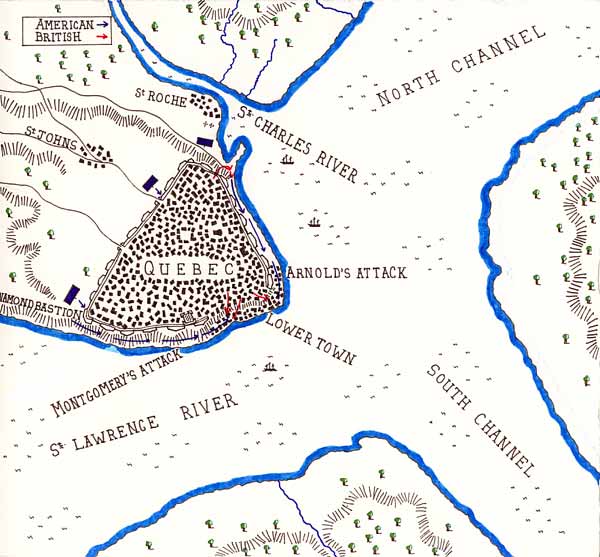
Map of Battle of Quebec, 1775 (courtesy of British Battles)
Morgan ordered the men up the ladders and first one gingerly began the climb. Morgan sensed his hesitancy, pulled him down and scaled it himself, shouting, “Now boys, Follow me!” The men instantly complied, and Morgan reached the top of the wall where a volley of musketry exploded, knocking him back to the snow-covered ground. The burst burnt his hair and blackened his face; one ball grazed his cheek and another pierced his hat; but Morgan was otherwise unhurt. Stunned he laid motionless on the ground for a moment, and the attack stopped, his men thinking him dead. But he soon stirred and clambered up the ladder to the cheers of his men who followed suit. This time he stopped before reaching the top, and hurtled himself over the rampart into the midst of the enemy. He landed on a cannon and injured his back and found British bayonets levelled at him from all directions. While the British focused on Morgan, his riflemen poured over the wall and came to his rescue, driving off Morgan’s would-be impalers. Morgan kept up a close pursuit of the British who offered weak resistance to the attacking riflemen. Although Morgan had broken into Quebec, the main body of Arnold’s division failed to follow the riflemen over the wall and exploit the opportunity at hand. Morgan captured much of the lower portion of Quebec with only two companies of his riflemen. He later described the breakdown that occurred:
“Here, I was ordered to wait for General Montgomery, and a fatal order it was. It prevented me from taking the garrison, as I had already captured half of the town. The sally port through the (second) barrier was standing open; the guard had left it, and the people were running from the upper town in whole platoons, giving themselves up as prisoners to get out of the way of the confusion which might shortly ensue. I went up to the edge of the upper town with an interpreter to see what was going on, as the firing had ceased. Finding no person in arms at all, I returned and called a council of war of what few officers I had with me; for the greater part of our force had missed their way, and had not got into the town. Here I was overruled by sound judgment and good reasoning. It was said in the first place that if I went on I should break orders; in the next, that I had more prisoners than I had men; and that if I left them they might break out and retake the battery we had just captured and cut off our retreat. It was further urged that Gen. Montgomery was coming down along the shore of the St Lawrence, and would join us in a few minutes; and that we were sure of conquest if we acted with caution and prudence. To these good reasons I gave up my own original opinion, and lost the town.”
Montgomery never arrived; he had been killed in the first blast of musketry against his column, and his command broke. As time went on, the British regained their composure and pushed back against Morgan’s command. Morgan went back and brought up 200 New Englanders who joined the riflemen as they attempted to renew the attack. Now, the previously undefended point, was well manned, and daylight illuminated the paucity of Morgan’s numbers. Nevertheless, Morgan pressed them back further into the town to an interior fortification. A brave British officer led a counterattack, but Morgan personally shot him dead and disrupted the assault. Nevertheless, the time for action had passed. The British had become aware that Morgan’s was the only active American force in the city and closed in around him. In the meanwhile, additional British forces reoccupied the gates Morgan had initially taken and trapped him in the city. Morgan had no choice but to surrender his small command.
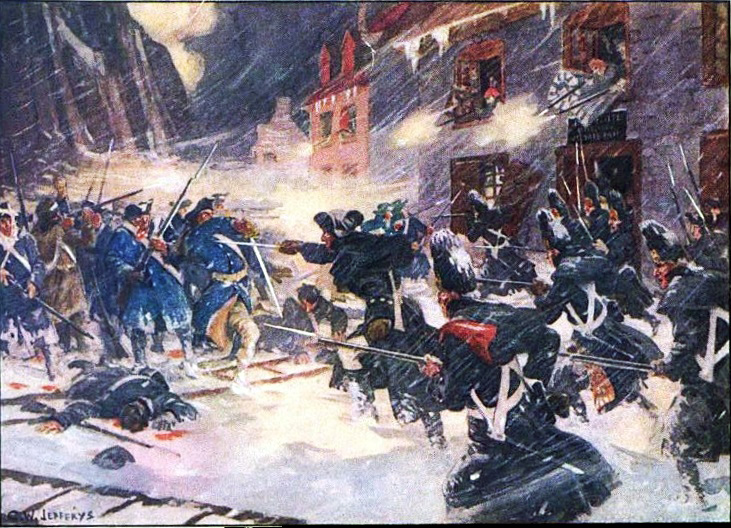
One artist’s depiction of the Battle of Quebec, 1775. Both forces are wearing blue overcoats. (courtesy of British Battles)
Morgan and the other officers enjoyed a liberal captivity with generous quarters in a seminary. The British officers visited them often and remained on friendly terms with the Americans. Morgan developed a dislike for some of his fellow officers whom he regarded as dishonest and scheming, and his fighting skills were brought to bear on at least one occasion when several men teamed up against big Dan Morgan. The imprisonment ended when the British returned the American officers on September 24, 1776, in New Jersey. Morgan returned to his wife and two daughters at his home outside of Battletown or Berryville, where he awaited his proper exchange. While there, he named his home “Soldier’s Rest,” as he recuperated from the trials of the taxing expedition to Quebec. The war was still young, and the Continental Army would soon be calling upon his services again. A special command of riflemen was being organized and Morgan would be its commander.
Emerging Revolutionary War welcomes guest historian Andrew J. Lucien. Brief bio of Andrew follows the post.
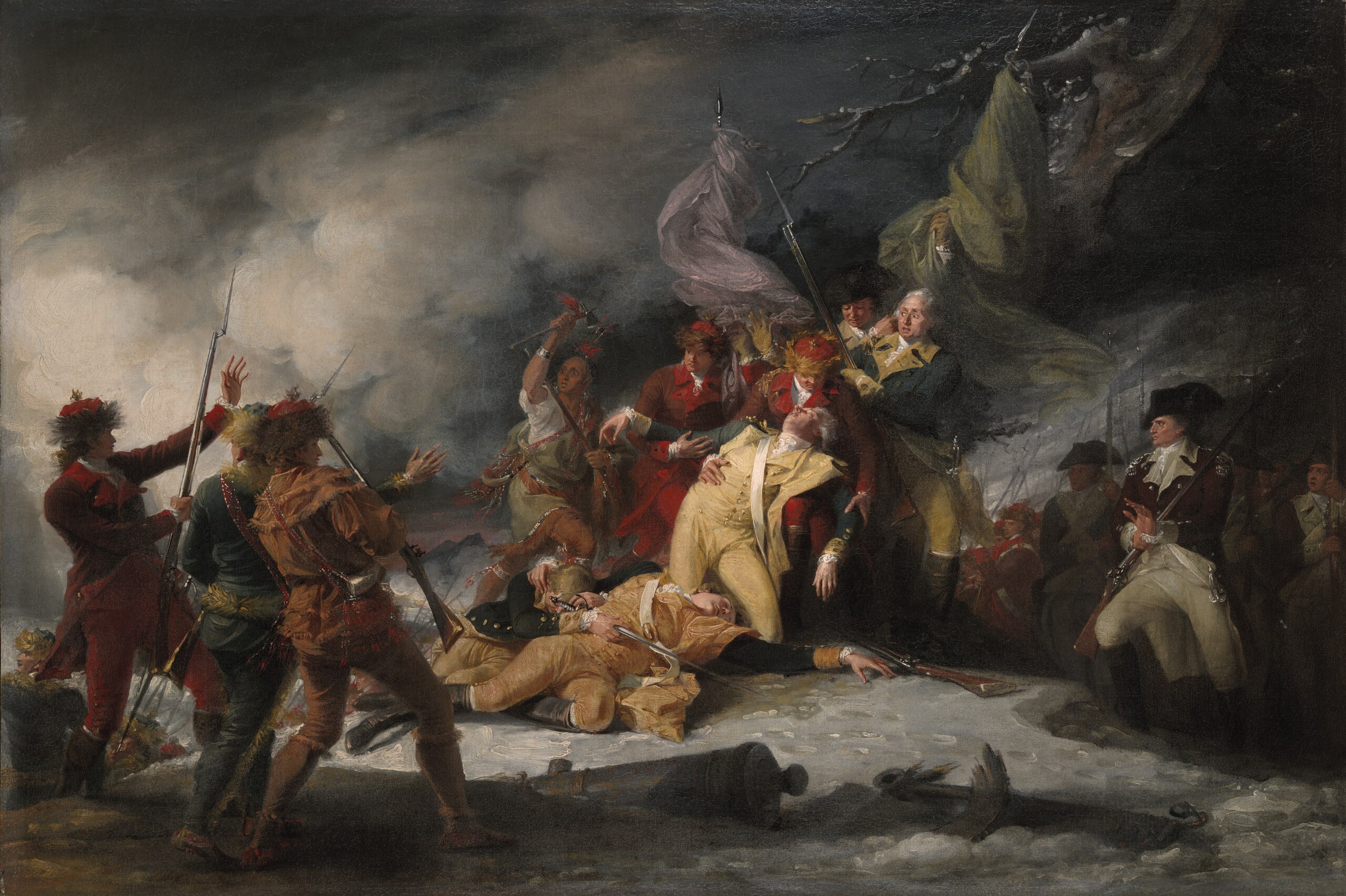
Death of General Richard Montgomery
Bunker Hill, Valley Forge, Yorktown, July 4, George Washington. These are the most common images that come to mind when the American Revolution is mentioned by most people. The collective unconscious of America has become steeped in the imagery of glorious American victories to win our independence from the superpower of the time. However, what many are unaware of is the unusual campaign that took place from 1775 to 1776, in an attempt to gain the support of Canada in our quest for independence. This campaign featured several battles, with the key one being the Battle of Quebec. This marked a significant turning point in the campaign and the war as a whole.
In 1775, the fate of the impending schism between Britain and its North American colonies was all but sealed. The colonial fervor had reached a climax at the Battles of Lexington and Concord in the spring of 1775, setting the mother country and its colony down a path of armed conflict. As tensions rose in 1775, Ethan Allan, along with Benedict Arnold, captured the British fort at Ticonderoga in early May, resulting in much-needed guns for the colonials. With successful action undertaken in the northern reaches of New York state, the Continental Congress approved plans to invade Canada. Intelligence led the patriots to believe that there were fewer than 700 British soldiers stationed in the Canadian territory and that the popular sentiment in the territory was in favor of rebellion, and that they, too, might take up arms against the British Crown.
By late September, Ethan Allan unsuccessfully attempted to capture Montreal. Near the same time, Benedict Arnold began to lead a force of around 1,100 men from Boston on an enterprise aimed at aiding in the capture of Canada (only about 600 would reach their destination). These men would eventually join forces with Richard Montgomery’s force around Quebec in December of 1775, “to finish the Glorious work you begun,” to quote George Washington. By the time Arnold’s men reached Canada, they were “in a very weak condition.” Montgomery’s force was moving north from Lake Champlain. His men captured Fort Chambly and Fort St. Johns. Following these captures, the force under Montgomery advanced on Montreal. The British governor, Guy Carlton, took approximately 150 men with him from Montreal to Quebec, believing it to be a more important and defensible position. Montreal was easily captured on the 13th. Montgomery did not rest long after capturing the fort, leaving a small garrison in Montreal and heading to join forces with Arnold’s men at Point aux Trembles. Montgomery, “…was anxious, after the capture of Chamblee, St. Johns and Montreal, to add Quebec, as a prime trophy to the laurels already won.”
With the combined force of Montgomery and Arnold now outside of Quebec, Montgomery sent Carlton multiple messages to surrender, which were all rejected. Upon hearing the refutation of his final offer, Montgomery was supposed to have said he would “dine in Quebec or Hell at Christmas.” Finally, with all other options seemingly exhausted, it was planned to forcibly take the city by sending Arnold’s corps to assault the lower town via St. Roque. Montgomery was to attack the lower town via Pres-de-Ville, near Cape Diamond. There was to be a fient east of St. John’s Gate under Colonel Livingston and one at Cape Diamond under Major Brown. The ultimate goal was to meet in the lower town, then storm the upper town.
Around midnight as the 31st began, clouds began to fill the sky and snow began to fall. This was a signal to the Americans to begin preparing for an assault, using the snowstorm as cover. By 2 a.m., the American troops began their movements. At about 4 a.m., Captain Malcolm Fraser saw flashes and lights on the Heights of Abraham. Fraser suspected that the lights were a sign of the American troops’ movement and ordered his guards to arm. The British began to play their drums and ring their bells to alert the men of Quebec to prepare for the city’s defense. The Americans launched two rockets to signal the beginning of their assault. With the rockets illuminating the early morning sky, the rebels began to fire their muskets into the British line. With the darkness of the morning still upon the soldiers, the British were unable to see their opponents, except when their muskets would flash and illuminate their heads. They used the flash of the muskets to guide their return volleys. The Americans began to launch artillery into Quebec from St. Roque. When Arnold saw the rockets in the morning sky, he led about 600 men from St. Roque to attack the British works at Saut-au-Matelot. Montgomery led his force of about 300 men to attack the works at Pres-de-Ville. Montgomery believed that this location was ripe for an escalade.
Arnold and the rest of his column advanced along the waterfront through St. Roque. The British sailors stationed there rained fire down on the Americans from atop the ramparts. The Americans “could see nothing but the blaze from the muzzles of their muskets.” As the Americans pressed forward, they lost the cover of the houses. Arnold was hit in the leg by enemy fire near the first barricade, and he was taken from the field by two men. Arnold tried to rally his men as he was taken away. Despite the setback, the Americans under Daniel Morgan pressed forward and used their ladders to scale and capture the first barricade at Saut-au-Matelot, along with 30 British troops. Here, the Americans found their muskets useless due to the snow. Many colonial troops resorted to confiscating British muskets. The Americans continued about 250-300 yards further to attempt to capture the second barrier, where they met opposition from the British. The Americans, on a narrow street, moved against the British, who had their own strong defenses, including a 12-foot-high barrier, cannons, and two lines of soldiers ready to repulse the attacking Americans. The British fired down on the Americans from the tops of the buildings. The colonial troops attempted to climb the barrier but were forced back by the British inside with their bayonets fixed. They then fired from under the cover of the houses, allowing the British to see them only as they moved from house to house. The attackers contemplated retreating; however, they tarried, ultimately a dire mistake. Carleton, aware of the developing assault, men to attack the flank of the Americans. With the Americans now flanked and facing stiff opposition in front, they surrendered to the British force.
Montgomery and his men suffered a far more deadly fate. As his column approached Pres-de-Ville, Captain Barnsfair had his men next to their guns and at the ready when the Americans arrived. The British had erected a barrier here with a battery. The Americans advanced within 50 yards of the British guns and halted, then resumed their advance, likely because they believed the soldiers were not on guard. Barnsfair “declared he would not fire till he was sure of doing execution, and… waited till the enemy came within… about thirty yards’ distance” and then called out, “fire!” “Shrieks and groans followed the discharge.” The fire of canister, grapeshot, and musketfire was deadly. When the fire stopped, the field of battle was clear with no rebels left standing on the field. Montogemery was one of the casualties of the action, found lying on his back with his arm still in the air. Seeing the folly of another assault, the remaining men retreated. An officer of Carlton’s declared the battle “a glorious day for us, and as compleat a little victory as was ever gained.” When the dust settled, the Americans suffered about 50 killed, 34 wounded, and 431 captured or missing, while the British defenders lost only 5 killed and 14 wounded. The fighting had lasted only around 4 hours.
Bibliography:
“An Account of the Assault on Quebec, 1775,” The Pennsylvania Magazine of History and Biography 14, no. 1 (1890): 47–63.
Blockade of Quebec in 1775–1776 by the American Revolutionists (les Bastonnais). Historical event, Quebec City, 1775–1776.
Caldwell, Henry. The Invasion of Canada in 1775. Quebec: Literary and Historical Society of Quebec, [microform].
Hatch, Robert McConnell. Thrust for Canada: The American Attempt on Quebec in 1775–1776. Boston: Houghton Mifflin, 1979.
Henry, John Joseph. Account of Arnold’s Campaign Against Quebec, and of the Hardships and Sufferings of That Band of Heroes Who Traversed the Wilderness of Maine from Cambridge to the St. Lawrence, in the Autumn of 1775. Albany: Joel Munsell, 1877.
Bio:
Andrew Lucien is a social studies curriculum director at the Cleveland Metropolitan School District, host of The Civil War Center podcast, and founder of thecivilwarcenter.com. He has written extensively on the Civil War and Revolutionary War.




 Emerging Revolutionary War Era