[go: up one dir, main page]

Archives for category: Tyranny

Paul Krugman, Nobel Prize-winning economist, is outraged by the Supreme Court’s decision to overturn the almost century-old precedent known as Humphrey’s Executor, which held that presidents could not fire members of independent commissions without cause..

The case was called Trump v. Slaughter. Rebecca Slaughter sued when Trump removed her from the Federal Trade Commission without cause. The court ruled in favor of Trump 6-3, allowing him to fire members of independent commissions without cause and replace them with cronies. Empowered with this decision, he can fire every Biden appointment and replace them with a MAGA yahoo who takes orders from Trump or Stephen Miller.

The New York Times wrote:

Rebecca Slaughter, the former Federal Trade Commission member whose firing was upheld by the Supreme Court on Monday, warned that the justices allowed for the possibility of abuse of presidential power.

Independent agencies like the F.TC. were created to act as watchdogs of powerful corporations, without interference by the president, the former Democratic commissioner said in a statement shortly after the decision was handed down.

“Today’s ruling makes it possible for presidents to fire watchdogs who won’t put politics over principle, and replace them with lap dogs,” Ms. Slaughter said. “It’s a recipe for corruption; working families will pay the price.”

The Supreme Court’s 6-to-3 decision in the case, Trump v. Slaughter, effectively gives the president free rein to fire members of more than 20 independent federal agencies, which are typically led by members of both parties. The decision overturned a 90-year-old law restricting presidents from firing officials without cause.

The F.T.C. was founded in 1914 to oversee fair trade and competition in commerce and enforces consumer protection and competition laws. The agency typically has five commissioners, three from the party in the White House.

Ms. Slaughter was appointed by President Trump in 2018 and served as acting chair of the agency during the early Biden administration. When Mr. Trump began his second term, she was the longest serving commissioner.

Paul Krugman said the decision is a blow for dictatorship and chaos:

Earlier today, the Supreme Court declared war on U.S. democracy. It also declared war, basically, on modern society, on everything it takes to function in the 21st century. And I’m not sure that people understand that yet. 

Hi, Paul Krugman with a quick video update. I’ll have more on this tomorrow. 

Really shocking decisions handed down by the Supreme Court. There were a couple that were not awful. Lisa Graves gets to stay at the Federal Reserve, although that in itself is a huge contradiction to the important stuff that the court did. I mean, Lisa is important and the Fed is important, but much more important is Humphrey’s Executor, which is the generations-long precedent that says that when Congress creates an independent agency, it is independent. It’s able to make decisions. 

Of course, the president has some role. Typically, the president can choose the agency’s head subject to congressional approval, but the president can’t just go and fire officials that he doesn’t like for whatever reason or for no reason, because the agencies that operate the U.S. government and basically run our society are supposed to be professional. They’re supposed to be following their legal mandate. They’re not supposed to be personal tools of a dictator in the White House. 

Well, the court just scrapped that. Now, lawyers, people who are legal experts, can do a better job of explaining just what went down. But what I think is important to understand is not only does this give essentially dictatorial powers to the occupant of the White House, but it also makes it extremely difficult for the economy to function. It makes it extremely difficult for society to function. 

We live in a complicated world, a world of technology, where there are all kinds of spillovers, all kinds of ways in which it’s important that there be well-established ground rules. If you’re a business, take the example of medicines and foodstuffs, where we have an FDA, Federal Drug Administration, that is charged with ensuring that products that people consume are safe. We do that for very good reason. We know that not just that that there have been examples, historically, of products that were foods, medicines that were not at all safe, but also that people want some assurance.

The fact that something has been FDA approved is a bit of a warranty, that it might turn out to be very harmful, but probably not. Businesses that want to invest in developing stuff need to know that there are some ground rules that determine what they can and cannot sell.

Now imagine that all these decisions are made by political appointees who are loyalists to the president, who basically do whatever the president wants, whatever the people around the president want. 

Do you want to invest in something where you have absolutely no idea what the ground rules will be, whether it will be approved or not? Do you want to invest in a whole business line when, for all you know, the White House will abruptly decide that your product isn’t safe and that a competitor’s product is, based on spurious grounds? 

And what would cause those decisions to happen? Well, how about the fact that some businesses are better at the business of bribing the president and his family than others. And if you think that this is outlandish — you know, a few years ago you might have said this was outlandish, things like that wouldn’t really happen — well, as we speak, these things are happening all the time.

So you are setting up a situation in which, you know, it’s a little bit like traffic laws. Traffic laws, yeah, they can be annoying, but aren’t we all kind of glad that there are in fact rules about when you can turn and when you can go through an intersection? In order to function, in order to drive your car around you need to have a set of stable traffic rules, not a situation in which a police officer can decide you broke the law and the other guy did not because I say what the law is. And especially not where the police officer does that based upon who’s been paying him off or who he expects to be paid off. 

The real world is far more complex than traffic rules but we need those rules and we need some stability and those rules cannot be specified with every letter, every punctuation mark set by Congress. The world is too complicated and changes too much. You need to have standing ethos, standing doctrine at the agencies that make modern life possible. 

Now all of that is gone. 

Now, it just adds to it that all of this is being done to empower a president who is the worst possible person for this job. This is not somebody you want supervising anything, everything that Trump touches turns to crud because he doesn’t care and he doesn’t actually understand or recognize that there’s such a thing as expertise as knowing what you’re doing. 

So this would be terrible even if we had a temporarily competent administration. But now you’re doing all of this, the Supreme Court is doing all of this to empower the guy who brought you the Reflecting Pool, who brought you the Iran war. Utter nightmare. 

Now, what will happen, hopefully, we emerge at the other end having fended off dictatorship. Then, I mean, as everybody knows, this Supreme Court is not actually empowering the presidency. It is empowering this president. And as soon as there’s a Democrat in the White House, suddenly there will be all kinds of restrictions on what that person can do. 

Well, this cannot go on. This is a clear argument that says we have to one way or another disempower the Supreme Court. I don’t know enough to tell you what is the best route to do that but court packing or something else is going to have to happen. Because this has been the clearest signal yet that we have six people (there are three who are not part of it, but we have six people) who are fundamentally hostile to democracy, fundamentally hostile to the modern world and determined to put the catastrophically bad leader that we currently have sitting in the White House in charge of everything, which is a nightmare scenario on every level. 

Take care, I guess.

Timothy Snyder is an expert on European history. He taught for many years at Yale University and held a prestigious chair in European history. In 2025, he accepted a chair at the University of Toronto. His Substack blog is titled “Thinking About…” This important essay appeared in May 9. Nothing Snyder says here has changed.

He wrote:

The United States has just spent billions of dollars to lose a war that enriches its oligarchs, impoverishes the citizenry, sabotages its alliances, and strengthens its enemies. As justification for the self-destructive mindlessness, the White House gestures towards Jesus and genocide.

On April 20th I was asked to speak in New York about ethics and power. My thinking, which I expressed in a conversation at the Council on Foreign Relations, on this little video, and in the media, was that our utterly unethical war was also utterly self-destructive. The war, a catastrophe in itself, suggests the guiding principle of Trump foreign policy: superpower suicide. The term was since come into more general use, and readers have been asking me to spell it out.

Empires have risen and failed before, but to my knowledge no state has ever chosen to kill its own power, and succeeded with such rapidity.

It is hard to see this clearly. Even as we oppose individual Trump adventures, we hope that in some way they are based on some understanding of the national interest. They are not. To get the perspective we need to see the nature of this anti-strategic self-slaughter, it will help to consider thirteen traditional bases of state power.

1. Statehood. A superpower must, at a minimum, be a modern state. This means that it must be an arrangement that includes, via law and other institutions, a larger body of citizens within a common endeavor. There is no sign that the Trump administration regards the United States of America as a state. It treats the existence of the United States as a commercial opportunity for a select few people, American and otherwise.

2. National interest. Another minimal requirement of superpower would be a sense of why that power must be used. The Trump administration exhibits no interest in the good of the people. Theorists of international relations have differed as to how leaders understand national interests; we are intellectually unprepared, however, for a situation in which the leader simply does not care about either the state or the nation.

3. Succession. Again, for a state to maintain itself as a superpower, it must maintain itself over time. The basic requirement of such continuity is a succession principle, a means by which authority is transferred from some people to other people while institutions continue to function. In the United States, democracy enables succession. Historically, there are means of succession, for example by dynasty (or dynastic adoption, as in second-century Rome) or by the decision of a politburo, as in China or the USSR (in the US this would be a capitalist politburo, the sort of oligarchical coven that got us JD Vance). Getting from democracy to such different arrangements would end the American republic. Trump aspires to stay in power indefinitely, and says so. By putting the vote in question, he puts America in question, and thus American power.

4. Elites. For states to thrive and to accumulate and maintain power, the right people have to be in charge. There is no perfect means to achieve this, and there is the inevitable tension, as the Roman Stoics and others have noted, between the skills needed to rise to the top and those suited to serving some general interest. And those who rise to a position of authority will try to pass it on to their children; the Roman Catholic Church went to the extreme of insisting on priestly celibacy to block this tendency. Historically, powerful states seek ways to enable qualified people to serve in positions of authority, regardless of birth. Ancient China had an examination system. Napoleon established the principle of merit in both civilian and military life. The United States had a civil service that was the envy of the world as well as a military that was its most meritocratic institution. The Trump administration has chosen to disable the civil service and to purge the military command of people of quality. This process has been carried out by people who are themselves wildly unqualified to hold any sort of office, let along cabinet positions. To see where we are, we must understand that people such as Tulsi Gabbard, Kash Patel, and Pete Hegseth, about whom one might raise other objections, had no business accepting their nominations, since they lack any qualifications. The fact that such people could be considered, let alone appointed, is a marker of superpower suicide.

5. Education. In a deeper sense, a superpower must have a mechanism to refresh its society, and thus its politics and administration, by preparing its population to understand the challenges of the world. This administration has done the contrary. University students are forbidden to gather and to speak their minds; university administrations are threatened with retaliation if they allow their faculty to teach freely; libraries around the country, including in military academies, are purged of useful books; public education generally is replaced with scams whereby tax money is transferred from the poorer to the richer while schools themselves are starved; an unregulated internet is allowed and indeed encouraged to transform the public sphere into a realm of emotions and recriminations.

6. Science. The rise of great powers often involves an alliance between politics and science. The ancient Mesopotamians were astronomers whose systems of describing the heavens still mark our ways of thought; so were the Mayans. The Romans managed to operationalize Greek science to build, defend, and cure. The Renaissance was, by no coincidence, also the age of exploration. Modern imperial powers built state institutions to fund science and attract scientists; the United States from the 1940s was the outstanding example of this trend, and science (often as practiced by immigrants) was the most important basis of American superpower. Current American policy is to fund science on the basis of primitive ideological taboos, and to discourage young scientists from immigrating to the United States. Senior scientists are also leaving; a colleague in a central position in US science just told me that he is leaving the country in part because the overall environment is better in other places. It is also US policy to cast doubt on basic scientific observations, such as that of human-caused climate change.

7. Energy. Human groups that pioneer new forms of energy technology rise; those that do not fall. This might be the most profound truth of our history; a magnificent forthcoming bookdemonstrates the significance of energy transitions at the most profound level, that of the history of life on earth itself. Humans who mastered fire could consume more energy themselves. Humans who domesticated dogs could use their energy to hunt mammoths. Humans who domesticated plants could turn solar energy to their own purposes. Humans who understood weather and climate could turn wind energy to the purpose of exploration and conquest, as did the Vikings. The United States was established on the cusp of a transition to hydrocarbon energy: coal, oil, natural gas. These forms of energy are now becoming obsolete, not only in ecological but also in economic terms. And yet this administration has chosen to cancel America’s energy transition and subsidize technologies that have no future. This is superpower suicide in perhaps the most basic form. And nothing could benefit America’s chief rival, China, more than this choice.

8. Technology. It requires little effort to associate technology with the rise of great powers. Military achievement is associated intimately with innovation; from the spur to the machine gun, the causal relationship is not really contestable. While the United States spends gigantic amounts of money on weaponry, the Trump administration has chosen to focus on weapons from the past rather than of the future. Trump’s idea is battleships named after himself based on what he remembers of a movie. The plans for “Trump-class” battleships are a mixture of the fictional and the vulnerable, which does reflect the man. The notion is to invest untold amounts of money into a kind of weapon has been understood to be obsolete since 1943, and which if somehow built would be highly vulnerable to weapons other countries now have. This strategic atavism draws the United States away from national security in its most basic sense. The shape of modern warfare is revealed by the high-tech war between Russia and Ukraine, especially in Ukraine’s successful self-defense. The Trump administration chose to ignore the lessons of that war and to demean and defund America’s Ukrainian ally, to the detriment of American interests and American warfighting.

9. Diplomacy. This art, celebrated by great powers, has been trashed by the United States. It cannot be practiced without understanding other countries, as the most focused American diplomats have stressed (for example, Henry Kissinger, who can hardly be excused of softheartedness). It has rested, in the American and other cases, on the deliberate construction of a diplomatic corps where people train in languages and trade in knowledge. Under the Trump administration, the foreign service has been trashed. The principle of diplomacy, such as it is, is that other countries will do what we want because we are big and bad. This has not worked. The bizarre notion that the president can himself “make deals” is the sign of a religious cult; like most cults, its activity is the generation of ever more creative excuses for the lack of performance. There is no evidence that Trump knows how to negotiate, and abundant evidence that he does not: for example, defeat in trade wars with China; personal vulnerability to the preferences of Russian leaders, and the disaster of Iranian nuclear enrichment, of which Trump himself is the chief sponsor. In practice, critical negotiations, with Iran and elsewhere, have been put in the hands of two people, Steve Witkoff and Jared Kushner, with close personal relationships with the president and obvious economic stakes in the relevant conflicts. The diplomacy of the Huns was far more sophisticated than this. It is hard to overstate how primitive the current American approach is, and how much joy it brings to America’s enemies.

10. Alliances. Great powers have allies. To be sure, they might change these alliances rapidly for reasons of interest, as the East Roman (Byzantine) Empire famously did. The whole history of the Roman Empire, for that matter, was one of active diplomacy with neighboring barbarians (as the Romans saw matters); archaeology bears witness to the arrangements that were made. The history of modern European empires was also one considered alliances, as the architects of American superpower understood. Under the Trump administration, useful allies are mocked and marginalized for no reason other than personal whimsy and a sense of grievance. Because there is no sense of state or national interest, there can be no understanding that alliances are of service. Trump feels annoyed because he is losing a war and removes US troops from Germany; those troops are there to enable the United States to win wars. I personally cannot think of any other example in which the leaders of a great power behaved in this way, presumably because these kinds of choices are inconsistent with the maintenance of power. The United States now seems to be treating as “allies” middle eastern countries that have nothing to offer except their own interests in the use of American armed forces in their own region, permanent engagement in the disastrous politics of oil, and financial opportunities for people personally close to Trump.

11. The international system. Postwar America did something far more impressive than build a system of alliances; it essentially created a set of laws, rules, and norms that allowed American power to maintain itself and to expand. The European Union and NATO, so abused by the Trump people today, were indirect and direct results of American policies intelligently designed to maximize American trade and security interests. But the achievement was far broader than that, and indeed historically unprecedented: the construction of laws and conventions that kept one country in the center of the world. Today, the Trump people make themselves at the World Economic Forum, the Munich Security Conference and similar gatherings and complaining that the rules are against them — the exact opposite was the case, because America made the rules. In deliberately destroying its own international system, this American government is improving the position of its rivals China and Russia, who have been calling for exactly this to happen, but who lacked the ability to make it happen.

12. The idea of victory. A superpower wins in confrontations, at least some of the time. This administration loses again and again, and is seen to lose by others. Trump announced that his main weapon of influence would be tariffs, but then lost his trade war with China, leaving Beijing more powerful and more emboldened. The Russo-Ukrainian war is a curious case. It would serve the interests of the United States in prosperity and stability for Ukraine to win; but under Trump the United States has switched its policy to one of support for Ukraine to support for Russia. So it has lost in that way. But since the United States has made that pivot, Ukraine has performed ever better in the war, and Russia has performed worse. And so the United States, amazingly, has managed to be the loser in the same war a double sense: by failing to see its own interests, and then by failing to fail. The Iranian war is an obvious strategic defeat in every traditional sense; insofar as there were any American objectives, they were not achieved. Trump’s policies have left Iran with more enriched uranium in the hands of a more radical regime which holds new sources of economic power in the world. In the current situation, in which military options have been self-humiliatingly exhausted, the useful instruments would be those that involved communicating with the Iranian people or influencing Iranian society. Those institutions existed until very recently; they were willfully demolished, to great fanfare, in early 2026.

The United States is now governed by people who celebrate defeat in symbolic terms characteristic of states in disastrous decline. Consider Defense Secretary Hegseth’s description of the rescue of a US pilot as the resurrection of Jesus. The screaming blasphemy of this might distract us from its strategic helplessness. Christological images of this sort are used as propaganda to transform defeat in the real world into victory in some imaginary one. The US lost the war in Iran. Among other things it was not able to sustain an air campaign. The downing of a US fighter meant than an individual mission failed. It is happy news, of course, that the pilot survived. But the notion that this was a “literal miracle,” as Hegseth claimed, brings the United States, sadly, into the tradition of losers who use Jesus to claim to be winners. An historical example of this was Polish Romanticism, with its idea that the collapse of a republic (chiefly due to wealth inequality) made of Poland the “Christ of Nations.” Donald Trump’s own self-deification has to be seen in similar terms: a president who could assert power in this world would not have to claim that his real authority comes from another one. His fantasies of the total destruction of Iranian civilization are part of an apocalyptic panorama that is inconsistent with decent politics.

13. Finances. Though not the most interesting historical subject, budget disaster stands behind many of the most notable collapses of state power, ancient and modern. Under Trump our national debt now approaches $40 trillion. National debt is higher than GDP of the country for the first time since the end of the Second World War. That is a notable point of comparison: it is normal to run big deficits when facing the challenge of the scale of a world war. We are running huge deficits for an entirely different reason: because we decline to tax wealthy individuals and corporations. That is not an approach that is consistent with fighting and winning wars, nor with maintaining the social services that allow a modern society to function. More profoundly: it reflects an approach to politics — government as customer service to the very wealthy — that leads us from power to ethics.

The war can lead us to a diagnosis of superpower suicide. Wars cannot be won by people who have no idea what they are doing, because they have no frame of reference (such as the nation or the state) beyond their own feelings. They cannot be fought well when the wrong people are making the daily decisions and the wrong weapons are being deployed. They cannot be reasonably brought to an end when there is no practice of diplomacy and no notion of the value of alliances and no concern about corruption.

But even a strict focus on power will lead us back to justice. But just as the war is only a symptom of superpower suicide, so superpower suicide is only a symptom of a still deeper condition, the one that must be addressed.

Even if all we cared about were American power, we would have to ask ourselves how to undo the distortions of democracy and the drastic inequalities of that enabled world-historical levels of strategic buffoonery. After a year of Trump, we face a situation where reform and repair are not the relevant categories. And, in a certain sense, this is useful. The fact that we reached this point, the fact that just a year of Trump could bring superpower suicide, shows us that the prior status quo was unsustainable.

The systems that made the United States a superpower cannot be rebuilt as they were, nor should they be: they involved structural injustices that made the present attempt at self-annihilation possible. From where we stand now there are two ways forward: one is the self-induced downfall of the American republic; the other is to reconsider American ideals and to restructure American politics so as to bring the people greater power over a more just future.

*****

PS. If you would like to help Ukrainians defend themselves from Russia’s criminal war of aggression, please consider contributing to the Sky Defense campaign. For worse but also for better, as the Ukrainians have shown us, this is a time when civil society campaigns can contribute to general security.
Timothy Snyder, scholar of European history, of tyranny and genocide, warns about the consequences of Trump threatening to wipe Iran and its ancient Persian civilization, off the earth. That’s genocide. Trump is an immoral monster.

Snyder writes:

“A whole civilization will die tonight, never to be brought back again.”

These are not the words of Hitler, or Stalin, or Mao, or Pol Pot, or Assad, or Putin. These are the words of the president of the United States, today.

Do not be distracted by circumstances. Of course there are emotions, personalities, politics, a war. None of this excuses that sentence. The reason we have a notion of genocide, and a convention on genocide, is to define certain actions as always and definitively wrong.

Are these “only words”? No, they cannot be “only words.” As any historian of mass atrocity knows, there is no such thing as “only words.” The notion of killing a whole civilization, once spoken, remains. It enables others to say similar things, as when another elected representative compared the entire country of Iran to a cancer that had to be removed.

Whatever happens tonight, the president, by saying such things, has already changed the world for the worse, and made acts of mass violence more likely. If we are Americans, he has also changed our country. He has changed us, because he represents us; we voted for him, or we didn’t vote and allowed him to come to power, or we didn’t do enough to stop him. These words are America’s words, until and unless Americans reject them.

Yes, there have been other genocides, and there are other politicians who endorse genocide. That makes the words of the president worse, not better. Yes, the United States has undertaken atrocities before. That makes it all the more important, all the more urgent, that we catch ourselves now. Neither the evil nor the good in our history determines who we are. It is what we do now.

If we do not say something ourselves about this horror, we allow ourselves to be changed. 

Around the president there will be people, sadly, who work deliberately to normalize the language of genocide. There will be other politicians who find the right words to reject it. One can hope that there will be politicians who find the courage to remove the man who speaks genocide from office. And these words should lead to resignations by everyone who works closely with the president.

But we cannot count on politicians. This is ultimately up to us, the citizens: for our own sake, for the sake of the future of the country, for the sake of a possibility of new beginnings, we need to say something, to someone else, to ourselves: this is simply wrong.

Whatever happens tonight, or any other night in this war, is now legally defined by the president’s statement. In the practical application of the law of genocide, the Genocide Convention of 1948, the difficulty is usually in proving “the intent to destroy, in whole or in part, a national, ethnical, racial or religious group.” Henceforth the intent is on the record, in the published words of the president of the United States and the commander-in-chief of the armed forces about the death of “a whole civilization.”

We all have good ethical and political reasons to reject the president’s words. But those who serve in government, and in the armed forces, have been placed under the legal shadow of genocide by what Trump wrote. To bomb a bridge or a dam or a power plant or a desalinization facility, very likely a war crime in any event, could very well have a different legal significance, a genocidal one, if it takes place after the expression of genocidal intent by the commander and head of state.

The concept of genocide was created by a survivor and an observer of atrocities, Rafał Lemkin, so that we could see ourselves, judge ourselves, stop ourselves. But genocide is not only a concept. It is also a crime under international law, signed by the United States in 1948 as a convention, ratified by the United States as a treaty in 1988. That makes the words I have quoted here the law of the land.

The president speaks genocide. And so we too must speak. Not only about crimes, but about their legal punishment.

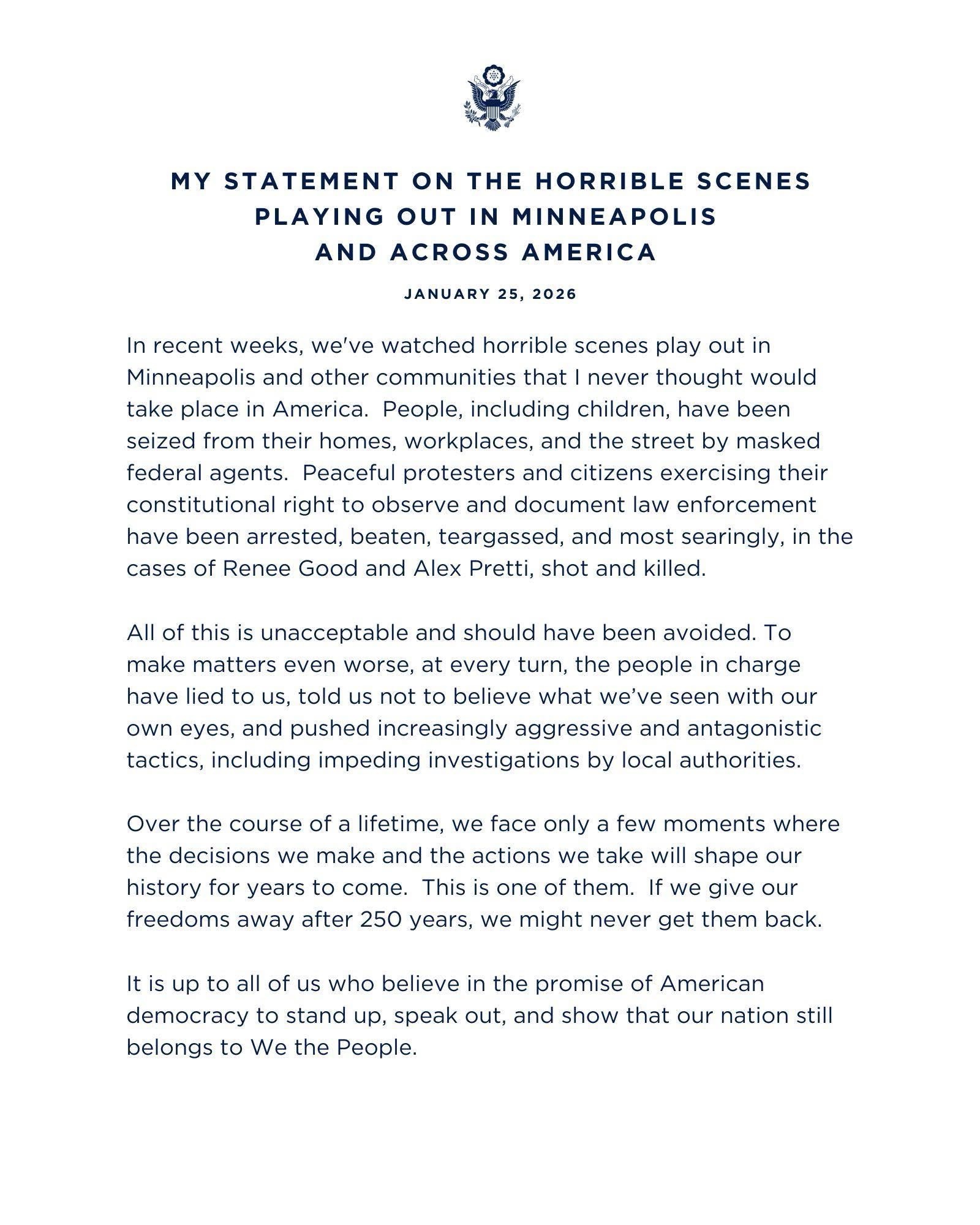
Former President Bill Clinton released the following statement about what’s happening in Minneapolis and other places, as Trump unleashes the armed, masked ICE agents to arrest, harass, and murder our fellow citizens in pursuit of undocumented immigrants .

Well said. Where are other retired Presidents, Vice-Presidents, Senators?

Please speak up, Former Presidents Bush and Obama.

Perhaps the strangest feature of Trump’s invasion of Venezuela is that he left the leadership of the regime in place, removing only Maduro and his wife. Four of the six Venezuelan leaders who were indicted for criminal activities are now running the country.

On the one hand, Trump avoids the problem of a renegade army and security apparatus, which can help repress the citizenry while the U.S. schemes to steal their oil.

On the other, the Maduro regime continues to be thuggish and corrupt.

The Economist magazine conducted a poll in Venezuela and found that most people were pleased that Maduro is gone.

The polling shows that Mr Maduro, who presided over torture and economic collapse and brazenly stole the presidential election in 2024, was deeply hated. Just 13% of respondents even mildly opposed his capture. Strikingly, more than half of them said their opinion of America had improved after the raid.

Its deputy editor Robert Guest wrote this commentary in the January 10-16 issue::

Outside a supermarket in Caracas a few years ago, I saw national guardsmen checking people’s identity before they were allowed in. The logic was that, courtesy of the revolutionary government, the state-owned shop sold essential groceries at below-market prices. So you needed men with truncheons and tear-gas to make sure shoppers only came in on their state-appointed shopping days.

Nicolás Maduro’s dictatorship was one of the most thuggish in the world. It was also one of the most economically incompetent. When I walked into that shop, half the shelves were bare and none of the groceries that were supposed to be on sale for less than they cost to make were, in fact, available. A combination of price controls, socialist dogma and industrial-scale corruption had dramatically impoverished a once-prosperous country. The economy shrank by 69% under Mr Maduro—a swifter decline than would normally occur during an all-out civil war. Small wonder Venezuelans in Miami danced in the streets when Donald Trump kidnapped Mr Maduro and whisked him to a courtroom in New York. But they were not dancing in Caracas, for fear of being arrested and tortured. For though the despot is gone, the rest of the regime is still in place.

open.substack.com/pub/anntelnaes/p/another-monument-to-trumps-megalomania

Just remember: Trump’s ego and need for praise are so vast that they can never be satisfied. Foreign leaders have learned that the way to get his attention is to flatter him. Everything he does is the best, the most, and has never been done before.

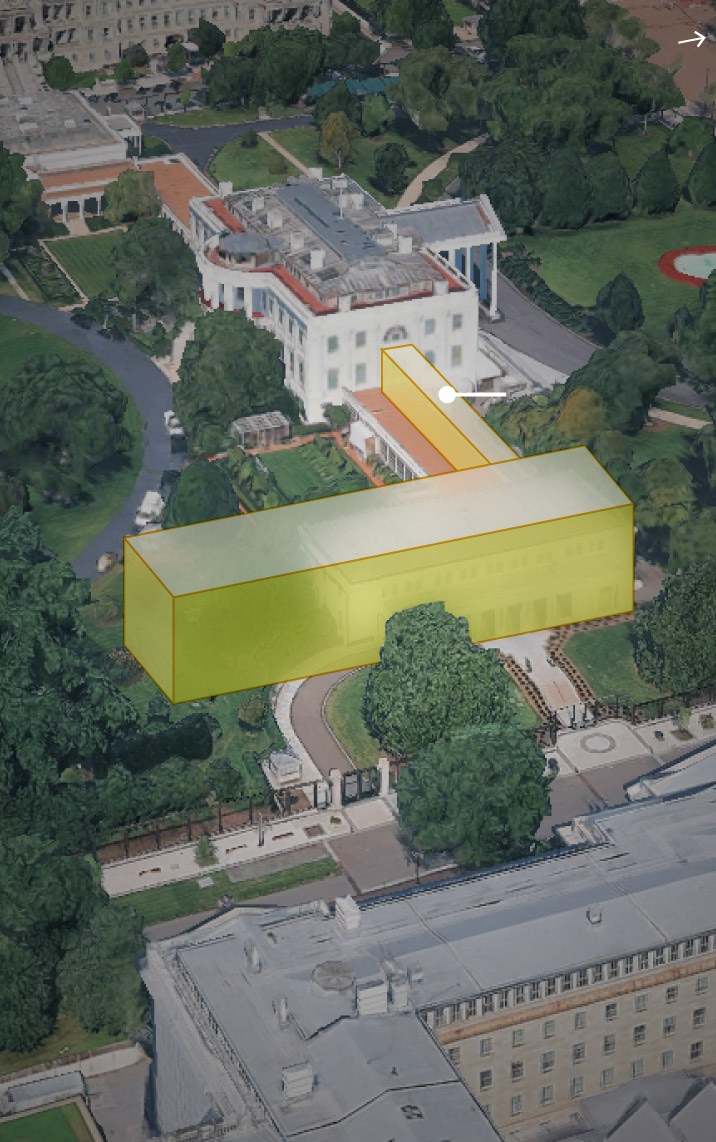
At this moment, in the midst of a government shutdown, while federal workers are lining up at food banks, Trump has demolished the East Wing of the White House and is constructing a gold-plated ballroom. It will be named the President Donald J. Trump ballroom. When that is done, he will build a triumphal arch that will be known as the Arc d’Trump.

His press secretary said that at this moment, while the government is closed, Trump’s highest priority is his grand ballroom. The ballroom will be 90,000 square feet. It will dominate the White House, which is only 55,000 square feet.

I hope you are signed on to Instagram. This is a commentary you should hear.

And this is a TikTok you should see to understand how quickly women’s rights can disappear.

This post is about the brutal tactics of ICE. In the instance described, ICE agents broke into the home of a U.S. citizen at 5:30 am, smashing his doors. Five people were arrested, two of them American citizens. One who was handcuffed and shown on television being led away by ICE was the homeowner, an American citizen, born in Texas.

Every time I see one of these ICE videos, I get outraged. I have seen them knocking people to the ground who were photographing them. I have seen them smash car windows and drag people out through the window. I have seen them brutalizing people suspected of being illegal. I have seen them beat up protestors. All while wearing a mask, but not a badge or shield. and I keep wondering, “is this America?”

Joyce Vance served as the U.S. Attorney for the Northern District of Alabama. She knows the law and she has a deep love of justice, compassion, and America.

She writes a blog called Civil Discourse, where this excerpt appeared. She is appalled by ICE’s thuggish tactics, and also by Kristi Noem’s showboat tactics. Noem’s behavior towards others reminds us that she killed a young dog because she couldn’t train him. She is known as “Ice Barbie.”

Vance reminds us that ICE in earlier days followed the law. Now, many people object to its actions, specifically, snatching people off the street, throwing them into an unmarked van, disappearing them, all without a warrant. And the masks! Are they being arrested or kidnapped? No one knows. No wonder people call them “Trump’s Brownshirts.”

Vance writes:

For weeks now, the news has been a deluge, making it impossible to keep up with everything. This week so far has been no exception. We know that this is intentional, at least in part. It tends to distract from things like the fact that the Epstein Files have yet to be released. There’s a constant hum of Trump’s incessant push to grow a more muscular, imperial presidency that will allow the Article II branch of government to eclipse the Article I and Article III branches.

But some days, it can be helpful to stop and focus on one small incident to get a snapshot of what’s happening. Today, I focused on some reporting about ICE, one of the agencies under the control of DHS Secretary Kristi Noem. 

A lot has been written about how Trump has transformed ICE. I know many of you have seen that and are deeply concerned by it, as am I.

ICE’s congressionally designated mission focuses on immigration enforcement and transnational crime. When I was a prosecutor, we worked serious cases with ICE agents. They were competent investigators. They knew how to get cases done. We did some of the early crypto for crime cases with them and also international networks that were engaged in human sex trafficking, drug trafficking, and elder abuse. They worked computer intrusion cases that had a transnational aspect. We did immigration cases with them, focusing on prosecuting people who were illegally in the U.S. after a prior deportation and who had violent criminal history or were involved in gangs. But what we didn’t do was bust into an American citizen’s house at 5:30 a.m. with the DHS Secretary along. 

Newsweek reported that Noem “joined federal immigration agents during an early morning operation in Elgin, Illinois, on Tuesday that resulted in multiple people being led away in handcuffs, and two U.S. citizens being briefly detained.” CBS reported that five people were arrested during the raid, among them two U.S. citizens, who were released after showing their papers.

Here is the report from CBS in Chicago

It’s a simple, red brick, ranch-style house. Witness video, taken after a pre-dawn explosion was heard by neighbors, shows agents peeking into the home, a helicopter flying overhead with a spotlight right on the house in what people in the video describe as a “very quiet neighborhood.” 

This is what Noem posted Tuesday morning, characterizing the men, including the two U.S. citizens who were subsequently released, as violent offenders.

By 8:30 a.m. local time, DHS was responding to these reports, tweeting that “No U.S. citizens were arrested, they were briefly held for their and officers’ safety while the operation in the house was underway. This is standard protocol. Please see our release on those arrested.” 

American Immigration Council Senior Fellow Aaron Reichlin-Melnick tweeted that the man seen in the video was a U.S. citizen named Joe Botello. “They smashed in the doors, dragged him and his roommates out in handcuffs, then posted a video online suggesting he was a criminal, despite knowing he was released soon after,” he wrote, relying on a report from the Chicago Tribune. The agents were masked and armed when they made forcible entry into Botello’s home, destroying both his front door and a glass patio door, according to the Tribune. An agent asked the Texas-born Botello, “how he was able to speak English so well.”

It was another poorly executed raid where people’s rights, in this case, American citizens, were violated.

By the way, the Secretary’s presence might seem like a small thing here, but it’s not. It’s not amusing. It’s not cosplay. It’s not cute. It’s not shake your head and then look away. It’s dangerous. And it was done, apparently, for a photo op.

I spoke with my former colleague Sarah Saldaña, who served as the Director of ICE from 2014 to 2017 and as U.S. Attorney for the Northern District of Texas from 2011 to 2014. She was the last presidentially-appointed, Senate-confirmed Director of ICE. I asked her about participating in law enforcement actions. She told me, “ICE removal operations in the field are highly sensitive and potentially dangerous events. Enforcement removal officers are fully armed and trained to respond to various, often unexpected scenarios that they might encounter. Our focus in removal operations under the Obama Administration was on individuals who presented threats to national security and public safety, and those with convictions of serious criminal offenses. As Director and with training only as an attorney and agency manager, I would never have considered actually interjecting myself into the execution of such an operation. I could easily represent a distraction to officers and, without the proper training, present a danger to them, the persons sought, and to myself.”

Noem, too, should be concerned about the security risk her presence creates. Furthermore, if Noem accompanied agents to the scene, as the reporting indicates, she made herself a witness. If I’m a criminal defense lawyer for one of the men or a plaintiff’s lawyer in a civil suit, I’m cutting the subpoena for her testimony pronto. This is why smart prosecutors know better than to go along when a search warrant is executed, let alone an attorney general or a cabinet secretary. But Noem likes her photo ops. It’s just another sign of the less-than-professional way Trump’s appointees are running government, following Pam Bondi’s comments about prosecuting people for First Amendment-protected speech earlier this week. 

Just as members of Congress challenged FBI Director Kash Patel during his oversight hearing on the Hill today, we have to continue to speak out and challenge Noem, Bondi, Kennedy, and others who aren’t up to doing the job the American people deserve. Americans speaking up is precisely what this administration doesn’t want. They want us to be overwhelmed by all the stories about all the things. They want us to be intimidated from exercising our right to speak, lest we fall under attack too. So, our job is to make sure that doesn’t happen. “Courage is contagious” is becoming one of our mottos for this administration. Keep focusing on the truth. Keep speaking out. Keep going.

We’re in this together,

Joyce

Jack Hassard, retired science educator at Georgia State University, writes that authoritarians can’t tolerate jokes directed at them. They are thin-skinned. They hate being ridiculed. In Russia, one of Putin’s first targets when he took power in 2000 was a puppet show.

Hassard wrote a book about Trump after his first term, called The Trump Files. No doubt he believed that we had seen the last of Trump. Now he blogs about science, politics, and education.

In one of his latest posts, Hassard wrote:

WHY AUTHORITARIANS FEAR LAUGHTER.

[He added: “They also fear teachers.” That is an amusing echo of the title of Randi Weingarten’s first book, which was just published. Its title: Why Fascists Fear Teachers.]

It is telling that satire, of all genres, is under assault. Authoritarian leaders understand that ridicule delegitimizes power more efficiently than argument. A chart or a speech can be rebutted. A joke that makes the president look ridiculous can’t. That is why Soviet authorities censored jokes. Autocrats in Hungary and Turkey sued comedians. Despots everywhere fear being laughed at. When the United States begins punishing its comedians, it signals a shift. The shift is from democracy confident enough to tolerate ridicule. It progresses to illiberalism that can’t bear mockery….

CONSEQUENCES BEYOND COMEDY

The silencing of late-night satire does not stand alone. It echoes what we have already seen on university campuses, where professors face funding freezes and political monitors in classrooms. It mirrors attempts to pressure journalists with access threats and selective prosecutions. Step by step, the Trump administration is narrowing the arenas in which dissent can be voiced. Censoring satire matters because it collapses one of the last mass-audience platforms for critique. Millions never read a legal opinion. They never attend a lecture. Still, they still meet politics through Colbert’s monologues or Kimmel’s opening jokes. Shut those down, and you have not just silenced comedians — you have muted a public square…

The legal challenges will come. Networks sue. Civil liberties groups will file briefs. Courts eventually reaffirm that the First Amendment forbids retaliation against political speech. But lawsuits take years, and the damage happens now. In the meantime, networks will err on the side of silence. That chilling effect is harder to measure than a canceled show, but it is more corrosive. A student who stops asking questions means a small silence. A professor who drops a reading does too. A comedian who trims a monologue is also a small silence. Collectively, they create a democracy that speaks less, laughs less, and thinks less freely.

NAMING THE PATTERN

If there is one lesson from history, it is this: censorship rarely arrives all at once. It arrives as a series of “exceptions,” each one justified as minor, situational, or deserved. It started on January 20, 2025 with Trump’s first set of Executive orders, and continued for months. Today it is Colbert and Kimmel. Tomorrow it is a journalist, a novelist, a professor, or a teacher. The pattern is clear: when power fears ridicule, it begins by silencing the jesters. The canceling of a late-night joke seems trivial against the backdrop of global crises. But in a democracy, humor is not trivial. Humor is a form of truth-telling. And when the government cancels the joke, it is really trying to cancel the truth.

Trump and Putin are meeting Friday in Alaska to discuss Ukraine. Ukrainian leader Zelensky was not invited, nor were any representatives of Europe. Trump will hear Putin’s grievances and claims. He will hear no other. After Russia intensified its drone bombing of Ukrainian civilian targets, Trump demanded a ceasefire. Putin ignored him. He gave his a deadline of 50 days (!) to stop the attacks. Putin intensified the attacks. Then Trump said the deadline was 10-12 days. That was two weeks ago. Putin got a face-to-face meeting with Trump on American soil, and his war against Ukraine goes on.

Timothy Snyder is one of the nation’s pre-eminent historians of Europe. He taught at Yale University for many years, but decided to accept an offer to teach at the University of Toronto after Trump was re-elected in 2024. He is the author of many books, including the national bestseller On Tyranny.

Snyder writes:

In the ancient world, people spoke of “Ultima Thule,” a mythical land in the extreme north, the end of the earth.

By venturing north to Alaska to meet Vladimir Putin, Donald Trump reaches his own Ultima Thula, the arctic endpoint of a foreign policy dreamworld.

The premise of Trump’s foreign relations is that foreign leaders can be dealt with like Americans, with fantastic promises and obnoxious bullying.

The fantasies do not function beyond America’s borders. The empty offer of a “beautiful” future does move dictators who commit crimes for their own visions, or affect people who are defending their families from a criminal invasion.

Ukraine has been resisting Russia’s full-scale invasion for three and a half years. Ukrainians fight because Russians invade their land, steal their wealth, kidnap their children and raise them as Russians, torture civilians in basements, murder people with any sort of association with politics or civil society, and destroy their sovereignty.

Putin, for that matter, has his own vision of a beautiful future, and no reason to prefer Trump’s to his own. Putin’s utopia is one of a Ukraine with no government, with a population cowed by torture, with children stolen and brainwashed, with patriots murdered and buried in mass graves, with resources in Russian hands.

Like Trump’s fantasizing, Trump’s bullying also does not work abroad. To be sure, many Americans are afraid of Trump. He has purged his own political party through stochastic violence. He is deploying the US military as a police force, first in California and then in Washington DC.

But foreign enemies apprehend these intimidation tactics differently. In Moscow, deployments of soldiers inside the United States look like weakness. Trump is signalling that he sees the task of the US military as to oppress unarmed Americans. The very move that shocks Americans delights America’s foes.

The tough talk may resonate in America, where we confuse words with actions. But for Russian leaders it covers a weak foreign policy. Trump has made extraordinary concessions to Russia in exchange for nothing at all. Russia has repaid him by continuing the war and seeking to win it — and by laughing at Trump on state-controlled television.

What are those concessions? Just by meeting Putin in Alaska, Trump gives the Russian dictator a chance to spread his own story of his invasion of Ukraine, both to the Americans around Trump and to the American press. By shaking hands with an indicted war criminal, Trump signals that the killings, the tortures, the kidnapings do not matter. 

Even the choice of Alaska is a concession, and an odd one. Russians, including major figures in state media, routinely claim Alaska for Russia. As one of Putin’s special envoys put it, Putin’s journey to Alaska is a “domestic flight.”

Inviting people who claim your territory inside your main military base on that territory to discuss a war of aggression they started without any participation of the country they invaded — well, that is just about as far as a certain logic of fantasy can go. It is Ultima Thule.

It is Ultima Thule, the very end, because Trump has already conceded the more fundamental issues. He does not speak of the need for justice for Russian war criminals, or of the need for Russia to pay reparations. The Trump administration grants that Russia can determine Ukraine’s and America’s foreign policy on the crucial point of NATO membership. They have accepted that Russia’s invasions should lead not only to de facto but also de jure changes in sovereign control over territory.

It would take a longer essay to explain how senseless these concessions are. Accepting that invasion can legally change borders undoes the world order. Granting Russia the right to decide the foreign policy of others encourages further aggression by Russia. Dropping the obvious legal and historical responses to criminal wars of aggression — reparations and trials — encourages war in general.

Trump speaks loudly and carries a small stick. The notion that words alone can do the trick has led Trump to the position that Putin’s words matter, and so he must go to Alaska for a “listening exercise.” Trump’s career has been full of listening to Putin, and then repeating what Putin says.

Trump and Putin are moved by the future perception of their greatness. Putin believes that this can be achieved by war, and an element of this war is the manipulation of the American president. Trump believes that this can achieved by being associated with peace, which, so long as he is unwilling to make policy himself, puts him in the power of the warmaker.

northern lights

Putin is not moved to end the war when his own propaganda is repeated by the president of the United States. He cannot be enticed by a vague vision of a better world, since he has in mind his own very specific atrocity.

In Alaska, Trump reaches his personal Ultima Thula, the limits of his own personal world of magical talk. 

He faces a very simple issue: will Putin accept an unconditional ceasefire or not.

Putin has refused any such thing. The Russians propose an obviously ridiculous and provocative counter: that Ukraine should now formally concede to Russia territory that Russia does not even occupy, lands on which Ukraine has built its defenses. And then Russia can of course attack again, from a far better position. 

Putin knows that Trump wants the Nobel Peace Prize. And so Putin’s obvious move is to suggest to Trump that war will end someday, and Trump will get the credit, if the two of them just keep talking (and while Russia keeps bombing).

If Trump leaves Alaska without Putin having agreed to an unconditional ceasefire, there are two paths that Trump can take. He can continue the fantasy, though it will become ever more obvious, even to his friends and supporters, that the fantasy is Putin’s.

Or Trump can make the policy that will make the war harder for Putin, and thereby bring its end closer.

The United States has not formalized its outlandish concessions to Russia, and could take them back in one press conference. The United States has the policy instruments to change the direction of the war in Ukraine, and could employ them.

Trump has threatened “serious consequences” if Putin does not accept an unconditional ceasefire. Those are words, and thus far the consequences of Trump’s words, for Russia, have been more words. This all becomes clear now, at Ultima Thule, clear to everyone. 

When Trump reaches the border of his fantasy world, what is his next step? Where will he go after Ultima Thule?