[go: up one dir, main page]

David Hockney 💖

Another post, another obituary. But this time it is a celebration of a life well lived—David Hockney did the thing he loved to do most, paint, to the very end. Not a bad way to go. He was 88, and his health had been failing for some time.

David Hockney was born in 1939 into a working-class family in the small industrial city of Bradford, Yorkshire, one of five children. His father was a self-employed restorer of baby carriages and a crusader against nuclear arms. His mother, Laura, to whom he was especially close, was a frequent subject of his portraits. David Hockney maintained close ties to his parents, returning yearly to spend Christmas with them until the end of their lives.
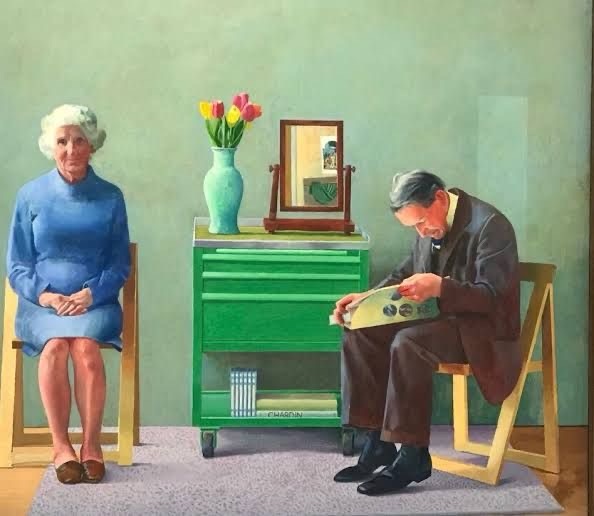

Image © Tate / My Parents © David Hockney 1977

Conservative in his art, since it was figurative and narrative in an era when abstraction was favoured, he was nevertheless avant-garde as one of the first widely popular artists of his time to make work with undisguised gay content.
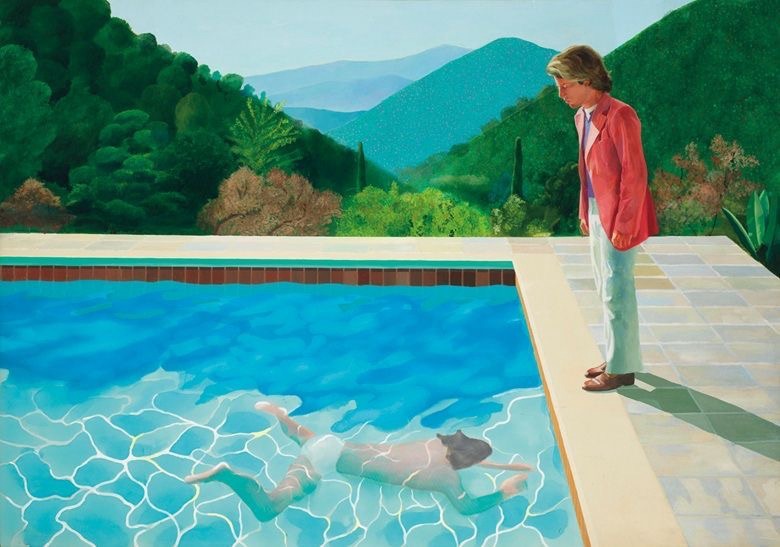

Image © Christie’s / Portrait of an Artist (Pool with Two Figurines)
David Hockney, 1972

Hockney travelled widely in search of inspiration and spent many years in America, in New York and especially Los Angeles, where he made a lot of his best-known paintings, many including images of swimming pools. These identified him as the quintessential artist of Southern California’s nouveau riche leisure life.


Christopher Isherwood and Don Bachardy, 1968. Acrylic on canvas, 212 x 303.5 cm. Private collection. © David Hockney

He painted the people around him, his family, lovers and friends, and made a series of evocative double portraits (the one above is a particularly favourite of mine.) He also painted vivid landscapes, some huge, filled with light and colour.
Hockney was a visually striking man, with a high-color wardrobe of plaid suits, striped soccer jerseys and mismatched colored socks, owlish glasses and bleached blond hair. A gregarious personality, he surrounded himself with people and made many friends, until late in life, when deafness isolated him slightly. He compensated by surrounding himself with his beloved pet dachshunds.

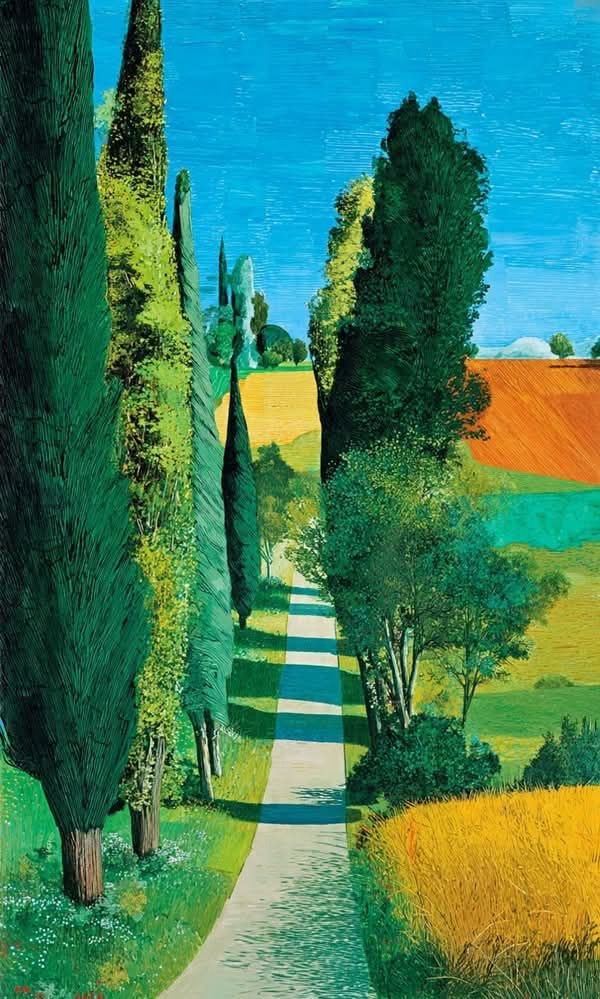
Made on iPad with Procreate

Later on he used technology in his art, making collages of photographs and iPad art. In fact during his long career he tried his hand at many different techniques, such as theatre sets and stained glass windows. He loved to experiment with various methods. Nevertheless, his appetite for technology was unexpected because, as The Washington Post put it: “There is no living art star less in need of a machine… Hockney can draw water. Hockney can draw smog. He can draw the bleaching sunlight… in Los Angeles. He can draw the chilling damp of Bradford… He can draw the glow of friendship.”

The photo is from an invitation to an exhibition at the Museum Boijmans Van Beuningen in Rottredam, 1995.

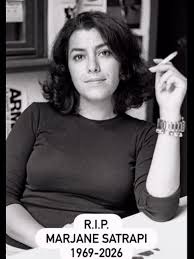
Sad about Marjane

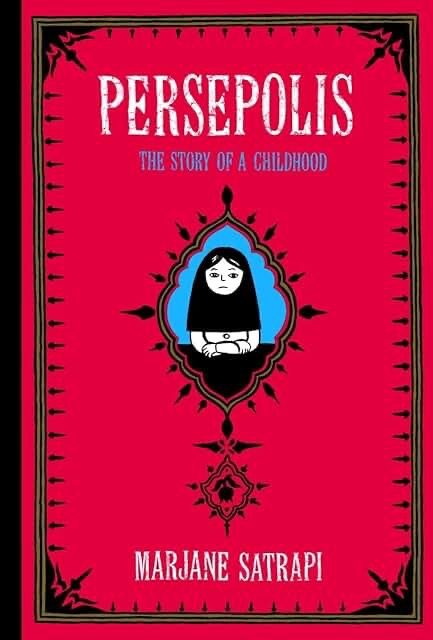
I was saddened to read that Marjane Satrapi, the Iranian-French author whose graphic novel series “Persepolis” documented the struggles of ordinary Iranians during the turbulent years around the Islamic Revolution, has died at 56 years old.

Apparently the cause of death was sadness stemming from the premature death of her beloved husband, Matthias Ripa. The couple did not have children.

Ms. Satrapi was a troubled but extremely talented and influential person—writer, artist, director. With the publication of the semi-autobiographical “Persepolis” in the early 2000s, Ms. Satrapi became one of the major exponents of a form of graphic novel — influenced by Art Spiegelman’s “Maus” — that combined political history and memoir.

Her heroine, Marji, is a girl living through some of the most difficult years of Iranian history, just as Ms. Satrapi did. Both she and her character were born in Iran in 1969, and were about 10 when the Shah was overthrown. They both lived through the rise of the clerics and the horror of the Iran-Iraq War, and left the country at 14 to study in Austria. For Satrapi, the Viennese experience was a disaster and she moved back home after four years.

Here is an excerpt from her obituary in the NYT:

Marjane Satrapi was born on Nov. 22, 1969, in Rasht, near the Caspian Sea, and grew up in Tehran. She had aristocratic ancestors, and her parents were cosmopolitan leftists; her father was an engineer and her mother designed dresses.

Marjane bridled against the new restrictions on dress and behavior. When she was 14, she hit a school principal who had tried to confiscate her jewelry, and her parents, worried for her safety, sent her to live with an Iranian family in Austria. There, she was overwhelmed by the experience of a very different world.

They opposed the Shah and protested against his government, but were disillusioned by the political and cultural crackdown that followed the revolution and the end of his rule. Marjane’s uncle was accused of being a Soviet spy, jailed and executed.

“At her nadir,” Simon Hattenstone wrote in The Guardian in 2008, “she was peddling drugs, homeless, and she almost died from bronchitis. After four years in Vienna, she admitted defeat, put on her veil and returned home.”

Back in Iran in 1989, she studied art in Tehran and had an early marriage that ended in divorce, then returned to Europe.’

In 1994, Ms. Satrapi moved to Paris, where she wrote the “Persepolis” series in French. It was later translated into English and other languages and has been read by millions of readers. The books have also become popular as school assignments. The series was adapted into a 2007 film that was nominated for an Academy Award for best animated feature.

Some years later, Ms. Satrapi documented another tumultuous moment in Iranian history: the unrest in 2022 that followed the death, in police custody, of a 22-year-old Kurdish woman, Mahsa Amini, who had been accused of violating a law requiring women to wear the hijab in public.

In protest, women across Iran tore off their veils, in one of the most significant cultural and political moments in the country since the 1979 revolution.

Marjane Satrapi with her husband Mattias Ripa in 2012.Venturelli/WireImage

Ms. Satrapi wrote several children’s books and other graphic novels, including “Chicken With Plums,” the story of the death of her great-uncle, which was also turned into a film. Another of her works, “Embroideries,” depicted Iranian women discussing love, sex and men over afternoon tea.

She directed several feature films, including “The Voices” (2014), with Ryan Reynolds, and “Radioactive” (2019), starring Rosamund Pike as Marie Curie.

She also won acclaim as a painter and was elected in 2024 to the Académie des Beaux-Arts, one of the highest honors in the French art world.

She wrote frequently about her perpetual sense of dislocation — living away from her home country, but thinking constantly of it.

“I call Iran home because no matter how long I live in France, and despite the fact that I feel also French after all these years, to me the word ‘home’ has only one meaning: Iran,” Ms. Satrapi wrote in a 2009 essay for The Times.

“No matter how much I am in love with Paris and its indescribable beauty,” she said, “Tehran with all its ugliness will in my eyes forever be the ‘bride’ of all cities around the world.”

I advise anyone who has not read ‘Persepolis’ to try it, even if graphic novels are not your cup of tea. Just as you should read ‘Maus.’

Also below you can find a trailer for the Persepolis animated movie.

https://youtu.be/3PXHeKuBzPY?si=J5OUPbOA-vHXbS0X