[go: up one dir, main page]

Αναζήτηση αυτού του ιστολογίου

14 Ιανουαρίου, 2026

MSC Baltic III hull buckling.....


MSC Baltic III hull buckling visible on starboard and port sides, Cedar Cove, Newfoundland and Labrador. 
Photo courtesy Canadian Coast Guard
Winter Storms Continue to Batter Grounded MSC Baltic III, Coast Guard Warns

Mike Schuler
January 13, 2026

Nearly a year after running aground on Newfoundland’s west coast, the container ship MSC Baltic III remains at the mercy of North Atlantic winter storms as salvage teams struggle to stabilize the battered vessel and contain ongoing pollution risks.

The 207-meter ship lost power and grounded near Wild Cove in the Bay of Islands on February 15, 2025, during severe winter weather. All 20 crew members were rescued by Royal Canadian Air Force helicopter shortly after the incident.

In its latest update, the Canadian Coast Guard said persistent winter conditions continue to restrict access to the wreck, slowing salvage operations. Crews have installed a cableway system from shore to reach the vessel when weather allows, but opportunities remain limited.

“As crews gain access to the grounded vessel, they continue assessing the condition of the MSC Baltic III,” the Coast Guard said in its latest update. “Salvage crews continue to remove oily debris from the engine room and are preparing for skimming operations to remove the oily water mixture that remains on the vessel following recent storms.”

Conditions worsened after a series of powerful storms in early December. Inspections on December 7 and 8 revealed new steel plate buckling on both sides of the hull, with the stern settling noticeably lower in the water. The ship has since suffered multiple hull breaches and has partially settled onto the seabed, effectively ruling out any straightforward refloating effort.

At the time of the grounding, the ship was carrying heavy fuel oil, marine gas oil, and about 470 containers, many of them empty. Although crews have removed most of the remaining fuel and offloaded hundreds of boxes, as of December there were still 65 containers trapped below deck and submerged. Those units must be lifted, drained, and removed — a complex operation that can only proceed in calm conditions.

Environmental concerns are mounting. The Coast Guard says shoreline patrols and drone flights have detected increasing amounts of oiled debris washing up on nearby beaches. Cleanup efforts are ongoing, but repeated storms, high seas, and strong winds continue to interrupt operations and further damage the vessel.

The Coast Guard is maintaining an emergency safety zone around the site and says it remains focused on stabilizing the wreck and minimizing pollution while preparing for the next phase of salvage when weather conditions finally ease.

gcaptain.com
Captain Did ‘Absolutely Nothing’ to Stop Fatal UK Tanker Collision, Prosecutors Say


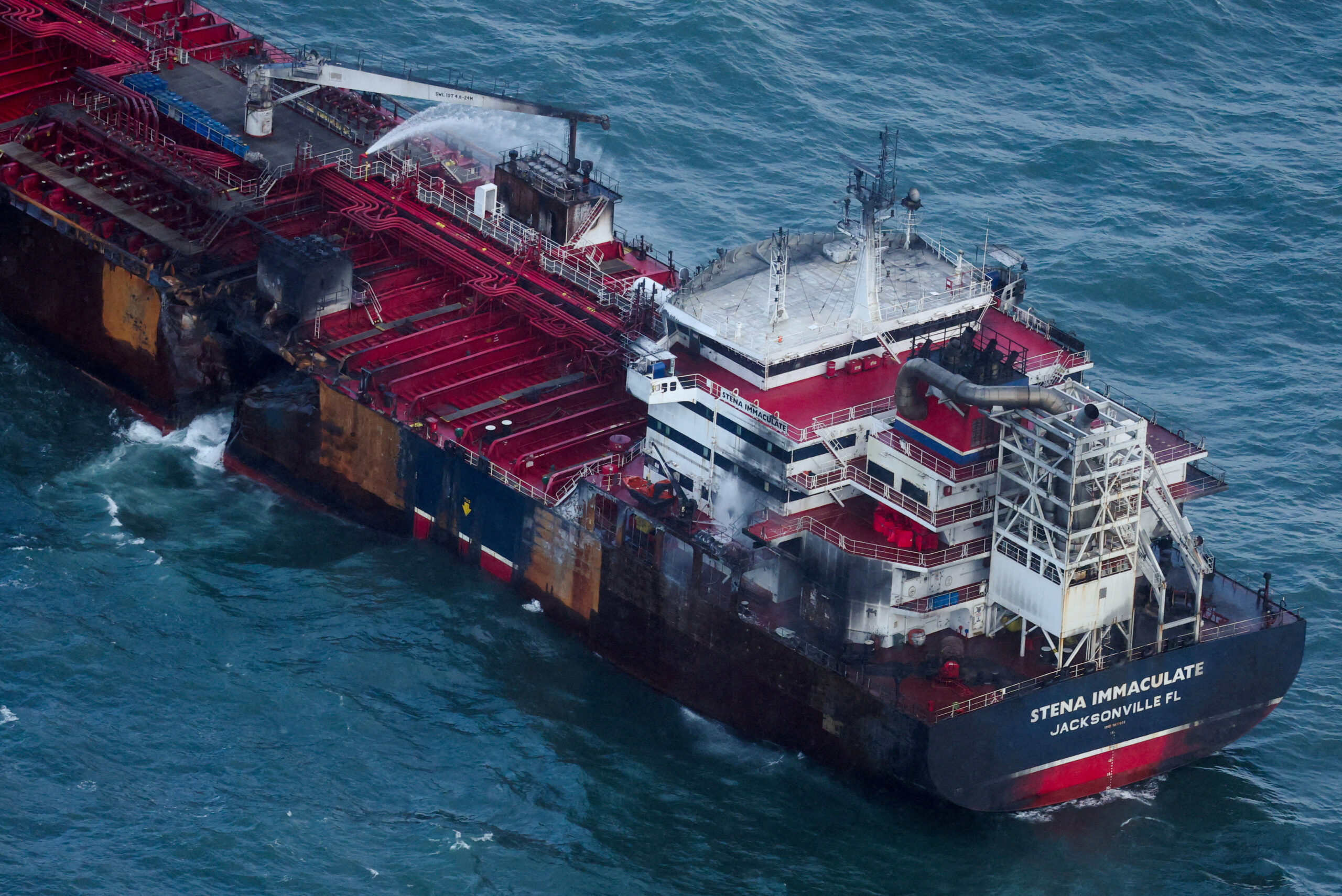
Aftermath of collision between container ship and oil tanker

Water flows through a damaged hull of Stena Immaculate oil tanker ship after it collided with a cargo ship off the northeastern coast of England, Britain, March 11, 2025. REUTERS/Phil Noble

Reuters 

January 13, 2026                  By Sam Tobin and Corey Rudy

LONDON, Jan 13 (Reuters) – The captain of a container ship that crashed into a U.S. tanker off Britain’s east coast last year did “absolutely nothing” to prevent an avoidable and fatal collision, British prosecutors said on Tuesday as his trial over a crew member’s death began.

Russian national Vladimir Motin, 59, was captain of the Portuguese-flagged Solong which was heading to Rotterdam in the Netherlands when it hit the Stena Immaculate tanker, which was anchored, on March 10 2025.

The Solong was mainly carrying alcohol and some dangerous goods, including empty but unclean sodium cyanide containers, while the Stena Immaculate was carrying just over 220,000 barrels of high-grade aviation fuel, prosecutor Tom Little said.The Stena Immaculate was waiting for a berth to discharge its cargo when it was hit, causing a fire which spread to both vessels, Little added. Jurors were played footage of the crash and its aftermath showing fire and smoke billowing into the sky.

Motin was charged days later with causing the death of Filipino national and Solong crew member Mark Pernia, 38, whose body has never been found and is presumed dead.

He has pleaded not guilty to one count of gross negligence manslaughter and is on trial at London’s Old Bailey court, where Little said Pernia’s death was “entirely avoidable.”

CAPTAIN ACCUSED OF ‘GROSSLY NEGLIGENT CONDUCT’

Little told jurors as Motin listened with the help of a Russian interpreter: “He (Pernia) would still be alive if it was not for the grossly negligent conduct of the man in the dock.”

He said the Solong was on a collision course with the Stena Immaculate for over half an hour before the crash and was traveling at roughly 18 miles per hour (29 kph).

Little said Motin had sent WhatsApp messages to his wife after the crash, saying “there had been a disaster and he will be ‘guilty’,” to which his wife replied that he should say he did not see the other vessel on the ship’s equipment.

The prosecutor told the court that Motin owed Pernia a duty of care as the Solong’s captain and as he was “on sole watch duty on the bridge” before the fatal crash.

“Ultimately, he did nothing, absolutely nothing, to avoid the collision,” Little added.

The Solong’s alarm system, which was intended to ensure someone was on the vessel’s bridge, had been switched off and was not active on the morning of the crash, he said. 

Little added that the crew of the Stena Immaculate and the Solong were given no warning of the impending collision.

The trial is expected to conclude next month.

(Reporting by Sam Tobin and Corey Rudy; editing by Sarah Young and Tomasz Janowski)

gcaptain.com

Italian Coast Guard Rescues Stricken Cargo Ship Off Tuscan Coast - MASTER NASSER


Stricken Master Nasser adrift off Italy's Tuscan Coast.

Stricken Master Nasser adrift off Italy's Tuscan Coast. Photo courtesy Italian Coast Guard

January 13, 2026

Italian authorities averted a potential grounding off Viareggio last Friday after the cargo ship Master Nasser suffered a complete power failure and began drifting toward the Tuscan coast.

The 80-meter Comoros-flagged vessel was sailing from La Spezia to Durazzo when it lost all onboard systems, leaving the crew unable to control the ship.

The Guardia Costiera coordinated the response through the Secondary Maritime Rescue Center in Livorno under the supervision of the National Operational Center. With the vessel moving toward shore, a helicopter was dispatched from the Sarzana air base to insert a harbor pilot onto the disabled ship.
Commander Michele Vullo of Marina di Carrara was airlifted to the Master Nasser, where he worked alongside Coast Guard personnel to stabilize the situation and monitor the vessel while weather and sea conditions were assessed ahead of towing operations.

Fedepiloti, the Italian Federation of Harbour Pilots, said the rescue underscored the value of its standing agreement with the Coast Guard.
“The result was made possible thanks to the full implementation of the Protocol of Understanding between Fedepiloti and the General Command of the Port Captaincy Corps – Coast Guard,” the pilots’ association said, noting that the agreement includes specialized training at Coast Guard air bases that allows harbor pilots to take part in helicopter-based emergency missions.The ship was secured without injuries or pollution, with Fedepiloti describing the response as “a winning and strategic collaboration model for the safety of navigation and for the protection of human life at sea, valuing the high professionalism of all figures involved.”

gcaptain.com

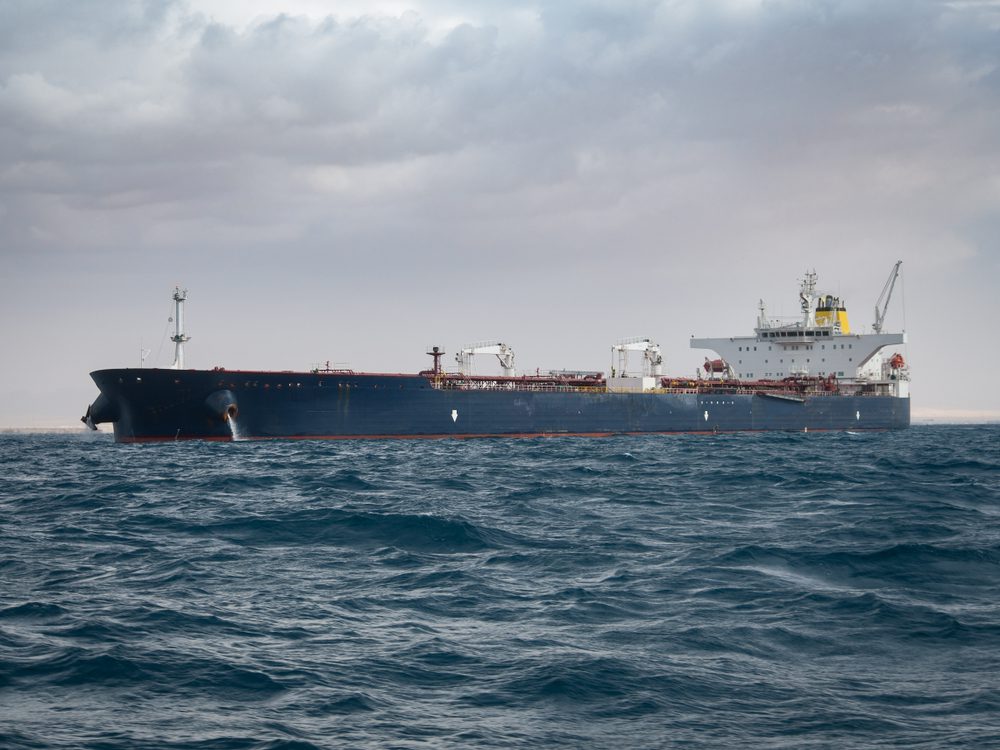
Iran Releases Greek-Owned Tanker St. Nikolas After Two-Year Detention


tanker at sea

Stock Photo: Evgeny Shulin / Shutterstock

Mike Schuler

January 12, 2026

Iran has quietly released the Marshall Islands-flagged, Greek-owned oil tanker St. Nikolas after holding the vessel for approximately two years, according to maritime intelligence firm TankerTrackers.


The release marks the latest chapter in a prolonged series of tit-for-tat vessel seizures between Iran and Western nations that have periodically roiled shipping through critical Middle Eastern chokepoints.

Iranian naval and Islamic Revolutionary Guard Corps (IRGC) forces initially seized the St. Nikolas in January 2024 as it transited the Gulf of Oman carrying Iraqi crude oil bound for Turkey. At the time, Iranian authorities claimed they were acting under a “court order,” though the seizure was widely viewed as retaliation for earlier U.S. actions.
The tanker’s detention traces back to April 2023, when U.S. authorities confiscated the vessel—then known as the Suez Rajan—in the South China Sea. That operation targeted over 980,000 barrels of Iranian crude oil belonging to the IRGC. The ship was subsequently brought to U.S. waters, where it waited off the Texas coast for more than two and a half months before the oil was discharged.
The U.S. Justice Department later revealed that the seizure came after the vessel’s bareboat charterer, Suez Rajan Limited, pleaded guilty to conspiring to violate sanctions against Iran. As part of a deferred prosecution agreement, Greece-based Empire Navigation agreed to transport the Iranian oil to the United States for physical seizure while covering the voyage expenses.

Iran’s response was swift and sustained. Almost immediately after the seizure of the Suez Rajan, Iran retaliated by seizing two tankers near the Strait of Hormuz, namely the Advantage Sweet and Niovi, the latter of which Iran continues to hold. The Advantage Sweet was carrying cargo for U.S. oil giant Chevron, though Iran’s rationale for detaining the Niovi remained less clear.

The pattern mirrors a 2022 incident in which Greece impounded the Iranian tanker Pegas on behalf of the United States, prompting Iranian forces to seize two Greek tankers a month later. After the U.S. confiscated part of the cargo, Greece’s supreme court ultimately ruled the oil had to be returned to Iran.

The Strait of Hormuz and Gulf of Oman together form a crucial waterway through which a fifth of all traded oil passes. The region has become increasingly fraught since 2019, when Iran began a series of ship seizures and assaults following the U.S. withdrawal from the Iranian nuclear deal in 2018.

Following the Suez Rajan seizure in April 2023, Greece—the world’s largest ship-owning nation—issued warnings to shipowners to avoid sailing close to Iranian waters to prevent possible retaliation.

The release of the St. Nikolas comes as Iran faces mounting domestic unrest, with at least 599 people killed—including 510 protesters—in nationwide demonstrations that began in late December over economic hardship.

President Donald Trump recently announced that any country conducting business with Iran will face a 25% tariff on all business with the United States. “This Order is final and conclusive,” Trump stated in a post on Truth Social.

As of publication, neither Empire Navigation nor Greek authorities have publicly commented on the St. Nikolas release.

WHY CLEAN FUELS ARE SCIENCE FICTION - ΓΙΑΤΙ ΤΑ ΚΑΘΑΡΑ ΚΑΥΣΙΜΑ ΕΙΝΑΙ ΕΠΙΣΤΗΜΟΝΙΚΗ ΦΑΝΤΑΣΙΑ

 Γιατί τα «καθαρά» καύσιμα είναι επιστημονική φαντασία

29.12.2025

ΑΡΘΡΟ Του Πάνου Ζαχαριάδη*

ΟΙ ΚΑΝΟΝΙΣΜΟΙ EU ETS και FUEL EU και οι κανονισμοί που, μάλλον, αργά ή γρήγορα, θα έρθουν από τον ΙΜΟ, έχουν σκοπό, με διάφορα χρηματικά πέναλτι , να ακριβύνουν τα ορυκτά καύσιμα των πλοίων, ώστε να μειωθεί η διαφορά κόστους με τα πολύ πιο ακριβά πράσινα καύσιμα (τα οποία είναι τρεις, τέσσερις έως και 10 φορές ακριβότερα) . Για τί; Μα γιατί τα πράσινα καύσιμα θα μας σώσουν!

ΤΑ ΠΡΑΣΙΝΑ αυτά καύσιμα είναι το πράσινο υδρογόνο , η πράσινη αμμωνία και η πράσινη μεθανόλη. Και η αμμωνία και η μεθανόλη φτιάχνονται από το υδρογόνο. Ναι, παίζουν και τα βιοκαύσιμα (συμπεριλαμβανομένων των βιο-μεθανίου και βιο-μεθανόλης) αλλά μόνο αυτά που προέρχονται από βιολογικά υπολείμματα, ώστε να μη συναγωνίζονται τη διατροφική αλυσίδα. Συνεπώς, εκ προοιμίου, οι ποσότητές τους θα είναι μηδαμινές για τις ανάγκες της ναυτιλίας.

ΤΟ ΥΔΡΟΓΟΝΟ είναι πολύ δύσκολο καύσιμο για μεγάλα πλοία (με δεξαμενές 10-12 φορές μεγαλύτερες των συμβατικών ακόμα και υπό πίεση) και γι ‘ αυτό όλη η ναυτιλία μιλάει για αμμωνία και μεθανόλη, που μπορούν πιο εύκολα να είναι σε υγρή μορφή. Όμως και αυτά έχουν πολύ χαμηλότερη ενεργειακή πυκνότητα σε σχέση με τα συμβατικά καύσιμα. Η αμμωνία 2,5 φορές χαμηλότερη και η μεθανόλη 2 φορές χαμηλότερη (και συνεπώς χρειάζονται αντίστοιχα μεγαλύτερες δεξαμενές).

Η ΝΑΥΤΙΛΙΑ χρησιμοποιεί τώρα περίπου 330 εκατομμύρια τόνους υγρά συμβατικά καύσιμα ανά έτος. Αν αυτά υποθετικά αντικατασταθούν από αμμωνία, χρειαζόμαστε 330 x 2,5 = 825 εκατομμύρια τόνους.

ΓΙΑ ΝΑ ΦΤΙΑΧΤΕΙ Το πράσινο υδρογόνα από ηλεκτρόλυση νερού χρειάζεται πολύ μεγάλες ποσότητες ανανεώσιμης ηλεκτρικής ενέργειας (54 έως 60 kWh για ένα κιλό υδρογόνου). Για να φτιαχτούν τα 825 εκατομμύρια τόνοι αμμωνίας χρειάζονται 165 εκατομμύρια τόνοι υδρογό νου. Άρα η ανανεώσιμη ηλεκτρική ενέργεια που χρειάζεται είναι 9.000 έως 10.000 TWh (terawatt) ανά έτος. Τι σύμπτωση! αυτή είναι όλη η ετήσια ανανεώσιμη ηλεκτρική παραγωγή του πλανήτη. Και επίσης είναι το 1/3 της συνολικής ηλεκτρικής παραγωγής του πλανήτη από όλες τις πηγές.

ΟΙ ΥΠΟΛΟΓΙΣΜΟΙ για την πράσινη μεθανόλη δεν είναι πολύ διαφορετικοί . Ας αφήσουμε το γεγονός ότιγια να φτιάξεις πράσινη μεθανόλη πρέπει να προσθέσεις «πράσινο» διοξείδιο του άνθρακα στο πράσινο υδρογόνο. Το πράσινο αυτό CO2 προέρχεται μόνο από απορρόφηση από την ατμόσφαιρα.

ΤΟ ΜΕΓΑΛΥΤΕΡΟ τέτοιο εργοστάσιο βρίσκεται στην Ισλανδία και μπορεί να απορροφά από την ατμόσφαιρα 36.000 τόνους διοξείδιο του άνθρακα τον χρόνο. Περίπου, δηλαδή, όσες είναι οι εκπομπές ενός πλοίου! Άρα, ας ξεχάσουμε τελείως την πράσινη μεθανόλη. ΘΑ ΧΡΕΙΑΣΤΟΥΜΕ, λοιπόν, όλη την ανανεώσιμη ηλεκτρική ενέργεια του πλανήτη για να φτιαχτούν καύσιμα ώστε να μειώσουμε το 2,5% των εκπομπών CO2 της ναυτιλίας. Και στη διαδικασία αυτή το 70% έως 80% αυτής της πολύτιμης ανανεώσιμης ενέργειας πετιέται κυριολεκτικά στα σκουπίδια. Γιατί στις μηχανές των πλοίων, το 60 % φεύγει ως θερμότητα από την τσιμινιέρα και , μετά τις τριβές, μόνο το 30% καταλήγει στην προπέλα ως ωφέλιμο έργο. Αν αυτή η ανανεώσιμη ενέργεια χρησιμοποιηθεί για φόρτιση μπαταριών ηλεκτρικών αυτοκινήτων, το 95% καταλήγει στις ρόδες ως ωφέλιμο έργο.

ΟΙ ΠΕΡΙΣΣΟΤΕΡΕΣ εκπομπές CO2 προέρχονται από τα εργοστάσια παραγωγής ηλεκτρικής ενέργειας που καίνε κάρβουνο και φυσικό αέριο. Μία μείωση των εκπομπών τους κατά μόλις 10% ισοδυναμεί με μείωση των εκπομπών της ναυτιλίας κατά 100%. ΚΑΠΟΙΟΙ λένε ότι οι ανανεώσιμες πηγές αυξάνονται με γοργούς ρυθμούς (περίπου 5% τον χρόνο) . Όσο και να αυξάνονται, αυξάνεται και η συνολική ετήσια ζήτηση ηλεκτρικής ενέργειας (κατά 4,3% ). Για να έχει η ναυτιλία την ανανεώσιμη ενέργεια που χρειάζονται αυτά τα πράσινα καύσιμα, θα χρειαστούν πάνω από ένα εκατομμύριο μεγάλες ανεμογεννήτριες ή 1.400 νέα πυρηνικά εργοστάσια ή 60.000 τετραγωνικά χιλιόμετρα φωτοβολταϊκών (το 25% της έκτασης της Μεγάλης Βρετανίας για παράδειγμα).

ΑΛΛΑ ας υποθέσουμε ότι με κάποιον μαγικό τρόπο θα έχουμε αυτήν την ανανεώσιμη ενέργεια. Θα έχουμε όμως το πράσινο υδρογόνο; Σήμερα η παγκόσμια παραγωγή υδρογόνου είναι λιγότερη από 100 εκατομμύρια τόνους, εκ των οποίων λιγότερο από το 0,3% είναι πράσινο. Το άλλο προέρχεται από φυσικό αέριο (γκρίζο υδρογόνο) και από άνθρακα (μαύρο υδρογόνο).

ΣΤΗΝ ΑΥΣΤΡΑΛΙΑ σχεδιάζουν ένα μεγάλο project πράσινου υδρογόνου και αμμωνίας, το Western Green Energy Hub, που θα παράγει περίπου 5 εκατομμύρια τόνους πράσινο υδρογόνο. Η έκταση που απαιτείται είναι ίση με το 1/10 της έκτασης της Μεγάλης Βρετανίας. Μέχρι λοιπόν αυτά τα πράσινα καύσιμα να είναι διαθέσιμα, προτείνω μία « ενδιάμεση» λύση: να πετούν τα πληρώματά μας χαρταετούς στην πλώρη για να εκμεταλλεύονται την αιολική ενέργεια.

Πάνος Ζαχαριάδης*
Technical Director Atlantic Bulk Carriers Management Ltd