[go: up one dir, main page]

Year: 2021
  • Short Stories, $1

    Imagine a perfect morning. You’re walking down a cobblestone street. Sun rays peer through leaves in the trees, around roofs and chimneys. A cool breeze bobs the geraniums in the window boxes. You have a coffee or a tea in hand. It is made exactly the way you like, from an open-air cafe just up the hill. You are alone. You are with a beloved companion.

    At the end of this gently sloping street is the sea. You stroll toward it, past shops just opening. The smell of fresh bread comes from a patisserie down the way. You know exactly which of the elaborate pastries you’ll get. Birdsong spills out into the blue sky.

    On a morning like this, the whole world is new and full of possibilities.

    Then, you see a vendor you’ve never noticed before in your morning walks down to the sea. At a little table, there is a typewriter and stacks of paper. Behind them sits a person. Taped to the front of the table is a sign that reads, “Short Stories, $1.”

    You know you have a dollar—these days, a dollar isn’t much. So you ask, “What is the short story about?”

    The Writer tells you. But it almost doesn’t matter. On this morning, you would take a chance on a  short story. There is something adventurous and mystical in the encounter. Even if the story you buy is terrible or strange, this will all make a good story in itself.

    So you pay your dollar and the Writer hands you the story.

    You tuck the story under your arm, and keep walking. You purchase that pastry (it comes in a little paper bag), and continue on to the sea. All the while, the story is calling to you.

    You sit down on the pier, drink your coffee, take a bite of your pastry, and begin to read.

    Where does the story take you? What foreign place do you explore? It could be anywhere, any time. And for this limitless trip, your ticket was only one dollar—less than the pastry, which, while delicious, is already gone, and will not linger in the memory the way these words will.

    When you finish, you watch the waves and the seagulls diving and think about the story you’ve bought. Or, you hand it to your beloved, and they read it too. No matter how many people read it, the story will never wear out. It will never be consumed. This experience of stepping into another life, another voice, is eternal.

    So here I am, the Writer, now intruding on this beautiful morning. I have a short story for sale. And it is $0.99. I do not ask you to rush to buy it. I ask you to consider, if you feel a resistance to spend $0.99 on a story, where that resistance comes from. To examine how our money does or does not value creators.

    There are some who would miss that dollar, and if you do need it, by all means, keep it! But for those who would not miss a dollar here or there, I ask the question of all perfect mornings full of promise and cool ocean breezes:

    Why not?

    ***

    My comic science-fiction short story FOOTNOTES ON A SPACE OPERA is out Labor Day, Sept. 6!

    When aliens land on Earth, opera—one of Western culture’s greatest but most polarizing musical traditions—becomes our planet’s greatest interstellar export.

    Hitchhiker’s Guide to the Galaxy meets Arrival on the stage of the Metropolitan Opera.

    Told from the distant future, this short story imagines a reality in which aliens are opera fans, the representative of the human race is a retired coloratura soprano, and classical music is the ticket to the stars. What could possibly go wrong?

    PREORDER: https://amzn.to/3BeXo7g


  • FOOTNOTES ON A SPACE OPERA: Cover Reveal And Preorder Link!

    Here we are, just vibing in the apocalypse…and I hope to distract from the arguably grim national and international current events with some updates regarding my upcoming short story publication, FOOTNOTES ON A SPACE OPERA!

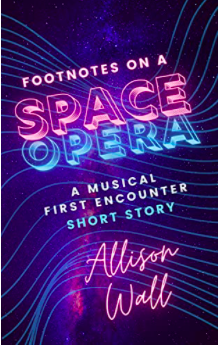
    Cover Reveal!

    I have a finalized cover design!

    I was very intimidated by this aspect of the indie publication process. I couldn’t find anything on pre-made cover websites that fit. And I knew I couldn’t design a professional-looking cover myself.

    I tried anyway, though. I played around on Canva (free online design software easy enough for the *ahem* design-challenged to figure out). I came up with a concept I liked, and then passed it along to the brilliant Danica Redfern, a fellow writer and pro designer, who gave it movement and brought it to life.

    Ready?

    Here it is!

    What I love about it

    (apart from everything)

    • The whimsy and fun of the colors
    • The movement of the sound waves across the back
    • That the sound waves look like the lines of a musical grand staff
    • The font, which reminds me of those good old marquee signs and neon lights

    Pre-Order Link!

    FOOTNOTES ON A SPACE OPERA is now available for pre-order on Amazon!

    So if you just can’t wait (or if you’re absent-minded like me and want to make sure you don’t forget) head over to Amazon, put in that pre-order, and on September 6, when the short story is officially published, it’ll download right to your device. All ready for some Labor Day alien invasion.

    Ah, the automated ease of 21st-century life…

    Once more, here’s that PRE-ORDER LINK!

    If you need me, I’ll be staring into the starry void of that gorgeous book cover…


  • Publication Announcement: FOOTNOTES ON A SPACE OPERA

    I am publishing a story!

    “Footnotes on a Space Opera” is a humorous first encounter short story, written in a satirical academic voice (complete with footnotes), in which the alien species that lands on Earth is interested in only one thing: opera.

    Story Origin

    I wrote the first draft of this piece way back in Spring 2015, when I was taking a class on Fantasy at Hamline University for my MFA. I had an assignment to write a short story with an emphasis on voice. As a veteran writing tutor, academic voice was something I knew well. I started writing and the words just flowed.

    I remember sitting outside on a patio, relishing the sun after a Minnesota winter, and cackling to myself as I typed. I enjoyed writing it so much, I am extremely proud of the way it turned out after revision, and I am thrilled to be able to share it with you!

    Who’s Publishing It?

    Here’s where things get even more exciting.

    Ready?

    Nobody.

    I shopped this piece to many markets over years: established SF/F magazines, brand-new zines, anthologies, you name it. I got personal, positive rejections, but no one picked it up.

    I have some guesses as to why…

    The footnotes can be a formatting challenge, and they’re integral to the story.

    It’s an extremely niche mix of genres. Editors maybe thought the Venn diagram overlap of those who enjoy opera and those who enjoy alien science fiction is slim. (This is confusing to me, though, since almost all of the classical musicians and opera buffs I’ve interacted with have been big sci-fi fans.)

    With so many submissions to read, any little obstacle can serve as an editor’s reason to say, “No.”

    “Footnotes on a Space Opera” is way too funny and I’m way too proud of it for it to sit alone and unread in a Word file on my laptop for the rest of time. So I said “Yes” to myself. I will be publishing this story as an independent author!

    Why Now?

    The pandemic has been instrumental in helping me come to this decision.

    Like many others, I found myself with a lot of time to reflect. I’ve realized that it’s more important to me to share my work and to use it to connect with you than to receive validation from traditional writing gatekeepers.

    Pandemic disruptions to the traditional publishing industry (which extend to smaller online markets) have made it difficult to maintain any sense of deadlines, response times, etc.

    Lockdown also revealed that I’m autistic and ADHD. People like me (neurodivergent [and female]) have typically needed to find back doors into traditional spaces. Our voices are underrepresented in the mainstream and undervalued by the mainstream gatekeepers. That doesn’t mean we don’t have important (and entertaining!) things to say.

    However, it does mean that if I want to see my work in the world, I need to take things into my own hands.

    When Can I Read “Footnotes on a Space Opera”?

    The official publication date is Monday, September 6! I’ll be back with info on where and how to read it, updates on the process, things I’ve learned, and a cover reveal as that date gets closer.

    This will be my first foray into the world of independent (or indie) publishing. That means I’m coordinating every part of the publishing process myself. It’s amazing how many details there are even for a short story.

    But I am so excited to share this story with you.

    And, if all goes well, I may have even more independent publishing news for you in the future…!

    What if I Don’t Like Opera?

    Never fear! I’ve had multiple readers who don’t know much (or anything) about opera/classical music, and they laughed right along with my musician readers. You may miss one or two of the more “inside” jokes, but then, you can always ask me (or Google) to help out. Links to my socials are at the bottom and top of the page. I’d love to connect. Especially over opera.


  • HOW TO SUCCEED AT TWITTER PITCH PARTIES

    THIS IS A LIST OF THINGS YOU SHOULD TOTALLY FOR REAL ABSOLUTELY DO IN ORDER TO GET A TON OF AGENT REQUESTS DURING TWITTER PITCH PARTIES. I’VE DONE MANY PITCH PARTIES OF VARIOUS SIZES AND RECEIVED AGENT REQUESTS. SO SERIOUSLY. DO ALL OF THESE THINGS. LIKE, ALL OF THEM. EXACTLY AS THEY’RE WRITTEN.*

    1. Hang all of your hopes and dreams for your book on this pitch party.

    If an agent doesn’t request your manuscript, it’s all over. Done. Wasted. There’s no hope. This is the only way to query an agent: by getting a heart on your tweet pitch. There’s definitely no OTHER way to query agents, and pitching in an event like this definitely doesn’t actually add a step to the very short and easy query process.

    2. Create a Twitter account specifically for pitching. (And don’t use it until pitching day.)

    You definitely want agents to look at your account, then immediately dismiss it as not being real, or as it not being a developed platform. Agents love writers with no online presence. Also, having just gotten onto a new social media platform and having little to no experience on said social media platform definitely doesn’t mean you’ll have no idea how to leverage its unique features for a complex interactive situation (like a pitch party).

    3. Don’t engage in any pre-pitch-day online interaction.

    The more people interact with your account, the more visible your tweets get. Wouldn’t want to increase your tweet visibility before the big day! And, it would be awful to make any new writer friends along the way who might end up being your best source of encouragement, future beta readers, and cheerleaders, or accidentally grow your follower count.

    4. Don’t look at examples of pitches that have been successful in the past.

    You don’t want a formulaic success–where’s the fun in that? Invent a new kind of tweet pitch that breaks all the contest ground rules, goes against all available advice, and that only the really intelligent agents will understand.

    5. Don’t get feedback on your pitches or revise them.

    I’m sure they’re great and totally clear and catchy! I mean, how hard could it be to hook an agent scrolling thousands of pitches with 280 characters about a book that’s tens (if not hundreds) of thousands of words long?

    6. Don’t use any of those pesky hashtags.

    They take up too many of those 280 characters! If your pitch is good, agents will just be drawn to it psychically, no hashtags needed.

    7. Don’t use comps.

    Using comparable book or movie titles takes up space, too, and they give agents such a good idea of the tone of your manuscript right away, that those agents don’t have to work at figuring out what the book is like. No mystery, no intrigue, right?

    8. Don’t pin your pitch to your profile.

    It would be a shame if people could easily find and retweet or comment on your pitch. That might increase its visibility and help an agent see it easily. No one wants a ton of requests from the lazy agents who aren’t spending all day on Twitter, working hard to find those pitches while their email inboxes and query manager accounts overflow.

    9. Don’t pitch as early in the day as possible.

    You wouldn’t want to give your pitch time to generate comments, retweets, and rise in the hashtag visibility rankings (since you aren’t even using hashtags anyway). Most agent likes come in way after the pitching is mostly over anyway (and most agent likes definitely do not occur BEFORE LUNCH TIME, EASTERN STANDARD TIME) so you have plenty of time to tweet out that unedited, unhashtagged pitch.

    10. Don’t spend any time online during the pitch day.

    There’s nothing you can do to help your pitch once you tweet it. Interacting with other people, responding to and liking comments on your pitch, and swapping retweets or comments definitely doesn’t boost your visibility.

    * Please do the opposite of these suggestions! I was possessed by a spirit of irony and this was WAY more fun than writing an actual helpful how-to. I’m open to chat about strategy and etc. via Twitter or comments on this post!! May the Force be with you, and your MS, and your tweets on The Big Day. ❤


  • The Value of a Book

    I recently paid $40+ for a used paperback book.

    I wasn’t required to buy it for any reason. And no, it wasn’t a college textbook. (That’d be a steal!)

    It was a book I was very much interested in reading, that was not available through my library, and that was out of print. So I paid more for it than a brand new hardback, waited the two-week shipping (for which I paid extra), received, read, and deeply enjoyed the book.

    I saw a screenshot meme online about book pricing that resonated with this experience. I can’t find it, unfortunately. It’s lost somewhere in the gaping, infinite maw of the internet. But the basic gist was a juxtapositioning. People are willing to pay $5 (sometimes more) for a latte that a barista made in 10-15 minutes, while complaining that paying $4.99 for an e-book, which took years and countless hours of work and effort and thought, is “too much.”

    During the pandemic, my local libraries closed. Delivery was slow and unreliable. And, besides, we were nervous to order things or interact with delivery people. Maybe the virus could ride in on packages, we knew so little about how it worked. I found myself stuck with the books I already had on my shelves. Over the last year, I have re-read most of them. And I am rediscovering the unending value of a well-written book.

    A coffee is great. Especially a well-made coffee. But it lasts an hour. Maybe a morning. A day if you count the caffeine effects. The next day, you need another coffee. It’s ephemeral.

    Know what’s not ephemeral? Written language. Preserved thoughts, poems, and stories. A human person (and if it’s traditionally published, many human people) labored to make sure those words were put down in exactly that order.

    Even if that roomful of monkeys did finally produce Hamlet, that would be a fucking miracle, wouldn’t it? I’d pay more than a latte for a miracle.

    Books are precious resources. The value we derive from a book is infinite. It can be consumed over and over. It can be passed from hand to hand. It can be gifted to our children and grandchildren. And all of this without diminishing. There is never less than when we began. In fact, now there is more: shared experiences, new conversations to be had, strengthened human connections.

    Their creators should be respected with what passes as a value indicator in a capitalist society. Money.

    How much money is enough for something miraculous as a book?

    Probably more than whatever you paid for your morning coffee.


  • EXCITING LAUNCH NEWS!

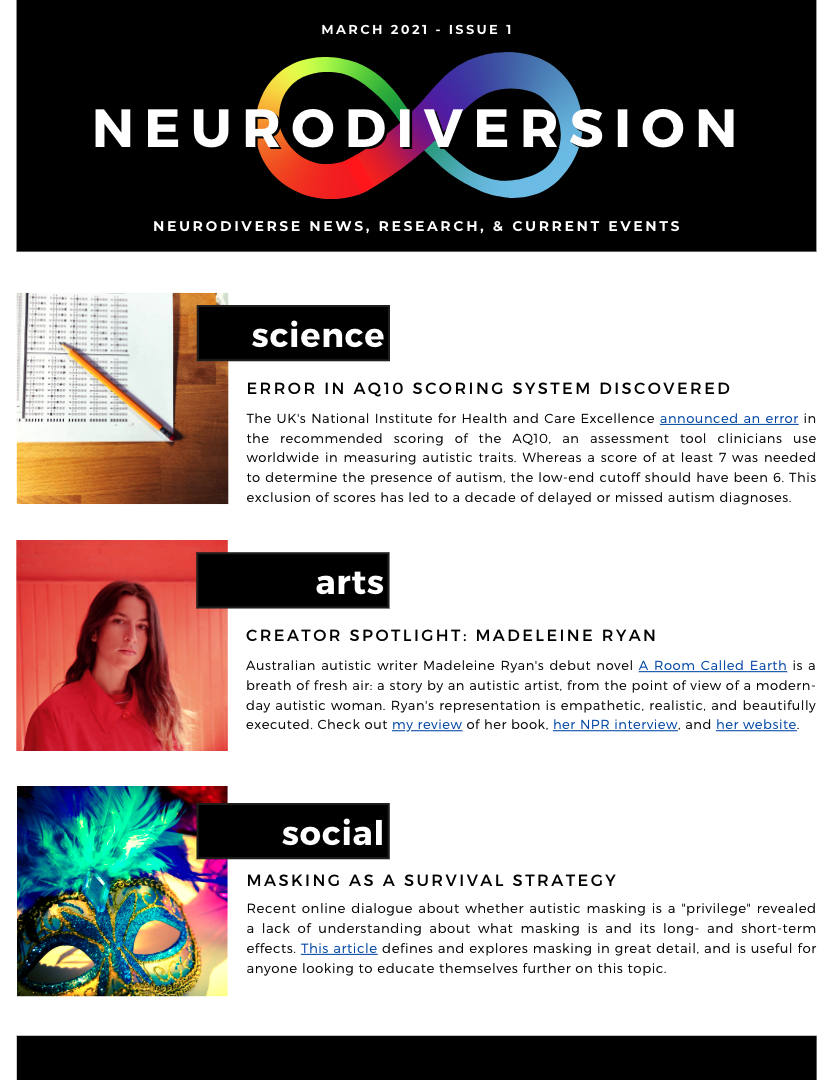
    I am thrilled to announce to you beautiful humans that I’m launching a new project! NEURODIVERSION: a monthly newsletter with curated articles, research, and current events that center neurodiverse stories and topics.

    Here are my goals for NEURODIVERSION:

    1. To provide a shortcut to useful, interesting information neurodivergent readers may find interesting, from a neurodivergent curator.

    Navigating the sea of the internet can be extremely overwhelming, especially when ND content is by no means mainstream. I’m going to dive in headfirst and bring up the best, shiniest, most interesting treasure, so you don’t have to!

    As I adjusted (and continue to adjust) to an ND paradigm, I find myself doing a ton of internet deep-dive research on neurodiversity in all of its forms. Like many of you, I have a burning desire to share what I learn. And so, rather than ranting about it to my family 24/7 or tweeting about it, I thought I’d package it up and send it to the people who’d be most interested.

    2. To provide a potential tool for education and sharing knowledge.

    I see this unfolding in two ways.

    First, for late-identified neurodivergent adults.

    A ton of the information out there (on autism and ADHD in particular) is focused on children and is written for parents of ND children. This is due in no small part to the misconception that these are “children’s disorders” that can be grown out of. I’ll focus on information adults would find interesting, useful, and educational.

    For an adult grappling with a recent realization or assessment that is causing a paradigm-identity shift (been there, still doing that), having a regular source of information about neurodiversity in manageable pieces rather than trying to drink from the fire hydrant of the internet all at once may be useful.

    Second, for the neurotypical crowd.

    I’ve noticed one of the major efforts of ND individuals is education of mainstream neurotypical folks in order to promote inclusive and empathetic practices. I’m not saying this SHOULD fall on our shoulders, but I am passionate about doing any work that will move society toward a future in which neurodiversity is celebrated, invited, and included in ways that respect everyone’s needs.

    The information I’ll share will be useful for any NT individual looking to educate themselves about the ND population and our experiences.

    Who is this newsletter for?

    Anybody who’s interested in learning more about neurodiversity, what’s going on in the world of neurodiversity right now, and ways to support this community.

    Anybody who’s interested in finding new friends they can connect with and relate to around the topic of neurodiversity. (Each issue will contain a “Connect” section in which I’ll share the social media accounts of real-life neurodivergents you can connect with in the wild!)

    What will it look like?

    Here’s a screenshot of the first page of Issue 1. (Note that none of the links will be active in the screenshot; you’ll have to get a copy of NEURODIVERSION in order to get access to the links.)

    How do I get a copy?

    Issue 1 of NEURODIVERSION is in pdf form below! Click the “Download” button to get your copy.

    Each subsequent issue will be delivered directly to the email inboxes of those who sign up to receive it.

    You can sign up to receive monthly issues of NEURODIVERSION by entering your email address below. I promise never to use your email for any other purpose than this newsletter, or to give away or to sell your email address to anyone.

    Processing…
    Success! You're on the list.

    I am so excited to be starting this new venture, and to learn and grow along with all of you in the wonderful ways of neurodiversity!


  • Querying While Autistic

    One of the most difficult parts in processing my late autism identification and diagnosis (at 30 years old) is dealing with a constantly shifting perspective, specifically in comparing how I function in the world and how non-autistic people function in it.

    I spent my whole life assuming my way of being was “normal” or neurotypical, but, as it turns out, neurotypical people exist in the world VERY DIFFERENTLY than I do. Every time I identify, process, and peel back a difference, I find a new one beneath. It’s extremely disorienting.

    Here’s the latest paradigm shift I’ve been working through.

    In my last post (Where Do Novels Go When No Agent Wants Them?), I wrote about my experience querying my novel ECHOES OF THE OLD WORLD and a couple of potential reasons why no agent made me an offer of representation. After publishing that post, a couple of threads on Twitter popped up that helped me realize I have more to say on this topic. Like, a lot more.

    When I wrote and queried my novel, I had no idea I was neurodiverse (autistic, ADHD, HSP). I had no idea that the ways I interact with and perceive the world and read books and watch movies are fundamentally different than the majority of the population. I had never heard the terms neurodiverse/neurodivergent and would not have applied them to myself if I had.

    I wrote ECHOES in a first-person point of view. In a lot of ways, my protagonist was a version of myself. We have our differences, but as I wrote her story, I put myself inside her head and looked through her eyes while she was simultaneously in my head…looking through my eyes… So a Russian doll kind of situation.

    I knew I was putting myself into her. I didn’t know that meant I was imbuing her with autistic qualities. I didn’t know those qualities were autistic. I didn’t know that neurotypical people didn’t have those qualities or might have trouble relating to them.

    Then, I self-identified as autistic, underwent assessment, and received a confirmation diagnosis of Autism Spectrum Disorder. My basic perceptions are fundamentally autistic. Most other people’s basic perceptions are fundamentally not autistic. I’ve lived 30 years without knowing about that difference.

    It’s a huge mind fuck.

    For example, I recently realized that I don’t think I read fiction the same way a neurotypical person does. This, because I read Madeleine Ryan’s gorgeous book A Room Called Earth, which is written in first-person stream of consciousness from the point of view of an autistic woman. I related to that character. Like, intensely. Like, to the point that I was shocked and emotional at how many times I related to her on each page. (HIGHLY recommend it. Here’s a review of A Room Called Earth I wrote for The Bookends Review.)

    Ryan’s book prompted me to ask myself a new series of questions. Do neurotypical people relate to protagonists in fiction as intensely as I related to this autistic character? Have I been not relating to neurotypical fiction in that way? Have I been observing the characters in neurotypical fiction in the same way that I observe neurotypical people in real life? Is there a difference between observing and analyzing someone and understanding and relating to them?

    For better or worse, I think the answer to all of these questions is, Yes.

    When I queried ECHOES OF THE OLD WORLD, I received a fair amount of responses along the lines of, “didn’t connect to your character/prose as much as I’d hoped” or, “didn’t find myself relating to your protagonist/voice.” I assumed these were form rejection letters. I think for the most part they were. But as soon as I realized I was autistic and remembered these responses, I got worried. Was my fiction fundamentally incomprehensible or inaccessible to neurotypical (the majority of) readers.

    Then, I saw a couple of threads on Twitter that confirmed for me that, yes, the neurotypical gatekeepers of traditionally published fiction misunderstand and reject autistic fiction all the time. Readers critique autistic elements within a novel as “not believable” or “not relatable.”

    One hypothesis I take away from this is that neurotypical readers need to feel connected with their characters in a way that I, as an autistic reader, don’t.

    Don’t get me wrong; relating to the autistic protagonist of A Room Called Earth was a POWERFUL experience. But I don’t have to relate to all characters to that degree to find them interesting enough to follow.

    I study people. It’s a survival mechanism. My whole life, my brain has been asking how I need to act to blend in within any given situation. I absolutely do not need to relate to someone to understand them or their motivations. I do not need to feel I would have the exact same emotional reaction as a character in order to understand why they might be reacting that way.

    This might be another fundamental difference between autistic and non-autistic readers: autistic readers are far more empathetic and able to analyze and understand characters within narratives. We’ve been practicing empathetic character/person reading our entire lives. We also tend to be more empathetic in general, and can empathize, even with characters with whom we have nothing in common.

    I may not have the same needs in terms of character-relatability that neurotypical readers do, because in general, I don’t relate to the majority of the population. I’m used to that. It’s my normal.

    So, if that’s true, the question becomes, do I as a neurodiverse writer need to account for that difference in neurotypical reader perception? How would I account for it? Especially if it’s something I can’t really see or identify? I don’t have answers to those questions, only the beginnings of thought processes that may or may not be valuable.

    Another realization I’ve had through all of this is that the querying process is harder for me than for my neurotypical peers. In fact, I’d go so far as to say that the querying process is traumatic to neurodiverse people. We tend to be hypersensitive to rejection. We’ve been avoiding it assiduously, consciously or subconsciously, our entire lives. I’ve always known there was something different about me, and because I’ve been consistently misunderstood, I’m sensitive to that. Rejection—especially with the reason of lack of relatability or connection—reads as a misunderstanding and a rejection of my perspective, and even me as a person.

    If agents are really using this lack of relatability as a form response, I’d suggest that, in order to make the process less traumatic to neurodiverse people, they use another phrase. A simple no thanks is plenty, if the rejection is going to be a form one anyway.

    As I begin to query my second novel, I’ve been experiencing a ton of anxiety. I know going in that my perspective and voice as a neurodiverse writer may not be understood, appreciated, or even wanted. I love this book, and I feel so strongly that it’s enjoyable, valuable, and well written, but going through the querying process feels like the mental equivalent of forcing myself to sit on a chair made of pins. The additional self-revelations that keep happening (will they ever stop??) just add to the emotional difficulty of the process.

    This post isn’t a white flag, by any means. Writing is my lifestyle, calling, and passion. I won’t ever stop. But the querying process is starting to feel like an insurmountable obstacle. Just one more of many gates that will never be open to me.

    Which is a real shame, because I and so many other neurodiverse writers out there are really, really good at what we do. The publishing industry would benefit from our voices, our dedication, our expertise, our skill, and our stories.

    I can’t help but wonder if traditional publishing, and the numerous gatekeepers that maintain it, will ever be ready for us.

    I wish I had a happier note to end on, fam, but this is where I’m at today. Take care of yourselves. You and your experiences are of infinite value, no matter who says otherwise.

    ***

    Here are a few links you might use as starting points for further research on the neurodiverse experience and perspective. I didn’t create any of the below content, nor am I being compensated to promote it. I found it useful for myself and so am including it here.

    Blog post: How To Make the Querying Process More Accessible: A Call to Arms

    Book: Divergent Mind: Thriving in a World That Wasn’t Designed for You

    Book Review: A Spectrum of Neurodiversity: A Review of Madeleine Ryan’s ‘A Room Called Earth’

    YouTube channel: Yo Samdy Sam: Neurodiversity, Autism, and Poor Attempts at Humor

  • Where Do Novels Go When No Agent Wants Them?

    I’m thrilled to be officially querying a brand new manuscript in hope of agent representation! It’s titled THE VIOLET TAMARIND and you can read more about it and see a gorgeous mood board one of my beta readers made for it here.

    But Allison (asked almost no one), whatever happened to that post-apocalyptic science-fiction novel you were writing for like five years and pitching and querying to agents?

    Ah. Yes. That.

    You’re referring to ECHOES OF THE OLD WORLD, the manuscript I started writing in my MFA program (one year for coursework, one year for my thesis) and then continued to work on until I finally (FINALLY) finished it, sent it to beta readers, revised (and revised and revised), and queried.

    The short answer is that after one year and over 100 agents queried, no one offered representation. I shelved the book.

    Shelved means I’m no longer working on it or attempting to publish it, traditionally or independently.

    Definitely unfortunate. Often depressing. Not what I wanted for myself or the story. But I learned a lot through it about my own process, how to write a book, how to NOT write a book, and the publishing industry.

    There were a couple of factors that, in retrospect, likely kept agents from offering on ECHOES.

    1. I was querying a post-apocalyptic novel during a global pandemic.

    Super bad timing. I had already started the querying process in January of 2020. Between the worldwide trauma and aversion to apocalypse since it seemed to be our new reality and the economic recession that hit (and is still hitting) the publishing industry, there was little to no chance of being offered representation with this book at that time.

    2. I had unintentionally and unknowingly written an autistic protagonist.

    I worked on this book between 2015 and 2019, and I found out that I’m autistic in November 2020. In the throes of processing this new self-knowledge, it dawned on me that my protagonist was also autistic. This amazed me, helped me understand agent rejections, and broke my heart a little. Amazed, because I had so clearly written in autistic traits without meaning to at all. Helped, because I could definitely see how a neurotypical person wouldn’t understand or relate to why my protagonist felt and acted like she did. Broke my heart, because I had so boldly written my own experience of being alive into this character, assuming it was relatable, and she’d been misunderstood. I’d been misunderstood.

    Figuring out that my protagonist is autistic is a huge step forward in making the book work. When I lay in bed at night, I get ideas about how to restructure the story so the reader will have no choice but to fall in love with my characters. Ideas about how to rewrite the thing so that autism is included with intention.

    But I also have other books in me that want to be written. I’m currently about 70k words into a first draft of a super cool fantasy novel that may end up being a duology. I have another idea for a different fantasy novel. And I could very well end up writing a sequel to THE VIOLET TAMARIND.

    I don’t want to move backward, caught in a maelstrom of a book that will never be finished, never be perfect, and never be represented or published, while books that could be are never written into existence.

    If there’s a time when it feels like coming back to ECHOES is right, I’ll come running to it with open arms. But for now, it’s onward and (hopefully) upward.


  • Why I Don’t Like to Tell People I was DIAGNOSED WITH Autism

    These are my own opinions and reflections. I know others may and do feel differently and at no point do I judge, belittle, or put down anyone for how they deal with or think about the subject of this post. I may also feel differently in the future. This is all a learning process.

    I was diagnosed with autism and inattentive ADHD in November 2020.

    Almost immediately after I found this out, I realized I hated saying that sentence, especially the “diagnosed with” part. I am still getting used to, “I am autistic,” but through those words, I feel a sense of pride and relief: they help me know myself more fully. “Diagnosed with” never sat well, and as time goes on, it’s sitting worse and worse and worse.

    Why?

    Let’s deal first with the word diagnose. What does it imply? Disease. Ill health. Failing organs. Shortened lifespan. And, sometimes, an accompanying cure.

    I know this word has been important in the history of autism and our understanding of it. Pathologizing neurodiversity as a disease has been historically necessary in order to get autistic children legal access to any form of education, let alone accommodation once actually in the classroom, and to get autistic adults accommodations in the workplace. But it’s wildly stigmatizing.

    Pathologizing neurodiversity has pathologized entire ways of being. For many neurodiverse (ND) people, this has led to damaging and traumatic experiences, as neurotypical (NT) people around them sought to cure them out of behaviors, traits, and tendencies that did not fit within arbitrarily and culturally defined categories of what they deemed “socially acceptable.”

    What NDs need is not diagnosis and cure, but empathy and acceptance from their NT peers. The anxiety and depression most NDs (including me) struggle with is in large part due to our attempts to interact with a society that does not understand us or our brains, and seems to have no use for us or interest in us.

    Societal education is needed, across the board, in workplaces and schools and religious institutions and grocery stores and banks and in public transit… This should be simple. But there is no switch to flip for a better society. And, unfortunately, there are NT people out there (like the musician Sia) who are willing to benefit financially from perpetuating stereotypical and harmful interpretations of autism for mainstream audiences, many of whom may not have other interactions with autism.

    But, as the wonderfully empathetic Mr. Rogers once said, there are always helpers. There are many amazing advocates and ND people hard at work right now with the goal of societal education in mind, some of whom have been working since before I was born. As a writer, choosing my language is one way to contribute, a way to fight back against pathologization, and to fight for a more enlightened, caring, and openly diverse population.

    Now for the word with.

    With is a preposition, a part of speech that expresses relation between a noun and something else in the clause. As I tell the students I tutor, prepositions are hard. I’d also add that they’re important.

    For example:

    There is nothing wrong with me.

    But there is something different about me.

    About me is identity. “Let me tell you about her,” implies that the speaker is going to describe the person in question. With me is in addition to, alongside, accompanying. Autism, ADHD–neurodiversity–is not accompanying me, as cancer cells do someone with Leukemia. Neurodiversity is me. It doesn’t impede my functionality; it describes it.

    In the right setting, my neurodiversity is an asset. In the wrong setting, it’s not.

    Which brings up another, darker layer to all of this though, involving internalized ableism.

    For those who might not have come across the term, Merriam-Webster defines ableism as “discrimination or prejudice against individuals with disabilities.” It’s essentially the incorrect concept that people with disabilities are lesser.

    When ableism is internalized, just like when racism is internalized, ableist thought becomes part of the structure of our minds. We can act in ableist ways without realizing what we’re doing. Even if that means we’re being ableist toward ourselves.

    There is a possibility that I may have an aversion to the phrase “diagnosed with” because I have unresolved internalized ableism, which I am experiencing here as resistance to applying that phrase to myself.

    But I also don’t feel totally comfortable with the term “disabled.” Again, this could be internalized ableism telling me “disabilities = bad” and so I try to distance myself. The facts of the matter are: I have to approach tasks and situations differently than NT people might. I have difficulties with social interactions and in relationships. I have a low energy level and I have trouble regulating my emotions. I struggle with anxiety and depression as a result of being in a culture that doesn’t seem to understand or value me, or what I need to thrive. The very reason I sought assessment in the first place was because I was feeling disabled.

    I clearly still have a lot of thinking and processing and learning and growing to do around all of this. But I wanted to write this essay anyway, to capture the evolution of my thoughts, to be transparent, to show what it looks like to realize you’re autistic in an anti-autistic society, and, selfishly, to help myself process by writing and thinking about all of this.

    Words matter. The way we talk about our differences matters.

    For now, this is how I’m choosing to talk about mine. Rather than saying, “I was diagnosed with autism,” I say,

    I’m neurodiverse. For me, that means I’m autistic, ADHD, and HSP.

    And, I suppose, if anyone expresses surprise or doubt, I can pull out the old, “I was evaluated and met assessment criteria for” card, but I’d like to do as much as possible to de-stigmatize and de-pathologize a way of being, even if I have to do it one word at a time.

    If you have thoughts on this topic, please share in the comments! I’d love to have dialogue with you all about this, whether this is all brand new to you, or if this is something you’ve thought about already. I’m completely open to learning and growing and changing my mind.