[go: up one dir, main page]

Year: 2018
  • 2018 in Books: Year-End Reflections, part 2

    The more times you’ve gone around the sun on this crazy bio-spaceship of ours, the harder it gets to remember all those en-route events, especially since we’re not “going anywhere” technically; mostly in a big loop. No destination in sight.

    What I’m saying is, it’s hard to remember stuff. The older you get, the worse this particular glitch becomes.

    One of the ways I remember my life is by recording the books I read. These books serve as landmarks of thoughts and events; book choice is often tied to what’s going on around me. For example, Ursula K. LeGuin passed away early in 2018, and so I read a lot of her work. A family health emergency in the summer meant I couldn’t handle a lot of new thoughts, and so I re-read books I loved in childhood to relax. There are also quite a few non-fiction books on Zen Buddhism toward the end of the list, as I’ve started exploring meditation and Zen thinking.

    Also, I read a lot. The books all kinda blur together. I do this so when people inevitably ask for a book recommendation, or ask what I’ve been reading, I actually can tell them.

    And…this was one of my most popular blog posts from last year, so I’m reprising it. 🙂

    So, here’s my reading list from 2018.

    Bold books are recommendations/favorites I would read again. Italicized books are re-reads, and also recommendations (as I only re-read books I really love).

    (NF = nonfiction, SFF = sci-fi/fantasy, YA = young adult, F = fiction)

    1. The Kite Runner, Hosseini (F)
    2. The Seven Storey Mountain, Merton (NF)
    3. Gormenghast, Peake (SFF)
    4. In Other Worlds, Atwood (NF)
    5. Mr. Fox, Oyeyemi (SFF)
    6. Sailing the Sea of Story, LeGuin (NF)
    7. Jonathan Strange & Mr Norrel, Clarke (SFF)
    8. Winter (The Lunar Chronicles), Meyer (YA, SFF)
    9. Contemplative Prayer, Merton (NF)
    10. The Wave in the Mind: Talks and Essays on the Writer, the Reader, and the Imagination, LeGuin (NF)
    11. The Heroine’s Journey, Murdock (NF)
    12. The Tombs of Atuan (The Earthsea Cycle), LeGuin (SFF)
    13. The Farthest Shore (The Earthsea Cycle), LeGuin (SFF)
    14. Borderline (The Arcadia Project), Baker (SFF)
    15. City of Stairs (The Divine Cities), Bennett (SFF)
    16. City of Blades (The Divine Cities), Bennett (SFF)
    17. City of Miracles (The Divine Cities), Bennett (SFF)
    18. How to Live Safely in a Science Fictional Universe, Yu (SFF)
    19. Goodbye Things, Sasaki (NF)
    20. The Year of Magical Thinking, Didion (NF)
    21. Spaceman of Bohemia, Kalfar (SFF)
    22. The Narrow Road to the Deep North and Other Travel Sketches, Basho (NF)
    23. Out of Africa, Dinesen (F)
    24. Help, Thanks, Wow, Lamott (NF)
    25. Gather the Daughters, Melamed (F)
    26. American War, Akkad (SFF)
    27. If on a winter’s night a traveler, Calvino (F)
    28. The Secret Garden, Burnett (YA, F)
    29. A Little Princess, Burnett (YA, F)
    30. The Best of All Possible Worlds, Lord (SFF)
    31. Phantom Pains (The Arcadia Project), Baker (SFF)
    32. Ninth City Burning, Black (SFF)
    33. The Way of Zen, Watts (NF)
    34. Updraft (Bone Universe), Wilde (SFF)
    35. From the Mixed Up Files of Mrs. Basil E. Frankweiler, Koningsburg (YA)
    36. Cloudbound (Bone Universe), Wilde (SFF)
    37. Four Quartets, T.S. Eliot (NF)
    38. The Man in the High Castle, Dick (SFF)
    39. Alias Grace, Atwood (F)
    40. Shadows on the Grass, Dinesen (F)
    41. Horizon (Bone Universe), Wilde (SFF)
    42. Imperfect Birds, Lamott (F)
    43. The Voyage of the Dawn Treader, Lewis (YA, SFF)
    44. Station Eleven, Mandel (SFF)
    45. This Census-Taker, Mieville (SFF)
    46. A Thousand Splendid Suns, Hosseini (F)
    47. The Lola Quartet, Mandel (F)
    48. Veniss Underground, VanderMeer (SFF) THIS BOOK, WHILE WELL-WRITTEN, WAS VERY GORY AND DISTURBING. PURSUE ONLY WITH DISCRETION. IT FREAKED ME OUT AND I ONLY SKIMMED THE ENDING TO SEE WHAT HAPPENED.
    49. Children of Blood and Bone, Adeyemi (SFF)
    50. Tree of Smoke, Johnson (F) I only got halfway through this one. I found it slow-paced and difficult to follow.
    51. You are Here, Thich Nhat Hanh (NF)
    52. Mr Palomer, Calvino (F)
    53. Finding the Still Point, Loori (NF)
    54. Paradise in Plain Sight: Lessons from a Zen Garden, Miller (NF)
    55. The Corn Maiden and Other Nightmares, Oates (F)
    56. The Girl with All the Gifts, Carey (SFF) One of the best first chapters I’ve ever read!
    57. The Power, Alderman (SFF)

    Started in 2018 but still in progress:

    1. Wonderbook, VanderMeer (NF)
    2. Italian Folktales, Calvino (SFF)

    BEST FICTION OF THE YEAR: Hands down, Tomi Adeyemi’s brilliant fantasy novel, Children of Blood and Bone. The world needs more books like this, and I’m on the edge of my seat, credit card ready, to buy the next in the series when it comes out.

    BEST SERIES: The Divine Cities Trilogy, by Robert Jackson Benett. The first novel is City of Stairs. Each is a gem, the world is fascinating, and I’m actively seeking more books by this writer.

    BEST NON-FICTION: The Narrow Road to the Deep North and Other Travel Sketches, by Matsuo Basho. This is a collection of essay and haiku from the master poet himself, recording his travels in Japan. Sparse, gorgeous, inspirational.

    BIGGEST SURPRISE: Out of Africa, by Isak Dinesen, aka Karen Blixen. Absolutely beautiful prose. More a collection of fictionalized memories than a connected novel, but such a lovely collage.

    If you’ve got a book I should check out in 2019, post below! I’d love to hear what you read. I’m always on the hunt for a good book…


  • 2018 Year-End Reflections, part 1

    A series of unexpected events including a family health crisis, new job opportunities, and limited writing time have conspired to turn the second half of 2018 into a largely blog-post-less enterprise. Not ideal. I have found writing this blog to be useful, I hope to you, but mostly to me. I am by nature an intuitive person. I drift. Without prompting, I won’t spell out my thoughts or understand them fully. So I’ve used this blog  as a medium to sort out my thoughts, which has led to forward leaps in my novel. Selfish. But isn’t all self promotion?

    You know what I mean.

    Anyway.

    I’ve missed you, and this, is what I’m trying to say, in typical incoherent, intuitive fashion. (My thoughts spiral inward toward the center. A beautiful inefficiency.) There have been several things I haven’t written about here in the wake of all unexpected.

    1. I went to a great writer’s conference in Denver: The Rocky Mountain Fiction Writer’s Gold Conference. TONS of great notes and thoughts I could share here. Maybe that’ll be my 2019 material…hmm… See, that’s that intuitive thing at work. I literally just thought of that. Anyway: I met some great writers there, had a great pitch session with an agent, and basically, I need to get my damn book finished, because there are people in the world who want to read it! Motivation received.
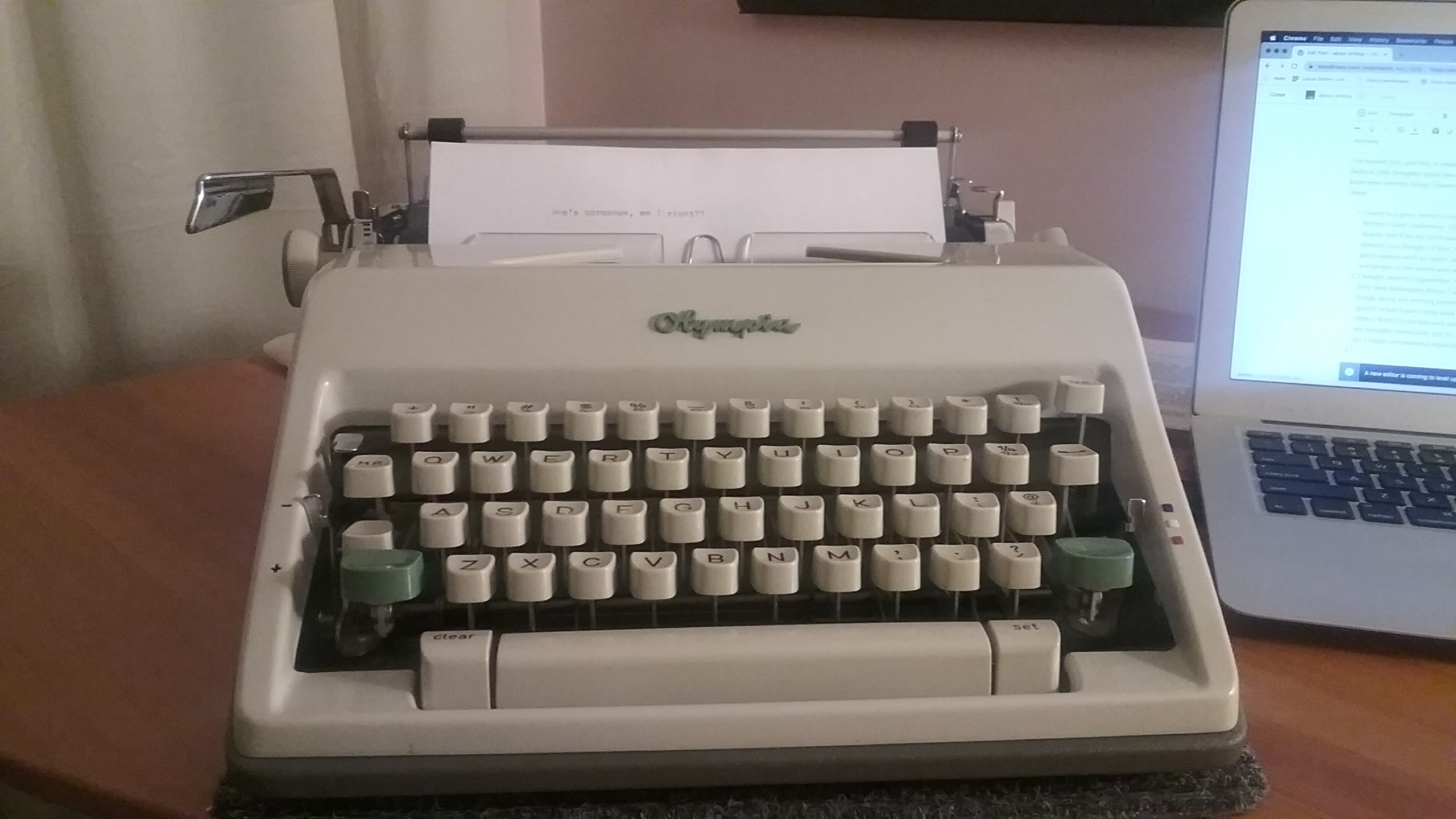
    2. I bought a typewriter. A vintage 1964 Olympia SM9 Portable Manual, to be exact, from the Etsy shop Mahogany Rhino. Friends, I am absolutely in love. In addition to just being FUN, writing on it is showing me things about writing process. For example, how often my thoughts loop (like a spiral): when I can’t jump back a few lines, add, edit, or move text, I notice how often I WANT to do this and can’t. Not sure whether this beauty will straighten out my thoughts, but if you love putting words together like I do, I highly recommend exploring other methods of word production. Also, robots are taking over the world, and I, for one, am not for abandoning all old tech in favor of AI that will probably kill us in our sleep. It’s the dystopian future, sheeple! WAKE UP!20181219_17503620181219_175048
    3. I plotted out an ending to my novel. This one is huge, folks. I haven’t been able to envision a good-feeling, solid sequence to wrap up this giant mess of notes and Word files that will one day (universe willing) be a book. I was reading Jeff VanderMeer’s Wonderbook: The Illustrated Guide to Creating Imaginative Fiction, in particular, a phrase about forgetting “to carry through on the wider consequences of an action” in a story. Not sure why my subconscious needed that prompt in particular, but I scribbled two pages of summary and the whole fucking thing just fell into place. It was amazing. Now, on to the…execution…the, uh, “writing” part…

    It’s been a pretty great writing year for me, mostly because I chose to prioritize this work over other kinds of work (like, you know, the kind that actually pays). I have a good friend who encouraged me to do this: I went to a writing retreat in May, and a conference in September. If you’re like me, a little stranded from literary circles by geography, I highly recommend saving up to take these kinds of adventures. Both jumpstarted my novel in fabulous ways. I got the beginning in May, and, after the conference, the ending. I plan to do at least two similar events in 2019.

    Keep an eye out for at least one other blog post before the New Year…


  • Writing as Self-Care

    The reason I haven’t written much lately is also the catalyst for my thoughts today. In early July, an immediate family member suffered a bad break (well, three breaks…pretty nasty stuff) to the leg. As the one with the most flexible work schedule, I stepped into a role I haven’t attempted before: live-in caregiving.

    I hold ZERO resentment. I’m thankful I get the chance to give back a fraction of the love and care I’ve been shown by this person. But I will say, it has pretty much shot my writing schedule to hell.

    The first few weeks, there were a lot of round-the-clock hours spent in ERs, hospitals, and surgery waiting rooms, a lot of hours spent cooking, doing laundry, timing distribution of meds, fetching ice, positioning pillows, refilling cups, calling doctors, and bathroom trips. When you’re in survival mode, you don’t have the brain space, capacity, or the time to write.

    A couple of days into this new reality, I realized this would be a problem. I have trouble writing when I may be interrupted. I need to have control over my environment in order to engage. I also have this thing where if I go too long without writing, I begin losing my humanity, the will to go on, etc. I need to write to survive.

    I don’t tend to acknowledge or verbalize my needs until they’ve been so neglected I’m angry, and then I pick a fight. I especially try not to “need” things if there’s someone else in the situation who has what I classify as a more “important need.” But after coming back from the Novel-in-Progress Bookcamp in May (read about my experience here), I’ve been trying to take writing more seriously like I would a regular job. Those around me don’t necessarily view it this way, as job usually means income, and I have none to speak of. I have to defend my writing time, and, in this situation as a caregiver, I knew I also had to defend my personal well-being so I could do a good job of caregiving.

    I talked this out with my family, who, of course, were very understanding. I got out of the house on a Sunday and wrote for three hours. Even though I wrote in a public place, going somewhere where I wouldn’t be asked to do something, even something small, was crucial; I knew I could concentrate.

    As soon as you find a way to balance, the world shifts around you…

    Now, as the routine of caregiving has become easier, and my family member’s overall health and mobility has improved, I’m working on getting up early to write before the day begins. This is totally foreign to me. I’m certainly not a night owl, but I’m definitely whatever the antithesis of a morning person is. I’m setting the alarm a little earlier every day, hoping to eventually get between two and three hours of writing in before tackling other daily responsibilities. I’ll definitely keep you updated on how this goes…..

    Anyhow. Point being:

    If you are a writer*, make sure you get time and space to write. Whether you actually put any good words together depends on you, too, but you won’t even get close to bad words unless you get to the desk, the notebook, the laptop, put on your headphones, shut the door. Tea is optional but recommended.

    You get me? Take time. Make space. Write like your life depends on it.

    It probably does.

    *one who writes to survive


  • The Problem with the Hero’s Journey

    There are two kinds of writers. Plotters, those who plan out the events of their stories before they write, and pantsers, those who write without knowing where they’re going.

    I have been (and probably always will be) a pantser. This is fun for me while I’m writing, but hell when trying to put together a novel. So, I thought, I’ll give plotting a try.

    I can see the allure. You know as much as you can about everything. You get everything organized and figured out up front. Of course, all of that can shift when you go to actually write out your grand master plan, but you’ll have avoided many mistakes and plot holes before putting any words together.

    But how do you plot a story?

    To the Google Machine!

    I ran into the Snowflake Method, the Save the Cat method, and the Hero’s Journey. As a recovering English Literature major, I was already familiar with the Hero’s Journey. In summary, it’s a pattern posited by Joseph Campbell in his book The Hero with a Thousand Faces, based on his theory that all stories in all cultures can be reduced to the same seventeen stages. His book explains the stages and provides examples from a wide variety of classic, mythic, and folk tales from different parts of the world. It is very dense, academic, and makes use of somewhat alienating psychology-specific language, but it is interesting.

    Screenshot 2018-06-03 17.00.34

    Writers can make use of the Hero’s Journey by structuring the events of their stories to match Campbell’s seventeen stages, which generally results in a satisfying story that is familiar, but (ideally) different enough that the general population isn’t bored.

    I attempted to apply the Hero’s Journey my protagonist. No go. It didn’t fit. There seemed to be more to her story than the stages were allowing.

    In 1981, a student of Joseph Campbell named Maureen Murdock asked him how the hero’s journey applies to women. His answer was deeply unsatisfying to her–essentially, that women don’t need to make any kind of journey. They’ve already “arrived” and their task is simply to realize it. This didn’t sit right with Murdock, so she began writing the book that in 1990 would become The Heroine’s Journey: Women’s Quest for Wholeness. Based on her experience as a woman and a therapist, Murdock created her own stages and compared her theories to myths and the stories of modern-day women.

    Screenshot 2018-06-03 17.01.05

    The problem with the Hero’s Journey is the same as that of any novel-plotting scheme that claims it works universally: it doesn’t encompass all stories. In particular, the Hero’s Journey doesn’t encompass women’s stories. Campbell’s “proofs” (the myths and stories that provide examples for his stages) were written or recorded in patriarchal cultures by those who had the privilege and permission to write.

    Have you been to the movie theater lately? Watched Netflix or Hulu or HBO with real discretion? Our stories are sick and suffering and dying. Maybe because they’re inbred versions of the same old Hero’s Journey. Maybe our most successful storytellers are just throwing stories out there, trying to turn a profit. Maybe our stories are being forced into a mold they just don’t fit.

    The Hero’s Journey doesn’t fit the story I’m trying to tell, and, I suspect, doesn’t fit many of the stories I’ve loved. It might not fit your story, either. And I’m not saying it shouldn’t, or that if it does, it’ll be a bad story. I’ve read and watched some amazing Hero’s Journey stories.

    But if you’re plotting out a story like I’m trying to do (with the sweat, blood, and tears of a true pantser), know that you don’t have to tell the Hero’s Journey. There are other stories out there, and they need to be told. It might take more work. You may have to build your own framework. You may not find support when you need it. But please, tell your stories. The world needs them.


  • Writing in Community

    I just got back from a week-long novel-writing retreat in Wisconsin. After recovering from the shock of stepping out of the airport into 95ºF with 80% humidity (and it’s not even June God help Kansas), I thought I’d share some reflections from that experience.

    We often think of ourselves as solitary creatures of coffee shops, basements, closets, and libraries, ink stained, prone to eye strain, our preferred writing utensils now just another extension of our bodies. Popular media portrays writers this way, too, and to an extent, it’s accurate. The work we do involves the page and the brain. This caricature is the bare minimum of what we need to do our thing. I don’t know about you, but bare minimum has never been appealing to me.

    Working intensely in isolation may be productive for a while. I need these times, when my ideas are mine and nobody else’s opinions are in the mix. But it gets…exhausting. The task takes on Herculean proportions. Everything is endless and impossible.

    Change of scenery is medicinal in and of itself. Being surrounded by people–writers!–who are passionate and determined about their own projects? Inspirational.

    Never imagine you can’t learn something about the craft. Even if you have every upper-level degree and tons of industry experience, hearing another writer describe their process in their words can open up new ideas and ways of understanding your own work that you would never have come to by yourself.

    I’ve also come away with a greater sense of pride in the work of writing. Because it is work. It is a job. Getting published is an entirely different animal. It’s always nice, but it doesn’t have anything to do with the work of writing. We write. We’re writers. We do our work.

    I had the chance to practice pitching to three agents. All of them were taken with the premise of my novel-in-progress (hugely encouraging!), and talked to me about next steps. Step One, finish the book. And they talked about that step so matter-of-factly. It wasn’t a matter of whether I could finish it, but of HOW and WHEN.

    So I’m working on my self-discipline. I’m working to keep to a stricter daily routine, to spend increasingly longer periods of time writing, and to always write at my desk. In the end, writing is really up to me. Though some of my fellow retreaters might get after me from time to time, no one will hound me. If I give up, no one will make me start again. It’s down to me.

    So I’m plunging back into the solitary part, refreshed, rejuvenated, and ready to finish this dang book.


  • Why We Need Disturbing Stories

    I’m a huge fan of The Handmaid’s Tale (the novel by Margaret Atwood and the Hulu series), but I wouldn’t say it’s easy to watch. It is violent, brutal, and traumatic. I cry at least once every episode. Season One gave me nightmares.

    When Season Two started streaming, the people who care about me couldn’t understand why I was so excited to put myself through that again. Often, when I ask friends or acquaintances if they’ve seen it, I get answers like, “I can’t watch that! It’s too disturbing.”

    Yeah. It is disturbing. And that’s exactly why I watch it.

    I’m not a sadist. I think that’s important to note before moving on.

    I believe that there is value in experiencing disturbing stories. Not that all disturbing stories are inherently valuable; it depends on why we feel disturbance.

    For me, one of the reasons The Handmaid’s Tale is disturbing because I am female. Watching strong women suffer because of their gender is traumatic. However, in many parts of the world, and almost everywhere historically, women have gone through horror because of their gender. The fact that I am only experiencing these things via story means I am privileged. I hate that. It should be a basic human right not to experience violence or torture or forced subjugation because of one’s gender. But that’s not how things go. Not historically, and not now.

    The Handmaid’s Tale emphasizes with alarming clarity how close we are, right now, to this level of repression. This too is disturbing. But we must remind ourselves where we have been and where we could wind up if we aren’t vigilant, outspoken, and strong, if we don’t take action when we encounter discrimination of any kind.

    The eeriest component of the governmental takeover described in Atwood’s dystopia–as well as an infamous real-world example: Nazi Germany–is the willing blindness of citizens to the signs of oncoming horrors. Living in comfort, undisturbed, humans desire to continue to be undisturbed.

    Our distractions are abundant. We carry them with us in our pockets, in our hands, on our wrists. Celebrity interviews and cat videos are a click away. We can choose oblivion, to self-medicate with a comedy that’s a little sexist/racist/whatever, but it’s so funny, we give it a pass. We would rather be comfortable in our privilege than deal with the implications of a rape joke. We would rather not think.

    If we sleepwalk through our lives, we won’t notice injustice or discrimination. The realities of The Handmaid’s Tale could become our reality.

    Our level of sedation is high. We need to be shocked awake. We need to be disturbed, affected, and changed.

    The Handmaid’s Tale wakes me up. It’s a challenge, and a call to arms. If I opt out because of my discomfort–the discomfort of identifying with characters and imagining going through their pain–what will I do when confronted with suffering in the flesh?


  • Do You Have Anything to Offer?

    I recently had the privilege of being able to hear one of my favorite opera singers perform live.

    Maybe not a sentence you expected to read today. Believe it or not, I was an opera singer in a past life. It didn’t work out, which was probably for the best. Anyhow, I still sing, teach voice lessons, and take huge delight in seeing professional musicians at work.

    This was Joyce DiDonato, a fabulous mezzo-soprano, singing with the Kansas City Symphony. I had tickets in the second row. Spit-zone close. I could go on about how amazing it was to watch her back breathing, the shape of her lips, etc. etc. But that would be a different blog.

    Laughing.jpg
    Joyce DiDonato, Photo: Simon Pauly

    In the afterglow of the concert, I was searching around for her online and came up with a lovely interview she did with Living the Classical Life. She told the story of how, as a young singer, a prominent and established musician told her she had nothing to offer as an artist.

    Can you imagine?!

    After some time passed, DiDonato started to try to figure out where this criticism had come from. And she realized something that totally revolutionized her approach to music as an artist. She was portraying perfectly what an “Opera Singer” should look like, walk like, talk like, and singing her arias like “Opera Singers” should. She had left herself completely out of it. There was nothing of Joyce in her art.

    If we are trying to be what we think is expected of us, to produce what is expected of us, we will have nothing to offer. The writers I consider important (Dickens, O’Connor, Lovecraft, Fitzgerald, Calvino, Dillard, LeGuin, Peake) all sound so incredibly like themselves. This is their strength: not that they can write a fantasy trilogy, a shocking short story, or invent a new form of fiction, but that they are doing what they do. What they want to do, what they can do, and they are saying it in their own voices.

    DiDonato took several years to figure out what she wanted to say. Now she is celebrated internationally for her skill and for her activism. She consistently emphasizes the humanity of the characters she portrays. She holds masterclasses with young singers. She works with prisoners at Sing Sing. She is trying to bring peace to the world. What she wanted to say is, I think, that everyone deserves compassion.

    And she earned the platform to say this by choosing to forgo the image of who she thought she was supposed to be. She is Joyce, 100%.

    I think this question of identity, especially for a young artist, is super important. We can’t create anything new if we’re trying to emulate another artist. We can’t create anything interesting if we’re caught up in the imaginary rules we’ve made for ourselves of what a “real artist” should do, say, think, or feel.

    So…

    Questions To Think About

    What does the market want?

    What would be an instant classic?

    What would people think is “cool”?

    How can I be more myself in my work?

    What persona is getting in my way?

    What is stopping me from believing who I am is enough?

    What do I want to say?

    What do I have to offer as an artist?


  • Novel Writing, Consumerism, and the Skill of Waiting

    We belong to an impatient culture. We don’t wait for anything if we can help it, and if we have to wait, we tap our feet, sigh, and complain.  Sitting and thinking that doesn’t lead to immediate action is “wasting time” or “naval gazing” or “daydreaming.”

    We have lost sight of the value in waiting.

    You know how sometimes it seems like the universe contrives to make you notice something by bringing it to your attention multiple times in a short span of time? (For example: After not hearing it or thinking about it for YEARS, I heard the phrase “like putting lipstick on a pig” three times from three different places, in one day.)

    This idea has been haunting me lately:

    A very common mistake in novel writing is to start writing before you are ready.

    And (like “lipstick on a pig”) it’s coming at me from different places…

    In his book Thrill Me: Essays on Fiction, Benjamin Percy writes that he sits with his novels for a year before doing any actual writing. He creates character boards, takes notes, makes maps, and thinks–for a year. When he does actually start writing, he knows his characters and their world inside and out.

    Ursula K. Le Guin claims that writers get “grabby” in her book The Wave in the Mind: Talks and Essays on the Writer, the Reader, and the Imagination. Writers get the first notions of an idea, seize the idea, and begin to write too soon. She insists on the importance of waiting to discover the rhythm of the piece you’re working on. This has to do with discovering your protagonist fully (Le Guin knew she had discovered her characters when she could identify ways they were different from herself…an interesting idea…), the syntax of your sentences, and the overarching pattern of the larger story. Once you have the rhythm, she says, it’s almost impossible to write a wrong word.

    Le Guin waited. She sat at her desk, listening for the voices of her protagonists, their cadences. From the outside, it looked like she was being lazy. Wasn’t she a writer? Why wasn’t she writing? She was wasting time. Daydreaming. Put some words on the page, already!

    In my typical process, the early stages of any piece are writing: experiencing events as the sentences unroll themselves into scene, dialogue, and description. The kind of sentence and its quality don’t matter much. I write only what’s necessary to spark an idea in my mind.

    I don’t want to plan it out, I want to live it, right now, in this moment. I don’t want to get to know the characters, I just want to know everything they do. I want to peel them open like cadavers, not understand them as humans.

    I want the story, and I want it now.

    I write half-assed dialogue, skimp on description, and pay no attention to mood or subtext.

    This mindset is all about my experience. It’s selfish. Impatient.

    I could make a case that it’s a result of living in this fast-paced, hyper-consumeristic society, in which convenience trumps quality. But finding somewhere to place blame doesn’t help me be a better writer.

    I can see the negative effects of not waiting before writing clearly in long pieces I’m working on. My lack of understanding–my lack of respect–is like anemia: it’s weakening everything in the story.

    I wish I had come across this idea years ago.

    I also wish there was a more definite way to know when you had done enough sitting in silence, listening to the echoes of your imagination, a way to know when you were ready to put aside the markers and glue and pick up the laptop. I wish there were steps to follow or bumpers, like in bowling, to keep you moving in the right direction.

    If wishes were fishes, we’d all swim in riches.

    If wishes were horses, beggars would ride.

    If wishes were writers, we’d all be Stephen King.

    Le Guin says that writers must be able trust themselves. We need to know our own skills, our intentions, and believe in our ability to carry them out. We must also be able to trust the story, that it will emerge as something greater than we could have planned.

    Maybe if we learn to trust our work, and ourselves, and ignore the howls of society (hurry hurry do write finish sell publish market fame fortune repeat) we’ll be able to sense when we are prepared to enter into a long story.

    Waiting is doing something.

    This is a countercultural idea. This is a countercultural writing process. But I wonder if the more we listen, the more sure we become. The less noise we allow in, the more we can hear of what counts. With patience, the profound.

    I’ve been sitting on a really cool cyborg pirate story for a while now. Rather than grabbing it by the horns, I think I’ll try sitting with it first. Getting to know it. Building trust and listening and waiting.

    Write it? Maybe next year…


  • In the wake of Ursula K. Le Guin’s passing

    As testimonies, tributes, and memorials flood the internet, many refer to the product of Ursula K. Le Guin’s writing career, her art, as a body of work.

    I am fascinated by the phrase.

    In leaving her physical body, Le Guin draws attention to that other body, the one she built with words. The body she created, the wake of her living, is extensive, dense, gorgeous, precise, urgently important, and breathing.

    In library shelves, old hardback novels, stained by the fingerprints of generations of readers. On bookstore displays, pages crisp and fresh, smelling of new ink. Dog-eared on bedroom nightstands, piled together with co-conspirators of every genre.

    It is right to mourn the passing of a person of such integrity, wit, intelligence, talent, dedication, discipline, someone who has influenced whole generations, and worlds, with her art. We should be grief-stricken. We have lost a giant.

    And yet, she is not gone. Not totally. Her body of work now stands in for her person. It is not a fair trade, bound pages for a soul, but it is a glittering legacy. Every time her words are read aloud, mentally, heard, understood, pondered over, she grins and winks. She whispers in our ears words of power, passion, truth, and imagination. In this way, she is not dead at all, and never will be.

    Do not stand at my grave and weep
    I am not there. I do not sleep.
    I am a thousand winds that blow.
    I am the diamond glints on snow.
    I am the sunlight on ripened grain.
    I am the gentle autumn rain.
    When you awaken in the morning’s hush
    I am the swift uplifting rush
    Of quiet birds in circled flight.
    I am the soft stars that shine at night.
    Do not stand at my grave and cry;
    I am not there. I did not die. 

    “Do Not Stand at My Grave and Weep,” Mary Elizabeth Frye