The Supreme Court’s ruling on birthright citizenship.
Happy Wednesday. I’m Isaac Saul and I’m feeling like an Ivy League–educated law student in the midst of SCOTUS Week (speaking of: departing associate editor and soon-to-be law student Lindsey Knuth is doing a Reddit AMA tomorrow!). Today, we’re diving into the birthright citizenship ruling that has lit the commentariat on fire. Tonight, I’ll be turning my brain off for a couple hours to chant “USA!” at my TV while pretending I understand how soccer works. I expect all patriots to join me.
Also in today’s newsletter: an under-the-radar story on people lying when they answer political polls, and a remarkable story about technology allowing a man to communicate despite his motor neuron disease. It’s a worthwhile 14-minute read. Let’s go.
What’s up with Britain?
Last week, British Prime Minister Keir Starmer announced his resignation. If it feels like the country’s leaders are always coming and going, that’s because… they are. With Starmer’s departure, Britain will have had six prime ministers in 10 years. Each entered office promising stability; each left amid deep public dissatisfaction. In our newest YouTube video, Associate Producer Aidan Gorman explores what’s going on across the pond. Watch it below:
Our latest YouTube video
Quick hits.
- NPR mistakenly published and broadcast a report that Supreme Court Justice Samuel Alito was retiring, then retracted the story minutes after publication. The outlet’s leadership said in a statement that the error resulted from legal affairs correspondent Nina Totenberg mishearing an announcement about retirements on the Court and assuming it referred to Alito. (The statement)
- Rep. Tom Kean Jr. (R-NJ) made his first public appearance in four months, delivering a speech on the House floor in which he said he had been diagnosed with depression and hospitalized on his doctors’ recommendation. (The return)
- Democratic socialist candidate Melat Kiros defeated 15-time incumbent Rep. Diana DeGette in the Democratic primary for Colorado’s 1st Congressional District. (The result)
- In a financial filing, President Trump disclosed earning $2.2 billion in 2025, including approximately $1.4 billion from his family’s cryptocurrency businesses. (The filing)
- Anthropic said the Commerce Department has lifted export controls on its Fable 5 and Mythos 5 artificial intelligence models, roughly three weeks after the government imposed the controls over national security concerns. (The update)
Avoid high interest and pay no interest until 2028 with this card
Stop letting high-interest credit card payments eat into your budget. Paying those steep rates every month? It’s like throwing money away! If you’re ready to break free, now might be the perfect time to switch to a card that allows you to pay no interest on balance transfers into 2028.
The FinanceBuzz editors have highlighted a card offering exactly that! That could mean an intro period of over a year of no interest on balance transfers, giving you the chance to pay down your balances faster and keep more money in your pocket.
Even better? This card comes with a $0 annual fee. It’s the ultimate way to take control of your finances and escape the high-interest trap.
Today’s topic.
The birthright citizenship ruling. On Tuesday, the Supreme Court struck down President Donald Trump’s executive order attempting to end birthright citizenship, ruling 6–3 in Trump v. Barbara that the order is unlawful. Three Republican-appointed and three Democratic-appointed justices comprised the majority, though Justice Brett Kavanaugh dissented in part. Justices Clarence Thomas, Samuel Alito, and Neil Gorsuch each authored dissents.
Back up: On the first day of his second term, President Trump signed an order declaring that a child born in the U.S. is not a citizen if their father is not a U.S. citizen or permanent resident, and their mother is either in the country illegally or only there temporarily. The order was immediately challenged on the grounds that it violated the 14th Amendment’s Citizenship Clause. The Supreme Court heard oral arguments in April.
Writing for the majority, Chief Justice John Roberts held that the 14th Amendment was clear in its intent that children born in the United States to parents illegally or temporarily present in the country should still be U.S. citizens. The amendment’s Citizenship Clause, he wrote, excluded “the children of foreign ministers and members of 19th-century Indian tribes,” but “no such intersovereign concerns apply to children born of parents unlawfully or temporarily present in the United States.”
Justice Kavanaugh filed an opinion dissenting from the majority’s view that the executive order violates the 14th Amendment, instead arguing that it was illegal under a federal law enacted in 1940 that mirrored the Citizenship Clause’s language. However, Kavanaugh suggested that Congress could amend that law and change the definition of birthright citizenship.
Justices Alito and Thomas strongly disagreed with the decision; Alito called it “a serious mistake,” while Thomas said the ruling “adds to the sad history of the Fourteenth Amendment, which was designed and understood to secure equal rights for the freed blacks but has instead been repurposed for political projects that the Reconstruction Congress did not support.”
Finally, Gorsuch (who also joined Thomas’s dissent) wrote that the Citizenship Clause does not apply to children born to parents who are temporarily in the United States — legally or illegally. However, he suggested that children of noncitizens who intend to remain in the country should be considered citizens, writing, “Is a child born here to parents who have long chosen to make this Nation their permanent home not a citizen under the Fourteenth Amendment solely because his parents’ presence violates statutory law? If those parents are not domiciled here, then where are they domiciled?”
Today, we’ll explore perspectives on the ruling from the right and left, followed by Executive Editor Isaac Saul’s take.
What the right is saying.
- The right mostly opposes the practical outcome of the ruling, though many acknowledge the majority’s sound legal reasoning.
- Some say the decision could be a political boon for Republicans.
- Others argue Congress should try to amend the 14th Amendment.
National Review’s editors wrote about “birthright citizenship after Barbara.”
“The Court took the traditional view of this broad language [in the Citizenship Clause] that most people in the country are ‘subject to the jurisdiction’ of American law unless they are members of a sovereign Native American tribe or represent a foreign government,” the editors said. “The Wong Kim Ark rule has the advantage of ease and clarity, and that plainly gave the Court pause in unsettling it. In the specific case of parents traveling through the country, how long do they have to be here to be considered legally domiciled in the United States, and what other factors would weigh in such a decision? The majority was not persuaded that an alternative test could easily be located in the Constitution.”
“It might have been wiser if the framers of the 14th Amendment had left the outer limits of birthright citizenship to Congress. Congress can adjust to new and changing situations and can write detailed rules to address distinctions that the courts are ill-equipped to draw based solely on general language,” the editors wrote. “Still, Congress and the president are not powerless even after Trump v. Barbara. Stricter rules could be applied to discourage and deter birth tourism… Illegal immigration, of course, can be stemmed with the border security and enforcement tools the president already has and is actively using.”
In PJ Media, Scott Pinsker explored “the political upside of losing the birthright citizenship case.”
“Weirdly, today’s Supreme Court loss was a net-positive for the Republican Party — at least for the 2026 midterms, and probably for 2028 as well… Traditionally, immigration has been President Donald Trump’s top-polling issue, although he occasionally faced pushback for ‘going too far.’ Because he lost, the immigration issue is still on the table,” Pinsker said. “It’s counterintuitive, but there’s a cost to solving a political problem: It removes the issue from the public sphere. Because we lost today, the immigration issue is still relevant. And we can still use it to drive voters to the polls.”
“If the Supreme Court hadn’t demonstrated its independence, the Democrats’ pledge to pack the court — and contort the Constitution — would no longer look like an insane overreach,” Pinsker wrote. “It also opens an opportunity for the GOP to tackle the immigration problem by other means… Now, we can have a national debate over what it means to be an American: Is it in our national interest for pregnant immigrants to illegally enter our country, deliver an anchor baby, and then claim lifelong citizenship? Or is that a recipe for abuse, fraud, and government waste?”
In Fox News, Jonathan Turley said the ruling “leaves conservatives with only one path.”
“[The majority] found the language and history of the amendment to be clear and, relying on prior rulings dating back decades, concluded that birth alone in this country is enough to confer citizenship — even if born to a tourist or someone briefly on our soil,” Turley wrote. “It is a view that is rejected by the vast majority of countries, which rightfully view birthright citizenship as bonkers, including some which followed the practice and then rescinded it. The United States remains one of the outliers in maintaining this ill-considered practice.”
“The matter now rests not with the court, but the country. We have never truly had a national debate over the practice. The basis and future of birthright citizenship have remained matters almost exclusively for the courts. We must now decide whether to pursue such a debate as a constitutional amendment,” Turley said. “While Congress can pass legislation cracking down on birth tourism, there is only so much that such laws can do in questioning why particular births occurred in the United States.”
What the left is saying.
- The left supports the outcome, expressing relief that the majority upheld the established understanding of the Citizenship Clause.
- Some criticize the Republican-appointed justices’ dissents.
- Others worry that future birthright citizenship challenges could still succeed.
The New York Times editorial board wrote “the Supreme Court remembers its principles.”
“The Supreme Court’s decision on Tuesday to preserve birthright citizenship comes as a relief. President Trump’s unilateral effort to prevent the children of undocumented immigrants from automatically becoming citizens was plainly unconstitutional,” the board said. “As the majority opinion by Chief Justice John Roberts shows, the history of the citizenship clause of the 14th Amendment, ratified in 1868, makes clear that ‘subject to the jurisdiction’ refers to the power of the United States to govern people within its territory. Federal and state laws do, of course, apply to the children of migrants.”
“The majority’s decision is a relief because this Supreme Court is not always willing to apply the law equally to Mr. Trump. Yes, it rightly rejected his tariffs as a usurpation of Congress’s authority to tax. But the court’s six Republican-appointed justices have been inappropriately deferential in a string of other cases,” the board wrote. “The birthright citizenship ruling is a reminder of what a principled, Constitution-bound court should look like.”
In Bloomberg, Noah Feldman asked “how was the birthright citizenship decision this close?”
“The bad news — and it is very bad — is that the vote in support of this position was 5 to 4, not 9–0… You read that right. The highest court in the United States came within a single vote of casting aside the text and history of the 14th Amendment and joining the anti-immigrant frenzy that accompanied Donald Trump to the White House nine years ago and has not yet fully abated,” Feldman said. “Justices Clarence Thomas, Samuel Alito, Neil Gorsuch and Brett Kavanaugh… ride roughshod over the language of the Constitution, not to mention precedent. Their path is determined by their ideological preferences, even as they insist it is based on their constitutional respect.”
“According to the four conservative dissenters, Congress could redefine the words ‘subject to the jurisdiction thereof’ so that people not lawfully in the U.S. are excluded. Yet everyone in the United States, lawfully or otherwise, is plainly subject to the jurisdiction of the United States. All of us here are obligated to follow U.S. laws and can be punished criminally if we don’t do so,” Feldman wrote. “[These justices] are supposed to take the text of the Constitution seriously. So how could they vote the way they did, ignoring the words of the 14th Amendment and rejecting the straightforward majority opinion that also relied on both history and precedent?”
In Common Dreams, Jordan Liz said “the battle is far from over.”
“After several disastrous Supreme Court rulings on Temporary Protected Status (TPS), asylum entries, transgender athletes, campaign finance restrictions, and presidential firing power, it may be tempting to see this decision on birthright as a glimmer of hope. Unfortunately, there are reasons to be concerned,” Liz wrote. “Kavanaugh believes that Congress could limit birthright citizenship themselves. A constitutional amendment would not be needed. The same is arguably true for Gorsuch, Thomas, and Alito. If Congress were to pass legislation that codifies Trump’s Executive Order and formally defines ‘domicile’ status in a way that excludes undocumented immigrants and temporary visitors, then those four justices would likely uphold it.”
“What we needed was a clear 7–2 decision (Thomas and Alito were always going to dissent). One that acknowledged what the Constitution plainly says and what it obviously grants,” Liz said. “As things stand, however, the Supreme Court is effectively one vote away from fundamentally changing who is entitled to U.S. citizenship and what it means to be an American. While birthright citizenship survived today, this ruling exposes how fragile its guarantee has become.”
My take.
Reminder: “My take” is a section where we give ourselves space to share a personal opinion. If you have feedback, criticism or compliments, don’t unsubscribe. Write in by replying to this email, or leave a comment.
- This outcome was reasonable and expected, but some of the reactions from the right have been shocking.
- The plain text of the 14th Amendment and its historical context support striking down Trump’s order.
- However, I found Gorsuch’s dissent compelling as a way to address the excesses of birthright citizenship.
Executive Editor Isaac Saul: Amid all the noise, let me just remind people: The 14th Amendment’s Citizenship Clause reads, in full, “All persons born or naturalized in the United States, and subject to the jurisdiction thereof, are citizens of the United States and of the State wherein they reside.”
I didn’t think this was particularly complicated after oral arguments, and I don’t think so now. Again, the amendment is not vague: “All persons born or naturalized in the United States, and subject to the jurisdiction thereof, are citizens of the United States and of the State wherein they reside.” Maybe you think that amendment is a bad amendment. Maybe you think it is poorly written. Maybe you think “subject to the jurisdiction thereof” has such force and importance that all the words around it don’t mean what they say. Maybe you think Congress should pass a law, or states should amend the Constitution, to end birthright citizenship.
But the language is right there.
Yesterday, Senior Editor Will Kaback graciously gave me some credit for rightly predicting the result of the late-arriving-ballots case while noting that many courtwatchers and left-wing writers were preemptively freaking out about the outcome, suggesting the “conspiracy-brained,” “misinformed” Court was about to outlaw late-arriving ballots. Then many of those people went silent when the ruling went the other way.
Well, today, I think it’s only fair to note the reactions from many of the ascendant, postliberal, reactionary, right-wing pundits, who are absolutely unraveling after the majority Republican-appointed Court upheld birthright citizenship.
Sean Davis, the CEO and co-founder of the influential conservative website The Federalist, is suggesting “sterilization of all foreign visitors” and “dissolution of the Union.” Matt Walsh called the ruling “evil,” accused Justice Amy Coney Barrett of being a DEI hire, and argued that “the worst Supreme Court justices of all time have been women, that’s just a fact.” Steven Crowder, the popular YouTube host (whose mom is French Canadian and who grew up in Quebec), said, “Amy Coney Barrett and John Roberts just decided that little Josue born to illegal Haitians in Springfield, Ohio is just as American as you and me.” Jeremy Carl, a senior fellow at the Claremont Institute, wrote: “If you think it’s a coincidence that the ‘conservative’ justice [Roberts] with no biological children and the justice [Barrett] with two Haitian adoptees are fundamentally libs when the chips are down, you have a lot to learn about politics.”
These reactions aren’t just confined to formerly fringe, now mainstream punditry, either. Fox News’s Brian Kilmeade suggested to an agreeable Homeland Security Secretary Markwayne Mullin that we might start banning pregnant women from traveling to the U.S. Stephen Miller, the White House senior adviser, said they were taking a serious look at this idea.
This was a totally predictable and completely rational ruling from a 6–3 Republican-appointed Court; to call these responses from the right abnormal or unhealthy would be the understatement of the week.
Frankly, I’m surprised the ruling wasn’t more lopsided. When we covered oral arguments, I predicted this decision would come down 7–2 or 8–1, and I’m having a hard time accepting that it was much closer than it should have been.
For instance: On Monday, I wrote about the Court’s decision on two immigration cases. In one of them, Justice Alito used much of his opinion to describe the “plain English” meaning of “arrives in,” arguing that when someone “arrives in” the United States, it means they are in the United States, not at a port of entry standing in Mexico. Therefore, he said, the Trump administration did not have to grant asylum to migrants until they arrived in the United States, because that’s what the language said, and thus they could block them from entering. I agreed with this rationale, because it makes sense. Yesterday, Associate Editor Carina Pacheco noted her support for Justice Alito’s plain English interpretation of Election Day — not week, fortnight, or month, but day. Therefore, she and Alito concluded, elections should not go on for weeks or months.
Well, what does Justice Alito think it means when the 14th Amendment says anyone “born or naturalized in” the United States is a citizen? What is the “plain English meaning” of that phrase? One might consider this answer a layup for such a staunch textualist. Yet, instead, Alito focuses on “careful analysis of the text of the Fourteenth Amendment and the process that led to its adoption,” and argues that the “Fourteenth Amendment confers citizenship on only those children who, at birth, owe allegiance solely to this country.”
These are words, language, and reasoning that appear nowhere in the text. It’s hard not to notice the glaring inconsistency. The fact that he somehow arrives in a place other than the 14th Amendment’s very plain language is both frustrating and alarming — and makes it harder to defend him from accusations of motivated reasoning.
Further, Alito and Thomas’s insistence that we focus on the historical context of the 14th Amendment does not — to me — help their cause. I went over a lot of this historical precedent the first time we wrote about this case, and it is fascinating. The upshot is that the plain language of the 14th Amendment fits cleanly with the historical record. When Congress was voting on the 14th Amendment, it had also just drafted the Civil Rights Act of 1866, which gave citizenship to “all persons born in the United States and not subject to any foreign power.”
Amid debate about the amendment, Pennsylvania Sen. Edgar Cowan objected to the Citizenship Clause, fearful it might let Chinese immigrants “overrun” California. Sen. John Conness (CA) responded that “the children begotten of Chinese parents in California… shall be citizens” and that the Civil Rights Act had already established “that the children of all parentage whatever… should be regarded and treated as citizens of the United States.” Congress simply thought it was putting the idea of birthright citizenship out of reach of legislative undermining, and largely intended it to do just that.
Or, as Chief Justice Roberts put it, the Amendment’s framers wanted to “permanently enshrine” the idea that “a child born on American soil and subject to American law was made an American citizen.” Roberts rightly described the “scant evidence” for any revisionist reading of this history. Again: Maybe you don’t like this amendment, or its language, but I think it’s pretty clear the framers of the Amendment understood the ramifications of its wording.
Still, “the Court rules 6–3 to uphold birthright citizenship” does not really capture the nuance of what just happened. In reality, Justices Roberts, Sotomayor, Kagan, Barrett, and Jackson all joined the critical majority opinion. Justice Kavanaugh concurred that Trump’s executive order was illegal but did not concur in the reasoning. He argued that the order did not violate the 14th Amendment but did violate federal law, and suggested Congress could amend that law or enact new legislation to make exceptions for children born in the U.S. to temporary visitors or foreign citizens.
Meanwhile, Justices Gorsuch, Thomas and Alito all dissented, but for different reasons. Gorsuch’s was most interesting to me — he argued for distinguishing between temporary visitors and immigrants here illegally. He would deny birthright citizenship to the children of temporary visitors but allow it for the children of noncitizens illegally in the country but with intent to stay. Gorsuch focused on the Court precedent and historical understanding of “domicile,” arguing that an unauthorized immigrant could be domiciled here and thus their children would be conferred citizenship.
As Reason’s Robby Soave noted, that makes it more like a 7–2 decision on the issue of whether the children of immigrants here illegally are citizens, which is the core political lens through which a lot of people are viewing this case. And in reality, it was probably 8–1 or 9–0 on that question. Both Alito and Thomas left open the idea that the children of (at least some) unauthorized immigrants who lived here would qualify as citizens because their parents were domiciled. In other words, there really was consensus on one of the core political questions downstream of the narrow legal question.
As a matter of pure outcome, not legal debate, I actually find Gorsuch’s view the most aligned with my own. The children of someone intentionally and obviously domiciled here — even illegally — should be citizens, while the children of someone who travels here temporarily and happens to give birth on U.S. soil (or only stays long enough to give birth) should not. Not so long ago, even stricter restrictions on birthright citizenship were mainstream among Democrats. I don’t believe this is what the 14th Amendment says, but I do think it would be the best-case scenario to address some of our modern-day immigration issues. Whether Congress or the courts can get there at a future date is an open question, but it’s not the question the Court resolved on Tuesday.
Take the survey: What do you think of the Court’s decision? Let us know.
Disagree? That’s okay. Our opinion is just one of many. Write in and let us know why, and we'll consider publishing your feedback.
Your questions, answered.
Q: I just read about “ghost students” defrauding colleges, universities, the government, and taxpayers out of millions of dollars. I don’t understand how people can make money off of this scheme. I thought that when people were awarded scholarships, grants and/or financial aid, the amount they were awarded was deducted from what they had to pay. Can you explain this?
— Jennifer from Toledo, OH
Tangle: A recent Department of Education analysis found that the government has disbursed nearly $90 million of fraudulent student aid, including $30 million to people who were dead. In 2023, three California women were indicted for using the identities of prisoners to falsely enroll in community college and obtain student loans, defrauding the government of roughly $1 million. These fraudsters are called “ghost students.”
Receiving federal student loans is basically a three-step process: First, prospective college students apply for aid through the Free Application for Federal Student Aid (or FAFSA). Future students input their financial information and their prospective schools so the government can consider their level of need. Second, after a student is accepted into a school and opts in to the available federal funds, the government disburses a personalized aid package into the student’s account with that school. This is true even for tuition-free community colleges, since many students receive aid packages to help with books, travel, or cost-of-living while enrolled. Third, the schools disburse the aid. For any package that disburses more in aid than the student’s tuition costs, the school will send the aid costs to the student (after a 30-day period, which is meant to prevent fraud).
“Ghost students” exploit vulnerabilities at each stage of the process. First, they steal Social Security numbers (SSNs) from other people in order to apply for aid under false identities. Then, they enroll in colleges with low or no tuition. Most colleges verify enrollment in classes after disbursing aid, and some do not require students to provide SSNs when they register for classes. That means fraudsters can even register and attend some classes themselves under fake identities until the schools pay them out — then, they “ghost” them. In California, where community colleges are free and are forbidden by law from requesting SSNs of students, the California Community Colleges Chancellor’s Office estimated last spring that over one third of all applicants were fraudulent.
Want to have a question answered in the newsletter? You can reply to this email (it goes straight to our inbox) or fill out this form.
Under the radar.
Two-thirds of Americans believe people lie in political polling. Does that mean most polling is flawed, because it relies on self-censored responses to politically sensitive questions? What do Americans really believe? In a recent series of polls divided along political, ideological, racial, and economic lines, a new initiative called the Honesty Project asked respondents for their “public” and “private” opinions on contentious issues. The polling found that Americans are privately more patriotic than they express publicly, Gen Z shows higher private support for political violence, and a majority of polled Americans privately believe other Americans are the country’s greatest threat. The overall data appears to coalesce around one common truth: Americans may be performing a certain flavor of politics in public while harboring much more complicated — and sometimes completely different — beliefs in private. The Free Press has the story.
Headlines Weighing You Down? There’s a Better Way
The Pour Over delivers politically neutral news for Christians — just enough to stay informed, with Biblical reminders that keep the Good News in focus. No anxiety spiral, no rage bait. 1.5 million readers trust their approach.
It’s free, it’s funny (sometimes), and the welcome email might actually make you smile.
The extras.
- One year ago today we covered the Supreme Court ruling on parents opting their children out of LGBTQ classroom material.
- The most clicked link in our last regular newsletter was the Supreme Court striking down limits on coordinated spending between candidates and political parties.
- Nothing to do with politics: A site that maps real-world journeys from classic books.
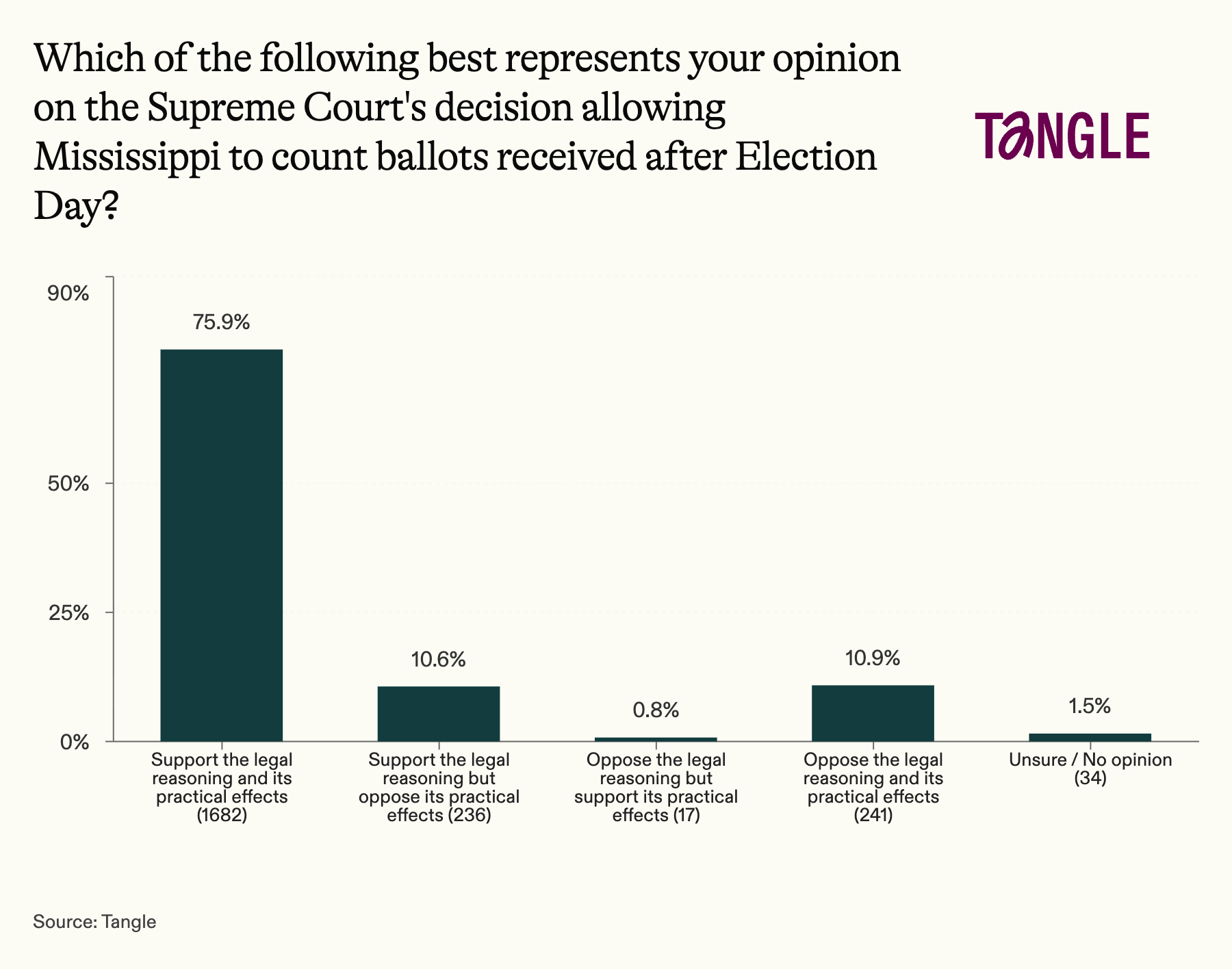
- Our last survey: 2,216 readers responded to our survey on the Supreme Court’s late-arriving-ballots decision, with 76% saying they support the legal reasoning and its practical effects. “What a happy surprise,” one respondent said. “We need to know who won the election on the night of the election. Stretching things out is ridiculous,” said another.
Have a nice day.
Six years ago, 48-year-old Casey Harrell was diagnosed with a motor neuron disease that left him paralyzed. But through his brain–computer interface, a device that operates through microelectrodes in his brain’s speech motor cortex, Harrell can send texts and emails, operate a computer, and keep working in his climate-advocacy position. A recent study analyzing nearly two years of Harrell’s home use of the device found that he had communicated 183,060 sentences, 92% of which he labeled at least mostly accurate. “This has allowed me to keep working and earn money and insurance for my family,” Harrell said. “This is reconnecting me with friends and family who are too shy or too afraid to come over and not be able to understand me.” Nature has the story.