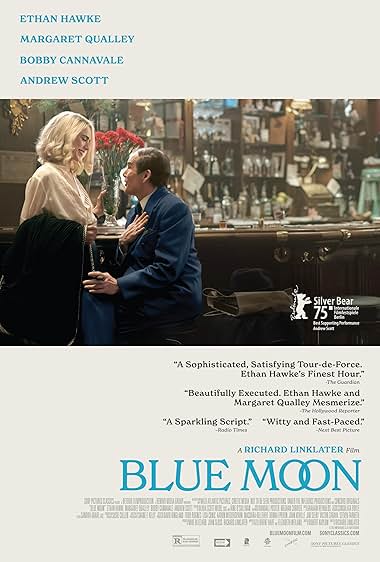

Tells the story of Lorenz Hart's struggles with alcoholism and mental health as he tries to save face during the opening of "Oklahoma!".Tells the story of Lorenz Hart's struggles with alcoholism and mental health as he tries to save face during the opening of "Oklahoma!".Tells the story of Lorenz Hart's struggles with alcoholism and mental health as he tries to save face during the opening of "Oklahoma!".
- Director
- Writers
- Stars
- Awards
- 12 wins & 35 nominations total





Robert Kaplow
- Radio Announcer
- (voice)
- Director
- Writers
- All cast & crew
- Production, box office & more at IMDbPro
Featured reviews
Blue Moon isn't a loud or dramatic biopic; it's a calm, melancholic night trapped inside the mind of a man who realizes the world is moving on without him. Ethan Hawke is fantastic here; he plays Lorenz Hart with such softness, bitterness, humor, and heartbreak that you can almost feel the weight on his shoulders.
The whole film has this serene, almost dreamlike atmosphere; a smoky bar, gentle music, people drifting in and out of conversations while a broken artist tries to hold himself together. It's amusing at times, calming in its rhythm, but underneath it all there's a quiet tragedy that makes the film linger.
Not perfect, but definitely memorable. A beautifully acted, elegant little character piece.
The whole film has this serene, almost dreamlike atmosphere; a smoky bar, gentle music, people drifting in and out of conversations while a broken artist tries to hold himself together. It's amusing at times, calming in its rhythm, but underneath it all there's a quiet tragedy that makes the film linger.
Not perfect, but definitely memorable. A beautifully acted, elegant little character piece.
Blue Moon
You saw me standin' alone
Without a dream in my heart
Without a love of my own
Ethan Hawke makes himself almost unrecognizable to play Lorenz Hart, the man who wrote those words.
Hart was five-feet tall, balding, a cigar always in his mouth, his back so curved his chin barely clears the bar at Sardi's where he spends most of the movie "Blue Moon" yakking away. His sad - if witty and sometimes brilliant - monologues are performed for bartender Eddie (Bobby Cannavale), piano player Knuckles (Jonah Lees) and assorted folks who stop by the legendary Broadway celebrity hangout one fateful night in 1943.
Showcasing the alcoholism and other sorts of self-destructiveness that would kill him at age 48 seven months later, it's a daring, all-in performance by Hawke. It's already getting buzz this awards season.
Whether or not it nabs an Oscar nomination or two, it won't win many hearts in audiences looking for a fun night out at the movies.
With composer Richard Rodgers providing the melodies, Lorenz Hart penned the sophisticated lyrics of countless Great American Songbook staples. Along with the movie's title tune, there was "Bewitched, Bothered and Bewildered." "My Romance." "Manhattan." "My Heart Stood Still." "The Lady Is a Tramp." And on. And on ... close to a thousand songs.
For two decades Rogers and Hart were a dynamic duo on Broadway and Hollywood. Piano bar songs on the soundtrack offer nonstop tribute to their musical glories, with echoes of contemporaries like the Gershwins, Cole Porter, Harold Arlen, Irving Berlin and even George M. Cohan.
Unfortunately, Robert Kaplow's script doesn't immortalize Lorenz Hart for all his achievements, but instead, for being the man who didn't write "Oklahoma!" Richard Linklater is once again Ethan Hawke's go-to director, confining the film's action essentially to one set, unfolding in something like real time on the night of March 31, 1943. For America, in those uncertain early years of World War II, that was the night "Oklahoma!" opened on Broadway and changed everything.
Rodgers and Hart were still a team when they began adapting the play "Green Grow the Lilacs" into a musical. Unfortunately, Hart's habit of going on weeks-long benders instead of showing up for work finally pushed Rodgers to his breaking point. As luck would have it, another lyricist was available. His name was Oscar Hammerstein II.
The rest, as they say, would become history, not just on Broadway but on community theater and high school stages to this day.
Lorenz Hart was in the audience for "Oklahoma!'s" opening night. But the corn as high as an elephant's eye, not to mention the dancing cowboys and the exclamation mark at the end of the title were more than his urbane Manhattan sensibilities could take. So he retreated to Sardi's for some lubricated self-pity an hour before the creators of the show, along with adoring first nighters would arrive to await the reviews.
Those reviews proved to be raves, hardly a recipe for improving Lorenz Hart's state of mind. His conversations with Richard Rodgers (Adam Scott), basking in triumph, are heartbreaking.
Among all the self-deceptions Hart concocts to help make it through the night, is his torrid passion for Elizabeth Weiland (Margaret Qualley), an aspiring stage artist and daughter of the president of the theater guild. Half his age and his devoted protege, her final admission that she doesn't have those feelings for him is just one more knife in the heart.
The fact that Hart was, in fact, gay in those closeted times certainly wouldn't do much to change those feelings on Elizabeth's part. But when he confides to Richard Rodgers that he is in love with her - "everyone is" - he speaks from the heart.
Insecurities, self-doubt and fear are as integral to the creative process as the exhilaration and joy of success. Hawke's portrayal uniquely illustrates the torture not of a has-been, but of what could have been.
Following last year's brilliant Bob Dylan biopic "A Complete Unknown," "Blue Moon" is a reminder that creative genius is not something that a handful of people possess ... but something more akin to a curse that possesses them.
Lorenz Hart was a lover of love, an appreciator of beauty, a chaser of make-believe. Unfortunately, the ability to find perfect words for these wonderful emotions doesn't translate into finding them in real life.
Ethan Hawke makes himself almost unrecognizable to play Lorenz Hart, the man who wrote those words.
Hart was five-feet tall, balding, a cigar always in his mouth, his back so curved his chin barely clears the bar at Sardi's where he spends most of the movie "Blue Moon" yakking away. His sad - if witty and sometimes brilliant - monologues are performed for bartender Eddie (Bobby Cannavale), piano player Knuckles (Jonah Lees) and assorted folks who stop by the legendary Broadway celebrity hangout one fateful night in 1943.
Showcasing the alcoholism and other sorts of self-destructiveness that would kill him at age 48 seven months later, it's a daring, all-in performance by Hawke. It's already getting buzz this awards season.
Whether or not it nabs an Oscar nomination or two, it won't win many hearts in audiences looking for a fun night out at the movies.
With composer Richard Rodgers providing the melodies, Lorenz Hart penned the sophisticated lyrics of countless Great American Songbook staples. Along with the movie's title tune, there was "Bewitched, Bothered and Bewildered." "My Romance." "Manhattan." "My Heart Stood Still." "The Lady Is a Tramp." And on. And on ... close to a thousand songs.
For two decades Rogers and Hart were a dynamic duo on Broadway and Hollywood. Piano bar songs on the soundtrack offer nonstop tribute to their musical glories, with echoes of contemporaries like the Gershwins, Cole Porter, Harold Arlen, Irving Berlin and even George M. Cohan.
Unfortunately, Robert Kaplow's script doesn't immortalize Lorenz Hart for all his achievements, but instead, for being the man who didn't write "Oklahoma!" Richard Linklater is once again Ethan Hawke's go-to director, confining the film's action essentially to one set, unfolding in something like real time on the night of March 31, 1943. For America, in those uncertain early years of World War II, that was the night "Oklahoma!" opened on Broadway and changed everything.
Rodgers and Hart were still a team when they began adapting the play "Green Grow the Lilacs" into a musical. Unfortunately, Hart's habit of going on weeks-long benders instead of showing up for work finally pushed Rodgers to his breaking point. As luck would have it, another lyricist was available. His name was Oscar Hammerstein II.
The rest, as they say, would become history, not just on Broadway but on community theater and high school stages to this day.
Lorenz Hart was in the audience for "Oklahoma!'s" opening night. But the corn as high as an elephant's eye, not to mention the dancing cowboys and the exclamation mark at the end of the title were more than his urbane Manhattan sensibilities could take. So he retreated to Sardi's for some lubricated self-pity an hour before the creators of the show, along with adoring first nighters would arrive to await the reviews.
Those reviews proved to be raves, hardly a recipe for improving Lorenz Hart's state of mind. His conversations with Richard Rodgers (Adam Scott), basking in triumph, are heartbreaking.
Among all the self-deceptions Hart concocts to help make it through the night, is his torrid passion for Elizabeth Weiland (Margaret Qualley), an aspiring stage artist and daughter of the president of the theater guild. Half his age and his devoted protege, her final admission that she doesn't have those feelings for him is just one more knife in the heart.
The fact that Hart was, in fact, gay in those closeted times certainly wouldn't do much to change those feelings on Elizabeth's part. But when he confides to Richard Rodgers that he is in love with her - "everyone is" - he speaks from the heart.
Insecurities, self-doubt and fear are as integral to the creative process as the exhilaration and joy of success. Hawke's portrayal uniquely illustrates the torture not of a has-been, but of what could have been.
Following last year's brilliant Bob Dylan biopic "A Complete Unknown," "Blue Moon" is a reminder that creative genius is not something that a handful of people possess ... but something more akin to a curse that possesses them.
Lorenz Hart was a lover of love, an appreciator of beauty, a chaser of make-believe. Unfortunately, the ability to find perfect words for these wonderful emotions doesn't translate into finding them in real life.
Blue Moon opens with quote from Oscar Hammerstein about Lorenz Hart: "He was alert and dynamic and fun to be around." Frustratingly, the movie then goes on to depict Hart as the kind of crashing bore you'd do almost anything to escape. For almost the entire running time Larry is engaged in a self-indulgent monologue about himself, with endless boastful references to his lyrical triumphs interspersed with his disdain for various rivals. There's nothing at all "fun" about it, unless you're inclined to revel in this kind of bitterness and self-flagellation. Ethan Hawke's performance as Hart - aided by a shaved head and greasy combover - is the kind of masturbatory turn finely calibrated to win admiring reviews and award nominations, even as it renders the character ever more insufferable, and finally loathsome. The one scene in which Hart isn't obsessed with himself has him obsessed with his beautiful 20-year-old "protege", with whom we're supposed to believe he is hopelessly in love (a notion perilously based on Hart's actual correspondence with Elizabeth Weiland). While writer Robert Kaplow and director Richard Linklater seem to have convinced themselves that this is believable, I seriously doubt any gay viewer or anyone appraised of the wisdom and self-awareness evident in Hart's lyrics will buy it for even a second. The scenes with Elizabeth, which so desperately strive to be poignant, not only ring hollow, they leave one wondering why a movie about Hart, who was unquestionably gay, needs to try so hard to convince us that he could also love a woman. I suspect I know why, but let's not go there. Suffice to say, this kind of archness is evident throughout. At one point, a young boy with Oscar Hammerstein, who the cognoscenti will guess is supposed to be Stephen Sondheim, is improbably rude about Hart's "sloppy" lyrics - an observation made decades later by Sondheim in his scholarly critiques of other lyricists. In the same scene Hart quips that "weighty affairs will just have to wait" - a quintessentially Sondheim lyric from A Funny Thing Happened on the Way to The Forum. Yes, it's that kind of wank-fest. But never mind, if that's not your idea of hilarity, watching the extremes to which Linklater goes to emphasise Hart's shortness may have you in stitches. Even sitting on a high bar stool, Hawke somehow still looks like one of the seven dwarves. But it's not a complete waste of time. If nothing else, Blue Moon left me with a new appreciation of the oft-derided 1948 film about Hart, Words and Music. That movie may also have stretched credulity to the limit, but Mickey Rooney was at least vaguely likeable.
Director Richard Linklater's "Blue Moon," a dramedy about Lorenz Hart, derives its name from the most famous song Hart ever wrote with composer Richard Rodgers. Writer Robert Kaplan's script is filled with crackling dialogue, sophisticated accent notes, rich undertones and an observant narrative style that celebrates Hart's brilliance with words while also sympathizing with the tragedy of his personal life.
It's March 31, 1943. Hart (Ethan Hawke) has arrived early at Sardi's to fête former writing partner Richard Rogers on the opening night of his new show "Oklahoma!" It's a melancholy night for Hart, who is agonizingly aware that his own unreliability has forced Rogers to find a new collaborator. As audience members, we know that Rodgers and Hammerstein will go on to become Broadway's most celebrated creative team, while Rodgers and Hart will never be equally appreciated.
Using Linklater's typically meandering narrative style, the film offers a slow-tempo celebration of Hart's humor, insight and intelligence. But it also excavates and explores the pain beneath his sardonic observations and clever wordplay and it foreshadowing the self-destructiveness that will end his life seven months later. Hart skewers "Oklahoma!" for its cornpone sensibility and heart-on-its-sleeve emotion, while simultaneously recognizing that the show will be adored by audiences and run for years. He has a conversation with EB White (author of "Charlotte's Web") and takes a couple of minutes to give White the inspiration to write "Stuart Little." More importantly, Hart's conversation with the erudite White provides a forum for deep discussion about art while offering glimpses of Hart's insecurity and humanity. Finally, there's considerable time devoted to Hart's wildly implausible (but true) infatuation with Elizabeth Weiland (Margaret Qualley - Andie McDowell's daughter), a 20-year-old Yale student on whom Hart lavishes gifts, rapt attention and unalloyed adoration, despite his general affinity for men. It's a story simultaneously confusing, crisply written, insightful, mournful, funny and tragic. For anyone with a soul, it's a film that will inspire thought and reflection well after the closing credits roll.
Andrew Scott has received critical attention for his portrayal of Richard Rodgers, whom he portrays as a character who is disgusted by Hart's alcoholic benders while still appreciative of Hart's skills and instincts as a wordsmith. There's also an undertone of condescension as Rodgers realizes he is moving onward and upward, without Hart. But for my money, it's Hawke and Qualley who steal the show here. There's a lot of camera wizardry (kudos to Cinematographer Shane F. Kelly) for Hawke's portrayal of Hart, who was balding, 4'10" and old well beyond his 47 years. Even so, Hawke disappears convincingly into the role. For Qualley, playing a gorgeous, self-absorbed twenty-something requires zero dramatic range. But she's so open, honest and thoughtful that she infuses believability into her role as the idealized love interest of a man more than twice her age.
The plot of "Blue Moon" is best summarized by its opening lyrics: "Blue moon, you saw me standin' alone, without a dream in my heart, without a love of my own." The film is a heartbreaking tribute to Lorenz Hart. It's also a cautionary note about the fragility of art and some of the artists who spend their lives creating it.
It's March 31, 1943. Hart (Ethan Hawke) has arrived early at Sardi's to fête former writing partner Richard Rogers on the opening night of his new show "Oklahoma!" It's a melancholy night for Hart, who is agonizingly aware that his own unreliability has forced Rogers to find a new collaborator. As audience members, we know that Rodgers and Hammerstein will go on to become Broadway's most celebrated creative team, while Rodgers and Hart will never be equally appreciated.
Using Linklater's typically meandering narrative style, the film offers a slow-tempo celebration of Hart's humor, insight and intelligence. But it also excavates and explores the pain beneath his sardonic observations and clever wordplay and it foreshadowing the self-destructiveness that will end his life seven months later. Hart skewers "Oklahoma!" for its cornpone sensibility and heart-on-its-sleeve emotion, while simultaneously recognizing that the show will be adored by audiences and run for years. He has a conversation with EB White (author of "Charlotte's Web") and takes a couple of minutes to give White the inspiration to write "Stuart Little." More importantly, Hart's conversation with the erudite White provides a forum for deep discussion about art while offering glimpses of Hart's insecurity and humanity. Finally, there's considerable time devoted to Hart's wildly implausible (but true) infatuation with Elizabeth Weiland (Margaret Qualley - Andie McDowell's daughter), a 20-year-old Yale student on whom Hart lavishes gifts, rapt attention and unalloyed adoration, despite his general affinity for men. It's a story simultaneously confusing, crisply written, insightful, mournful, funny and tragic. For anyone with a soul, it's a film that will inspire thought and reflection well after the closing credits roll.
Andrew Scott has received critical attention for his portrayal of Richard Rodgers, whom he portrays as a character who is disgusted by Hart's alcoholic benders while still appreciative of Hart's skills and instincts as a wordsmith. There's also an undertone of condescension as Rodgers realizes he is moving onward and upward, without Hart. But for my money, it's Hawke and Qualley who steal the show here. There's a lot of camera wizardry (kudos to Cinematographer Shane F. Kelly) for Hawke's portrayal of Hart, who was balding, 4'10" and old well beyond his 47 years. Even so, Hawke disappears convincingly into the role. For Qualley, playing a gorgeous, self-absorbed twenty-something requires zero dramatic range. But she's so open, honest and thoughtful that she infuses believability into her role as the idealized love interest of a man more than twice her age.
The plot of "Blue Moon" is best summarized by its opening lyrics: "Blue moon, you saw me standin' alone, without a dream in my heart, without a love of my own." The film is a heartbreaking tribute to Lorenz Hart. It's also a cautionary note about the fragility of art and some of the artists who spend their lives creating it.
Soon after I began my freshman year at George Mason University in the mid-1990s, a new book titled THE COMPLETE LYRICS OF LORENZ HART entered the GMU library's collection. Through this and similar books I (who was already a musical theatre fan) became particularly interested in the Broadway musicals of the 1910s through the early 1940s; among the lyricists of that period, my favorite was Lorenz Hart whose collaboration with composer Richard Rodgers commenced in 1925. From such Rodgers and Hart recordings as the 1983 revival cast CD of ON YOUR TOES and the 1989 studio cast CD of BABES IN ARMS, I formed an impression of Hart the lyricist as equally witty to Cole Porter yet melancholier and more self-deprecating than the suave Porter ever was. These qualities of Hart's style seemed to stem from his perceived personal troubles: the quintessential outsider, he was Jewish (which would have made him an outcast in certain non-theatrical circles), short, homely, an alcoholic, and perpetually unlucky in love. While Hart unsuccessfully pursued many women, he was rumored to be gay-a rumor he himself neither confirmed nor denied-as well as something of a voyeur. The same emotional baggage that made Hart's private life miserable makes him a natural movie character; of the two movies that have dramatized Hart's life, 2025's BLUE MOON is the darker and more thought-provoking film.
Whereas 1948's WORDS AND MUSIC (an MGM production with Mickey Rooney as Lorenz Hart) surveyed Hart's heyday as a lyricist, BLUE MOON shows him on a particular night in 1943, the final year of his life. Having ceased to work with Richard Rodgers after a disagreement, he attends the premiere of OKLAHOMA!, Rodgers' first hit musical with his new lyricist Oscar Hammerstein II. This rather brave act of Hart's is undermined by his churlish, sour attitude at Sardi's Restaurant where most of the film is set; as he waits for Rodgers and Hammerstein and their guests to arrive for the opening-night celebration, Hart denigrates OKLAHOMA! To anyone who will listen-namely, a bartender who tries not to serve him alcohol and a young pianist who is on leave from military duty in the ongoing World War. When Rodgers, et al. Do pour in, much of Hart's cynicism vanishes and we see how desperate he is to reconcile with Rodgers and resume their collaboration. We also see how desperate he is for one last chance at romance when Elizabeth Weiland, a blonde Yale theatre student whom he has been "mentoring," arrives for a rendezvous with the sadly washed-up middle-aged lyricist.
BLUE MOON is extremely well acted, with Ethan Hawke giving the performance of a lifetime as Hart. At times the screenplay seems less like a movie and more like a theatre script-one that contains, in my opinion, far more profanity than is necessary to convey that Hart is a wag and is bitter about the fact that Hammerstein has replaced him. Perhaps the screenplay's best aspect is that it offers a convincing counterpoint to Hart's complaint that OKLAHOMA! Is too corny to be great art, when Rodgers argues (I'm paraphrasing here), "Well, but the audience and most of the critics adored the show. Who are you to say that they don't know a good musical when they see one?" To be sure, the supposedly maudlin OKLAHOMA! Contains considerable darkness in the character of Jud, an outcast who might be said to resemble Hart in some ways. Though the movie never mentions this as a possibility, I wonder if Hart in real life saw something of himself in Jud and then sought to hide this recognition behind vehement criticism of OKLAHOMA! (Here I'm assuming that the actual Lorenz Hart disliked the show; I had always heard that he loved it-but, as he does in BLUE MOON, he may just have been concealing his dislike before Rodgers so as not to appear jealous of Hammerstein.) Regardless, I feel that a lesson BLUE MOON aims to teach is that one's artistic judgment ought ideally to be kept free of personal biases.
Although I am not at all sorry I saw it, BLUE MOON struck me as too relentlessly negative in tone to be a movie I'd want to watch multiple times. I was going to say that I would have preferred to see a modern film about Hart when he and Rodgers were writing hit musicals; but even a movie of this kind could not possibly avoid dealing with the addictions that, for example, compelled Rodgers to lock Hart in his room at New Jersey's Stockton Inn so that Hart would finish writing the lyric to the song "There's a Small Hotel" (ON YOUR TOES) rather than disappear on a drinking binge. BLUE MOON, therefore, can at least be commended for depicting Hart truthfully: as a brilliant, sensitive lyricist whose inability to achieve equanimity in his personal life eventually encroached on his professional life.
Whereas 1948's WORDS AND MUSIC (an MGM production with Mickey Rooney as Lorenz Hart) surveyed Hart's heyday as a lyricist, BLUE MOON shows him on a particular night in 1943, the final year of his life. Having ceased to work with Richard Rodgers after a disagreement, he attends the premiere of OKLAHOMA!, Rodgers' first hit musical with his new lyricist Oscar Hammerstein II. This rather brave act of Hart's is undermined by his churlish, sour attitude at Sardi's Restaurant where most of the film is set; as he waits for Rodgers and Hammerstein and their guests to arrive for the opening-night celebration, Hart denigrates OKLAHOMA! To anyone who will listen-namely, a bartender who tries not to serve him alcohol and a young pianist who is on leave from military duty in the ongoing World War. When Rodgers, et al. Do pour in, much of Hart's cynicism vanishes and we see how desperate he is to reconcile with Rodgers and resume their collaboration. We also see how desperate he is for one last chance at romance when Elizabeth Weiland, a blonde Yale theatre student whom he has been "mentoring," arrives for a rendezvous with the sadly washed-up middle-aged lyricist.
BLUE MOON is extremely well acted, with Ethan Hawke giving the performance of a lifetime as Hart. At times the screenplay seems less like a movie and more like a theatre script-one that contains, in my opinion, far more profanity than is necessary to convey that Hart is a wag and is bitter about the fact that Hammerstein has replaced him. Perhaps the screenplay's best aspect is that it offers a convincing counterpoint to Hart's complaint that OKLAHOMA! Is too corny to be great art, when Rodgers argues (I'm paraphrasing here), "Well, but the audience and most of the critics adored the show. Who are you to say that they don't know a good musical when they see one?" To be sure, the supposedly maudlin OKLAHOMA! Contains considerable darkness in the character of Jud, an outcast who might be said to resemble Hart in some ways. Though the movie never mentions this as a possibility, I wonder if Hart in real life saw something of himself in Jud and then sought to hide this recognition behind vehement criticism of OKLAHOMA! (Here I'm assuming that the actual Lorenz Hart disliked the show; I had always heard that he loved it-but, as he does in BLUE MOON, he may just have been concealing his dislike before Rodgers so as not to appear jealous of Hammerstein.) Regardless, I feel that a lesson BLUE MOON aims to teach is that one's artistic judgment ought ideally to be kept free of personal biases.
Although I am not at all sorry I saw it, BLUE MOON struck me as too relentlessly negative in tone to be a movie I'd want to watch multiple times. I was going to say that I would have preferred to see a modern film about Hart when he and Rodgers were writing hit musicals; but even a movie of this kind could not possibly avoid dealing with the addictions that, for example, compelled Rodgers to lock Hart in his room at New Jersey's Stockton Inn so that Hart would finish writing the lyric to the song "There's a Small Hotel" (ON YOUR TOES) rather than disappear on a drinking binge. BLUE MOON, therefore, can at least be commended for depicting Hart truthfully: as a brilliant, sensitive lyricist whose inability to achieve equanimity in his personal life eventually encroached on his professional life.
Hot Takes From NYFF 2025
Hot Takes From NYFF 2025
A little known French-language thriller wound up being one of IMDb Editor Arno Kazarian's top picks from the 2025 New York Film Festival. See what else made the list.





Did you know
- TriviaThe boy accompanying Oscar Hammerstein II is a young Stephen Sondheim. He derides Lorenz Hart's line "weighty affairs will just have to wait", which later became a lyric in the song Comedy Tonight from Sondheim's musical A Funny Thing Happened on the Way to the Forum.
- GoofsIn 1943, no man would open talk about being gay in a public place, even if only talking to a bartender. Homosexual acts were criminal in 1943 and gay people did not speak openly about their sex lives in public places.
- Quotes
[repeated line]
Lorenz Hart: Oklahoma exclamation point!
Details
- Release date
- Countries of origin
- Official site
- Languages
- Also known as
- Блакитний місяць
- Production companies
- See more company credits at IMDbPro
Box office
- Gross US & Canada
- $2,016,570
- Opening weekend US & Canada
- $65,593
- Oct 19, 2025
- Gross worldwide
- $2,497,435
- Runtime
- 1h 40m(100 min)
- Color
- Sound mix
- Aspect ratio
- 2.39 : 1
Contribute to this page
Suggest an edit or add missing content