IMDb RATING
7.7/10
8.3K
YOUR RATING
A documentary that examines the 1989 case of five black and Latino teenagers who were convicted of raping a white woman in Central Park. After having spent between 6 and 13 years each in pri... Read allA documentary that examines the 1989 case of five black and Latino teenagers who were convicted of raping a white woman in Central Park. After having spent between 6 and 13 years each in prison, a serial rapist confessed to the crime.A documentary that examines the 1989 case of five black and Latino teenagers who were convicted of raping a white woman in Central Park. After having spent between 6 and 13 years each in prison, a serial rapist confessed to the crime.
- Directors
- Writers
- Stars
- Awards
- 10 wins & 18 nominations total
Kharey Wise
- Self - Wrongfully Convicted
- (as Korey Wise)
Matias Reyes
- Self - Confessed Rapist
- (archive footage)
- (archive sound)
Calvin O. Butts III
- Self - Reverend
- (as Rev. Calvin Butts)
- Directors
- Writers
- All cast & crew
- Production, box office & more at IMDbPro
Featured reviews
I think this documentary was done well overall. It captures an era in US history when New York City and many US cities were in rapid decline due to the economy, drugs, crime, white flight, etc
What happened with the Central Park Five was the culmination of many factors that ultimately led to their conviction then exoneration. To put things in context, in 1989 NYC was in the midst of an unprecedented crime wave. In 1989 there were 2,244 murders and 5,479 rapes in NYC. In 1989 and even to this day, crime statistics show 90% of all crime in New York is perpetrated by blacks and other minorities, including the criminal that was ultimately convicted of brutally raping and almost beating to death the female white jogger. At the time, Central Park seemed like a piece of calm and safety amid the crime and chaos of NY. The night of the incident, when police got reports of a gang of colored teenagers beating and terrorizing people in the park, they quickly picked up these five kids who were in the area. Under great public pressure to get the sociopath(s) responsible for this heinous crime, the police threw out their code of ethics and justice and unbelievably contrived and then cajoled false confessions out of five naive and susceptible teens and their unwitting parents. Although lacking any physical evidence and with conflicting stories from the teens, with their own contrived video taped confessions, the five teens (scapegoats) were convicted and sentenced to prison. Ultimately, another minority in prison for murder confessed to the crime and the 5 teens were vindicated as being innocent. What this documentary shows is many parts of a society in decay
from the break down of the justice system, the manipulation and railroading of innocent teens by police, the media hype that overlooked the facts, the outrageous level of crime perpetrated by minorities, overzealous prosecutors who want the feather in their cap despite the teens innocence, etc
etc
A good, insightful documentary.
I remember the skeptical tone of one news report I read in 2002, when the Central Park Five ("CP5") were exonerated due to Matias Reyes's confession to the 1989 assault and rape of Trisha Meili. The majority of people (including myself) who gave the story a cursory glance seemed doubtful about a serial rapist who was already serving a life sentence--i.e., with nothing left to lose by making a false confession--meeting one of the CP5 by chance in prison and taking the blame in order to clear the names of several young men who must have been properly convicted some years earlier. "What did Reyes get in return?" many of us wondered, ignoring the facts that all of the CP5 had already completed their sentences for the rape and near-murder of Meili--though one of them was incarcerated for a later drug trafficking offense and just happened to meet Reyes in prison--and that Reyes's DNA matched the profile found at the crime scene.
THE CENTRAL PARK FIVE is very important in showing the other side of the story. It definitely has its slant, as any documentary will, but it makes a strong argument for the basic fact that five teenaged boys were convicted solely because of coerced and contradictory confessions to the crime after hours of being interrogated and played off against one another with a complete disregard for the lack of direct evidence against them. It clearly shows how this can and does happen far more often than many of us want to think. It's also very revealing of how dangerous public emotion and outrage, regardless of its focus, can be.
Unfortunately, the NYPD, the prosecutors in the case, and everyone else responsible for the convictions declined to speak to Directors Ken and Sarah Burns, which is very telling but also limits the scope of the film. THE CENTRAL PARK FIVE is dominated by interviews with the CP5 and their relatives, obviously a crucial ingredient, but it becomes repetitive. There are, however, important comments from then-Mayor Ed Koch, who was all for conviction and serious punishment of the CP5 in 1989 but has now apparently changed his mind. The brief input by NYC historian Craig Steven Wilder and several others also adds a great deal.
One of the strongest aspects of THE CENTRAL PARK FIVE is the brief sociological perspective of New York City's racially polarized, have/have-not environment during the 1970s and 80s. Not only is it elucidating in its own right, it also provides background and something in the way of explanation for the wrongful conviction of the CP5.
Some of the more negative reviews have criticized THE CENTRAL PARK FIVE simply for being "boring," and at the risk of sounding crass, I see what they mean. While this is an important miscarriage of justice that should not be ignored, the repetitiveness and narrow scope of the film will inevitably limit its mass appeal. Anyone with a serious interest in this case and wrongful convictions in general, however, will probably find its two-hour length well-worth sitting through.
More analysis of the details that led to the wrongful convictions would have been helpful, e.g., the term "wilding." One of the CP5 confessed to police that he and a number of others were "wilding" in Central Park on the night of the crime. The term "wilding" is roughly equivalent to "raising hell," the usual term-of-choice when I was a kid in the late '70s/early '80s. "Raising hell" could, of course, refer to anything from driving fast, drinking beer, and talking loudly and irreverently (as we meant it) to violent felonies. More discussion of how misinterpretations of the loose term "wilding" were a critical factor in the conviction would have added some depth to this documentary.
THE CENTRAL PARK FIVE is very important in showing the other side of the story. It definitely has its slant, as any documentary will, but it makes a strong argument for the basic fact that five teenaged boys were convicted solely because of coerced and contradictory confessions to the crime after hours of being interrogated and played off against one another with a complete disregard for the lack of direct evidence against them. It clearly shows how this can and does happen far more often than many of us want to think. It's also very revealing of how dangerous public emotion and outrage, regardless of its focus, can be.
Unfortunately, the NYPD, the prosecutors in the case, and everyone else responsible for the convictions declined to speak to Directors Ken and Sarah Burns, which is very telling but also limits the scope of the film. THE CENTRAL PARK FIVE is dominated by interviews with the CP5 and their relatives, obviously a crucial ingredient, but it becomes repetitive. There are, however, important comments from then-Mayor Ed Koch, who was all for conviction and serious punishment of the CP5 in 1989 but has now apparently changed his mind. The brief input by NYC historian Craig Steven Wilder and several others also adds a great deal.
One of the strongest aspects of THE CENTRAL PARK FIVE is the brief sociological perspective of New York City's racially polarized, have/have-not environment during the 1970s and 80s. Not only is it elucidating in its own right, it also provides background and something in the way of explanation for the wrongful conviction of the CP5.
Some of the more negative reviews have criticized THE CENTRAL PARK FIVE simply for being "boring," and at the risk of sounding crass, I see what they mean. While this is an important miscarriage of justice that should not be ignored, the repetitiveness and narrow scope of the film will inevitably limit its mass appeal. Anyone with a serious interest in this case and wrongful convictions in general, however, will probably find its two-hour length well-worth sitting through.
More analysis of the details that led to the wrongful convictions would have been helpful, e.g., the term "wilding." One of the CP5 confessed to police that he and a number of others were "wilding" in Central Park on the night of the crime. The term "wilding" is roughly equivalent to "raising hell," the usual term-of-choice when I was a kid in the late '70s/early '80s. "Raising hell" could, of course, refer to anything from driving fast, drinking beer, and talking loudly and irreverently (as we meant it) to violent felonies. More discussion of how misinterpretations of the loose term "wilding" were a critical factor in the conviction would have added some depth to this documentary.
The documentary is well polished. And it proves the professionalism of the production team. But it is dull. And all the accents are missing. The whole film is something done to get cookie points from someone.
It starts with the populist statement about the rich of New York. The whole first part has no connection with the case. Just a "see, we're all for social justice" or something. In the end, the whole production is about not upsetting anyone. Yes, the case was badly handled. And there is racial polarization present in all footage. But the production team does not have the guts to say it it was about race. Also, not a word the whole movie about the leeches in the Police and DA. Only the last five minutes a mild talk, even more diluted with talk about "the press". How about when they had a positive identification of the DNA evidence and the bureaucrats become very scrupulous and started an investigation. Which meant more prison time for the victims and more money spent from the tax payer. There is only one slide about the civil suit brought by the Five against the governmental workers that handled the case. Nothing about the generous pension plans and impeccable record of the judge, district attorneys, policemen.
Nothing that could upset anyone while getting the most about being heroes talking about a 20 year old case. A perfect case of exploitation of somebody's pain for personal gain.
It starts with the populist statement about the rich of New York. The whole first part has no connection with the case. Just a "see, we're all for social justice" or something. In the end, the whole production is about not upsetting anyone. Yes, the case was badly handled. And there is racial polarization present in all footage. But the production team does not have the guts to say it it was about race. Also, not a word the whole movie about the leeches in the Police and DA. Only the last five minutes a mild talk, even more diluted with talk about "the press". How about when they had a positive identification of the DNA evidence and the bureaucrats become very scrupulous and started an investigation. Which meant more prison time for the victims and more money spent from the tax payer. There is only one slide about the civil suit brought by the Five against the governmental workers that handled the case. Nothing about the generous pension plans and impeccable record of the judge, district attorneys, policemen.
Nothing that could upset anyone while getting the most about being heroes talking about a 20 year old case. A perfect case of exploitation of somebody's pain for personal gain.
I was leery of this despite a friend's recommendation. I didn't live in NY at the time and basically ignored the news reports. So, this film I found fascinating, should be required for all law students and certainly worthwhile for everyone else. It could have been 5 or 10 minutes shorter but frankly I feel that way about most films. I had a bit of confusion sorting out the Five and their adult selves. (One of them changed to or from a Muslim-sounding name, I think). Also it's a very interesting portrait of NYC circa 1990. I'd like to know more about why the civil case is still "unresolved". The tone of the film is indignant but, more importantly, it is truth-seeking. That's why it's so compelling: we viewers want to find out what happened.
"Central Park Five" serves as a warning about legal incompetence, innocent lives destroyed, and a judicial system vulnerable to manipulation. The documentary details a nightmare scenario for five Harlem teenagers facing hard time, and the condemnation of America for a crime they didn't commit. The production sets the situation immediately, introducing the viewer to NYC in the 1980s, where Wall Street is in the process of rebuilding its reputation, while crack ravages the inner city, creating an explosive racial divide.
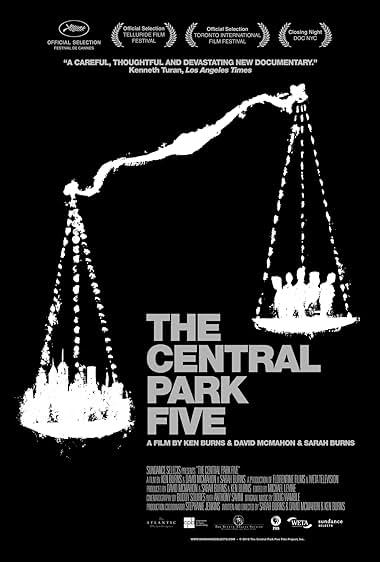
The film examines the infamous 1989 Central Park Jogger case, where a young white woman is brutally beaten and raped in New York's Central Park. At the same time, a group of five young black and Latino teenagers were quickly arrested for the crime and imprisoned. Following swift arrests by law enforcement officials, the prosecutors proudly declared the conviction as a step forward in the reclamation of a the city. Despite the lack of concrete evidence, all five are found guilty on multiple charges. Raymond Santana, Yusef Salaam, Antron McCray, Kevin Richardson, and Kharey Wise each spent between six to 13 years in prison, professing their innocence, while maintaining that it was a coerced confession to the crime. However, a chance encounter between the oldest of them and convicted serial rapist Matias Reyes, who years later yields his free admission of sole responsibility for the crime, and the claim is further substantiated with DNA evidence.
The documentary's approach seamlessly blends past and present, re-examines the assault, and walks you through what happened to the teenagers, from their arrest through their exoneration. Burns captures the complexity of history with startling results, yet "The Central Park Five" isn't quite as comprehensive as hoped, and fails to add anything substantively new to the story. Additionally, an element of balance is missing that would have turned a very good documentary into an exceptional one.
"The Central Park Five" presents the facts of the case with clarity, and it is a courageous, revealing look at the often complex and broken legal system in the United States. Unfortunately, there is no avoiding the conclusion presented by historian Craig Steven Wilder: "Rather than tying (the case) up in a bow and thinking that there was something we can take away from it, and that we'll be better people, I think what we really need to realize is that we're not very good people."
The film examines the infamous 1989 Central Park Jogger case, where a young white woman is brutally beaten and raped in New York's Central Park. At the same time, a group of five young black and Latino teenagers were quickly arrested for the crime and imprisoned. Following swift arrests by law enforcement officials, the prosecutors proudly declared the conviction as a step forward in the reclamation of a the city. Despite the lack of concrete evidence, all five are found guilty on multiple charges. Raymond Santana, Yusef Salaam, Antron McCray, Kevin Richardson, and Kharey Wise each spent between six to 13 years in prison, professing their innocence, while maintaining that it was a coerced confession to the crime. However, a chance encounter between the oldest of them and convicted serial rapist Matias Reyes, who years later yields his free admission of sole responsibility for the crime, and the claim is further substantiated with DNA evidence.
The documentary's approach seamlessly blends past and present, re-examines the assault, and walks you through what happened to the teenagers, from their arrest through their exoneration. Burns captures the complexity of history with startling results, yet "The Central Park Five" isn't quite as comprehensive as hoped, and fails to add anything substantively new to the story. Additionally, an element of balance is missing that would have turned a very good documentary into an exceptional one.
"The Central Park Five" presents the facts of the case with clarity, and it is a courageous, revealing look at the often complex and broken legal system in the United States. Unfortunately, there is no avoiding the conclusion presented by historian Craig Steven Wilder: "Rather than tying (the case) up in a bow and thinking that there was something we can take away from it, and that we'll be better people, I think what we really need to realize is that we're not very good people."
Did you know
- Quotes
[last lines]
Antron McCray: The truth came out. Truth came out.
- ConnectionsFeatured in Ken Burns: America's Storyteller (2017)
- SoundtracksYo Slippin
Written by KRS-One
Published by Universal Music - Z Tunes LLC
Performed by Boogie Down Productions
Courtesy of RCA Records
By arrangement with Sony Music Licensing
- How long is The Central Park Five?Powered by Alexa
Details
- Release date
- Country of origin
- Language
- Also known as
- Los cinco de Central Park
- Filming locations
- Production companies
- See more company credits at IMDbPro
Box office
- Gross US & Canada
- $325,653
- Opening weekend US & Canada
- $30,570
- Nov 25, 2012
- Gross worldwide
- $325,653
- Runtime
- 1h 59m(119 min)
- Color
- Sound mix
- Aspect ratio
- 1.78 : 1
Contribute to this page
Suggest an edit or add missing content