IMDb RATING
7.6/10
19K
YOUR RATING
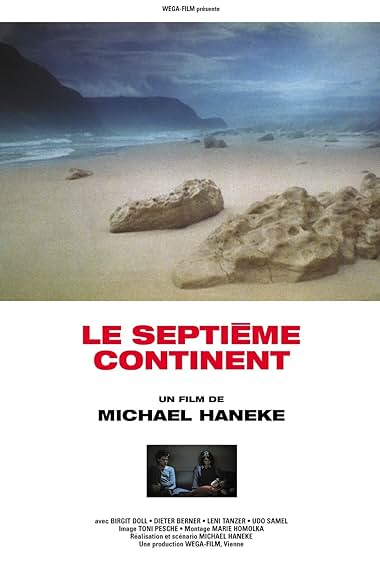

The daily routines of a seemingly ordinary Austrian family begin to take on a sinister complexion.The daily routines of a seemingly ordinary Austrian family begin to take on a sinister complexion.The daily routines of a seemingly ordinary Austrian family begin to take on a sinister complexion.
- Awards
- 2 wins & 1 nomination total


Jennifer Rush
- Self
- (archive footage)
- (uncredited)
- Director
- Writers
- All cast & crew
- Production, box office & more at IMDbPro
Featured reviews
Der Siebent Kontinent is a film you should watch. It is not pleasant neither does Michael Haneke uses any tricks in order to even interest you about the characters or their lives. Yet, it is as powerful as an atomic bomb during peace time. It is LOUD and its message (which is whatever you want it to be) is right in your face.
It is amazing how a masterpiece needs no soundtrack, fancy camera work or explicit and extended dialogs.
Unfortunately, it is very hard to find. The screenings are rare and no personal editions on VHS or DVD exist as far as I am aware. Many will recognize the "Piano Teacher" approach to directing but, this is as powerful as it can get. One of the finest examples of style not overlapping form.
Treat yourself with this lesson. Watch it if you can. Specially if you experienced depression at a given time in your life.
It is amazing how a masterpiece needs no soundtrack, fancy camera work or explicit and extended dialogs.
Unfortunately, it is very hard to find. The screenings are rare and no personal editions on VHS or DVD exist as far as I am aware. Many will recognize the "Piano Teacher" approach to directing but, this is as powerful as it can get. One of the finest examples of style not overlapping form.
Treat yourself with this lesson. Watch it if you can. Specially if you experienced depression at a given time in your life.
A powerful, disturbing film, shot in a highly idiosyncratic style. Michael Haneke's dissection of Austrian alienation is astonishingly effective. The style is, for the first part of the film, full of such close-ups that we don't see the characters' faces for nearly half an hour, but we share with them their view of the breakfast cereals, shoes and shopping. It should be boring, but is instead gripping, a quiet build-up to the prosaic horrors to come.
It is hard to comment without revealing some of these horrors, but the overall effect is shattering, tolerable only because Haneke avoids any real involvement with the characters and their motivations. With hindsight this is a weakness, and I reached the end of the film with the feeling 'what was that all about?'. But it is a film to reflect on, unlike any other that I have seen. Don't miss it - unless you are feeling depressed!
It is hard to comment without revealing some of these horrors, but the overall effect is shattering, tolerable only because Haneke avoids any real involvement with the characters and their motivations. With hindsight this is a weakness, and I reached the end of the film with the feeling 'what was that all about?'. But it is a film to reflect on, unlike any other that I have seen. Don't miss it - unless you are feeling depressed!
From my introduction to Michael Haneke through his 1997 film, Funny Games, I knew he shared an important quality with one of my favorite filmmakers. Like David Lynch, Michael Haneke doesn't care if the audience is comfortable while watching his films. Haneke extends his scenes past the point where the audience watching thinks is necessary, creating a hypnotic trance that one is unable to look away from. This ability of Haneke's to espouse the audience's attention forces the viewer to become an active participant in his films and thrusts us into an often much-needed self-examination. Haneke's feature film debut, The Seventh Continent takes an in-depth look at the lives of a family chained by the shackles of their expected existence willing to go to extreme measures to escape the monotonous confines of their daily existence.
The long takes Haneke favors throughout The Seventh Continent, introduce the audience to a young family living in Europe that live in precisely the way that is expected of them. Georg Schober (Dieter Berner) works diligently at his career, always placing himself in the best possible position to advance through promotions and better situate himself in his profession. Anna Schober (Birgit Doll), an optometrist, steadfastly maintains her family's home, dutifully completing all the tasks and errands to keep the everyday lives of her family running. Anna is also reacting to the death of a parent, which has devastated her brother, assuming the role of the strong focused sibling taxed with the burden of maintaining her parents' business. The youngest member of the family, Evi, fills her time coloring pictures, doing her homework, and occasionally causing mischief at school by feigning blindness. Neither Georg's career advancements, Anna's mourning, nor Evi's misbehavior is consequential to the story--they are simply moments that happen in each of their lives and fills their days. This is precisely Haneke's point; most of what we do in our lives are mundane activities which fill our time until we die. Whether it be a scene filmed in real time at a car wash or listening to someone relay a story during an eye exam, Haneke gives us these moments in as similar a way as they actually occur, removing all sense of grandiose filmmaking, forcing the audience to see themselves in the lives of those depicted on screen. It's hypnotizing they way we can scoff at collective suicide, yet through watching the events that lead up to the act come to understand the universality of the expectations we adhere to. Every move is repetitive, the same food is served every day at breakfast, the same pommel horse is jumped over in gym class, the same filling station is visited when the car is low on fuel. We often live our lives thinking of the future, fooling ourselves into believing that the monotony we serve daily is crucial to our growth until we are shocked to learn that the future we have been striving towards has become the past. We get so lost in the day-to-day that we need Haneke to make clear that the way we actually live our lives doesn't make all that much sense once analyzed.
The cold emotionless state maintained in the Schober home is sobering to watch. No amount of intimacy brings the family closer together. Even after making love, Georg and Anna immediately return to the distance between each other that fills their days. Not only does one hardly see any affection between the members of the Schober family, but we also rarely see them enjoy conversations with each other. The cold, detached atmosphere isn't confined to their home, either. Each time they exchange currency for a service, the audience is afforded a glimpse into the lives of everyone they interact with, each doing their job or performing a service while all vitality seems to have been drained from their being. Through the entire runtime of The Seventh Continent, we don't see a single meaningful human connection. There is even a scene in which a man recently released from his employment with Georg, returns for his things and isn't given a single embrace of encouragement or a kind word. His appearance disrupts the work because he is unexpected, further cementing Haneke's notion that our lives are simply made up of a series of repeated actions, and we are stricken by the break from routine when interrupted. Despite the lack of compassionate connectivity, I would argue that Haneke's feature is one of the most humanistic films I have recently seen, because it gives hope to our existence and alerts us to think critically about our society.
The long takes Haneke favors throughout The Seventh Continent, introduce the audience to a young family living in Europe that live in precisely the way that is expected of them. Georg Schober (Dieter Berner) works diligently at his career, always placing himself in the best possible position to advance through promotions and better situate himself in his profession. Anna Schober (Birgit Doll), an optometrist, steadfastly maintains her family's home, dutifully completing all the tasks and errands to keep the everyday lives of her family running. Anna is also reacting to the death of a parent, which has devastated her brother, assuming the role of the strong focused sibling taxed with the burden of maintaining her parents' business. The youngest member of the family, Evi, fills her time coloring pictures, doing her homework, and occasionally causing mischief at school by feigning blindness. Neither Georg's career advancements, Anna's mourning, nor Evi's misbehavior is consequential to the story--they are simply moments that happen in each of their lives and fills their days. This is precisely Haneke's point; most of what we do in our lives are mundane activities which fill our time until we die. Whether it be a scene filmed in real time at a car wash or listening to someone relay a story during an eye exam, Haneke gives us these moments in as similar a way as they actually occur, removing all sense of grandiose filmmaking, forcing the audience to see themselves in the lives of those depicted on screen. It's hypnotizing they way we can scoff at collective suicide, yet through watching the events that lead up to the act come to understand the universality of the expectations we adhere to. Every move is repetitive, the same food is served every day at breakfast, the same pommel horse is jumped over in gym class, the same filling station is visited when the car is low on fuel. We often live our lives thinking of the future, fooling ourselves into believing that the monotony we serve daily is crucial to our growth until we are shocked to learn that the future we have been striving towards has become the past. We get so lost in the day-to-day that we need Haneke to make clear that the way we actually live our lives doesn't make all that much sense once analyzed.
The cold emotionless state maintained in the Schober home is sobering to watch. No amount of intimacy brings the family closer together. Even after making love, Georg and Anna immediately return to the distance between each other that fills their days. Not only does one hardly see any affection between the members of the Schober family, but we also rarely see them enjoy conversations with each other. The cold, detached atmosphere isn't confined to their home, either. Each time they exchange currency for a service, the audience is afforded a glimpse into the lives of everyone they interact with, each doing their job or performing a service while all vitality seems to have been drained from their being. Through the entire runtime of The Seventh Continent, we don't see a single meaningful human connection. There is even a scene in which a man recently released from his employment with Georg, returns for his things and isn't given a single embrace of encouragement or a kind word. His appearance disrupts the work because he is unexpected, further cementing Haneke's notion that our lives are simply made up of a series of repeated actions, and we are stricken by the break from routine when interrupted. Despite the lack of compassionate connectivity, I would argue that Haneke's feature is one of the most humanistic films I have recently seen, because it gives hope to our existence and alerts us to think critically about our society.
One of the most chilling movies I have ever seen, the idea for this film was reportedly sparked by real events in Austria. Similar to "Safe" in its depiction of modern anomie, but more powerful. The director is much more sympathetic to the characters than Todd Haynes was in his film.
Having spent a couple years now browsing thru IMDb, this is the first film I've seen that actually motivated me to leave a comment. I've seen 3 other (more recent) movies by Haneke: "Funny Games," "Code Unknown," and "The Piano Teacher." All of them disturbed me in their own special way--a feeling that I obviously don't mind getting from a film. "The 7th Continent," though, really blew me away in ways that I find difficult but necessary to describe.
This was Haneke's first theatrical film & apparently based on a true story--although I'm always skeptical of such disclaimers (the same was said about "Picnic at Hanging Rock," another great creepy film). It's divided into 3 parts: 1987, 1988, and 1989. Many scenes repeat themselves, and we get a clear sense that the family (dad, mom, daughter) is going through the motions of modern life. The banalities have a bizarre and uneasy edge to them, though, that really piles up by the time Part 3 arrives. All I have to say about the last 40 minutes is: OH MY GOD! I thought Gaspar Noe's "I Can't Sleep" (?) had an excruciating buildup, but that one (with all its explicitness) can't hold a candle to the amount of emotional and physical devastation packed into the conclusion of "Continent."
Fans of Haneke's later work should definitely check this one out to see the origin of his trademarks: no music score, seemingly pointless scenes that linger (often with little or no dialogue), off-putting camera angles (we sometimes see only the actors' hands or feet). While these techniques aren't always successful in his films ("Code" had some interminable moments), they all come together seamlessly in "Continent." A superb work!
This was Haneke's first theatrical film & apparently based on a true story--although I'm always skeptical of such disclaimers (the same was said about "Picnic at Hanging Rock," another great creepy film). It's divided into 3 parts: 1987, 1988, and 1989. Many scenes repeat themselves, and we get a clear sense that the family (dad, mom, daughter) is going through the motions of modern life. The banalities have a bizarre and uneasy edge to them, though, that really piles up by the time Part 3 arrives. All I have to say about the last 40 minutes is: OH MY GOD! I thought Gaspar Noe's "I Can't Sleep" (?) had an excruciating buildup, but that one (with all its explicitness) can't hold a candle to the amount of emotional and physical devastation packed into the conclusion of "Continent."
Fans of Haneke's later work should definitely check this one out to see the origin of his trademarks: no music score, seemingly pointless scenes that linger (often with little or no dialogue), off-putting camera angles (we sometimes see only the actors' hands or feet). While these techniques aren't always successful in his films ("Code" had some interminable moments), they all come together seamlessly in "Continent." A superb work!


Did you know
- TriviaBased on real events.
- Quotes
Georg Schober: We have to cancel the newspaper subscription
Anna Schober: Mhm
- ConnectionsFeatured in Selección TCM: Michael Haneke (2012)
- SoundtracksSend Me Roses
(uncredited)
Written by Günter Mokesch and Karin Raab
Performed by Günter Mokesch and Karin Raab
- How long is The Seventh Continent?Powered by Alexa
Details
- Release date
- Country of origin
- Languages
- Also known as
- The Seventh Continent
- Filming locations
- Production company
- See more company credits at IMDbPro
Box office
- Gross worldwide
- $595
Contribute to this page
Suggest an edit or add missing content