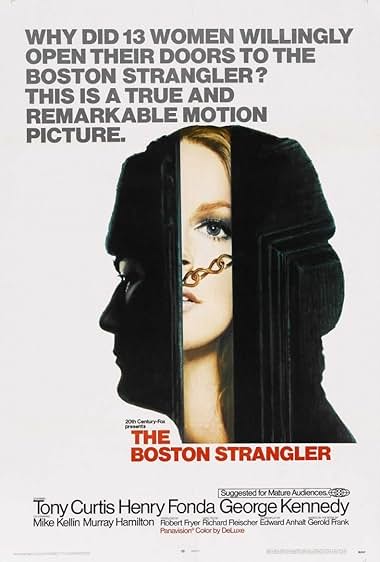

A series of strangulation murders of Boston women sparks a protracted complex manhunt. Law professor John Bottomley leads a multi-jurisdictional task force in the investigation, with help fr... Read allA series of strangulation murders of Boston women sparks a protracted complex manhunt. Law professor John Bottomley leads a multi-jurisdictional task force in the investigation, with help from surviving victim Diane Cluny.A series of strangulation murders of Boston women sparks a protracted complex manhunt. Law professor John Bottomley leads a multi-jurisdictional task force in the investigation, with help from surviving victim Diane Cluny.
- Awards
- 3 nominations total


- Director
- Writers
- All cast & crew
- Production, box office & more at IMDbPro
Featured reviews
The film is exceptionally well-directed--the split screen is a bit disorienting at times but, ultimately, it helps the film. It keeps you on edge. It's also very interesting to see what Boston looked like in 1968. The only sour spot is there is some homophobia in the movie...but this does take place in '62-'64 and they did think the strangler was a gay man.
From what I've heard this film was not a big hit when released which probably explains why it took so long to get out on DVD. It's probably one of the best serial killer movies ever made and the multiple screens look great on DVD.
Well worth seeing if just for Curtis' performance.
The film is divided rather neatly into two parts. The first half is a police procedural with a couple of colorful detectives checking out tips and equally colorful possible suspects as the victim count rises. Albert DeSalvo (Tony Curtis) is captured - and for that matter first appears - at the halfway point. The second half consists of a character study and psychological profile of DeSalvo as he is extensively interviewed and questioned by assistant D. A. John Bottomly (Henry Fonda).
The part about DeSalvo having multiple personality disorder as well as how he was caught is completely false, but the anecdote about the psychic was true - A psychic really was employed who gave a completely accurate description of a suspect in the case who also turned out to be totally innocent. This episode greatly embarrassed the attorney general.
Made the same year that the production code officially ended, it dealt with sex crimes quite frankly and in a way that would have been considered unthinkable just five years before. The supporting cast has a deep bench and includes George Kennedy, Sally Kellerman, William Hickey, Hurd Hatfield, Mike Kellin and in small roles people like Alex Rocco and James Brolin. If you can deal with a true crime film that has quite a few falsehoods in it for the purpose of dramatic license, I'd recommend this one.
13 women were found dead in the Boston area of manual strangulation and they were also sexually molested. Public concern was so great that the then Attorney General Edward Brooke, played by William Marshall, overrode local jurisdictions and prerogatives and assigned a lawyer from his office John Bottomly to coordinate the strangler investigation.
Henry Fonda plays Bottomly who takes the task on quite reluctantly because his expertise is civil litigation. My guess is that Brooke was thinking that Bottomly would be best for the job because he came in with no preconceived notions on how to do the job and would be open to anything. Turned out he was right.
Actually Fonda has more screen time than Curtis because the first half of the film concentrates on him and the investigation. He follows up every red herring thrown at him. He even hires a medium paid for with private funds by a millionaire friend of Brooke's played by George Voskevec who actually comes close in terms of geography to finding the real killer.
One of the red herrings is a gay man played by Hurd Hatfield who in those days before Stonewall was considered a likely suspect. He gets turned in by his landlady who is suspicious of his reading material. It's something he's used to, every time there's a lurid sex murder as an openly gay, or at least openly gay for that time he's brought in for questioning. This was one of the few times I ever heard the word gay used in a film made before the Stonewall Rebellion of 1969.
Curtis however dominates the film. The last 20 minutes or so is a final confrontation with him and Fonda and for those who are used to the insouciant leading man of swashbucklers and comedies, this is a real breakthrough. As much if not more of breakthrough than his part in Sweet Smell of Success.
In his memoirs however Curtis decries the fact that on this, the second of two films he worked with Henry Fonda on, he said that he found Fonda cold and forbidding as a person to work with.
The film is tautly directed by Richard Fleischer with some fine editing though I think Fleischer was a bit too fond of the split screen technique. Still it's a film worth watching.
The first half of the film shows how the police deal with (or, try to) the number of female bodies steadily piling up in the city. Some of the material is dated, with homosexuals being the primary suspects, and various types of perverts, like peeping toms, rounded up in unintentionally amusing scenes (see also "The Detective"1968 with Frank Sinatra for similar scenes of the homosexual community persecuted by the police dept.). Fonda plays the chief investigator, placed in charge against his wishes, but who soon accepts the gravity of the situation. George Kennedy is one of the main detectives.
Curtis doesn't appear until the first hour ends. As an actor, he immersed himself in this unpleasant role, and, from the first minute he's seen on screen, all his past film roles are summarily wiped away. He was a star for close to 15 years at that point and all those comedies & sappy adventures he'd been in immediately disappear from one's mind. It's a rather astounding feat - who knew he was this method actor? But, he wasn't even nominated for an Oscar. Also, unlike, for example, Travolta's comeback in "Pulp Fiction"(94), this did not revitalize his career. Sally Kellerman("M*A*S*H",1970) also appears in an early role as a victim who just may survive. Look also for, in a very early role, James Brolin in one scene as a police sgt. caught in some indiscretion by a supposed clairvoyant. Modern filmmakers should also check out some of director Fleischer's techniques towards the end, in that white room with Curtis.
Tony Curtis showed them off brilliantly with his chilling portrayal of confessed 1960's serial killer,Albert DeSalvo who killed and strangled 13 women in the streets of Boston. Curtis is frighteningly good at depicting the schizophrenic life of a seemingly normal family man who hides his sexual compulsions. Here also you have Henry Fonda as the detective out to stopped him and George Kennedy in a co-starring role. Director Richard Fleischer(of "Fantastic Voyage",and "20,000 Leagues Under The Sea" fame)uses a split screen technique show DeSalvo crimes along with the painstaking police investigation that finally nabbed him in 1964. Shocking as it was back in 1968,and still shocking today in one of Tony Curtis' most gripping roles and exhilarating performance.




Did you know
- TriviaTony Curtis generally was considered too old to play Albert DeSalvo despite being only six years older than DeSalvo. At the times of the murders, DeSalvo was only in his early thirties.
- GoofsIn the film, it is assumed DeSalvo was guilty, and it portrays him as suffering from multiple personality disorder and committing the murders whilst in a psychotic state. DeSalvo was never diagnosed with, or even suspected of, having that disorder.
- Quotes
Albert DeSalvo: [inside sanitarium] But... I don't belong here.... I-I guess everybody says that, don't they?
- Crazy creditsClosing credits epilogue; ALBERT DESALVO, PRESENTLY IMPRISONED IN WALPOLE, MASSACHUSETTS, HAS NEVER BEEN INDICTED OR TRIED FOR THE BOSTON STRANGLINGS.
THIS FILM HAS ENDED, BUT THE RESPONSIBILTY OF SOCIETY FOR THE EARLY RECOGNITION AND TREATMENT OF THE VIOLENT AMONG US HAS YET TO BEGIN.
- Alternate versionsThe original UK cinema version suffered heavy BBFC cuts with edits to shots of a woman's dead body, the murder scenes, and the removal of graphic descriptions of the murder victims. Video versions were cut by 1 min 5 secs and reduced the torture of Dianne Cluny to a series of flash shots by removing facial closeups, a shot of her kicking, and detailed footage of her arms and legs being tied to the bed. The cuts were fully restored in the 2004 TCF widescreen DVD.
- ConnectionsEdited into Voskovec & Werich - paralelní osudy (2012)
- SoundtracksSemper Fidelis
(uncredited)
Music by John Philip Sousa
Heard from the television during the opening scene
Also played during the flashback montage
Details
- Release date
- Country of origin
- Language
- Also known as
- El estrangulador de Boston
- Filming locations
- Longfellow Bridge, Boston, Massachusetts, USA(fighting hippie couple scene)
- Production company
- See more company credits at IMDbPro
Box office
- Budget
- $4,100,000 (estimated)
- Gross worldwide
- $9,439
- Runtime
- 1h 56m(116 min)
- Color
- Aspect ratio
- 2.35 : 1