AVALIAÇÃO DA IMDb
7,2/10
1 mil
SUA AVALIAÇÃO
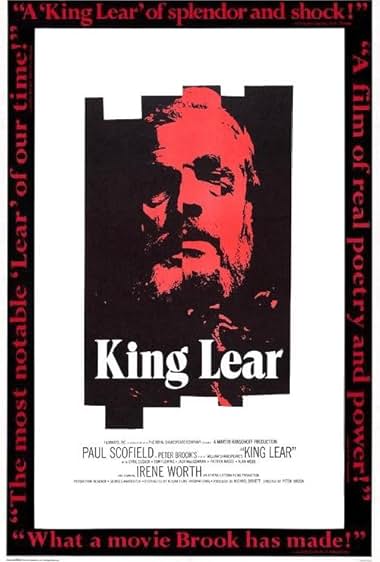
Adicionar um enredo no seu idiomaKing Lear divides his kingdom among his daughters, giving great importance to their protestations of love for him. When Cordelia refuses to idly flatter the old man, he banishes her and turn... Ler tudoKing Lear divides his kingdom among his daughters, giving great importance to their protestations of love for him. When Cordelia refuses to idly flatter the old man, he banishes her and turns for support to his remaining daughters.King Lear divides his kingdom among his daughters, giving great importance to their protestations of love for him. When Cordelia refuses to idly flatter the old man, he banishes her and turns for support to his remaining daughters.
- Direção
- Roteiristas
- Artistas
- Prêmios
- 2 vitórias e 1 indicação no total


- Direção
- Roteiristas
- Elenco e equipe completos
- Produção, bilheteria e muito mais no IMDbPro
Avaliações em destaque
Peter Brook has the knack of making his stagings completely his own while at the same time enhancing the character of the play. Thus in "Carmen" he turns it into something of a chamber play, and here in King Lear he stresses the primitivism of the play turning into almost something like a documentary of the dark ages. In especially the first part including the storm he is entirely successful, in spite of the rather experimental expressionism,and the realism of the primitive middle age settings in a landscape of only moors and snows, not a tree in the whole film, is effectively impressing. The actors are superb throughout, and Paul Scofield renders a very interesting interpretation of the old man losing himself with occasional magnificent outbursts of powerful rage. The play is shortened, of course, you can't put all of a Shakespeare play into a film, (I believe the only successful attempt at that was Kenneth Branagh's "Hamlet" and very commendable as such,) while here the text abbreviations unfortunately suffer, the cuts being so obvious. Another flaw is that the articulation is not very good - it was fashionable in the end of the 60s to allow actors to talk on stage like as if they talked naturally, but theatre can't do without rhetoric; and especially with a language like this, which is the very essence of the play, you can't trifle with it, every word has to be pronounced distinctly, or it isn't Shakespeare.
Towards the end the direction gets more sloppy, the intensity loses its grip, while the apocalyptic battle scenes crown the direction. The austere scenery throughout I believe will be what you most will remember of this film adaptation, which couldn't be more impressive, while I think I would prefer the Russian version from about the same time as more convincingly Shakespearian. Since many years I have been waiting for an opportunity to see the Laurence Olivier version from 1983.
Towards the end the direction gets more sloppy, the intensity loses its grip, while the apocalyptic battle scenes crown the direction. The austere scenery throughout I believe will be what you most will remember of this film adaptation, which couldn't be more impressive, while I think I would prefer the Russian version from about the same time as more convincingly Shakespearian. Since many years I have been waiting for an opportunity to see the Laurence Olivier version from 1983.
Peter Brook's film is a very bleak and barbaric interpretation of King Lear. He does a great job directing and whilst some of his experimentation doesn't pay off (such as very strange zooming with Kent at the beginning), when it does pay off it is fantastic (such as Lear's monologues)
As has happened so many times with the Oscars, another great film-actor-ensemble has been neglected. Recognised nearly universally as the ultimate test of an actor's craft, Paul Scofield as Lear in this 1971 version could be deified for his performance, even more complex than his Oscar-winning Thomas More in 1966's best pic "A Man For All Seasons". Viewing this film should be a prerequisite not just for R.A.D.A. acting students. Incorporating as he did the essence of Lear so organically, Scofield sadly was not even nominated, another nod to the lowest common denominator public taste. This review, nearly forty years after the pic's release, was an on-the-spot spontaneous impulse after yet another viewing of the film. People are afraid of Shakespeare(a.l.a. DeVere); don't be. All, but especially any pained by their own offspring, will turn away from the screen with much more than a penny's worth of thought and a rediscovery of the art of Paul Scofield and ensemble. It is a cliché, but they just don't make movies like this one anymore.
I have read altogether too many reviews of this film which bash it all to hell because the reviewer doesn't agree with Brook's reading of KING LEAR. To all such folk I would like to say: We Shakespeare fans should positively glory in the fact that every reader (and a fortiori every director) has his or her own interpretation of all the plays. Given Brook's interpretation, the film is wonderful.
This version of Shakespeare's greatest tragedy is not only consistent with itself, which most aren't, it is acted to a hilt. The characters are brilliantly portrayed. The interactions between them appear as the absolute and utter epitome of conflict and love, of the heroic and villainous way people act when confronted with a situation that is calculated to freak a human being out.
My favorite characterization is that of the Fool, who utterly steals the show and who becomes almost a Greek chorus. The way he interacts with Lear suggests a metaphysical mood of "We know exactly what's going on here, don't we?" The understanding between these two is too deep to be expressed in normal language; in the conversation around "The reason why the seven stars are only seven" (which would have struck any of the other characters, except maybe Kent, as a demented sequence of non sequiturs) suggests that Lear knows, at least at that moment, how the story will turn out, and that his attitude is one of "what is't to leave betimes? Let be." The Fool is here a prophet of absurdity, a Dark Age cross between a Marx Brother and Lenny Bruce.
And I challenge anyone to show me any actors who could do Kent and Gloucester better than those who portrayed them in this film. To say nothing of the wonderful job Scofield does with the title role.
Brook's Lear is almost sociopathically unfeeling until disaster begins to overtake him. To be sure, this view of Lear is not mine. But again, Shakespeare's characters are topics inexhaustible, and there is no such thing as a Lear to end all Lears. Whether one agrees with Brook or not, he carries his idiosyncratic reading off brilliantly---just as brilliantly as Laurence Olivier and Ian Holm in their utterly un-Brookish TV versions. I say: Let it ride! Let's have as many defensible and indefensible Lears as possible, and let's have them as utterly contradictory of each other as the 1945 and 1991 film versions of Henry the Fifth are.
By the way, I am a recent convert to this position. Before I saw the light, I was (for example) utterly ticked off at Kenneth Branagh's film of HAMLET, because it portrayed the Prince as having had sex with Ophelia way back when, and because its Fortinbras was an uncultured creep who dissed Hamlet by tearing down his father's monument. Wasn't it obvious that the text utterly contradicts both notions? Yep! But Branagh would have every right to say to me, "The hell with you, go make your own film." And so would Brook to his critics.
See it, friend. I look forward to our friendly argument.
This version of Shakespeare's greatest tragedy is not only consistent with itself, which most aren't, it is acted to a hilt. The characters are brilliantly portrayed. The interactions between them appear as the absolute and utter epitome of conflict and love, of the heroic and villainous way people act when confronted with a situation that is calculated to freak a human being out.
My favorite characterization is that of the Fool, who utterly steals the show and who becomes almost a Greek chorus. The way he interacts with Lear suggests a metaphysical mood of "We know exactly what's going on here, don't we?" The understanding between these two is too deep to be expressed in normal language; in the conversation around "The reason why the seven stars are only seven" (which would have struck any of the other characters, except maybe Kent, as a demented sequence of non sequiturs) suggests that Lear knows, at least at that moment, how the story will turn out, and that his attitude is one of "what is't to leave betimes? Let be." The Fool is here a prophet of absurdity, a Dark Age cross between a Marx Brother and Lenny Bruce.
And I challenge anyone to show me any actors who could do Kent and Gloucester better than those who portrayed them in this film. To say nothing of the wonderful job Scofield does with the title role.
Brook's Lear is almost sociopathically unfeeling until disaster begins to overtake him. To be sure, this view of Lear is not mine. But again, Shakespeare's characters are topics inexhaustible, and there is no such thing as a Lear to end all Lears. Whether one agrees with Brook or not, he carries his idiosyncratic reading off brilliantly---just as brilliantly as Laurence Olivier and Ian Holm in their utterly un-Brookish TV versions. I say: Let it ride! Let's have as many defensible and indefensible Lears as possible, and let's have them as utterly contradictory of each other as the 1945 and 1991 film versions of Henry the Fifth are.
By the way, I am a recent convert to this position. Before I saw the light, I was (for example) utterly ticked off at Kenneth Branagh's film of HAMLET, because it portrayed the Prince as having had sex with Ophelia way back when, and because its Fortinbras was an uncultured creep who dissed Hamlet by tearing down his father's monument. Wasn't it obvious that the text utterly contradicts both notions? Yep! But Branagh would have every right to say to me, "The hell with you, go make your own film." And so would Brook to his critics.
See it, friend. I look forward to our friendly argument.
"King Lear" is not one of my favourite Shakespeare plays (sacrilege indeed!) but I must say I find this film version immensely impressive and the best film version of Shakespeare I have seen.
The key to this is the direction of Peter Brook. Unquestionably this is an "arty" avant-garde production that has echoes of Bergman and Beckett as other reviewers have noted. For me this works extremely well. The choice of a barren Danish landscape in winter, the use of black and white, and unusual decision to eschew music all contribute to a very dark and bleak atmosphere. The director keeps viewers on their toes and presents a despairing tragedy.
There is nothing theatrical about this - quite rightly as this is a film version. The performances are restrained and measured. The acting is very strong - Patrick Magee particularly stands out as a very menacing Cornwall while Susan Engel and Irene Worth are fine as the manipulative elder sisters.
My only real reservation is that the climax of the film is rather rushed, with the numerous deaths needing a little more reflection. The suicide of Goneril is though extremely powerful. Lear's death is always poignant but the direction of it doesn't work completely.
Opinions are very mixed on this film but I certainly think it deserves attention. It would especially appeal to followers of Bergman and anyone who is struck by a dark tale.
The key to this is the direction of Peter Brook. Unquestionably this is an "arty" avant-garde production that has echoes of Bergman and Beckett as other reviewers have noted. For me this works extremely well. The choice of a barren Danish landscape in winter, the use of black and white, and unusual decision to eschew music all contribute to a very dark and bleak atmosphere. The director keeps viewers on their toes and presents a despairing tragedy.
There is nothing theatrical about this - quite rightly as this is a film version. The performances are restrained and measured. The acting is very strong - Patrick Magee particularly stands out as a very menacing Cornwall while Susan Engel and Irene Worth are fine as the manipulative elder sisters.
My only real reservation is that the climax of the film is rather rushed, with the numerous deaths needing a little more reflection. The suicide of Goneril is though extremely powerful. Lear's death is always poignant but the direction of it doesn't work completely.
Opinions are very mixed on this film but I certainly think it deserves attention. It would especially appeal to followers of Bergman and anyone who is struck by a dark tale.


Você sabia?
- CuriosidadesBrook based this production on ideas expressed by Polish theater critic Jan Kott in the book "Shakespeare, Our Contemporary".
- Cenas durante ou pós-créditosNot only is there no music in the film, but there are no "ambient sounds" at all during the opening credits, giving the impression that they were filmed using no soundtrack whatsoever.
- ConexõesFeatured in Shakespeare: Rise of a Genius: Episode #1.3 (2023)
Principais escolhas
Faça login para avaliar e ver a lista de recomendações personalizadas
- How long is King Lear?Fornecido pela Alexa
Detalhes
- Data de lançamento
- Países de origem
- Central de atendimento oficial
- Idioma
- Também conhecido como
- King Lear
- Locações de filme
- Empresas de produção
- Consulte mais créditos da empresa na IMDbPro
- Tempo de duração
- 2 h 17 min(137 min)
- Cor
- Mixagem de som
- Proporção
- 1.66 : 1
Contribua para esta página
Sugerir uma alteração ou adicionar conteúdo ausente