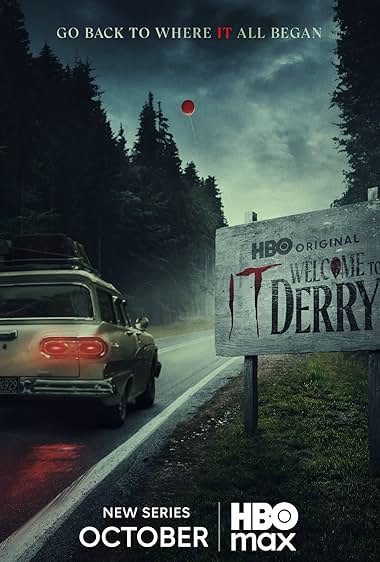
Der Film wird in den 1960er Jahren spielen, in der Zeit vor den Ereignissen des ersten Films der Stephen-King-Reihe It.Der Film wird in den 1960er Jahren spielen, in der Zeit vor den Ereignissen des ersten Films der Stephen-King-Reihe It.Der Film wird in den 1960er Jahren spielen, in der Zeit vor den Ereignissen des ersten Films der Stephen-King-Reihe It.
- Auszeichnungen
- 1 Gewinn & 2 Nominierungen insgesamt
Folgen durchsuchen
Zusammenfassung
Reviewers praise 'IT: Welcome to Derry' for its atmosphere, suspense, and expansion of Stephen King's universe. Rich storytelling, haunting tone, and strong performances are highlighted. However, criticisms include overuse of CGI, weak acting, and pacing issues. Some find it derivative or unoriginal, drawing unfavorable comparisons to 'Stranger Things'. Despite mixed opinions, the series is noted for its potential to engage horror fans and expand the lore of Derry and Pennywise.
Empfohlene Bewertungen
I genuinely didn't know how to feel at first. Some episodes are bonkers, some interesting, some slow, and some downright stupid. The acting is mixed and the pacing uneven. And yet, after a few episodes, I was counting down the days until each new release. Skarsgård absolutely nails it - his presence (and that dance) lingers in your nightmares. Frustrating, flawed, but strangely addictive. I'm actually disappointed it's over!
This new chapter of IT takes a noticeably different approach, and for the most part, it is a "Welcome" one. The use of CGI will likely be a point of debate, but here it feels far more controlled and purposeful than in the previous films. Rather than relying on visual effects purely for shock value, the CGI works to support the atmosphere and scale of the horror. In that sense, it represents a clear technical upgrade from IT Chapter 1 and 2.
Compared to the earlier IT films, this entry feels more controlled in its storytelling. While pacing issues have not disappeared entirely, they are handled with more consistency, allowing tension to develop instead of constantly resetting itself. The film shows more patience in letting ideas and atmosphere settle, and it makes a clearer effort to explore where Pennywise comes from and why it exists. That added context gives the horror more weight without losing its mystery.
The most notable improvement lies in the type of horror being explored. Instead of relying primarily on jump scares, the film leans into body horror and psychological unease. Jump scares are still present and occasionally predictable, but they are no longer the main driver of fear. The emphasis on discomfort and lingering dread creates a more effective and mature horror experience. Centering the story on Pennywise proves to be a strong creative choice. It allows the narrative to feel tighter and more cohesive, and the smaller plot threads integrate naturally without feeling forced. The film feels confident in its direction, building atmosphere rather than rushing toward the next scare. The cinematography and lighting are handled with care, using angles and shadow to strengthen the tension and mood throughout.
Overall, this entry feels like a more assured step forward for the franchise. It is not flawless, particularly in its pacing, but it demonstrates a clearer understanding of its identity and tone.
I am the eater of worlds!
Compared to the earlier IT films, this entry feels more controlled in its storytelling. While pacing issues have not disappeared entirely, they are handled with more consistency, allowing tension to develop instead of constantly resetting itself. The film shows more patience in letting ideas and atmosphere settle, and it makes a clearer effort to explore where Pennywise comes from and why it exists. That added context gives the horror more weight without losing its mystery.
The most notable improvement lies in the type of horror being explored. Instead of relying primarily on jump scares, the film leans into body horror and psychological unease. Jump scares are still present and occasionally predictable, but they are no longer the main driver of fear. The emphasis on discomfort and lingering dread creates a more effective and mature horror experience. Centering the story on Pennywise proves to be a strong creative choice. It allows the narrative to feel tighter and more cohesive, and the smaller plot threads integrate naturally without feeling forced. The film feels confident in its direction, building atmosphere rather than rushing toward the next scare. The cinematography and lighting are handled with care, using angles and shadow to strengthen the tension and mood throughout.
Overall, this entry feels like a more assured step forward for the franchise. It is not flawless, particularly in its pacing, but it demonstrates a clearer understanding of its identity and tone.
I am the eater of worlds!
It improves significantly from the fifth episode onwards and becomes truly outstanding with the presence of Bill Skarsgård, who steals the show every time he appears. Although the script has certain shortcomings and the narrative is somewhat scattered, especially in the first three episodes, overall the final result is satisfactory both in terms of the emotional growth the characters experience throughout the series and in terms of the use of resources commonly associated with horror films.
IT: Welcome to Derry is a series that truly understands what Pennywise is - and, more importantly, what he represents. It doesn't try to replicate IT (2017) or compete with it, but instead expands its universe through a more atmospheric, narrative-driven, and patient approach. The horror here isn't built on constant jump scares, but on a lingering sense of menace that hangs over Derry like a living, corrupted organism.
One of the show's greatest strengths is its portrayal of the town itself. It becomes clear that the real monster isn't just Pennywise, but the cycle of violence, collective silence, and normalized cruelty. Evil is inherited, hidden, and repeated, and Derry functions as a diseased body that feeds on it.
The pacing is slow but deliberate. The series takes its time developing characters and context, and while some episodes could have been tighter, the tension never fully disappears. Pennywise appears less frequently than expected, but every appearance is carefully measured and effective, reinforcing his mythic and unsettling presence.
Visually, the show maintains a strong level of quality, with careful production design and smart use of lighting and off-screen space. It doesn't reinvent horror, but it refines it. Welcome to Derry isn't perfect, but it's a smart, coherent, and worthy expansion of the IT universe.
One of the show's greatest strengths is its portrayal of the town itself. It becomes clear that the real monster isn't just Pennywise, but the cycle of violence, collective silence, and normalized cruelty. Evil is inherited, hidden, and repeated, and Derry functions as a diseased body that feeds on it.
The pacing is slow but deliberate. The series takes its time developing characters and context, and while some episodes could have been tighter, the tension never fully disappears. Pennywise appears less frequently than expected, but every appearance is carefully measured and effective, reinforcing his mythic and unsettling presence.
Visually, the show maintains a strong level of quality, with careful production design and smart use of lighting and off-screen space. It doesn't reinvent horror, but it refines it. Welcome to Derry isn't perfect, but it's a smart, coherent, and worthy expansion of the IT universe.
Unlike rubbish like Rings of Power, Wheel of Time, et al, IT: Welcome to Derry succeeds because the writers have obviously read and loved the source. Why wouldn't you?
On top of that, whomever these writers are gets 80s horror novels, and like those pull no punches. If by the end of the first episode you haven't got the point - this is horror as it was meant to be.
If you're not horrified it probably means you lack empathy for every poor souls throughtout.
Skarsgard's return gives him much more space and unlike the films where he felt outshined by Tim Curry, here he really gets to shine and he's brilliantly malevolent.
After the awful 90s where none of the kids can act and ruined so many tv shows here they're on brilliant form.
Only thing letting it down is some of the CGI.
On top of that, whomever these writers are gets 80s horror novels, and like those pull no punches. If by the end of the first episode you haven't got the point - this is horror as it was meant to be.
If you're not horrified it probably means you lack empathy for every poor souls throughtout.
Skarsgard's return gives him much more space and unlike the films where he felt outshined by Tim Curry, here he really gets to shine and he's brilliantly malevolent.
After the awful 90s where none of the kids can act and ruined so many tv shows here they're on brilliant form.
Only thing letting it down is some of the CGI.
The "IT: Welcome to Derry" Cast's Childhood Nightmares
Taylour Paige is joined by her "It: Welcome to Derry" co-stars, and creator Andy Muschietti to discuss expanding the iconic Stephen King universe, childhood nightmares, and weaponizing fear.
Wusstest du schon
- WissenswertesAccording to director Andy Muschietti, Bill Skarsgård was "hesitant" to return as Pennywise because "he had played a lot of very dark characters... it takes a toll to live in the head of those characters for a long time." However, Skarsgård finally agreed because he was interested in exploring Pennywise's backstory as Bob Gray.
- Crazy CreditsThe title sequence is made of pleasant paintings of Derry with IT in them, as they slowly become more violent and nightmarish.
- VerbindungenFeatured in Half in the Bag: Halloween Hangover (2025) (2025)
Top-Auswahl
Melde dich zum Bewerten an und greife auf die Watchlist für personalisierte Empfehlungen zu.
Details
- Erscheinungsdatum
- Herkunftsländer
- Offizieller Standort
- Sprache
- Auch bekannt als
- IT: Welcome to Derry
- Drehorte
- Produktionsfirmen
- Weitere beteiligte Unternehmen bei IMDbPro anzeigen
- Laufzeit
- 1 Std.(60 min)
- Farbe
- Sound-Mix
- Seitenverhältnis
- 16:9 HD
Zu dieser Seite beitragen
Bearbeitung vorschlagen oder fehlenden Inhalt hinzufügen