IMDb-BEWERTUNG
6,9/10
13.808
IHRE BEWERTUNG
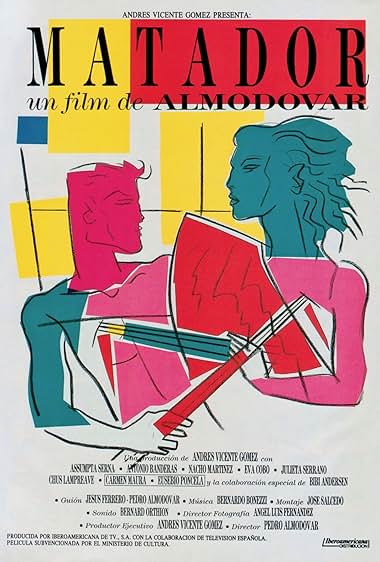
Füge eine Handlung in deiner Sprache hinzuA matador is wounded by a bull and can no longer kill in the arena. It is just one of the problems of one of the characters that unexpectedly collide in this film.A matador is wounded by a bull and can no longer kill in the arena. It is just one of the problems of one of the characters that unexpectedly collide in this film.A matador is wounded by a bull and can no longer kill in the arena. It is just one of the problems of one of the characters that unexpectedly collide in this film.
- Regisseur/-in
- Autoren
- Stars
- Auszeichnungen
- 6 Gewinne & 7 Nominierungen insgesamt


Nacho Martínez
- Diego
- (as Nacho Martinez)


Bibiana Fernández
- Vendedora Flores
- (as Bibi Andersen)


Verónica Forqué
- Periodista
- (as Veronica Forque)

Mercedes Jiménez
- Alumna 3ª
- (as Mercedes Jimenez)

Francesca Prandi
- Alumna 4ª
- (as Francesca Romana)
Empfohlene Bewertungen
Every Artist has a reoccurring theme, that he successfully or unsuccessfully explores and tries to capture through out his life time, and that eventually becomes his, what we might call - style. With Ingmar Bergman it's the detachment from life and confronting death, with Woody Allen, the comical absurdity of man-woman relationship, with Filliny it's the nostalgia for the lost, often irreplaceable innocence of childhood. In case of Pedro Almodovar though, to put it lightly, it's unorthodox, sex crazed love stories. (love that guy!)
I had watched three films by him (Bad Education, Law Of Desire, Talk To Her), and all of them were rather twisted, but this one is defiantly the weirdest love fable I had ever seen or read even by his standards.
The story begins with a young man, (played by heavenly-gorgeous, 18 year old Antonio Banderas) who is studying to be a matador, under a world famous, but retired, due to an injury, Maestro. One night after being suspected of being a homosexual, he decides to prove his masculinity and toughness by attempting to rape Maestro's girlfriend. But being in reality a very innocent and tender soul, he literally faints before anything happens, when she accidentally cuts her finger.
The girls reports him, and while being questioned, the cops hang on him three more murders. Apparently there have been bodies popping up through out the city, with all the victims assaulted in the same strange manner - at the height of their sexual arousal, they are stabbed in the back of their necks, with a hair pin, with the same technique a toreador brings a bull down.
And now, brought together by serendipity, the female lawyer, who had come to defend Antonio, and is investigating the case, is beginning to have a sort of an "affair" with the Maestro. Both of them being obsessed with sex, violence and mostly important death, which they find the most arousing thing in the world. Imagine Romeo and Juliet, only where they both not only desire each other sexually, but also long for each other's death.
I had personally often wondered, why the element of violence is so often present in sex. Even when one makes love, no matter how gentle, there will be some hair pulling, slight choking or biting. To experience pain and dominance, seems to be counterintuitive to receiving pleasure, yet something in our wiring arouses us by that. With books like "Fifty Shades Of Grey' bondage and sadomasochism had become house hold names, and practices. But what I can't wrap my brain around is why do these seemingly, logically unpleasant activities arouse us?
The theme in this film, of the desire to kill the one you love, and to define death and brutal violence as sexy, that is bound to make an indelible imprint on your soul and to stay with you for the rest of your life.
I had watched three films by him (Bad Education, Law Of Desire, Talk To Her), and all of them were rather twisted, but this one is defiantly the weirdest love fable I had ever seen or read even by his standards.
The story begins with a young man, (played by heavenly-gorgeous, 18 year old Antonio Banderas) who is studying to be a matador, under a world famous, but retired, due to an injury, Maestro. One night after being suspected of being a homosexual, he decides to prove his masculinity and toughness by attempting to rape Maestro's girlfriend. But being in reality a very innocent and tender soul, he literally faints before anything happens, when she accidentally cuts her finger.
The girls reports him, and while being questioned, the cops hang on him three more murders. Apparently there have been bodies popping up through out the city, with all the victims assaulted in the same strange manner - at the height of their sexual arousal, they are stabbed in the back of their necks, with a hair pin, with the same technique a toreador brings a bull down.
And now, brought together by serendipity, the female lawyer, who had come to defend Antonio, and is investigating the case, is beginning to have a sort of an "affair" with the Maestro. Both of them being obsessed with sex, violence and mostly important death, which they find the most arousing thing in the world. Imagine Romeo and Juliet, only where they both not only desire each other sexually, but also long for each other's death.
I had personally often wondered, why the element of violence is so often present in sex. Even when one makes love, no matter how gentle, there will be some hair pulling, slight choking or biting. To experience pain and dominance, seems to be counterintuitive to receiving pleasure, yet something in our wiring arouses us by that. With books like "Fifty Shades Of Grey' bondage and sadomasochism had become house hold names, and practices. But what I can't wrap my brain around is why do these seemingly, logically unpleasant activities arouse us?
The theme in this film, of the desire to kill the one you love, and to define death and brutal violence as sexy, that is bound to make an indelible imprint on your soul and to stay with you for the rest of your life.
Matador is one of the strangest, darkest, (and yet compelling) early films from Spanish master filmmaker Pedro Amoldovar.
It is completely nuts.
Pour in equal measures of sadism, masochism, bullfighting, perverted sexuality, and sexual violence. Add in a splash of comedy and soupcon of star-crossed lovers (if, for a moment, you thought pairing Tybalt and Lady McBeth qualified as star-crossed) and you have what passes as characterisation. Mix dark nights with gaudy flamenco colours and you have some striking cinematography. I'll come to the plot in a minute
Amoldovar was clearly enjoying Spanish cinema's new-found, post-Franco sexual and artistic liberalism. The prudish among his audience might suggest he was positively wallowing in it. Whatever the truth, Matador is a masterpiece of his style, if not, indeed, a whole style in of itself.
The plot or possibly a better description, the tapestry over which the characters move is a murder hunt. Very few prizes will be won, however, for guessing the culprit/s. Two people are quickly in the audience's frame because they are shown er murdering people on camera. A third person (Banderas, in to my mind his best Amoldovar role) confesses to the murders in a fit of insecurity and remorse over an attempted rape ("some girls get all the luck" comments a female duty officer dryly, proving that feminism wasn't that big in Spain back in the 1980s). Nevertheless, the net soon closes on the crushingly obvious culprits (who in the meantime have developed quite a crush on each other). As previously mentioned, completely nuts.
Matador's strengths are in its characterisation and its sheer bare-facedness. Amoldovar has, as usual, assembled a character list of freaks and proceeded to humanise all of them to the point where there is a genuine whiff of tragedy in the final act. To mention the great performances is really to rehearse the cast list. Assumpta Serna, Nacho Martinez, Antonio Banderas and Eva Cobo are all excellent. And it really is worth seeing, just for the young Antonio.
There are some interesting points made in the film about outsiders, liberalism, sexual politics and gender politics (as always with Amoldovar). I'll let you pick through them. It is, though, not so much a film as a giant red rag to the raging bull of conservatism, deftly whisked aside to the ragged applause of an admiring, if somewhat perplexed, audience. A positive Jimi Hendrix of a film, unpolished, with some definite dud notes, but undeniably the work of a genius. 8½/ 10
It is completely nuts.
Pour in equal measures of sadism, masochism, bullfighting, perverted sexuality, and sexual violence. Add in a splash of comedy and soupcon of star-crossed lovers (if, for a moment, you thought pairing Tybalt and Lady McBeth qualified as star-crossed) and you have what passes as characterisation. Mix dark nights with gaudy flamenco colours and you have some striking cinematography. I'll come to the plot in a minute
Amoldovar was clearly enjoying Spanish cinema's new-found, post-Franco sexual and artistic liberalism. The prudish among his audience might suggest he was positively wallowing in it. Whatever the truth, Matador is a masterpiece of his style, if not, indeed, a whole style in of itself.
The plot or possibly a better description, the tapestry over which the characters move is a murder hunt. Very few prizes will be won, however, for guessing the culprit/s. Two people are quickly in the audience's frame because they are shown er murdering people on camera. A third person (Banderas, in to my mind his best Amoldovar role) confesses to the murders in a fit of insecurity and remorse over an attempted rape ("some girls get all the luck" comments a female duty officer dryly, proving that feminism wasn't that big in Spain back in the 1980s). Nevertheless, the net soon closes on the crushingly obvious culprits (who in the meantime have developed quite a crush on each other). As previously mentioned, completely nuts.
Matador's strengths are in its characterisation and its sheer bare-facedness. Amoldovar has, as usual, assembled a character list of freaks and proceeded to humanise all of them to the point where there is a genuine whiff of tragedy in the final act. To mention the great performances is really to rehearse the cast list. Assumpta Serna, Nacho Martinez, Antonio Banderas and Eva Cobo are all excellent. And it really is worth seeing, just for the young Antonio.
There are some interesting points made in the film about outsiders, liberalism, sexual politics and gender politics (as always with Amoldovar). I'll let you pick through them. It is, though, not so much a film as a giant red rag to the raging bull of conservatism, deftly whisked aside to the ragged applause of an admiring, if somewhat perplexed, audience. A positive Jimi Hendrix of a film, unpolished, with some definite dud notes, but undeniably the work of a genius. 8½/ 10
Before I saw this movie in late 80-s I knew something about culture, tradition and 'spirit' of Spain, the country which inspired me for years. This movie made an enormous impression on me as it gave me very deep insight into 'real Spanish spirit', i.e. what does death mean to Spanish people in the light if their tradition and culture.
The personality of ex-matador and his behaviour underlined by his words - 'to stop to kill means to dye for me', on the other hand a high class woman being 'infected' with death, treating Diego as her God of Death, and these two 'lost worlds' slowly approaching each other into a fatal bitter end, which was filled with the most beautiful tune ever made (Esperame en el cielo mi corazon...) all this creates an unforgettable and distinctive impression after watching this movie.
Pedro Almodovar you gave us a great piece of art, I believe there are some more pictures that you can bring to us in the future.
Thanks Pedro..............
The personality of ex-matador and his behaviour underlined by his words - 'to stop to kill means to dye for me', on the other hand a high class woman being 'infected' with death, treating Diego as her God of Death, and these two 'lost worlds' slowly approaching each other into a fatal bitter end, which was filled with the most beautiful tune ever made (Esperame en el cielo mi corazon...) all this creates an unforgettable and distinctive impression after watching this movie.
Pedro Almodovar you gave us a great piece of art, I believe there are some more pictures that you can bring to us in the future.
Thanks Pedro..............
The connection between sex and death is not a novel one. Elizabethan poetry would occasionally use the latter as a metaphor for the former. Pedro Almodóvar's sixth feature is about three people who have erased the line between the two: Nacho Martinez, a matador gored in the ring, who now teaches students on the art; Antonio Banderas, one of his pupils; and Assumpta Serna, a lawyer defending Banderas who is charged with raping and killing two girls.
In other words, it's one of Almodóvar's movies about the weird kinks of the world. This time, however, he is not concerned with the people at the edge of Spanish society, but at the center of the normal world... assuming there is such a thing. We are all weird, we all act outside the norms, and the people we respect can be the most bizarre.
It's rather slow-moving for one of his movies, probably because this is not one of his shock comedies - although there are comic elements. Visually, it is sumptuous, with a focus on colors, particularly bright reds that draw one's eyes. Miss Serna is a sharp dresser, and she wears a cape in several scenes, which she whirls like a bullfighter going in for the kill.
Is Almodóvar decrying bullfighting? Or in favor of consensual activity of whatever sort? Has he simply presented his bizarre story, and left his audience to draw the moral conclusions it chooses? Or is this simply the sort of story he likes to tell? I think the last is true, but there's nothing simple about it.
In other words, it's one of Almodóvar's movies about the weird kinks of the world. This time, however, he is not concerned with the people at the edge of Spanish society, but at the center of the normal world... assuming there is such a thing. We are all weird, we all act outside the norms, and the people we respect can be the most bizarre.
It's rather slow-moving for one of his movies, probably because this is not one of his shock comedies - although there are comic elements. Visually, it is sumptuous, with a focus on colors, particularly bright reds that draw one's eyes. Miss Serna is a sharp dresser, and she wears a cape in several scenes, which she whirls like a bullfighter going in for the kill.
Is Almodóvar decrying bullfighting? Or in favor of consensual activity of whatever sort? Has he simply presented his bizarre story, and left his audience to draw the moral conclusions it chooses? Or is this simply the sort of story he likes to tell? I think the last is true, but there's nothing simple about it.
It is very much worth watching this early film of Almodovar from 1986, with a painfully young Antonio Banderas also at one of his first major screen presences. As many of his latest great movies it's a film hard to put in a precise square, a combination of comedy and tragedy, of crime, love and corrida movie with a touch of absurd and a touch of passion taken directly from life.
Although many of the major themes of passion, sexual desire and ambiguity, relation between love and death are already present the movie is somehow simpler in action and easier to watch than some of the later films. The story of two sexual predators and murderers, united in life by the passion for bull fights and in death by their passion for each other is acted with accuracy by a good team of actors and directed with an already recognizable style by Almodovar. The hand of the young master is certainly already there, and the film ages well 20 years after is premiere.
Although many of the major themes of passion, sexual desire and ambiguity, relation between love and death are already present the movie is somehow simpler in action and easier to watch than some of the later films. The story of two sexual predators and murderers, united in life by the passion for bull fights and in death by their passion for each other is acted with accuracy by a good team of actors and directed with an already recognizable style by Almodovar. The hand of the young master is certainly already there, and the film ages well 20 years after is premiere.




Wusstest du schon
- WissenswertesPedro Almodóvar said the opening sex scene between Assumpta Serna and Jesús Ruyman was unsimulated. In Serna's biography by Nuria Vidal, the actress recalled that at the end of the sequence, Almodovar came to her side and said, "Thank you for your generosity."
- Zitate
Francisco Montesinos: I've told you not to shoot up in the dressing rooms!
- VerbindungenFeatured in Playboy: The Story of X (1998)
Top-Auswahl
Melde dich zum Bewerten an und greife auf die Watchlist für personalisierte Empfehlungen zu.
- How long is Matador?Powered by Alexa
Details
- Erscheinungsdatum
- Herkunftsland
- Offizielle Standorte
- Sprache
- Auch bekannt als
- 鬥牛士
- Drehorte
- Viaducto de Segovia, Madrid, Spanien(Bridge where Maria and Diego talk.)
- Produktionsfirmen
- Weitere beteiligte Unternehmen bei IMDbPro anzeigen
Box Office
- Bruttoertrag in den USA und Kanada
- 279.394 $
- Eröffnungswochenende in den USA und in Kanada
- 13.399 $
- 13. Aug. 2006
- Weltweiter Bruttoertrag
- 286.126 $
Zu dieser Seite beitragen
Bearbeitung vorschlagen oder fehlenden Inhalt hinzufügen