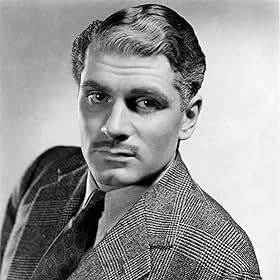
Füge eine Handlung in deiner Sprache hinzuIvan Kouznetsoff, a Russian engineer, recounts during World War II his stay in England prior to the war working on a new propeller for ice-breaking ships. Naive about British people, and con... Alles lesenIvan Kouznetsoff, a Russian engineer, recounts during World War II his stay in England prior to the war working on a new propeller for ice-breaking ships. Naive about British people, and convinced by hearsay that they are shallow and hypocritical, Ivan is both bemused and amused ... Alles lesenIvan Kouznetsoff, a Russian engineer, recounts during World War II his stay in England prior to the war working on a new propeller for ice-breaking ships. Naive about British people, and convinced by hearsay that they are shallow and hypocritical, Ivan is both bemused and amused by them. He is blunt in his opinions about Britons, and at first this puts off his hosts, ... Alles lesen
- Regie
- Drehbuch
- Hauptbesetzung
- Ann Tisdall
- (as Penelope Ward)
Empfohlene Bewertungen
It's interesting to see the famous actor Laurence Olivier playing Ivan Kouznetsoff--a Russian who talks to some British seamen during the war about his visit to London before the war. His accent seemed okay to me, but who am I to judge?! Anyways, the film is all told in flashback form. For the most part, Olivier's character is a bit standoffish and seems to think everything Russian is better--though this improves a bit through the course of the film. As for the Brits, they range from a few suspicious idiots to those who keep pointing out how "they are just like us". A father even wonders out loud about what a great husband Kouznetsoff would make. Talk about over-idealizing the Russians. As a result, the people in the film seem more like caricatures than real people. And as for Olivier, he seemed a bit silly--very stereotypical and broad in his portrayal.
Now despite me not loving this film and disliking how unreal everyone seemed, it was a good bit better than the WWII Hollywood films that were pro-Russia. They went even further to idealize Russia--to such a point that the films are downright dumb, as no group of people is THAT wonderful and happy and full of spunk! Overall, it's an interesting curio but certainly not a film you should run out to rent.
In the midst of the propaganda against the backdrop of a war that until 1942 had not gone in Great Britain's favor, you even get to see historic pageants, and an apology for the UK colonizing half of the planet.
This film is an interesting document of the mindset of the day, when Great Britain was still the empire on which the sun never set, but it does not really work from a cinematographic standpoint. Photography is average, acting so-so, and the screenplay carries some extremely cheesy holes.
Strikingly elegant Penelope Dudley-Ward conveniently represents Britain's openness to a loving relationship with the USSR, but there's really no chemistry spark between her and Olivier. It's as totally unconvincing a love affair as this is as piece of film-making.
Perhaps the most interesting comment to be made about THE DEMI-PARADISE is that by 1945 Winston Churchill was referring to the Soviet Union as the "iron curtain," and warning about the dangers of the USSR's occupation of Eastern Europe, and by 1948 the Cold War had started in earnest.
Really strange bedfellows, therefore. Thankfully, Dudley-Ward is very easy on the eye, especially when she smiles, but even her beautiful face cannot save this overlong piece of propaganda.
I suffered watching it because of Covid-prompted confinement but rest assured that I'll not watch it again.
The Demi-Paradise was produced as an aid to bridging the cultural gap between those two allies, at least from the British point of view. I have no idea whether it was ever shown in Russia, let alone how it would have been perceived by audiences there.
The story concerns a Russian engineer, played by Olivier, who encounters a pair of British seamen ashore in Murmansk during World War II. Typically, the British are complaining about the difficulties they are having among the "foreigners". To their astonishment, Olivier jokingly informs them in English that it is they who are the "foreigners" in Russia, and then proceeds to recount his own experiences as a "foreigner" when he was assigned to do a job in Britain both before, and during, the war.
In addition to being a wartime propaganda film, The Demi-Paradise is full of the sort of self-deprecating humor the British seem to love. While produced in Britain, the script actually was written by a Russian ex-patriot, Anatole de Grunwald. Consequently, one cannot help but feel that the writer brought a lot of his own personal experiences and impressions into the story. The result is very droll, and one cannot help but feel that the protagonist's experiences are probably universal to any stranger in a strange land.
While nowhere near the league of, say, "A Canterbury Tale", The Demi-Paradise has enough realism (of the British character) to while away a pleasant hour and a half.
Wusstest du schon
- WissenswertesRoland Culver was cut out of this movie.
- PatzerBeatrice Harrison's cello-and-nightingale broadcasts were mostly in the 1920s, but in any case no live broadcast would have been made during an air raid since it would give information to the enemy. (For this reason recordings were used for Big Ben chimes instead of the live feed when an air raid was in progress.)
- Zitate
Ivan Kouznetsoff: I don't understand the English.
Mr. Runalow: My dear fellow, who does?
- Crazy CreditsOpening credits prologue: "Joking decides great things stronger and better oft than earnest can . . ."
- VerbindungenReferenced in Cinema: Sir Laurence Olivier (1970)
- SoundtracksHold Your Hand Out, You Naughty Boy
(uncredited)
Written by Worton David and C.W. Murphy
Sung by hecklers at Hyde Park
Top-Auswahl
Details
- Erscheinungsdatum
- Herkunftsland
- Sprachen
- Auch bekannt als
- Adventure for Two
- Drehorte
- Produktionsfirma
- Weitere beteiligte Unternehmen bei IMDbPro anzeigen
- Laufzeit
- 1 Std. 54 Min.(114 min)
- Farbe
- Seitenverhältnis
- 1.37 : 1