[go: up one dir, main page]

Showing posts with label Ambrose Bierce. Show all posts

Friday, January 31, 2014

One Hundred Years Gone

Today I picked up a book at a secondhand store. It's called Lost . . . and Never Found and it's by Anita Gustafson. (1) Lost . . . and Never Found is about people who have disappeared, never to be seen again. The second chapter is on the disappearance of Ambrose Bierce. I read something in that book that I have never read before. In his last letter of December 26, 1913, sent to his secretary from Chihuahua, Mexico, Bierce wrote that he was going to proceed with Pancho Villa's army to Ojinaga. From Anita Gustafson's book:
Some explanations of [Bierce's] disappearance point to his last letter, when he wrote that he was going with Villa's army to Ojinaga. The siege of that city began on January 11, 1914, and one Mexican army dispatch lists a casualty named A. Pierce. Was that Ambrose Bierce? (2, 3)
If Bierce wrote a letter on December 26, 1913, announcing some plan for immediate action, it seems pretty likely to me that he lived into the year 1914. So if the A. Pierce who died at Ojinaga was indeed Ambrose Bierce, then this month--January 2014--marks the one hundredth anniversary of his passing. There aren't many today who are puncturing the great gasbags of our age the way Bierce did in his. We could use someone like him again. Rest in peace.

Notes
(1) Lost . . . and Never Found was published by Scholastic in 1985.
(2) p. 23.
(3) An article on the website of Marfa Public Radio says that the battle at Ojinaga was actually won on January 10, 1914. The New York Times reported fighting there on or before January 1. If Bierce died at Ojinaga, then his death may have taken place some time between January 1 and January 10. That's a big if. By the way, as everyone knows, Marfa, Texas, is home of the mysterious Marfa Lights. If, as Charles Fort suggested, someone in the great universe is collecting Ambroses, then maybe they made their approach to Mexico above Marfa and still do.

Original text copyright 2014, 2023 Terence E. Hanley

Monday, June 24, 2013

Happy Birthday, Ambrose Bierce!

Today is Ambrose Bierce's birthday. He was born on June 24, 1842, along Horse Cave Creek in Meigs County, Ohio, not far from where I write this. I can say today is his birthday rather than the anniversary of his birth because nobody knows that he died. He just disappeared in late 1913. Some people place the year of his death as 1914. That seems like overconfidence to me. For all we know, old Ambrose is still wandering around out there somewhere. Charles Fort, for example, speculated that someone in the great universe is collecting Ambroses. If you have collected a perfectly good Ambrose, wouldn't you want to preserve it for as long as you could?

Today is also the birthday of flying saucers. On June 24, 1947, Kenneth Arnold spotted the first lot of them while he was winging his way past Mount Rainier. As everyone now knows,  the alien pilots of those flying saucers like to abduct people. The first experiences people had with saucermen were not abductions however, but contact. George Adamski was the first and most famous of the contactees. Many years before that, he had served in the U.S. Army on the Mexican border. I wonder if he would have encountered Ambrose Bierce in either one of those places, either in Mexico or on a spaceship bound for Venus. If he did, he never let on as far as I know.

Happy Birthday, Ambrose Bierce!

(And Happy Birthday to the Flying Saucers, too.)

Copyright 2013, 2023 Terence E. Hanley

Saturday, October 20, 2012

Ambrose Bierce (1842-?)-Part 4

Ambrose Bierce was one of a kind. Author of journalistic pieces, war stories, horror stories, nascent science fiction, humor, fables, tall tales, and satire, he is an uncategorizable author. S.T. Joshi has called him "a satiric horror writer--or horrific satirist." "As such," Joshi concludes in The Weird Tale, "he simultaneously founded and closed a genre; he has no successors." I won't go into any theorizing about Bierce's work, but it seems to me that Mr. Joshi's conclusion--"he has no successors"--is true. Maybe that's why Weird Tales reprinted only one of Bierce's short stories ("The Damned Thing") and why there isn't much Bierce in the writing of authors who came after him. August Derleth wanted to be H.P. Lovecraft. Lovecraft wanted to be Lord Dunsany or Edgar Allan Poe. But has anyone ever wanted to be Ambrose Bierce?

H.P. Lovecraft obviously admired Ambrose Bierce, yet he seems to have looked elsewhere for inspiration. It's true that Lovecraft used names created by Bierce in his own fiction. However, those names seem to have come to him second hand. As far as I know, through my own limited resources, Bierce created three proper nouns that Lovecraft appropriated for his own stories.* Carcosa, a fantastic city, came from "An Inhabitant of Carcosa" (1891) by Ambrose Bierce. Hastur, the name of an entity, is from "Haïta the Shepherd" (1893) by Bierce. Finally, Hali, presumably a person, has his origins in "An Inhabitant of Carcosa." Lovecraft didn't look to the source when he wrote the words Carcosa, Hastur, and Hali into his stories. Instead, he found them in the writings of Robert W. Chambers.

Robert W. Chambers (1865-1933) came into the world about halfway between Bierce (born 1842) and Lovecraft (born 1890). Initially trained as an artist, he switched to the writing life while in his late twenties. His second book, The King in Yellow (1895), had a profound influence on Lovecraft and his circle, and for good reason. The idea of a text that--when read--drives the reader mad is a weird-fictional idea of the first order. Lovecraft would later put the idea to good use in his fictional grimoire, The Necronomicon. In any case, Chambers adapted Carcosa, Hastur, and Hali to his own purposes: Carcosa remained the name of a city, while Hastur was used ambiguously as the name of a place or an entity, and Hali was transformed into the name of a lake. Lovecraft recycled those same names, using them once or twice in his own writings. August Derleth later developed Hastur more fully.

As I have written before, H.P. Lovecraft seems to have injected verisimilitude into his stories by referring to people, things, dates, and places that either are true or sound like they could be true. If you read a Lovecraft story and come across a name like John Dee or Malleus Maleficarum or Carcosa, you might say to yourself, "I've heard of those names before--maybe they're real." In the first two cases you would be correct. The effect (and presumed intent) of all this was that Lovecraft would lend credence to his tale by referring to sources outside his own oeuvre. (It reminds me of a routine Jay Leno did on Star Trek when he appeared on David Letterman's show sometime in the Precambrian Era.)

The upshot of all this is that H.P. Lovecraft, despite knowing of Ambrose Bierce's weird fiction, borrowed three of Bierce's proper nouns not directly from Bierce, but from Robert Chambers, who happened to have borrowed them first.

*Postscript: In reading "H.P. Lovecraft: The Decline of the West" by S.T. Joshi, I have come across another of Bierce's creations borrowed by Lovecraft, courtesy of the essay's author: "Morryster's wild Marvells of Science," from Lovecraft's story "The Festival." (The essay by Mr. Joshi, by the way, is in The Weird Tale, published in 1990.) (Nov. 12, 2012)

Carcosa, Hastur, and Hali--three proper nouns that first appeared in the works of Ambrose Bierce but were made famous by other writers, first Robert W. Chambers, then H.P. Lovecraft. Here's a Spanish-language edition of An Inhabitant of Carcosa and Other Tales of Terror.
"An Inhabitant of Carcosa" also appeared in Magazine of Horror in the magazine's winter issue, 1966-1967.

Text copyright 2012, 2023 Terence E. Hanley

Friday, October 19, 2012

Ambrose Bierce (1842-?)-Part 3

GHOST, n. The outward and visible sign of an inward fear.
--from The Devil's Dictionary
by Ambrose Bierce

A few weeks ago, I wrote about Fritz Leiber, Jr. and the problem of the weird tale. You're probably saying, oh, no, not that again. Bear with me for a moment, then I'll move on. One of the points I had hoped to make in that article is that we will always have ghosts and monsters because we will always have fears. The form taken by our ghosts may change; they keep haunting us nonetheless. You never know when Ambrose Bierce is pulling your leg, but his definition of the word ghost goes along with what Leiber seemed to be saying and what I attempted to say in my essay. (1)

* * *

Speaking of fear, less than a decade and a half after Bierce's death--if he indeed bit the dust in Mexico in 1913 or 1914--another author of weird stories began a seminal essay with these words:
The oldest and strongest emotion of mankind is fear, and the oldest and strongest kind of fear is fear of the unknown.
The author was H.P. Lovecraft and the essay was "Supernatural Horror in Literature." By the time he wrote those words, Lovecraft was well on his way to becoming the most important American writer in the field of horror and fantasy since Edgar Allan Poe, Ambrose Bierce notwithstanding. I have wondered what influence Bierce may have had on later writers. It seems not to have been very significant, at least in any direct way. But listen to what Lovecraft had to say about him in the course of a very long passage from "Supernatural Horror in Literature": 
Closer to real greatness [than Fitz-James O'Brien] was the eccentric and saturnine journalist Ambrose Bierce. . . . Bierce was a satirist and pamphleteer of note, but the bulk of his artistic reputation must rest upon his grim and savage short stories; a large number of which deal with the Civil War and form the most vivid and realistic expression which that conflict has yet received in fiction. Virtually all of Bierce's tales are tales of horror; and whilst many of them treat only of the physical and psychological horrors within Nature, a substantial proportion admit the malignly supernatural and form a leading element in America’s fund of weird literature. . . .
Bierce's work is in general somewhat uneven. Many of the stories are obviously mechanical, and marred by a jaunty and commonplacely artificial style derived from journalistic models; but the grim malevolence stalking through all of them is unmistakable, and several stand out as permanent mountain-peaks of American weird writing. "The Death of Halpin Frayser," called by Frederic Taber Cooper the most fiendishly ghastly tale in the literature of the Anglo-Saxon race, tells of a body skulking by night without a soul in a weird and horribly ensanguined wood, and of a man beset by ancestral memories who met death at the claws of that which had been his fervently loved mother.
There's more, and in writing about Bierce, Lovecraft could almost have been writing about his own works. One story "evokes with singular subtlety yet apparent simplicity a piercing sense of the terror which may reside in the written word." In another, a character "is found crouched in a corner with distorted face, dead of sheer fright at something he has seen. The only clue visible to the discoverers is one having terrible implications." Another tale--"The Spook House"--is "told with a severely homely air of journalistic verisimilitude, [but] conveys terrible hints of shocking mystery." Lovecraft may have been a different kind of writer, but it seems that he gained something by reading Bierce.

In his conclusion on Bierce, Lovecraft wrote:
Bierce seldom realises the atmospheric possibilities of his themes as vividly as Poe; and much of his work contains a certain touch of naiveté, prosaic angularity, or early-American provincialism which contrasts somewhat with the efforts of later horror-masters. Nevertheless the genuineness and artistry of his dark intimations are always unmistakable, so that his greatness is in no danger of eclipse. (2)
Lovecraft created his dreamland fantasies and his tales of the Cthulhu mythos in part by looking at the works of writers who went before him. Lord Dunsany was of course a major influence. But what of the occurrence of proper nouns created by Ambrose Bierce in the work of H.P. Lovecraft? That will have to wait until next time.

To be continued . . .

Notes
(1) Bierce continued his definition of ghost: "There is one insuperable obstacle to a belief in ghosts. A ghost never comes naked: he appears either in a winding-sheet or 'in his habit as he lived.' To believe in him, then, is to believe that not only have the dead the power to make themselves visible after there is nothing left of them, but that the same power inheres in textile fabrics. Supposing the products of the loom to have this ability, what object would they have in exercising it? And why does not the apparition of a suit of clothes sometimes walk abroad without a ghost in it? These be riddles of significance." Bierce lived during the era of spiritualists and had reason to look closely at these questions. It would wait for Dr. Seuss to answer them in "What Was I Scared Of?" in The Sneetches and Other Stories (1961).
(2) Lovecraft criticizes Bierce for his provincialism. One irony here is that Bierce was born and lived the first few years of his life in the same kind of place that Lovecraft set his rural horror stories such as "The Colour Out of Space" and "The Dunwich Horror."


Speaking of Dr. Seuss, if you haven't yet seen Dr.FaustusAU's version of "The Call of Cthulhu" as done by Dr. Seuss, you should do so right now. It's the kind of thing I wish I had done as an artist. You'll find it by clicking here.

Original text copyright 2012, 2023 Terence E. Hanley

Wednesday, October 17, 2012

Ambrose Bierce (1842-?)-Part 2

Ambrose Bierce was born on June 24, 1842, along Horse Cave Creek in Meigs County, Ohio. I have been along that creek, named for its large shelter caves, presumably big enough to stable a horse. If there was ever a single place called Horse Cave Creek, "a religious settlement" as one source says, it's long gone. In short, the exact place of Bierce's birth is unknown.

Bierce's middle name was Gwinett or Gwinnett. I wonder if he could have been related to Button Gwinnett of American Revolution fame. His descent from fame on his mother's side is sure, for she came from William Bradford. By the way, all of Bierce's brothers and sisters bore names beginning with the letter A. In the romances of Nathaniel Hawthorne, the letter A was scarlet.

As a child Bierce moved from the Appalachian foothills of southeastern Ohio to the lake country of northern Indiana. Before age twenty, he enlisted in an Indiana infantry regiment and went to war. Bierce fought at the battle of Shiloh and was wounded at Kennesaw Mountain. Discharged in January 1865, he traveled across the country the following year in a military expedition, finally arriving in San Francisco. There he would find his success as a writer.

From the 1860s onward, Ambrose Bierce wrote editorials, criticism, journalistic pieces, short stories, poems, fables, and satire, including the definitions compiled in The Devil's Dictionary (1911). Most if not all of the work Bierce produced during those many decades is available on the Internet. There are also numerous websites devoted exclusively to him and his work. Some of them are very good. Others are curiously lacking.

In 1913, at age seventy-one, Bierce traveled to Mexico and in one way or another became involved in Pancho Villa's revolution, as a journalist or an observer. And that was the last anyone ever heard of Ambrose Bierce. He disappeared, perhaps in late 1913 or in 1914. No one knows where, when, or under what circumstances he met his end.

* * *

In my research for this posting, I looked at a website called The Ambrose Bierce Project. The author's works are listed there by categories and in columns. The column listing Bierce's horror stories is--surprisingly--longer than his list of Civil War stories and other war writings. (It's also longer than his list of tall tales.) There are forty-five titles all together, and though they're called horror stories, they include science fiction and other kinds of fantastic fiction. Some are well known: "Moxon's Master," "The Damned Thing," "The Middle Toe of the Right Foot." That list makes me wonder if any American writer of equal stature (or any American writer at all) between the time of Edgar Allan Poe and H.P. Lovecraft wrote more tales of mystery and imagination than Ambrose Bierce. It also makes me wonder why Weird Tales didn't avail itself of more of his stories. It seems to me that the editor, Farnsworth Wright, a Californian and a fan of fantasy fiction from early on, would have known of Bierce's work. (I even wonder if the two could have met.) In any case, Bierce must have been an influence on younger writers, men who made up the first generation of American authors of science fiction and fantasy. But I haven't found much evidence of that. In fact, Bierce--whom every student of American literature knows--it curiously absent from many sources, and where you find him, there is often only a little said of him. Here's an example from L. Sprague de Camp's Science-Fiction Handbook (1953):
He wrote a large number of short horror-stories, supernatural and otherwise. These are of uneven quality, usually vigorous, but often marked by a crudity and extravagance reminiscent of the original Gothic outburst.
And that's about it. Sam Moskowitz seems to have skipped over Bierce. So did David Kyle, Sam Lundwall, and Brian Ash in their studies of science fiction. James Gunn was only a little more generous. And it's almost impossible to find an illustration for Bierce's fantasy fiction from before recent years.

Before moving on to part three of this article, I should point out that The Encyclopedia of Science Fiction suggests reading Everett F. Bleiler's collection, Ghost and Horror Stories of Ambrose Bierce, from 1964. At last, someone had the good sense to issue Bierce's work in a popular format. I should also point out that Vincent Starrett, a teller of weird tales, wrote a biography entitled simply Ambrose Bierce and published in 1969.

Ambrose Bierce was born in Meigs County, Ohio. In 2003, the state put in place a historical marker in observance of that fact. The marker is located along State Route 7, not far from Horse Cave Creek.
Illustrations for Ambrose Bierce's stories are hard to find. Here's a cover illustration for his Fantastic Fables (1898 or 1899). I don't know whether this is the original edition or a later edition, nor do I know the name of the artist.
Bierce's most popular and well known work is probably The Devil's Dictionary. Here's a French edition with an introduction by Jean Cocteau and a Picasso-like cover illustration.
The Devil's Dictionary has also been translated into German.
And into an abbreviated version issued by Peter Pauper Press.
Bierce's stories have shown up here and there in the popular press, but never with any regularity. The Magazine of  Horror reprinted his "One Summer Night" in its February 1964 issue. Most of the other authors listed on the cover also appeared in Weird Tales.
Ballantine Books issued The Frankenstein Reader in 1962. It included "The Middle Toe of the Right Foot" by Bierce and numerous other stories by tellers of weird tales. The cover is by Richard Powers.
Finally, a more recent edition (1977) of Bierce's stories and fables, selected by Edward Wagenknecht and illustrated by the enigmatic Ferebe Streett (or Street).

Text and captions copyright 2012, 2023 Terence E. Hanley

Monday, October 15, 2012

Ambrose Bierce (1842-1914?)-Part 1

Soldier, Journalist, Author, Fabulist, Critic, Satirist
Born June 24, 1842, Along Horse Cave Creek, Meigs County, Ohio
Died Date and place unknown, presumably in Mexico in late 1913 or 1914

The life of Ambrose Bierce is bracketed in mysteries, for no one knows where he was born (precisely) nor where or when he died. He was at once a realist and a fantasist, states of mind combined nowhere else as in "An Occurrence at Owl Creek Bridge." From a life of horror, bitterness, and tragedy, Bierce forged lasting works of art and fierce humor. He contributed equally to journalism, composition and usage, satire, naturalistic fiction, and--conversely--stories of the supernatural. His book, The Cynic's Word Book, better known as The Devil's Dictionary (1906), is an indispensable work, especially in the current age of prickly feelings and political correctness. In this election season, it's edifying and enlightening to read a few definitions from Bierce's book:

CAPITAL, n. The seat of misgovernment.

DEBT, n. An ingenious substitute for the chain and whip of the slave-driver.

PLATITUDE, n. The wisdom of a million fools in the diction of a dullard.

POLITICS, n. The conduct of public affairs for private advantage.

SUCCESS, n. The one unpardonable sin against one's fellows.

TWICE, adv. Once too often.

VOTE, n. The instrument and symbol of a freeman's power to make a fool of himself and a wreck of his country.

WALL STREET, n. A symbol of sin for every devil to rebuke.

The critic Carey McWilliams made his case for Bierce with these words: 
[H]e wrote a half dozen of the finest American short stories, a dozen or so of the most memorable letters and battle pieces, some of the best American satiric verse and . . . he was the greatest American satirist in the classic tradition.
Kurt Vonnegut (another Hoosier) had this to say:
I consider anybody a twerp who hasn't read the greatest American short story, which is "Occurrence at Owl Creek Bridge," by Ambrose Bierce.
Part Edgar Allan Poe, part Stephen Crane, part O. Henry, part H.L. Mencken, Ambrose Bierce was wholly himself, an American original and an uncategorizable author.

 * * *

Weird Tales published just one work by Bierce. It's called "The Damned Thing," and it appeared in the first year "The Unique Magazine" was in print. It would be wholly inaccurate to say Bierce was only a peripheral figure in the history and development of weird fiction however. Before getting to the main point, we should note that Bierce was separated from Clark Ashton Smith by a single generation of poets, for Bierce was a mentor to George Sterling (1869-1926), the California poet and San Francisco bohemian who was himself a mentor to Smith (1893-1961). I wonder if Sterling's suicide in 1926 could have been a prod to Clark Ashton Smith, for most of his submissions to Weird Tales came after that date. In any case, Smith distinguished himself among contributors to "The Unique Magazine" with his scores of fantastic poems and stories.

As another sidelight, consider the case of Adolphe de Castro (1859-1959), aka Adolphe Danziger (and other aliases). A Polish Jew who immigrated to the United States in 1883, Danziger was at various times a rabbi, dentist, journalist, teacher, publisher, lawyer, and diplomat. Like George Sterling, he sought the advice and guidance of Ambrose Bierce while living in San Francisco. The two men even formed a publishing partnership and collaborated on the story "The Monk and the Hangman's Daughter." Well after Bierce's disappearance and presumed death, Danziger approached H.P. Lovecraft with a planned memoir on the departed author. After some delay and with some revisions and other work by Lovecraft and his friend Frank Belknap Long, Danziger published his Portrait of Ambrose Bierce in 1929. Reviews were mixed. Nonetheless, Danziger, as Adolphe de Castro, also collaborated with Lovecraft on two stories for Weird Tales, "The Last Test" (Nov. 1928) and "The Electric Executioner" (Aug. 1930). I should add that the collaboration seems to have been no such thing: Lovecraft simply reworked de Castro's ideas, effectively functioning as a ghostwriter. You can read more about the whole affair in an article entitled "The Revised Adolphe Danziger de Castro" by Chris Powell, here, and in L. Sprague de Camp's Lovecraft: A Biography (1976).

To be continued . . .

Ambrose Bierce's Story in Weird Tales
"The Damned Thing" (Sept. 1923)

Further Reading
A simple search of the Internet will turn up a lot on Ambrose Bierce. A trip to a university library would likely keep you busy all day.

The Classics Illustrated line adapted the work of Ambrose Bierce to the comic book format. The art is by Gahan Wilson, an artist of the macabre and the author of the last illustration to appear in the original Weird Tales magazine.
Bierce was also the author of Fantastic Fables, published in 1899, the same year in which George Ade published his famous Fables in Slang. The fable of course is an ancient form, but the form lent itself to twentieth century practitioners such as James Thurber, George Orwell, Don Marquis, and Franz Kafka.
Here is the dust cover for a Caedmon Record of David McCallum reading "An Occurrence at Owl Creek Bridge" and "The Damned Thing." Thanks to Garrick for the image.
Ambrose Bierce and Adolphe de Castro collaborated on an adaptation of the story "The Monk and the Hangman's Daughter." De Castro went on to publish a memoir of his relationship with Bierce and to collaborate with H.P. Lovecraft on two stories for Weird Tales.
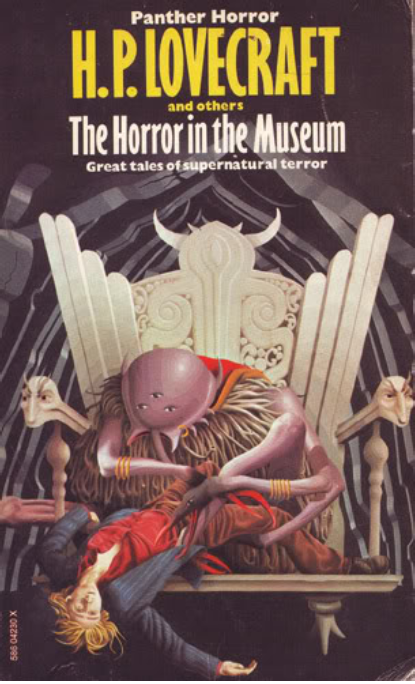
Those two stories--"The Last Test" and "The Electric Executioner"--appeared in book form in The Horror in the Museum. Here's a paperback version, a British edition that may or may not contain all the tales from the original Arkham House edition. Can anyone attest to its contents? And does anyone know the name of the cover artist?
A stamp with a portrait of Ambrose Bierce, described as "immensely attractive . . . handsome, debonair, erect, and in the habit of looking out and over life, so to speak, as from an eminence."

Text and captions copyright 2012, 2023 Terence E. Hanley