Abstract
Water scarcity is an escalating environmental challenge, particularly in semi-arid regions like Spain, where balancing human and ecosystem needs is critical for sustainable development. Freshwater ecosystems are vital for biodiversity, water security, and economic systems, but often lose protection during droughts. Spain, largely under a Mediterranean climate, shows strong interdependence between ecological and socioeconomic systems, with agriculture, tourism, and energy sectors heavily reliant on scarce water resources. Spain’s economy has thrived on water-dependent activities yet increasing droughts and infrastructure limits are pushing ecosystems toward collapse, with severe biodiversity loss and irreversible damage. Furthermore, investments aimed at increasing water-use efficiency often backfire, leading to expanded irrigation without real water savings. Climate change, urbanization, and pollution exacerbate these tensions, posing risks to public health and economic stability. Transformative strategies are urgently needed: protecting and restoring ecosystems, promoting conservation agriculture, regulating water-intensive industries, and planning collective responses to illegal water use. Simply increasing supply or reacting to crises without systemic change of water demands will not ensure future water security. Spain’s experience highlights the urgent need for integrated management of natural and human systems to preserve freshwater resources, biodiversity, and economic resilience.
Original content from this work may be used under the terms of the Creative Commons Attribution 4.0 license. Any further distribution of this work must maintain attribution to the author(s) and the title of the work, journal citation and DOI.
1. Water allocation and ecosystem protection
One of the major environmental challenges today is how to allocate water resources in a way that meets both societal and ecosystem needs while minimizing water security risks for humans and biodiversity (Bakker 2012, Garrick and Hall 2014). This issue is particularly acute in regions with limited water availability where water-intensive sectors—such as agriculture, tourism, or specialized industries—are prevalent (EEA 2024). There, human demands conflict with the preservation of freshwater ecosystems, which are not only critical components of the landscape and key habitats for biodiversity but also serve as primary sources of water for human use. Maintaining freshwater ecosystems in good ecological status is critical for water security (Poff and Matthews 2013), as they play fundamental roles to maintain the balance required for the sustainability of economic systems (Vörösmarty et al 2010). Nonetheless, in situations of extreme drought or persistent water scarcity, most societies reduce or postpone the protection of freshwater ecosystems (Schmidt et al 2023). In such cases, achieving an equitable allocation of water resources is particularly critical, and it invariably requires comprehensive agreements between governance and management entities.
2. Interdependence of ecological and socioeconomic systems
Managing water scarcity without accounting for the interdependence between ecological and socioeconomic systems may result in negative impacts on both. Semi-arid countries like Spain are prime examples of how interdependent ecological and socioeconomic systems are, and more so as the scale of human interventions increases. Nearly two thirds of Spain are under Mediterranean climate (Iberian Climate Atlas 2011), and half of the available water resources in the country are diverted for human use, reaching up to 90% in some coastal Mediterranean basins (estimated from available official data; figure 1). Uses are mostly agricultural (particularly in the Mediterranean basins, where it ranges from 60%–90% of the total demand), and tourism and urban (reaching up to 51%–67% in the Internal Catalan Basins and Balearic Islands, respectively).
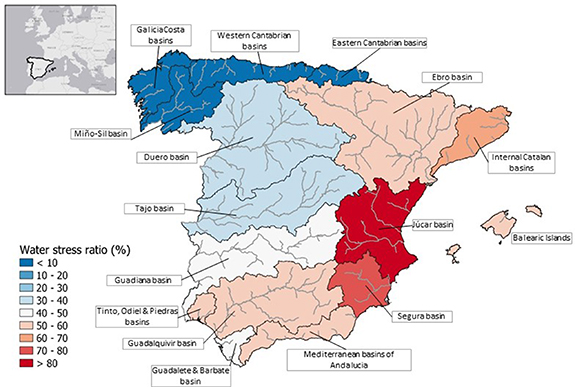
Figure 1. Water stress ratio (i.e. demands of all sectors vs renewable and non-renewable resources) in Spain (Canary Islands not included in the analysis) by hydrographic regions. Data were obtained from the respective hydrological plans for the 2022–2027 period (MITECO, Spain).
Download figure:
Standard image High-resolution imageThe acute difference between basins and hydroclimatic regions in Spain is clearly shown by the water stress ratio (WSR), an index that relates the demands of all economic sectors against available water resources (figure 1). The WSR includes renewable and non-renewable water resources, these being desalinated or reused waters, as well as obtained from water transfers. The WSR therefore is specific for the hydrological sources in each basin, tough it is overall comparable to the widely used WTA index, which is defined as the ratio between the annual water withdrawals to water availability (Revenga et al 2005). Values of WTA greater than 40% indicate high water stress—a threshold which corresponds to that of the WSR, and which is exceeded throughout the entire Mediterranean basin of the Iberian Peninsula (figure 1). WTA and WSR express the long-term effects of water use on water stress, and basins exceeding this 40% threshold risk experiencing chronic water shortages (Alcamo et al 2007). It is important to note that these water stress metrics do not account for the ecosystem’s water requirements i.e. such ‘environmental reserve’ refers to the volume of water that should remain in the system to maintain its ecological integrity (Revenga et al 2005).
WSR is tightly related to aridity (expressed as the ratio of precipitation to potential evapotranspiration; Beguería et al 2025), in a relationship that may impact ecosystems, agriculture, and human populations. Aridity implies a significant lack of moisture, commonly associated to low rainfall, high evapotranspiration rates, or both. On average, the relation between WSR and aridity in Spain reveals nearly an order-of-magnitude difference between the Atlantic and the Mediterranean regions (figure 2). WSR increases as the climate becomes more arid, overall enhancing the high impact on freshwater ecosystems precisely when water resources are the lowest. In southeast Spain, where low rainfall and high evaporation rates generate the most arid conditions, the societal water demands require of desalination and inter-basin transfers, but the impact of overexploitation of surface and groundwaters remains extreme. Desalinated water is only usable and affordable for agriculture after diluting with surface or underground waters (Zarzo Martinez 2020), and the high agricultural water demand in that region keeps an overall high pressure on natural water resources. Where domestic consumption, including tourism, is higher than agriculture (e.g. Internal Catalan Basins or the Balearic Islands; figure 1), desalinated water production (Morote et al 2017) goes along with overexploitation of surface and groundwaters, mostly during long droughts.
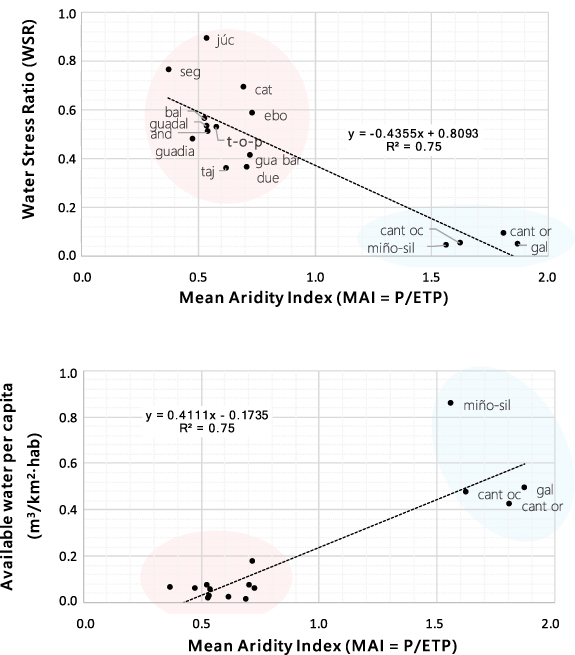
Figure 2. (a) Linear regression showing the relationship between the water stress ratio (i.e. WSR, demands of all sectors against renewable and non-renewable resources) and the mean aridity index across different Spanish hydrographic regions (Canary Islands are not included in the analysis); (b) Linear regression showing the relationship between per capita water availability and the mean aridity index; t–o–p indicates the Tinto, Odiel and Piedras basins in the Western Andalucía, whose climatic characteristics are influenced by Atlantic conditions anomaly increasing water availability in the area; hence we have excluded this from the regression analysis and marked as outlier; there, chemical pollution is the main threat to water availability. Abbreviations stand for the different hydrographic basins and regions i.e.: ebo for Ebro, due for Duero, taj for Tajo, guadia for Guadiana, gua for Guadalquivir, júc for Júcar, seg for Segura, cat for Catalan Internal basins, bar for Balearic Islands, and for Guadalete and Barbate, gal for Galicia-Costa, cant-oc for Western Cantabric, and cant-or for Eastern Cantabric.
Download figure:
Standard image High-resolution imageHistorically, water-providing ecosystems have played a critical role in Spain’s economic development. In the arid regions, water for irrigation, often from inter-basin transfers, compensates for disadvantages such as poor land or less abundant labor, boosting the food industry and other interconnected industries such as agrochemicals or transport. Additionally, water provision in these areas makes Spain a leading sun-and-sea tourism destination, whereas hydropower remains a source of energy crucial for the stability of the transitioning energy grid as non-programmable wind and solar sources become more frequent. Spain’s economic success has paradoxically consisted of building a water-dependent economy in a semi-arid region.
The Mediterranean climates show highly variable water availability; the low rainfall season (typically from late spring to early autumn) coincides with periods of high evaporation and human demand, causing even higher pressure on water resources. This situation is almost untenable during the driest years, when renewable resources lay at their minimum. Such climate and socioeconomic tensions are not unique to Spain but are shared by other regions with Mediterranean-like climates (Horne 2018, Budds 2020, Stewart et al 2020).
3. Water development caveats
Spain is a hydraulically developed country (ca. 1200 large reservoirs; Belletti et al 2020), with few marginal opportunities to develop new water infrastructures to meet renewable water demands. Freshwater ecosystems are exhausted and show signs of irreversible losses. For example, the Ebro River, the largest basin in the country, has experienced a nearly 40% decrease in mean annual flow over the last 50 years (Gallart and Llorens 2004, López-Moreno et al 2006) due to a decrease in precipitation, reforestation of headwaters, and increased water consumption (mostly for agriculture). Emblematic freshwater ecosystems such as Doñana (Green et al 2024), Daimiel (Castaño et al 2018) or the Ebro delta (Mariano et al 2023) show signs of being at the edge of collapse. The biodiversity and essential ecological function of many other freshwater ecosystems are threatened, among others, by thousands of barriers that disrupt river dynamics and longitudinal connectivity (Belletti et al 2020). At the same time, native species decline while invasive species proliferate (Radinger and García‐Berthou 2020), groundwaters are depleted or suffer saline intrusion in many coastal areas (Jasechko et al 2024), with scarce prospects for recovery. The marginal costs of restoring the physical, chemical, and ecological conditions of water bodies escalate to a point where they become infeasible without a transformative approach to reversing water scarcity trends and adapting to global change. Therefore, the perception of a successful water development policy in Spain is under scrutiny (EC2025).
Given the tight interconnection between ecological and social systems, the question is not whether one can adapt to the pressures exerted by the other, but rather how external pressures influence the structure and functioning of both (Gómez and Pérez-Blanco 2014). In Spain, there is increasing evidence that the degradation of water ecosystems is putting the water-dependent economy under growing pressure. Escalating water scarcity from climate change, intensive land use, and aquifer overexploitation, raises the risk of eutrophication and chemical hazards (Arenas-Sánchez et al 2016), tightly linking water quality and quantity. Particularly in highly and unevenly urbanized Mediterranean basins, where the population is mainly concentrated in a few large towns and along the coast, river networks have been systematically disconnected from their floodplains, transformed into wastewater conduits with little dilution capacity, threatening public health and freshwater ecosystems (Abily et al 2021). Remarkable examples of this stress are the Manzanares and Llobregat Rivers—which respectively receive treated wastewater from the urban areas of Madrid and Barcelona—and are extremely polluted by industrial products and human pharmaceuticals (Ginebreda et al 2014, Wilkinson et al 2022).
Water scarcity equally puts pressure on agricultural exploitation and tourist facilities, which may be forced to redefine their productivity goals (Gómez and Maestu 2024). It is necessary to shift from past water demand-driven management practices to others that contemplate the tight connection with natural systems. Massive investments to enhance irrigation efficiency have not reduced water demands (Grafton et al 2020, Pérez-Blanco et al 2020) but have resulted in expanded area of irrigated land (Serrano et al 2024). Alternative water resources, such as desalinated or reclaimed water require high subsidies and under current market prices cannot be applied except in selected periods or regions (Morote et al 2017). Severe responses are necessary to face illegal water abstractions or informal water markets (Gómez and Maestu 2024), which although logical from an individual business standpoint, cause an overall decrease of collective water security at the regional or catchment level.
4. Maintaining water security amidst water scarcity: potential solutions and challenges
Collective solutions that address the needs of both natural and socioeconomic systems should be prioritized, rather than focusing on closing demand-supply gaps or reacting to water extremes without considering the occurrence of future events. While this goal might be of general application, it is ineluctable in socioeconomic systems that are extremely dependent on fragile freshwater ecosystems. Environmental degradation reduces ecosystem services and disrupts the economy, threatening its long-term sustainability (Sutton et al 2016, Acheampong and Opoku 2023). Therefore, the socioeconomic system should contemplate avoiding further environmental degradation and preserving and restoring freshwater ecosystems. This implies a critical shift towards, for instance, conservation agriculture to enhance biodiversity and natural soil biological processes, improving water and nutrient use efficiency and sustaining crop production (Carmona et al 2015, Cordeau 2024). Careful consideration also needs to be given to new water-consuming activities, such as large tourist facilities or highly water-demanding industries, which may disrupt water allocation in the territory. This shift requires a paradigm change in water allocation and in the way it is seen by several sectors of Spanish economy. Political decisions suffer from poor coordination among competent authorities, and from the strong defense of private or local interests, among other issues (Vargas-Amelin and Pindado 2014).
Structural funds are needed to rehabilitate catchment processes and freshwater ecosystems, promote research and set demonstrative case studies where ecosystem services are recovered. On this regard, integrated solutions should recognize the interdependence between terrestrial catchment process, the quantity and quality of water resources, and the conservation status of freshwater ecosystems. Intended plans for restoring freshwater ecosystems, such as those outlined under the Nature Restoration Law (European Commission 2024), which should be developed through National Restoration Plans by the European member states during 2026, might offer funding opportunities to recover (at least partially) the natural water cycle and the integrity of associated freshwater ecosystems. Favoring water savings and water reuse, while minimizing unwanted water losses (both in agricultural and urban water systems), and allocating highly demanding water facilities (industrial, touristic or agricultural) in areas not suffering from moderate to high water stress, may also be essential. Only through these transformative changes we may aim to restore the mutual resilience of the Spanish water dependent socio-ecosystems and ecological systems.
5. Final remark
Spain and other arid or semi-arid regions facing intense water scarcity continue to be primarily managed to meet human needs, then pushing freshwater ecosystems beyond their capacity to provide essential services and adequately respond to extreme events. As an example, the dramatic effects of the recent flash flood in the Valencia region cannot be understood without considering flooding risks in the design of new urbanization plans and the modification of ravines, flooding areas, wetlands, and river corridors, in areas which cannot longer buffer the impact of such extreme events. Climate change predictions suggest that pressures on water resources will increase (MITECO 2020, Sanz and Galán 2021, CEDEX 2017), with serious implications for country’s economy and freshwater ecosystems. Water scarcity is advancing (EEA 2025), and this demands fast solutions. Transformative approaches should be addressed to curb water demand and over-abstraction, particularly in the most water-stressed regions (figure 1). These approaches should specifically concern agricultural practices, water savings and reuse, and political decisions aimed at preventing the establishment of high-water-demanding facilities in regions experiencing water stress. Only through such a shift it will be possible to ensure water security, preserve biodiversity, and sustain socioeconomic development in the face of the growing challenges related to increasing human population and climate change impacts.
Acknowledgments
This paper has been prepared as part of the activities conducted under the Research Network RED2022-134781-T funded by the Spanish Ministry of Ciencia, Innovación y Universidades, and the Agencia Estatal de Investigación, Spain. Discussions were supported by the Project H2OSEG of the Fundación Banco Bilbao Vizcaya Argentaria (FBBVA). The map in figure 1 was drawn by Xavier Garcia (ICRA), and Fanny Ville (UdL) assisted in preparing figure 2.
Data availability statement
No new data were created or analysed in this study.