A Light-Up Map Of Monaco

If you want to get around Monaco, a map — digital or otherwise — is probably the best way to navigate. But if you just want to appreciate the city’s form in a more artistic way, you might enjoy [Terence Grover’s] latest project—a backlit topographic map of the unique principality.
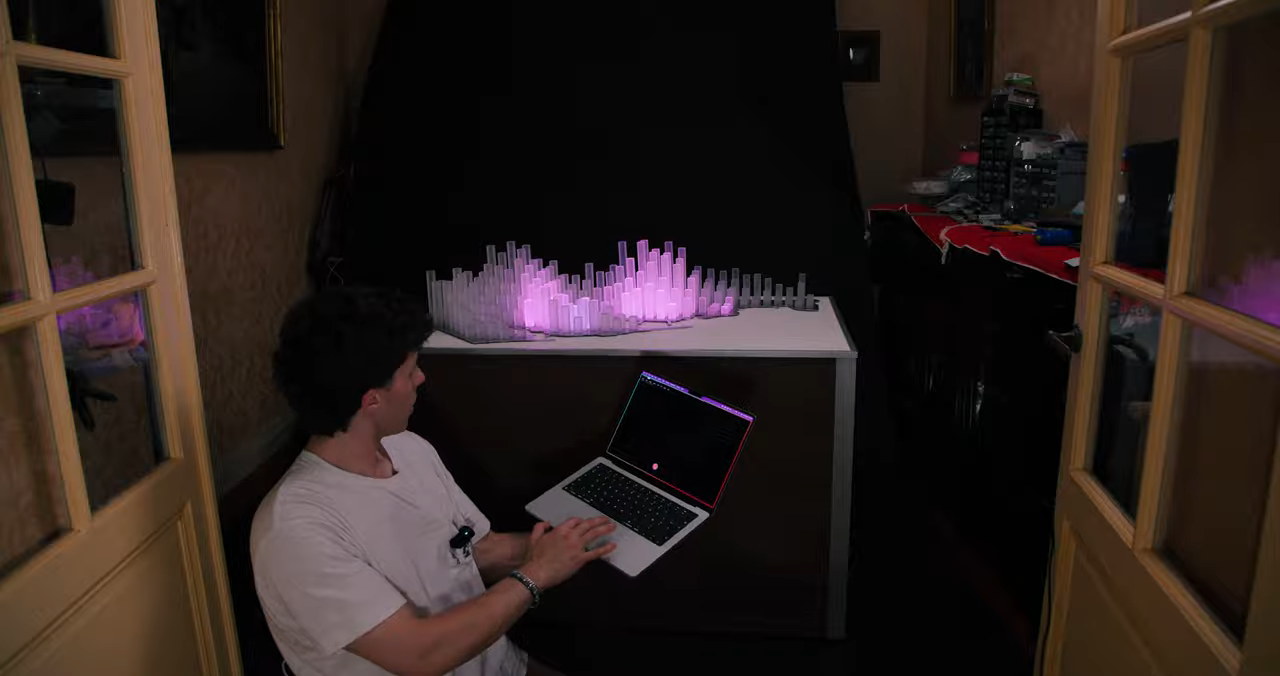
The touch mode allows one to draw patterns across the map.

The project started with a QGIS mesh of Monaco, with the data fed through the Open-Meteo elevation API, which takes into account building heights. This was used as the basis for the heights of 179 pieces of 20 mm x 20 mm acrylic. These were assembled into a laser cut steel base, and were sanded on all sides but the base in order to allow them to diffuse light more effectively.

Strips of CS8812 LEDs are used to light the plastic towers, driven by a pair of Adafruit Feather RP2040 Scorpio boards. They’re fed pixel data from a Raspberry Pi 5, which runs a Flask panel accessed over an iPad. This allows control over the LED map display, showing things like civic data, highlighted events, and weather. There’s even a touch-sensitive mode that lets one paint fun patterns across the representation of the city.

We love a good artistic map, particularly when they’re full of LEDs and represent useful information.

Continue reading “A Light-Up Map Of Monaco”

Know Your Food: Organic Production

A few weeks ago we published the first in a new series of articles, Know Your Food. It was born out of the realisation that most people know surprisingly little about what they eat, and to apply a bit of Hackaday curiosity to received opinion on the subject. As we put it then: “To know both how common foodstuffs should be made, as well as how they are made industrially, should be an essential for everyone” We’ll continue in that vein, with a look at organic food.

If you buy your food in a supermarket it’s likely that in the vegetable aisle you’ll be presented with a choice. On one hand you will have the normal vegetable, and on the other and usually for a slightly higher price, the organic version of the same vegetable. What’s going on?

So What Is This Organic Stuff All About?

A watercolour picture of a bucolic scene with a farmhouse surrounded by trees, and some cows in the foreground.
It is unlikely that a typical organic farm in the 2020s will resemble this John Constable painting. John Constable, Public domain.

Organic production is a system of agriculture that emphasises natural fertilisers, pesticides, and farming methods over synthetic or intensive ones. It has its roots in the first half of the 20th century, and as the decades progressed it has become an important sector of agricultural industry. I grew up steeped in organic agriculture because my grandfather was an early adherent in the years following the war, so I’ve seen it from the sharpest end. There is a lot to commend organic production for and plenty of reasons to embrace it, but with that come some problematic aspects, and even dubious claims. Here I’ll try to unpick some of that.

It’s tempting to believe that all organic production is somehow a return to a 19th century rural idyl, complete with the obligatory chickens in the farmyard. Some organic producers do take a slice of this back-to-the-land approach to their craft, but the reality of organic farming is a very modern approach to managing the ecosystem. Organic farmers are not wary of progress, and neither are they reluctant to use pesticides or other chemicals. Instead they do so according to the principles of organic agriculture, so any techniques they use are designed to be beneficial to the ecosystem, and any chemicals have a natural origin. Continue reading “Know Your Food: Organic Production”

Sony To End Physical PlayStation Disc Production In 2028

Sony has just announced on their PlayStation blog that they will stop the production of game discs starting January 2028. This effectively means a shift away from physical media to one that fully relies on downloading content from the PlayStation online store.

Although not technically confirmed, this announcement would strongly indicate that the PlayStation 6 will do away with its optical drive altogether as previously speculated. Of course, physical media has long since been on the ropes, particularly when it comes to gaming. Valve’s recently released Steam Machine doesn’t feature an optical drive, and for that matter, neither does the average gaming PC these days. But it’s still disappointing to see in many ways.

Although digital downloads have their advantages, a major problem here is that due to Digital Rights Management (DRM) you only ever get a license to lease a game. This means losing the ability to lend or borrow a game, and will likely mark the end of second hand sales. With narrow exceptions such as Good Old Games (GoG) and its DRM-free installers that you can e.g. burn onto a CD or copy to a USB drive as a static instance of the software, this shift by Sony effectively ends game ownership for PlayStation owners.

A Rare Drone Common Sense Outbreak, In Denmark

Last September, Denmark was gripped by a spate of drone sightings near airports. It’s familiar territory for Hackaday, as we reported on a similar drone panic saga at British airports back in the last decade. Back then the British police dragged their feet and hid behind secrecy laws for years to avoid admitting they overreacted, but it seems in Denmark they do things differently (Danish language, Google Translate link.).

The Danish police in Jutland have rolled back their report, and noted that a reported observation alone is not enough to confirm a drone was present. It’s not confirmed why they’ve taken this step, but we’ve been told that there’s been an effort within the drone community to identify possible aircraft flight paths which could have resulted in a false drone sighting at the times in question.

We welcome this correction, and hope that its important message travels widely. Of course it is the right thing to do for a police force to take drone reports seriously, but overreacting as the British police did is of little help. We commend the Danish police for taking this step, and we’re likely to trust any drone reports from them a little bit more in the future. If you’d like to read our plea for a sensible response at the time, it’s here.

Thanks [UAVHive] for the tip.

Trying Out Viewer Suggestions For Levitation On An Induction Cooker

Doing something once is fun, but if you get interesting feedback from viewers on how to make things even more fun, you can only follow all of these instructions and put more random objects on top of an induction cooker, as [Brainiac75] fortunately did.

Much like in the first video, the goal here is to use the Lorentz force that is induced in the object for levitation, ideally without having said object depart for orbit, melt into a puddle of molten metal or be a general hazard to anyone standing in the same room.

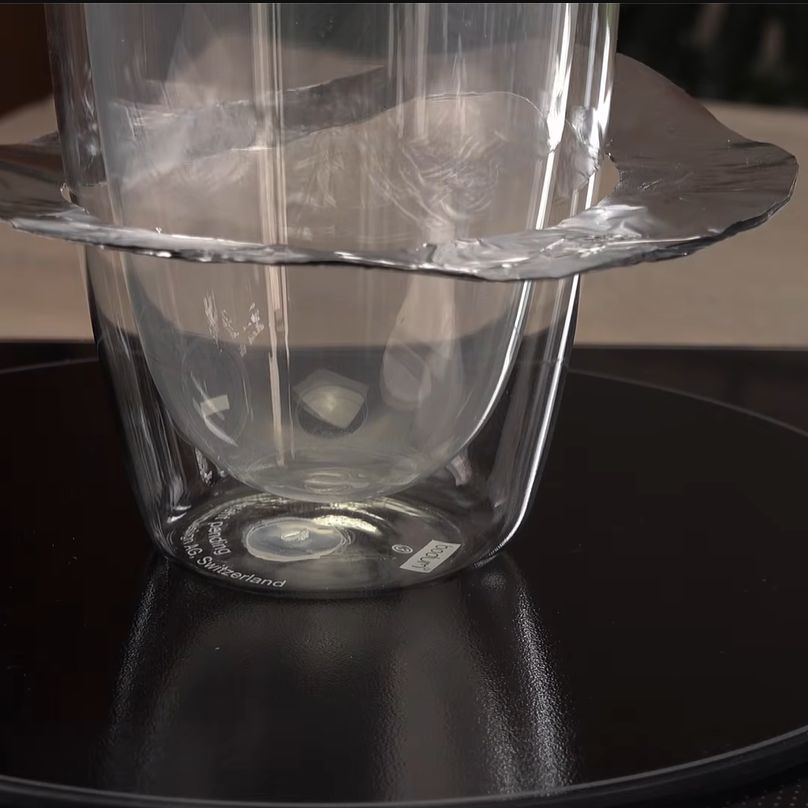
Some of the suggestions were rather benign, such as improving the aluminium foil ring by adding four times more layers to create more mass. Unfortunately adding more layers here had the device refuse to turn on due to the absence of a suitable ferromagnetic target. The difference between the working versions with one to three layers was here also not really noticeable. Various aluminium and copper tape configurations were then attempted, but without much success.

Of note is that while levitating, the metal gets pretty hot. At one point a CD even gets melted to aluminium foil. Even the use of water-filled aluminium cans will only give you so much time, and ramping down the power level on the induction cooker only revealed that this particular model operates only at either at full blast or off. Correspondingly a new induction cooker with claimed constant output was obtained for the next experiments at lower levels.

Interestingly, it was this new induction cooker set to a more reasonable output level that showed the first reasonably static levitation results without immediate conflagration or molten metal splatter risk. Whether this is the kind of levitation display that you want to set up in your living room in lieu of a boring magnetic one is still a good question, but at least this demonstration got downgraded to something potentially safe enough to play around with in a physics class.

Continue reading “Trying Out Viewer Suggestions For Levitation On An Induction Cooker”

GPU-Accelerated Autorouter Handles Monstrous PCB Designs

[Brian] had an absolute monster of a PCB with thousands of nets to be routed, the kind of design that stopped traditional routers in their tracks. It would take months to route by hand, likely trying the patience of a saint in the process. To solve this specific problem he created OrthoRoute, a GPU-accelerated autorouter that he cautions is no more trustworthy than any other autorouter, but at least it’s fast!

A closeup of an extremely high-density board routed by OrthoRoute.

A KiCad plugin, OrthoRoute is so named because traces are laid down in a Manhattan lattice, a grid of orthogonal segments. All components (surface-mount only, no through-hole stuff) go on the top layer of the PCB, and all lower levels contain a grid of traces, connected as needed with blind and buried vias to route everything. OrthoRoute takes a structured and iterative approach, eventually converging on a satisfactory layout.

How does OrthoRouter actually decide how to connect things? [Brian] adapted PathFinder, an algorithm designed for routing FPGAs. Laying out a grid of orthogonal traces and punching down through them with vias to make connections has a lot in common, conceptually, with routing FPGAs. GPU acceleration makes the whole thing far more efficient than pipelining the calculations through a CPU.

OrthoRoute was built to solve a very specific problem, but in the process showed that GPU-accelerated routing is definitely feasible. Check it out in the videos, embedded below the page break.

[Brian] cautions that as-is, OrthoRoute is useful to maybe a handful of people at best, but as a KiCad plugin it’s highly modular and the hard parts are all done. If you want a closer look, or have some ideas about how to repurpose or extend it, check out the GitHub repository.

We’ve seen some nifty KiCad plugins for all kinds of purposes, from breadboarding to giving PCB traces an old-timey look, and even one specifically for designing custom keyboards. It’s not every day we see a plugin aimed at handling high-density boards with thousands of nets, though.

Continue reading “GPU-Accelerated Autorouter Handles Monstrous PCB Designs”

No-Drill Sailing Kit For A Canoe

The first known use of humans using wind to perform mechanical work with machines dates back to ninth-century Persian windmills. But if we count sailing vessels among those machines, the history goes back to sometime just before the invention of written language. Since then, humans have been sailing everything from the tiniest of Sunfish to the largest of shipping vessels, and even sailing boats like canoes that aren’t typically designed for efficient sailing. For those who already own a canoe, the conversions can be straightforward but often involve drilling into the hull. This homemade conversion kit, on the other hand, requires no drilling at all.

The first, and most obvious, part of the conversion is to add a mast and sail. [Tea]’s primary setup does involve drilling a mast thwart into the gunwales of the canoe, but he also built an alternative setup which clamps to the gunwales and the bow deck instead. The standing lug sail is then hoisted on an unstayed wooden mast. The next major component of the build are a pair of leeboards which also clamp to the gunwales and function like a centerboard, and can be adjusted for one’s preferred amount of weather helm. Rounding out the stern of the boat is a custom-built rudder with a pair of lines in lieu of a tiller which can be positioned anywhere along the length of the boat.

All of the wooden parts of this build were custom-built from common lumber with finishing touches from a router to soften all of the hard edges. Canoe sailing is fairly popular, although without the leeboards these common sailing kits are often meant for downwind sailing only. A complete setup like this turns it into a much more capable craft. Without a canoe as a base vessel to start with, though, a complete sailing vessel can be built from common lumber as well.

Continue reading “No-Drill Sailing Kit For A Canoe”