
Note: This report will be updated as I discover more information. For one thing, apparently this situation has exceeded its original scope and no longer could be reasonably described as a “kerfuffle,” so I have gone with the term “incident” instead. I apologize in advance for the hassle.
EDITs as of early/mid Dec 2024: Apparently, Emily & Chris Bell have been barred from further attendance at Gen Con for 2025 and (presumably) the future as well. I have not verified this beyond Emily’s own claims on the subject, nor do I know Gen Con’s thinking on the subject. I do not know of anyone else involved in this incident banned from Gen Con.
Also, it has come to my attention that Maurice Broaddus has been elevated as the new head of the GCWS for 2025, which is fantastic. Well-deserved and long overdue. Maurice is an institution at the GCWS, and he will be an excellent chair of the leadership team.
EDIT as of 15 Sept: 2024 There have been suppositions that I am in some way supporting/defending Gen Con and/or attacking Chris & Emily Bell. That is not correct. I am only looking for the truth. Both sides made mistakes. I criticize both sides. I do not now nor will I ever work for Gen Con, nor am I a leader at the Symposium. My goal here is to present a third-person perspective based on actual research and evidence, not supposition. Is everything I say entirely corroborated and accurate? Not necessarily, but I have made a concerted effort to ground all of my statements in my research. If one party comes off looking worse than the other, that is a consequence of the events, not my efforts.
If anyone would like to reach out to me with their own perspectives and evidence, I left my email below.
Herein, I present my findings about the recent conflict between Emily and Chris Bell, members of the leadership team (Chris was the de facto chair) for the Writers’ Symposium for 2024, and Gen Con, our contracting company that hosts the symposium every year at Gen Con in August. The Bells worked very hard and long to put on what was, by all accounts, an excellent Symposium.
EDIT: an earlier version of this analysis suggested that Emily was herself the head of the leadership team, alongside Chris. Chris has attested that he was the de facto chair and all decisions were made at the leadership team level.
Principal members of Gen Con who will be discussed here are Marian McBridge, the Symposium’s liaison, and Derek Guder, her boss on the event committee. Within the last days, Gen Con (I’m not sure specifically who said it) informed the Bells they are removed from leadership of the Symposium going forward through 2025 and beyond. It was originally stated that the entire committee was removed, but Gen Con has since softened its stance that only Chris and Emily Bell are not welcome back on the leadership committee for 2025.
The aim of this analysis is to determine why.
Tl;dr, it isn’t racism or that Gen Con objected to the leadership committee bringing in BIPOC writers. Gen Con was all for that, in fact. It was the leadership team (under the direction of Chris Bell) who halved the expected four (4) featured guests at the Con to two (2), then used the remaining funds for other unintended purposes, then delivered Gen Con an ultimatum, prompting the current rift between them and Gen Con.
Note that I *did* inform Emily about this change in Gen Con’s stance *before* she posted the second part of her post about being dismissed from leadership, with corroboration from Derek. She knew before she posted that Gen Con’s problems were with herself and Chris, not the rest of the leadership team or the Symposium in general. But she still posted the account she posted.
“Who the fuck do you think you are?”
To answer Emily Bell’s question (trust me, the WS discord has been a JOURNEY), here’s some information about me for context.
I am a long-time member of the Gen Con Writers’ Symposium. I am not a member of the leadership committee, nor do I have any interest in being such. I was not set to be a panelist in 2024 (it was a bye year for me), but I was going to attend (as I do every year) until I came down with COVID the previous Monday and didn’t want to put anyone at risk.
I am also well-acquainted with the various players in this situation, including Chris and Emily Bell as well as Derek Guder and Peter Adkison of GenCon.
I am also the “writer who asked to remain anonymous” in Emily’s blog post about the issue. In fact, you should read her post, as this piece assumes you have. Here’s the link:
True to my word, I reached out to Peter on her behalf, and he informed me that he had no involvement in the situation and intended to stay out of it. He supported the decisions made by the events team, Marian McBride (the WS’s direct liaison) and her supervisor, Derek Guder. He declined to meet with Emily.
To be entirely upfront, my goal here is to offer a true accounting for what happened and preserve the Writers’ Symposium going forward. I think the Bells did a lot of good work in making the Symposium more diverse and progressive than ever, and I highly support that effort. But we must also acknowledge our mistakes and learn from them, to avoid repeat problems.
My research is also still ongoing, and I would invite anyone with insights into the situation to reach out to me with their own perspectives and evidence. My email is erikscottdebie AT yahoo DOT com. (Yes, yes, I am one of those silly elder millennials who still uses Yahoo.)
Here are the facts, based on my research.
Gen Con is the contracting organization for the Writers’ Symposium, i.e. they contract a leadership team of interested writers/publishers/editors/industry figures to put on an event every year consisting of panels, presentations, workshops, and potentially other events, which we refer to as the Writers’ Symposium. This has been going on for decades.
Gen Con is a major, but not the sole funder of the Symposium, which also relies on sponsors and donors, be they individual authors or companies. Catalyst Game Labs was a sponsor for 2024, for instance. I have not, as yet, determined how much funding the Symposium received from sponsors and donors for 2024; my research continues.
For WS2024, Gen Con funded the Writers’ Symposium leadership team to the tune of $4,000, increasing the Writers’ Symposium budget from the previous year (2023) on the assumption they would bring in FOUR featured writers, BIPOC encouraged but not required. Gen Con wasn’t going to *insist* that the leadership team bring in only BIPOC writers, but clearly inclusivity was the direction of the Symposium under the Bells’ leadership (this is attested in Emily’s narrative of events), and everyone was on board. This money was intended to subsidize housing and transit for featured guest writers who might need it.
The leadership team identified not four but TWO featured guests, providing them each a $1000 stipend, and allocated the rest of the money to other administrative purposes.
So where did the money go? According to Chris Bell:
- Travel expenses of (non-committee) Symposium guests (over $3000 spent in 2024)
- Social events for Symposium members and volunteers
- Parking reimbursements for volunteers
- Signage (not provided by Gen Con) to identify the Symposium area in both the Marriott and Vendor Hall
- Website, email, IT expenses (not provided by Gen Con)
The leadership team invited these two guests: Linda D. Addison and Mikki Kendall. There’s nothing wrong with either as a choice—by all accounts (and my personal opinion), Kendall in particular is fantastic and has great perspectives to offer. I’m less familiar with Addison, but she too is amazing. I will focus this account on Kendall, as so does Emily, and because her name was allegedly on the emergency meeting notice that GC would ultimately send out. I have not seen a copy of this meeting notice, but Emily says it was on there, and I believe her. We’ll get to that.
But from Gen Con’s insular perspective, they were outside-the-box choices, with relatively limited connections to SFF and gaming as industries. “Relatively” in this case compared to a featured guest like Brandon Sanderson, N.K. Jemisin, etc. To be clear, they were expecting the Symposium to invite at least one featured guest with massive name recognition and wide appeal to the SFF audience. Addison is a horror institution, but Gen Con does not focus on the horror overlap. And though both of them have worked extensively in the industry and are–again–fantastic gets, Gen Con had the reaction they had.
(Credit goes to Maurice Broaddus for his role in bringing Kendall and Addison to Gen Con. Maurice is not mentioned even once in Emily’s account, when last I checked, but I thought it was important to acknowledge his influence here.)
Per my research, Gen Con had not heard of either of them, despite their decades of work in the industry. I cannot explain this, as I would expect Gen Con to google them and see their work. Perhaps they did, and still calculated that the two would not be a draw on the level of, say, Ed Greenwood (a niche weirdo, sure, but this is his niche) or R.A. Salvatore a couple years ago, who packed the Symposium with attendees anxious to see him.
(And yes, Gen Con’s reliance on white guy authors–and their historical dominance of the SFF genre–are a key backdrop to this whole situation. I am not ignoring that.)
The communication relationship between the WS leadership team and Gen Con, by all accounts, was always somewhat fraught, and continued to erode over time. Gen Con, when they heard about this choice, logically wanted to discuss, only to find out that the invites had already been made, and the WS leadership team was going to announce publicly within the next day or so. The Symposium’s liaison Marian escalated the situation (which was becoming urgent) to her boss, Derek Guder, and GC called an emergency meeting to discuss the matter.
Per Emily’s account, the meeting’s title was “Concerns regarding Special Guest Mikki Kendall” or something to that effect. Which it seems she interpreted to mean that GenCon did not want to invite Kendall because of her race and/or activism, though I have discovered no evidence to this effect.
The concern expressed during this meeting regarded the actions of the leadership team in inviting an unconventional guest and not giving GenCon the chance to consult or even know about the invite before it was extended and/or publicly announced.
Per Emily’s account, Marian and particularly Derek castigated (in strong terms) the leadership team for acting unilaterally, using GC’s money (given to them in good faith) for purposes other than what it was intended for (i.e. to bring in four guests in consultation with Gen Con, and they only brought in two), and for inviting guests without informing them beforehand. Which, for those of us who have been in such meetings and can attest, is a traumatic and upsetting experience, no question. It can certainly be argued (as Emily has) that the leadership team’s treatment at the hands of Gen Con was overly harsh and prompted PTSD responses, which is not defensible.
I happen to share this opinion. I do not think there is any place for belittling or abuse in a professional setting.
(EDITED to state my own opinion. I am in no way defending Gen Con here.)
Is any of what happened at all reasonable?
Sigh. Let’s talk about the context.
Let’s be clear. Putting on the Symposium is expensive. It’s a lot of work. And Gen Con should definitely provide more funding, in this author’s opinion. The leadership team made their own calculations and invited these two featured guests, and no more. I think it is understandable that they did not bring in more featured guests if they did not have the funds. Unfortunately, this put them on a collision course with Gen Con’s expectations going into 2024.
Per my research, Gen Con has always had the final say in what featured guests get invited, and it is customary (probably contractually required, but I can’t confirm) to submit a list of guests to be invited for Gen Con’s review and approval before invites are sent out. It is my understanding that in past years, GC has been fairly hands off when it comes to selecting guests, which probably has to do with trust built in the leadership of the Symposium. We had stable leadership for many years, and fostered a strong relationship with Gen Con. The last few years have seen more turnover, and the Bells took point just recently.
From Gen Con’s perspective, featured guests at the Symposium are intended as a draw for attendees. There are people who come to Gen Con SPECIFICALLY to meet people at the Symposium: typically well-known SFF authors and/or designers. To not invite someone who might draw attendees is, from Gen Con’s perspective, a business-related error.
And per my research and Emily’s account, Gen Con did not recognize Addison and Kendall as sufficient draws to justify their investment. Kendall—for all her bona fides—is an unusual fit for the Symposium. Gen Con expressed concerns about her appeal to the Gen Con-going audience, who might not even have heard of her and about the provocative nature of her political advocacy. Derek allegedly (and incorrectly if so) described them as having “zero appeal.” Which is definitely not true, but these less conventional choices were intentionally chosen to expand the conventions of the Symposium. Emily has been very clear about her intent to champion the cause of inclusion at the Symposium, and it is clear these two featured guests were part of that effort. And I, for one, applaud these efforts.
Because… hell yeah, Kendall. She’s awesome. The best thing to come out of this whole mess as far as I’m concerned is exposing a bunch of us whitebread writers to her work. 😊
I personally and firmly believe broadening the horizons of our audience is indeed something the Symposium SHOULD be doing, and I personally applaud the choice of Kendall. There were a number of years where the Symposium relied heavily on white men to represent SFF, and that is not acceptable going forward. I see the fact that at least some of our audience wouldn’t immediately recognize her as a STRENGTH, not a weakness. The Symposium SHOULD be about learning and pushing the envelope. I support the choice of Kendall, 100%.
At the same time, I can certainly understand why Kendall’s selection would give Gen Con pause. They weren’t familiar with her, they suspected most attendees wouldn’t either, and they were wondering why someone who is primarily known as a political activist would be a good fit for the Symposium.
As for the issue of how Kendall’s politics and activism affected Gen Con’s concerns, that is unclear. Historically, Gen Con seeks to remain non-political or at least find compromise in most instances, as we have seen with their initial pushback and threat to leave Indianapolis against Indiana’s restrictive legal measures regarding LGBTQ people, then backing down when the issue cooled down. Whether this is a sustainable strategy or even logically possible is another question–one outside the scope of this particular report.
But I digress.
Back to the facts, as they unfolded.
Regardless, Gen Con does not typically take direct political stances, and the invitation of a progressive, social-justice oriented activist (as awesome as that is for the Symposium and in this author’s personal opinion) warranted some discussion.
It is, as yet, unclear what the timeline of these decisions might have been. When did the invitations go out? When did Gen Con find out about the invitations?
It is my understanding, based on my research and discussions with various involved parties, that when Gen Con learned of the invites, they wanted a conversation, learned that it was too late to do anything about it, and reacted negatively, leading to the contentious meeting noted above, where Gen Con (through Derek) called an emergency meeting and sternly rebuked the leadership team for its actions.
Per my research, there was no discussion of Kendall’s race or her work in racial justice at the emergency meeting, though it certainly makes sense how one could interpret Gen Con’s concerns as being about those issues (i.e. dog whistling). Emily clearly has interpreted Gen Con’s actions in this light, and she has told anyone and everyone who will listen that it is a matter of inclusion, rather than having anything to do with her actions.
After the emergency meeting, communication broke down dramatically. The Bells (understandably) went on the defensive, engaged Gen Con in several long, contentious meetings where they (allegedly) expressed it was unacceptable that they would even ask for oversight into whom the Symposium was inviting, and that the Symposium must be free to make its own decisions.
After Gen Con pointed out that the leadership team are contracted to run the Symposium *FOR* Gen Con, the committee finally unliterally submitted an ultimatum to Gen Con (drafted by Chris Bell and signed by numerous but not all members of the leadership team) that if the Symposium is not treated as a wholly un-regulated, independent entity with full autonomy and no oversight, they would step down, in effect canceling the Symposium for Gen Con 2024.
The Ultimatum
Here’s the email they sent, as posted on Emily’s blog. It’s a long letter, so I’ve broken it up into several passages. You can read the whole thing on her blog, and I’ll post the transcript in the comments below.
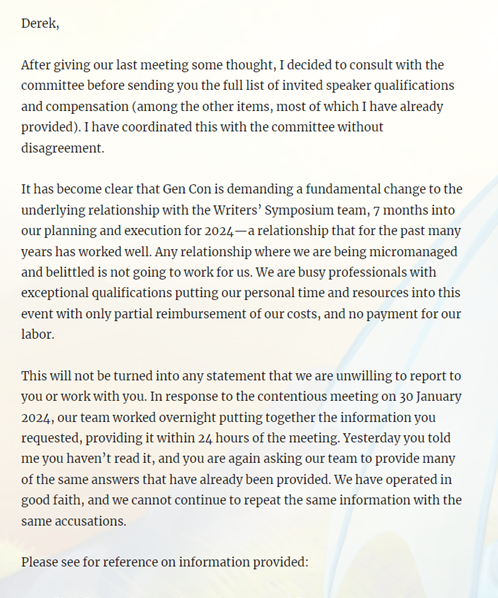
Note: I am not sure what the “fundamental change to the underlying relationship” between Gen Con and the Symposium is, but from context, it seems to be asserting that Gen Con seeking to have oversight (i.e. consultation and veto power) regarding featured guests is fundamentally unlike what we’ve done before.
Which, as noted in my above analysis, is not entirely off-base. GC has been fairly hands-off, so long as the Symposium has invited the guests they expect. When they invited Kendall, it was an unusual choice, and they wanted to step in and at least have a conversation, only to be told they didn’t have time.
There’s a lot of focus on Derek “not reading” the team’s report, and I’m not sure how much that obtains. As far as I understand Gen Con’s responsibility structure, Derek isn’t responsible for the Writers’ Symposium—Marian is. She brought him in specifically because there was a timely issue to be handled, and it seems reasonable that he would leave the review to her, not do it himself.
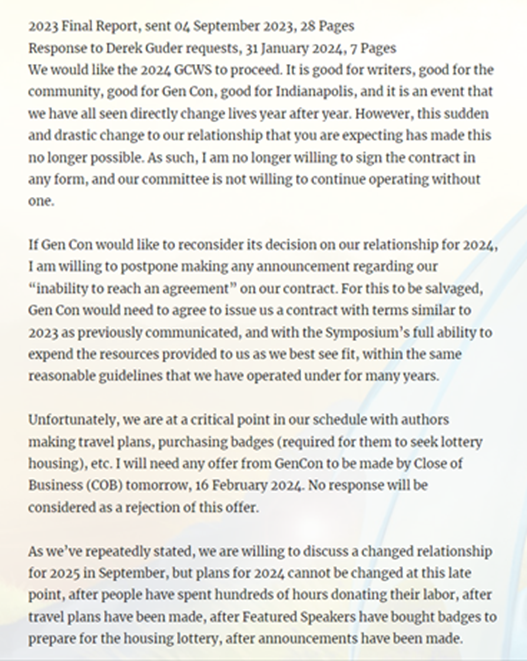
The letter is entirely correct that this was an 11th hour issue and travel plans were having to be made. Gen Con should have stepped in sooner, but it is unclear that Gen Con was even *aware* of the Symposium’s choice earlier. The letter points out, correctly, that it is basically too late to make changes, and Gen Con is stuck with the Symposium’s choices. Which they basically were.
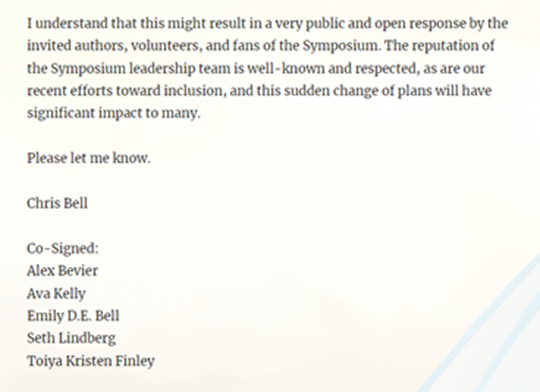
I don’t know about you, but that stuff about a “very public and open response” sounds like a threat to me, and they were right. If Gen Con *had* vetoed Kendall or Addison at the 11th hour, it would have been a PR and logistical disaster for all involved. The letter reiterates their commitment to inclusion, which implies (at least to me) that such a veto would be seen as a racial issue, rather than as a business decision for drawing an audience.
EDIT TO ADD: Note also that not every member of the leadership team signed this email. Some names are notably absent. So as not to invite harassment of those individuals, I will not be naming them. (Please do not harass anyone. Including Chris and Emily Bell.)
All in all, they are strong-arming Gen Con as best they could. Which… I’m not sure that’s the best strategy when dealing with your contracting entity? But I have to respect their determination in sticking to their principles.
But it put Gen Con in an awful position–accede to their demands or risk significant damage to the convention. So they carried on to get through 2024.
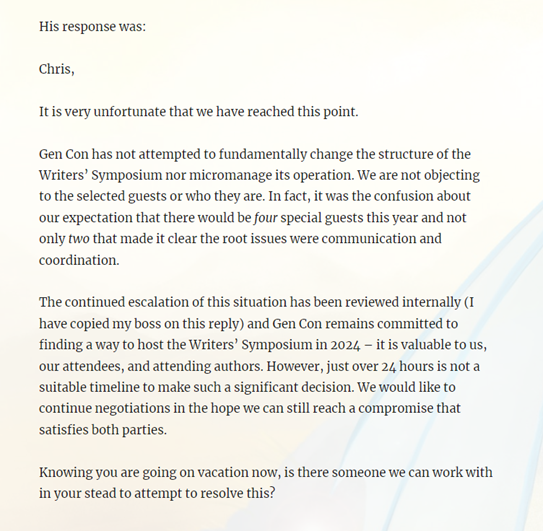
Note that Derek reiterates that his concerns are focused upon how many guests the leadership team invited, and about how the issues were communicated and coordinated.
At this point, per my interview with Derek, Gen Con accepted there was nothing to be done for 2024. It was too late to make any radical changes to the Symposium, the guest list, or any of it, and so they let it ride for 2024.
After a successful Symposium (the leadership team did an excellent job putting on the Con, and that should be noted), Gen Con informed them at their debrief meeting that they would not be working with the present leadership team again. What exactly was said at the end of the meeting, I am still researching, but as Emily frames it, they said something to the effect of “no one on the current committee will be invited back next year.”
EDIT: Chris gave me a quote, which is “none of you or your committee will be invited back to run this.” He didn’t specify who made the statement.
That could be interpreted as “none of you on the team can be on the leadership team next year” or “you can’t come back at all.” I do not know how Gen Con intended it, but I have interviewed Derek on the subject and he says they just don’t want to work with Chris and Emily Bell specifically.
What does this all mean?
So Gen Con does not want to work with the Bells again. They didn’t “disinvite” anyone–i.e. they didn’t ban anyone from attending the convention in the future, nor did they “dismiss” the Symposium as a whole. They just won’t work with the Bells again. When it comes to the other members of the leadership team, Gen Con is willing to talk with them to sort this out, whether or not they were signatories on the email. And yes, I have confirmed that with Derek. (EDITED for clarity.)
EDIT Mid December: Emily claims to have received communication that she and Chris are barred from attending Gen Con 2025 and (presumably) future Gen Cons. Per Emily, this is devastating, because they care deeply about the convention in general and the symposium in particular. I do believe her about this, because I know she has put a lot of work and passion into her participation in Gen Con. The Bells have my sympathies.
Let me reiterate: the other members of the leadership team, even those who signed the email noted above, are on the table to remain as leaders for the Symposium. Which is a very good thing, because the team has a lot of talent and promise. (Mid-December edit) Maurice Broaddus (WS institution and member of the leadership committee for 2024) has been tapped as the leader of the GCWS for 2025, and that’s fantastic.
Only the Bells are unable to be on the leadership team going forward. Derek has made that very clear.
This decision is, of course, entirely within their rights as the contracting agency. The Symposium is a contractor to Gen Con, and they (we) are entirely subject to their decisions. If they decide that they want to go a new direction with the Symposium, that’s fine—and it’s quite normal in the corporate world. But it sucks, and I know Emily poured a great deal of effort into her work on the Symposium, and it’s crushing to be removed from her position. In her place, I would be just as hurt and upset.
Financials
At this point, Chris has provided me an accounting of the funds raised by the anthology (which I’m told is pretty great, btw, pick up a copy if you can) and novel sales. I cannot corroborate these numbers directly, of course.
Atthis Arts (Chris and Emily Bell’s small press) footed the cost for a good deal of the anthology and novel sales, as GenCon has no on-site bookseller (and has not in several years). I will share the numbers, because I think it’s useful to understand the scope.
According to Chris, Atthis Arts lost thousands of dollars at GenCon 2024:
- This year, Atthis Arts spent $496 on hand-held square terminals, receipt paper, and cases — so that volunteers wouldn’t need to use their personal cell phones. These are not items Atthis Arts need for their normal business, this was specific for the Writers’ Symposium.
- Atthis Arts collected $1066 in gross credit card sales, which after transaction fees, resulted in a net income to Atthis Arts of $181 (the 20% they collected for the service).
- All in all, Chris states that Atthis Arts spent over $300 providing this service. This was paid out of pocket by Atthis Arts, not the Symposium.
I am not a forensic accountant–I hate finances–but to me, this reads as:
Atthis Arts spent $496 on equipment to facilitate sales (bullet 1), sold $1066 worth of books and collected a profit of $181 (the 20% fee they collected for the service) while the remaining $885 went to the authors whose books were purchased (bullet 2). Leaving some $315 (over $300, so that checks out) they still spent on equipment… which Chris writes off as a loss.
Surely the Symposium can reuse at least some of that equipment? It seems very reasonable to me that the Symposium could purchase those square terminals and cases for future use, but maybe I’m missing something.
Next up is the anthology, which Chris claims Atthis Arts lost “over $2000” on the anthology, due in part to paying “pro-qualifying rates” to authors. He didn’t tell me exactly what this rate was, but I do concur with his assessment that paying authors fairly is very important to do. In return, he anticipates Atthis Arts earning a net $400 on USB drive sales (i.e. the anthology). So that’s a $1600+ loss.
He also stated Atthis Arts directly assisted Symposium members with attendance costs to the tune of $1100. He states that “over $3000” was spent doing this in 2024, which presumably includes some percentage of Gen Con’s funding and, presumably, other funds raised from Sponsors and/or Donors. How much came in from these sources, I do not know.
I can’t corroborate these numbers, not having access to Atthis Art’s financials (as I shouldn’t), so I’ll take Chris’s word for it.
Legal Implications
EDIT: I mostly removed the legal implications section, as it’s mostly my own speculation and unproven allegations from other sources, which don’t help anyone. I have left the example of one of Emily’s posts attempting to raise money for her Worldcon trip. Eventually, she would attend, where she apparently hosted a panel about being kicked out of multiple conventions (more about that in the comments of this blog post).
Also the note about defamation. I have endeavored to make my report as accurate as possible with all the information I can find.
This author did not personally attend Gen Con 2024 (COVID round 4, blech), but I can attest to frequent solicitations on the discord for donations for Worldcon, which sometimes took on a guilting sort of tone? Like we owed Emily for her efforts? Obviously people can and should use their funds as they see fit, but soliciting donations in such terms seemed off to me. And I don’t think I’m alone in feeling that way.
Here’s an example:
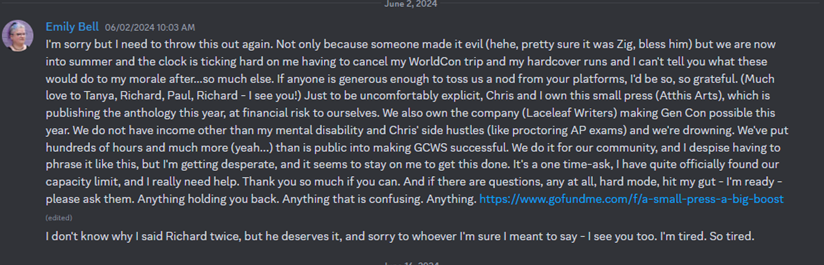
I’ll leave that to your own interpretation.
I am personally concerned that Emily has defamed Derek Guder specifically and Gen Con in general with her accusations on her blog. It is her own choice, of course, but she risks tarnishing the Symposium by association with her accusations. It is my belief, based on my research, that the facts do not support Emily’s accusations, and she is potentially opening herself up to liability.
If we were still on speaking terms, I would encourage her directly to apply caution to what she says in public.
In Conclusion
Throughout this process, I have sought to keep an open mind. The information I have received from both sides is contradictory, with either side presenting the facts to suit their own interests. Anyone involved in the Gen Con Writers’ Symposium Discord can attest that it has not been easy, and has frequently been extremely messy. Which is to be expected when something like this happens.
I do not believe that any party is guiltless here. The issue was primarily miscommunication and growing frustration on all sides.
It should be noted that on the private Writers’ Symposium discord, Emily Bell doesn’t want any of us to question any of this. She wants us to support her, no questions asked, and the slightest bit of pushback is met with insults, guilt-tripping, and harassment. She has personally cursed at me, told me to “go to hell” and justified it as “I’m just telling him to go home,” and implied that my pursuit of the facts to be “licking” and/or “admiring” Derek’s genitals. (But hey, what’s a little bit of homophobia among colleagues?)
Most telling, however, is her continued assistance that if one does not IMMEDIATELY support and stand by her side, then you are against inclusion, against BIPOC and marginalized people, and generally speaking, evil. Which is patently absurd.
No one person is the avatar of inclusivity or the *only* white person to be doing the work. To claim otherwise is to appropriate social justice language to deflect from one’s own questionable actions. That’s some white savior BS.
As far as I can tell, Emily is using her self-asserted image as a “voice of inclusion” to shield herself from criticism, deflecting concerns regarding her unprofessional and frankly unacceptable behavior.
Per my research, Gen Con’s decision had nothing to do with racism, and neither did Origins, or ConFusion, who have also (allegedly) cut ties with the Bells under similar circumstances. The Cons in question DO support diversity, equity, and inclusion efforts. As far as I know, their decisions are based on her actions as a leader: poor communication, acting unilaterally, and not consulting them.
Let me reiterate: Per my research, Gen Con is parting ways with the Bells because of their at-best difficult and questionable leadership decisions, such as not allowing Gen Con to have veto power or even a discussion before invitations for featured speakers were sent. Derek makes it very clear their objection was how they used the money, not anyone’s race or anyone’s politics.
This is not to exculpate Gen Con in all this. If Emily’s account of the contentious meeting where Derek rebuked them is to be believed (and I do believe her at least somewhat), that sounds terrible and overly harsh. I don’t know, I wasn’t there, it’s hard to read tone from dry text. Could they have been kinder and more accommodating of Emily? Absolutely. And I hope this is a learning experience for all involved.
I am concerned about Emily using the specter of racism to turn this into a self-promotion opportunity. I mean, if you don’t believe me, apparently she did a panel at Worldcon about how she got “kicked out of three literary conventions because of racism”? And now she seems determined to cause as much damage to the Symposium as she can on the way out.
A sad day, indeed.
Conclusion to the Conclusion.
I don’t have all the facts. My research is ongoing. But that’s exactly my point:
Take what Emily claims with a grain of salt.
Look into this.
Good luck.










 Worldswalker