Abstract
Recent observations of fast radio bursts (FRBs) indicate a perplexing, inconsistent picture. We propose a unified scenario to interpret diverse FRBs observed. A regular pulsar, otherwise unnoticeable at a cosmological distance, may produce a bright FRB if its magnetosphere is suddenly “combed” by a nearby, strong plasma stream toward the anti-stream direction. If the Earth is to the night side of the stream, the combed magnetic sheath would sweep across the direction of Earth and make a detectable FRB. The stream could be an AGN flare, a GRB or supernova blastwave, a tidal disruption event, or even a stellar flare. Since it is the energy flux received by the pulsar rather than the luminosity of the stream origin that defines the properties of the FRB, this model predicts a variety of counterparts of FRBs, including a possible connection between FRB 150418 and an AGN flare, a possible connection between FRB 131104 and a weak GRB, a steady radio nebula associated with the repeating FRB 121102, and probably no bright counterparts for some FRBs.
1. Introduction
The origin of fast radio bursts (FRBs) remains a mystery after one decade of observations (Lorimer et al. 2007; Thornton et al. 2013; Petroff et al. 2015a; Champion et al. 2016; Masui et al. 2015; Keane et al. 2016; Spitler et al. 2016; DeLaunay et al. 2016; Chatterjee et al. 2017). The distance scale of FRBs is finally settled to the cosmological range (∼Gpc) thanks to multi-wavelength follow-up observations that nail down the host galaxy of the repeating source that produced FRB 121102 (Chatterjee et al. 2017; Marcote et al. 2017; Tendulkar et al. 2017).
The collected data for FRBs so far are however perplexing and inconsistent. (1) Whereas the source of FRB 121102 clearly repeats (Spitler et al. 2016; Scholz et al. 2016), other FRBs so far have not been observed to repeat, despite dedicated follow-up observations for some of them (Petroff et al. 2015b). (2) In the error circle of FRB 150418, a bright fading radio source was discovered in a galaxy at redshift z = 0.492, which was claimed as the afterglow of the FRB (Keane et al. 2016; Zhang 2016b). However, the radio source re-brightened later, leading to the suggestion that the radio source is a coincident background AGN not associated with the FRB (Williams & Berger 2016). However, the chance probability to have such a highly variable AGN in the field of view of the FRB and to have a bright flare follow the FRB is low (Li & Zhang 2016; Johnston et al. 2017). (3) DeLaunay et al. (2016) discovered a sub-threshold long GRB that was spatially and temporally associated with FRB 131104 (Ravi et al. 2015). (4) The repeating bursts from the FRB 121102 source are not associated with bright transient counterparts in other wavelengths, but the repeater is rather associated with a steady bright radio source (Chatterjee et al. 2017; Marcote et al. 2017; Tendulkar et al. 2017).
Many FRB models have been proposed so far. However, no model can explain all the above observational facts. The catastrophic models (e.g., Totani 2013; Kashiyama et al. 2013; Falcke & Rezzolla 2014; Zhang 2014, 2016a; Wang et al. 2016) cannot interpret the repeating FRB 121102. The previously favored super-giant-pulse model (in analogy to nanoshots from the Crab pulsar; Cordes & Wasserman 2016; Connor et al. 2016) invokes nearby galaxy not at the cosmological distances and therefore are challenged by the fact that the repeater is located in a host galaxy at redshift z = 0.193 (Tendulkar et al. 2017; but see Katz 2016a, 2016b). The magnetar giant flare model (Popov & Postnov 2010; Kulkarni et al. 2014; Katz 2016c) is in apparent conflict with the non-detection of bright radio pulse from the SGR 1806-20 giant flare (Tendulkar et al. 2016). Other repeating models (e.g., Dai et al. 2016b; Gu et al. 2016) invoke specific physical conditions. These models also cannot account for the apparent association of FRB 131104 with the gamma-ray transient Swift J0644.5-5111 (DeLaunay et al. 2016). Models invoking more energetic magnetars as the source of FRBs have been proposed (Zhang 2014; Murase et al. 2016; Piro 2016; Murase et al. 2017; Gao & Zhang 2017; Dai et al. 2016a; Metzger et al. 2017). However, in order to account for both the repeater and the putative association of a GRB for FRB 131104 (DeLaunay et al. 2016), both catastrophic and repeating mechanisms are needed.
Here, we propose an alternative mechanism to produce FRBs, which may give a unified interpretation of all FRBs observed so far. This model invokes an interaction between an astrophysical plasma stream and a foreground regular pulsar. The pulsar is otherwise non-detectable at the cosmological distance, but may produce an FRB as observed by an Earth observer when the plasma stream with significant ram pressure combs the magnetosphere toward the anti-stream direction and sweeps the direction of Earth.
2. The Model
The condition for a cosmic comb is that the ram pressure of the stream is greater than the magnetic pressure of the pulsar magnetosphere. For a most general expression, we write the ram pressure in the relativistic form. The energy-momentum tensor of a perfect fluid is given by  , where
  is the metric tensor, uμ = γ(1, βx, βy, βz) is the dimensionless 4-velocity; (βx, βy, βz) is the dimensionless 3-velocity vector with amplitude β = v/c;
  is the Lorentz factor; ρ, e, and
  are the mass density, internal energy density, and pressure of the fluid, respectively;
  is the adiabatic index; and c is speed of light. For a fluid with co-moving mass density ρ0, internal energy density e, and pressure p, the lab-frame energy density is
 . Subtracting the rest mass energy density one can obtain the ram pressure. The condition for a cosmic comb then reads

For a non-relativistic (γ2 − 1 ≃ β2), cold (e ≃ 0) flow, this is reduced to the familiar form of

The magnetosphere of a pulsar is enclosed within the light cylinder with radius RLC = c/Ω = cP/2π ∼ (4.8 × 109 cm) P, where Ω and P are the angular frequency and period of the pulsar, respectively. The magnetosphere of a pulsar is significantly modified if the ram pressure exceeds the magnetic pressure at the light cylinder, BLC ∼ Bs(RLC/R)−3, where R ∼ 106 cm is the radius of the neutron star, and a dipolar magnetic configuration has been assumed. The right-hand side of Equations (1) and (2) is therefore

where the median values of surface magnetic field  and period P = 1 s for Galactic radio pulsars have been adopted (throughout the Letter, the convention Q = 10nQn is adopted in cgs units). Noticing the strong dependence on Bs and especially on P, one can conclude that cosmic combs more easily happen in slow and low-field pulsars.
For a relativistic blastwave such as a GRB afterglow or a relativistic AGN flare, since  and
and  due to relativistic shock heating, the left-hand side of Equation (1) can be simplified as

for a nominal value γ = 10 and nISM = 1 cm−3, where e = (γ − 1)nISMmpc2. For a non-relativistic outflow such as a supernova explosion, a quasi-isotropic compact star merger ejecta, or a quasi-isotropic tidal disruption ejecta, the left-hand side of Equation (2) can be expressed as

for an impulsive explosion (where  is the ejecta mass, Δ is the thickness of the shell, r is the distance from the center of explosion, and v is the speed of the ejecta), or

for a continuous wind (where  is the wind mass-loss rate). One can see that cosmic comb condition can be satisfied for a variety of systems if the pulsar is close enough to the source. For typical parameters, the “horizon” of a cosmic comb is of the order of 0.1 pc. However, noticing the sensitive dependence of magnetic pressure on P and B, the horizon can easily reach ∼pc for slower and weaker-field pulsars.
If the cosmic comb condition is satisfied, when the plasma stream suddenly arrives, the pulsar magnetosphere is combed toward the anti-stream direction in a duration of  , where Rsh ∼ RLC is the distance of the sheath from the pulsar (Figure 1, in analogy with the Earth magnetosphere). The strong ram pressure of the stream may trigger magnetic reconnections, which would quickly accelerate particles to relativistic speeds within a timescale much shorter than the combing timescale. The relativistic particles move along the magnetic field lines and flow out from the sheath to produce coherent radio emission. During the combing process, the sheath very quickly sweeps a near-2π hemisphere solid angle. If the electrons (or electron–positron pairs) in the sheath move with a Lorentz factor γe, then the emission beam angle of the sheath would be 1/γe, which is usually much smaller than the physical opening angle of the sheath. If the distance range over which emission into the characteristic radio band of the telescope (e.g., GHz range) is small, an observer at a random direction in the “night” side of the hemisphere would detect the signal in a duration

This is consistent with the millisecond durations of the observed FRBs if γe ≳ 103 is satisfied.
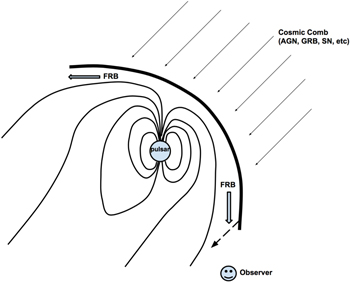
Figure 1. Cartoon picture of a cosmic comb. An FRB is produced in the sheath region, which sweeps the line of sight during a short period of time defined by Equation (7).
Download figure:
Standard image High-resolution imageThe coherent radio emission mechanism is not specified. One interesting estimate is that with the nominal parameters, the curvature radiation frequency is

which falls into the range of FRB detection frequency (the curvature radius ρ ∼ Rsh has been assumed). If the combing process may allow particles to emit in phase (the antenna mechanism), bright coherent radio emission can be generated. Alternatively, a cyclotron instability mechanism, as was proposed to interpret pulsar radio emission (Kazbegi et al. 1991), may operate near the light cylinder region to power the FRB. A sheath-origin coherent emission has been introduced to interpret radio emission of Pulsar B in the double pulsar system (Lyutikov 2004). Here, we assume that the combing process can produce bright coherent radio emission detectable from cosmological distances, and encourage a full investigation of the coherent mechanism of such a process in detail.
3. Case Studies
This model can explain the puzzling properties of several FRBs in a unified way:
FRB 150418: Keane et al. (2016) discovered a bright radio source starting from 2 hours after the FRB. The source dimmed in the next two observational epochs at 6 and 8 days after the FRB, respectively, and reached a quiescent level with a steady flux. Williams & Berger (2016) discovered that the source re-brightened to the level of the original detection flux more than 300 days later, suggesting that the radio source is an AGN rather than the afterglow of the FRB. Long-term monitoring of the source (Johnston et al. 2017) suggested that the source is usually not in the high state. A Monte Carlo simulation suggests that the random probability of having the FRB occur almost during the peak flux time of the AGN activity is very low, i.e.,  (Li & Zhang 2016). Instead of attributing the AGN flare to an independent event from the FRB, we interpret FRB 150418 as emission from a combed pulsar by the AGN flare.1
A prediction is that FRB 150418 may repeat during another bright flare from the same AGN. However, not all flares may trigger additional FRBs from the same pulsar. This is because at the close distance (<0.1 pc) from the supermassive black hole, the pulsar must be undergoing orbital motion, so that there are occasions when the geometry does not work for the cosmic comb signal to be detectable from Earth. Within this picture, the galaxy at z = 0.492 is indeed associated with FRB 150418, as is supported by the measured DM of the FRB (Keane et al. 2016).
(Li & Zhang 2016). Instead of attributing the AGN flare to an independent event from the FRB, we interpret FRB 150418 as emission from a combed pulsar by the AGN flare.1
A prediction is that FRB 150418 may repeat during another bright flare from the same AGN. However, not all flares may trigger additional FRBs from the same pulsar. This is because at the close distance (<0.1 pc) from the supermassive black hole, the pulsar must be undergoing orbital motion, so that there are occasions when the geometry does not work for the cosmic comb signal to be detectable from Earth. Within this picture, the galaxy at z = 0.492 is indeed associated with FRB 150418, as is supported by the measured DM of the FRB (Keane et al. 2016).
FRB 131104: DeLaunay et al. (2016) discovered a sub-threshold, putative GRB that coincides with FRB 131104 both in spatial position and in time. A radio afterglow was not detected (Shannon & Ravi 2016), but the non-detection is consistent with the afterglow model if the ambient density is low (as expected from the neutron star–neutron star (NS–NS) or neutron star–black hole (NS–BH) merger models) or the shock microphysics parameters are low (Murase et al. 2017; Gao & Zhang 2017; Dai et al. 2016a). The possible mechanisms that might produce an FRB associated with a GRB include collapse of a supramassive millisecond magnetar to a black hole (Zhang 2014), which requires that the FRB appears near the end of an extended X-ray plateau, or pre-merger electromagnetic processes (Zhang 2016a, 2016b; Wang et al. 2016), which require that the FRB leads the burst. The latter scenario may be argued to marginally match the data (Dai et al. 2016a; Gao & Zhang 2017). However, there might be γ-ray emission already 7 s before the FRB according to the data. Furthermore, the Swift BAT was not pointing toward the source direction before −7 s with respect to the FRB (DeLaunay et al. 2016). So it is likely that the FRB occurred during the process of a long-duration GRB. If so, known models are difficult to interpret the FRB. In the cosmic comb model, one requires that a pulsar is located at a distance  away from the central engine in the direction of the jet (or at a closer distance if the line of sight is mis-aligned from the pulsar-engine direction). Considering a possible star-forming region for a long GRB or a possible globular cluster for an NS–NS or NS–BH merger event, the chance probability to have a foreground pulsar from the GRB may not be small.
The repeater (FRB 121102): The repeater is located in a star-forming dwarf galaxy at z = 0.193 (Tendulkar et al. 2017). The source is associated with a radio source (Marcote et al. 2017), which is offset from the center of the galaxy (Tendulkar et al. 2017). A plausible scenario might be that the source of the FRB, likely a rapidly spinning magnetar, is at the center of the radio source and pumping energy to power a nebula (e.g., Yang et al. 2016; Murase et al. 2016; Piro 2016; Metzger et al. 2017). However, this model predicts an observable evolution of DM over the year timescale (Piro 2016; Metzger et al. 2017; Yang et al. 2017), which is marginally inconsistent with the non-detection of DM evolution of the repeating FRBs. Within the cosmic comb scenario proposed in this Letter, the repeating bursts may originate from a foreground pulsar being episodically combed by an unsteady flow from a young supernova remnant. If the condition (1) is marginally satisfied, the pulsar may relax to its normal magnetospheric configuration after a particular combing, but may be combed again and again when clumps with a higher ram pressure reach the pulsar magnetosphere region repeatedly. The pulsar is therefore observed to emit FRBs repeatedly. For a remnant with a finite width Δ and speed v, the repeating phase may last for  . Since the repeater has been observed to repeat in a multi-year timescale, the remnant may be continuously energized by a central engine, likely a rapidly rotating neutron star. Since the FRB source is a foreground pulsar from the central source, the DM evolution could be much weaker depending on the geometry, consistent with the data. There is no direct observational evidence of ram pressure variation within a supernova remnant. However, for a nebular powered by continuous energy injection from a central engine (which is not the source of FRBs in the cosmic comb model), variation of ram pressure of the stream is expected. For a marginally satisfied comb condition envisaged here, a variation of ram pressure by a factor of a few would suffice to make a repeating FRB source as observed.
Other FRBs: No counterparts have been claimed for other FRBs. Within the cosmic comb model, the ram pressure of the plasma stream essentially depends on the energy flux of the stream source. For example, a flare from a companion star (similar to a corona mass ejection event of the Sun) may provide a comparable ram pressure to a pulsar as the blastwave of a more distant GRB or supernova. As a result, one does not necessarily expect that all FRBs are associated with bright counterparts. It is possible that a fraction of FRBs may be associated with GRBs, supernovae, AGN flares, or tidal disruption events, while other FRBs may be combed by a stellar flare of a companion star so that no bright counterpart is detectable.
4. Discussion
We have proposed a scenario of FRBs that may interpret the perplexing, inconsistent FRB phenomenology within a unified framework. The magnetosphere of a slow, low-field pulsar may be combed by a cosmic plasma stream toward the direction of the Earth to make an FRB. The stream may originate from an explosion (a supernova, a GRB, or a neutron star merger event), an AGN flare, a tidal disruption event, or even a stellar flare from a binary companion of the pulsar.
The event rate density of FRBs is estimated as  , where
  is the number of FRBs per day all sky with the current telescope sensitivity, and the typical value Dz is scaled to z = 1 (Zhang 2016a). The cosmic comb model can easily account for such a large event rate density. This is because many explosions (e.g., supernovae and GRBs) and flares (from AGNs or companion stars) can potentially make FRBs if there are one or more pulsars in the vicinity of each plasma stream. In fact, the total event rate density of all the relevant explosions and flares exceed by orders of magnitude than the inferred FRB event rate density. A correct FRB event rate density may be obtained if the probability of having a slow, weak field pulsar in the vicinity is not negligibly small. In star-forming regions (where GRBs and supernovae occur), globular clusters (where compact star mergers occur), and galactic center regions (where AGN flares occur), the stellar density can be as high as 100–1000 pc−3 (Genzel & Stutzki 1989; Harris 1991; Genzel et al. 2010). Since one old pulsar within ∼(0.1–several) pc from an explosion source or AGN would give a 50% probability to make a cosmic comb toward Earth (as long as Earth is in the night-side hemisphere of the stream), one would expect a good fraction of explosions/AGN flares to trigger cosmic combs. Adding binary systems composed of an old pulsar and a flaring companion, the event rate would be even higher.2
More detailed Monte Carlo simulations are needed to better estimate the event rate density of cosmic combs.
is the number of FRBs per day all sky with the current telescope sensitivity, and the typical value Dz is scaled to z = 1 (Zhang 2016a). The cosmic comb model can easily account for such a large event rate density. This is because many explosions (e.g., supernovae and GRBs) and flares (from AGNs or companion stars) can potentially make FRBs if there are one or more pulsars in the vicinity of each plasma stream. In fact, the total event rate density of all the relevant explosions and flares exceed by orders of magnitude than the inferred FRB event rate density. A correct FRB event rate density may be obtained if the probability of having a slow, weak field pulsar in the vicinity is not negligibly small. In star-forming regions (where GRBs and supernovae occur), globular clusters (where compact star mergers occur), and galactic center regions (where AGN flares occur), the stellar density can be as high as 100–1000 pc−3 (Genzel & Stutzki 1989; Harris 1991; Genzel et al. 2010). Since one old pulsar within ∼(0.1–several) pc from an explosion source or AGN would give a 50% probability to make a cosmic comb toward Earth (as long as Earth is in the night-side hemisphere of the stream), one would expect a good fraction of explosions/AGN flares to trigger cosmic combs. Adding binary systems composed of an old pulsar and a flaring companion, the event rate would be even higher.2
More detailed Monte Carlo simulations are needed to better estimate the event rate density of cosmic combs.
Support for the cosmic comb model proposed in this Letter may be obtained by a list of observational tests, e.g., a detection of repeating bursts from FRB 150418 and the localization of the bursting source to the spatially coincident AGN; more detections of FRBs associated with GRBs and afterglows; detections of FRBs that are associated with supernovae, tidal disruption events, and other cosmological transients.
On the other hand, it is entirely possible that multiple mechanisms are at play to make FRBs. Some other models have specific predictions that can be tested by future observations. For example, if future localizations of FRBs all reveal associations with bright radio nebulae, it would suggest a newborn millisecond magnetar as the source of FRBs (e.g., Murase et al. 2016; Metzger et al. 2017), an FRB coincident with a gravitational-wave (GW) signal due to an NS–NS, NS–BH, or black hole–black hole merger would suggest a direct connection between the FRB and the merger (Totani 2013; Zhang 2016a; Wang et al. 2016)3; and an FRB coincident with the disappearance of an extended plateau emission would suggest the ejection of a magnetosphere during the collapse of a supramassive neutron star (“blitzar”) as the mechanism of FRBs (Zhang 2014; Falcke & Rezzolla 2014).
I thank Sarah Burk-Spolaor, Zi-Gao Dai, Yuan-Pei Yang, and an anonymous referee for helpful comments. This work is partially supported by NASA NNX15AK85G and NNX14AF85G.
Footnotes
- 1
- 2
Within this picture, one may expect some of the Galactic binary systems would make FRBs. However, the event rate would be extremely low, i.e., at most ∼1 per century based on the observed FRB rate.
- 3
The charged BH merger model proposed by Zhang (2016a) applies to all three types of mergers, since NSs are naturally charged; the mechanism of Wang et al. (2016) applies to mergers with at least one NS member; and the mechanism of Totani (2013) applies to NS–NS mergers only. For NS–NS and NS–BH mergers, an FRB can be observed only in a small solid angle where FRB emission is not blocked by the dynamical ejecta launched during the merger process.