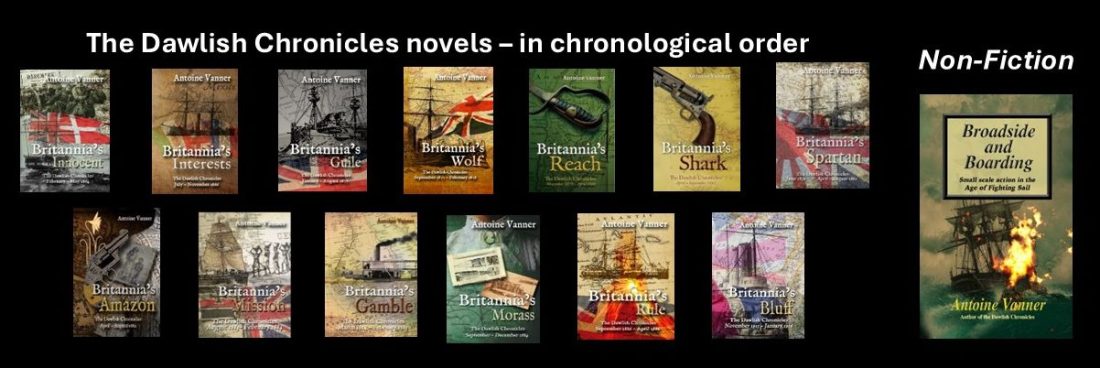
The disaster that overcame the first-rate ship of the line HMS Royal George in 1782, while anchored in calm water in sight of shore, was to have as strong an impact on the contemporary public mind as the loss of the RMS Titanic was to have one hundred and thirty years later. The tragedy was all the more terrible for the fact that it would have been avoidable if the simplest of precautions had been taken – and without them over 900 men and women were to die.
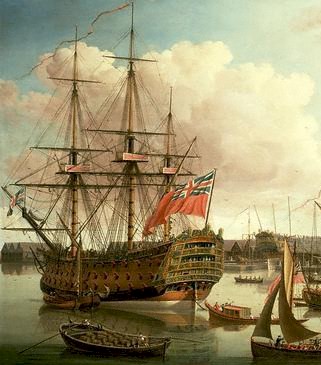

The First Relief of Gibralta, 1780 – painting by Dominic Serres (1722–1793)
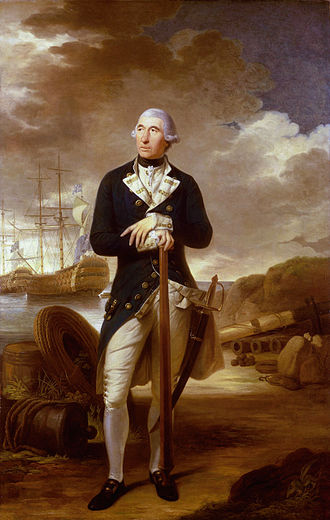
Though the exact number could never be confirmed it was estimated that up to 1200 people were on board, including some 300 women and 60 children. Many were undoubtedly family members taking leave of their menfolk but contemporary accounts also refer – delicately – to ladies “who, though seeking neither husbands or fathers, yet visit our newly arrived ships of war”. A number of traders and pedlars also appear to have been present. One suspects that the scene below decks was a bizarre mix of the domestic, the poignant and the debauched, brief moments of happiness, sadness and orgiastic pleasure snatched in brief hard lives.
In mid-morning a slight breeze began to ruffle the water and it lapped occasionally over the port-sills on the port side. This appeared to drive up mice from the lower part of the ship and they began to be hunted as a game. The wind was freshening further and yet more water began to spill in, but nobody had yet perceived the situation as dangerous. A 50-ton sloop, HMS Lark, had come alongside with supplies of rum and she was secured to the port side to allow transfer of kegs.

HMS Royal George starts her fatal roll (Victorian-era illustration)
It was the carpenter who first awoke to the hazard and he went to the nineteen-year old lieutenant of the watch, Philip Charles Durham (1763-1845), to request an order to right the ship. He was ignored at first attempt but at the second Durham told him “If you can manage the ship better than I can, you had better take the command.” Only when the ship heeled lurched further did the lieutenant order the drummer to beat to “right ship”. It was too late – a gust of wind heeled her still further and many of the starboard guns appear to have broken loose and rolled to port. Water was now pouring in through every gunport. The huge ship rolled on her side until her masts lay flat on the water, the mainmast bearing down on the sloop Lark alongside. HMS Royal George now sank like a stone, taking the sloop with her.
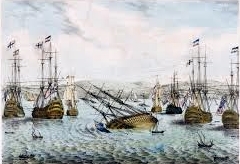
Contemporary view – HMS Royal George sinks close to the rest of the fleet
Admiral Kempenfelt was being shaved in his quarters as the ship rolled but the movement jammed the doors and he could not be got out. Hundreds of others were equally unlucky and the majority of 255 saved were already on deck. These were to save themselves by running up the rigging, while only about 70 were able to scramble out from below through the gunports. The presence of so many other ships in the anchorage meant that rescue boats were quickly on the scene but this was little help for the wretches trapped below deck.

The scramble through the open gunports (Victorian-era illustration)
One survivor, named Ingram, managed to get out through a port and looking back saw the opening “as full of heads as it could cram, all trying to get out.” He went on “I caught hold of the best bower anchor, which was just above me, to prevent falling back into the porthole and, seizing hold of a woman who was trying to get out of the same porthole I dragged her out.” He was sucked down with the vessel but rose clear to the surface and swam to a block floating near. Using this to support him he saw the Admiral’s baker in the shrouds of the mizzen-topmast, which was just above water, and behind him, still floating, the woman he had pulled free. With the baker’s help he managed to catch her and secure her to the rigging. A rescue boat took her to HMS Victory – Nelson’s future flagship – and she appears to have survived. Another survivor was a child who was playing on deck with a sheep as the vessel rolled and as he spilled into the water he managed to keep hold of the animal’s fleece. It swam about, supporting him, until a boat reached them. The Royal George’s captain was another survivor, but the carpenter drowned.
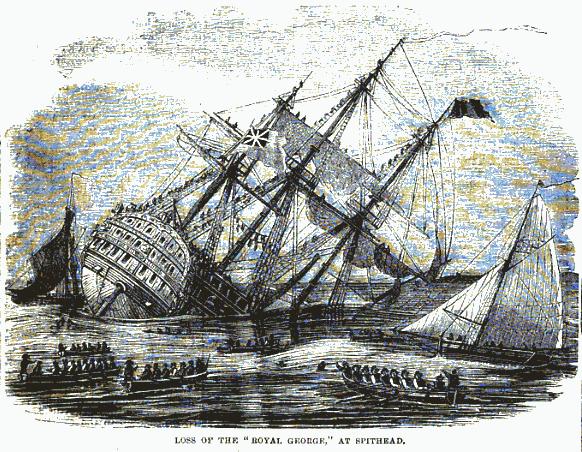
The final roll – note the figures in the rigging
(incorrect depiction – HMS Royal George rolled to port!)
The final death-toll was estimated to be over 900, including all but a few of the women and children. A few days after the ship sank bodies started to come up. It is a sad commentary on human nature that many of the watermen who made their living by ferrying families and traders to and from the ships stripped the bodies of buckles, money and watches. One witness wrote of these bodies “towed into Portsmouth harbour in their mutilated condition, in the same manner as rafts of floating timber, and promiscuously (for particularity was scarcely possible) put them into carts, which conveyed them to their final sleeping place in an excavation prepared for them in Kingston churchyard”.
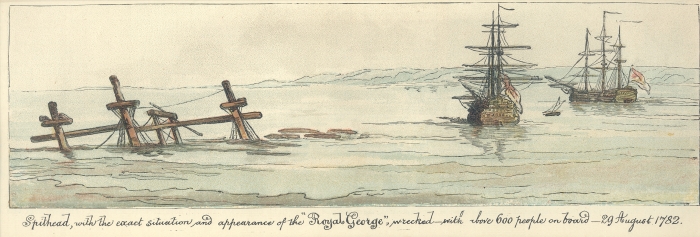
HMS Royal George’s mast-tops after sinking
HMS Royal George had sunk in relatively shallow water and she righted herself of her own accord, so that the tops of her masts were still visible seventeen years later. All attempts to salvage her failed until the 1840s, when the wreck was blown apart with gunpowder charges and advances in diving equipment allowed recovery of guns and equipment. Her surviving timbers were raised, much of the wood being sold as relics.

It’s November 1915: The Great War rages. Britain has failed to break through the Dardanelles Strait to open a supply route to its Russian allies.
Over 80,000 allied troops are trapped in tiny footholds on the rocky Gallipoli peninsula. Weakened by disease and exposure, they are dominated by Turkish artillery and entrenchments on higher ground. Repeated attempts to advance have resulted in mounting casualties. Now, with winter looming, victory is unachievable. But evacuation from the landing beaches could bring yet worse tragedy . . .
Admiral Sir Nicholas Dawlish, sees one chance – a colossal bluff – to reduce the risks of evacuation. He plans a lightning diversionary campaign at sea, on land and by air.
But will it be in time to help prevent a final bloodbath at Gallipoli?
Purchase Links below.
Australia & New Zealand Click here.