[go: up one dir, main page]

Month: August 2017
  • Frank Zappa, Art, and The Frame

    I was talking with a friend about Frank Zappa’s view of Art, and started listening to his band, The Mothers of Invention. I’d heard them before, but just little snippets of songs. Today, I listened straight through the first two albums in a kind of wondrous, outraged, joyful daze.

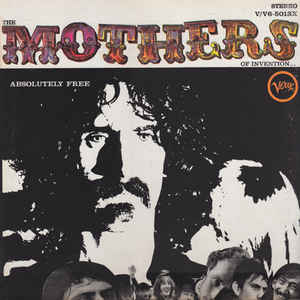
    It’s totally weird. Stream of consciousness. Avant garde. Totally free self-expression. The first track in Freak Out! has a kazoo solo. In fact, I think all the tracks in Freak Out! have kazoo… I’ve never heard anything like this stuff.

    A while back, I read a short essay by Zappa. In it, he loosens the definition of Art as anything with a frame around it.

    The most important thing in art is The Frame. For painting: literally; for other arts: figuratively– because, without this humble appliance, you can’t know where The Art stops and The Real World begins. You have to put a “box” around it because otherwise, what is that s*** on the wall?

    For example, he writes, the sound of a man swallowing juice is nothing. But if you record that sound and call it Art, then it has significance. We start to ask questions: What about this is art? What could this sound represent? How does it make me feel? And that’s what makes it art. That we think about it and find meaning based on it.

    Frank Zappa put out over 60 albums in his lifetime, and I think this view of Art had something to do with that incredible amount of work. Whether or not you like them or love them or hate them, they exist. His vision exploded into the world and remains even after he’s gone. No matter how humble we pretend to be, all of us have these pearly dreams of being remembered after we die, of our work surviving us. That kind of immortality.

    Here’s the problem. We don’t let our work out. I think it’s fair to say that Zappa didn’t worry too much about whether a track was perfectly recorded. The imperfections were just as much a part of the Art as the parts that sound more like what is typically called music.

    At first I assumed that these were sort of first drafts of songs. Most of them sound very raw. Then The Mothers would sing in perfect four-part harmony. The parts that sound “bad” (whatever that means) were intentional. Planned. Just because something sounds like stream of consciousness doesn’t mean it popped out of someone’s brain that way.

    Then again, I often fear we take ourselves too seriously. We think of our work as The Next Great Novel instead of the sound of a guy swallowing juice. If that’s the Art we can offer the world, the kind of sound effect that makes some Art-viewers uncomfortable, some Art-critics quit their jobs, the kind that’s controversial, the kind that might be considered “lesser” (whatever that means) by the general public, then we should offer it. 

    Put a frame around it.

    I’m not necessarily advocating for all of us to become the kind of person Zappa was, believe in what he believed in, or do the things he did. What I will say is, he got me to write a blog post I had given up on, in one sitting, with a pretty liberated feeling. His attitudes (and his music) take me outside The Box, The Status Quo. I’m thinking about how to write with his mentality, without self-doubt, without so much self-editing and -criticism. If he doesn’t do that for you, cool. Groovy. Whatever. I’m sure he wouldn’t care.

    But when you stumble across other artists and work that pushes you into new territory, go there. Explore. Listen to people playing kazoos, bobby pins, and tweezers. Respect their Frame. Do your Art.


  • the in-between

    I’ve been thinking a lot about the concept of liminal space. The English word liminal comes from the Latin word limen which means threshold. It is the in-between. Something has ended and the next thing hasn’t started. You have left the security of what has been known, but haven’t yet entered into a new understanding. You’ve left the oasis but haven’t crossed the desert. The ship has sailed, but isn’t to the next port. You’ve left one job and haven’t gotten another.

    Liminal spaces occur in every context, and they are uncomfortable.

    In the writing life, liminal space is no less (and perhaps more) inevitable. Between projects, one short story is completed, and the new page is still blank. Between chapters, paragraphs, sentences, words.They feel like desolation, emptiness, and a total lack of inspiration.

    …incidentally, I don’t believe in the need to feel i/Inspiration to get work done. The inspiration I have experienced is too fickle. You could make a case that there’s an inverse relationship between i/Inspiration and liminal space, but given how infrequently i/Inspiration comes knocking, this is probably a more depressing than useful hypothesis…

    There’s no time limit or expiration date on liminal space. Sometimes they last only as long as it takes to remember that one word (existential, pungent, cruciferous, snafu). Often, longer.

    In order not to be conquered by it, we have to figure out how to deal with liminal space in our writing lives and writing processes. Maybe first, by acknowledging that all writers experience liminal space. 

    The liminal space is one of uncertainty. It is not safe. We do not know, cannot guess, what might be on the other side of it.

    Some deal with this discomfort by self medicating. This isn’t a good long-term solution.

    A better strategy may just be learning to be uncomfortable. Getting used to sitting quietly in the middle of liminal space. Meditating in the desert. Discomfort can reveal a lot about ourselves as writers and people. What in particular gives us the most anxiety? Why is it so hard to be uncertain?

    The most common fear of the liminal space is that there may be nothing on the other side. That we’ll wait and wait, and struggle to forge ahead, sitting in our writing chairs, putting words together like blank puzzle pieces, and nothing will come of it. We’ll cross the threshold and step blindly into an abyss.

    Here is something I have learned and that I believe in and cling to with (what I hope is) an unshakable faith. There is always something there. The threshold does not lead into a vacuum. It may lead to a place I do not at first want to go, or somewhere I do not expect. But there is always something to write. Words are omnipresent and until my brain ceases its electrical firing, I will have ideas.

    They fill from beneath, like well water. –Annie Dillard

    Liminal space is a time of testing. It takes guts, stamina, determination, and discipline to get across the threshold. You cannot rely on Inspiration. Inspiration does not enter the liminal space. It abandons you at the borders. You enter alone, and must find your own way to the other side.

    There is always a way. Writing is the only way to find it.

    Lay down your track of thoughts. String them into notes, lists, pictures, graphs, words, sentences, paragraphs, and watch where the engine of your mind takes you. It may take a long time to travel through the liminal space. It may feel like you’ll never arrive on the other side, but you will.

    If you write.


  • writing, identity, and self worth

    As a vocation, writing can be life-giving one day and draining the next. If we ignore the fact that it is simultaneously the best and most impossible thing, we are not being honest with ourselves. That self-deception is emotionally unhealthy and bad for our writing in the long run. So here’s my run at openness and honesty in where I’m at in my writing life.

    My writing schedule has been disrupted quite a bit over the last few weeks, which has also affected my blogging schedule. (Sorry about that.)

    It takes me a long time to find my rhythm again. To maintain and cultivate a state of mind consistently ready to write. You’d think this would be good incentive to keep up the habit…

    Anyway. As I tried to find that regular rhythm, I encountered deep feelings of ambivalence toward the story I’ve been trying to write for the past (almost) three years. Reasons to put it aside (code for: GIVE UP) sprout up like weeds, mushrooms, baby rabbits: The story is dark and heavy. I want to write something that would make a child laugh instead. I’m making no progress whatsoever. I’m nowhere near finished. I don’t know what happens next. And so on.

    As I straightened up my writing space, procrastinating, I found a note from the professor who gave me feedback on many drafts of this story while I was enrolled in my MFA program. She wrote,

    Don’t let it go–it needs to be finished and you’re the only one who can do it.

    That was more than enough motivation to get me writing yesterday, and it even carried me through my writing time today. But will those warm fuzzies carry me through the end of the book? Probably not. I’m not even sure they’ll help me tomorrow.

    My work and the way I feel about my work are always tangled together. This is not a good thing. Too often, it means I measure my worth as a writer, and even as a human, by how I feel about my writing sessions. If I’ve had a good writing session (as I did after finding my professor’s encouraging note), I am satisfied, fulfilled, and the rest of my day has a golden glow. If I’ve had a bad writing session, I don’t move on serenely to another activity, I quit trying, and grouch away. The whole day feels less valuable. Wasted.

    The problem is, the way I feel about the work is rarely an accurate indication of the quality of work I have accomplished. I’ve had sessions that FELT good, where all I wrote was one flimsy paragraph, and sessions that FELT bad where I’ve done really important revision work or discovered new things about major characters.

    Super famous writers have said they can never tell which pages came to them easily and which were hard labor. In the end, what should count is that the work gets done. If I feel unsuccessful about the work, it does not mean I am unsuccessful as a writer/human. In other words, I am not how I feel about what I do. And, I am not what I do.

    As I continue deeper into my writing life, I need to purposefully make a distinction between who I am and what I do. This is not necessarily a popular or encouraged idea. When we meet someone for the first time, we ask,

    1. What’s your name?
    2. What do you do?

    By the latter, we are asking after their means of gainful employment, the thing on which they spend the majority of their hours.

    Writing is not my means of gainful employment. It is the thing I can’t live without. If I don’t write, I start to feel like a shaken bottle of Coke. The psychic pressure builds. I start acting more like an unstable maniac. If I don’t write, I am not my best self.

    At the same time, I am not the sum of my work. My identity is not a function of what I do. I am a human who writes, not a writer who is human.

    I’d love to be able to give some practical advice about how to deal with this unwieldy seesaw of the writing life, conquer it, and become a best-selling author (REALLY THOUGH), but this isn’t something I’ve figured out how to balance. It’s a problem I’m becoming more aware of. I’m trusting that awareness will lead me in the right direction.

    So,

    It needs to be finished, and you are the only one who can do it.

    Write no matter how you feel.

    Write because you have to.

    Just do the work.

    You are more than the sum of your words.

    I am saying these things as mantras. Eventually, if I repeat them enough times, the truth will sink in.