: any of a genus (Quercus) of trees or shrubs of the beech family that produce acorns
also: any of various plants related to or resembling the oaks
b
: the tough hard durable wood of an oak tree
2
: the leaves of an oak used as decoration
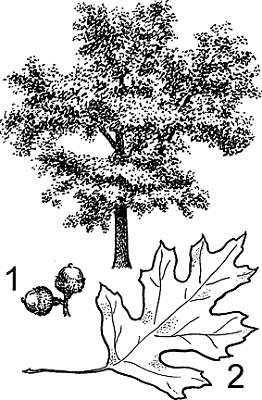
Illustration of oak
1 acorn
2 leaf
Examples of oak in a Sentence
Tall oaks line the street.
The table is solid oak.
The cabinets are made of oak.
Recent Examples on the Web
Examples are automatically compiled from online sources to
show current usage.Read More
Opinions expressed in the examples do not represent those of Merriam-Webster or its editors.
Send us feedback.
It’s finished with oak veneer, which adds a rustic and warm feel to the piece.—Alicia Geigel, Southern Living, 11 Jan. 2026 Contemporary art and collectible furniture pieces intermingle with ancient lava flows—around which entire suites have been constructed—original oak-beamed ceilings, and stone walls.—Condé Nast, Condé Nast Traveler, 10 Jan. 2026 Given the less-than-one-half-inch insect’s track record of devastating oaks since being first detected in San Diego County in 2008, scientists and land stewards are alarmed — and working to contain the outbreak.—Lila Seidman, Los Angeles Times, 10 Jan. 2026 Sunlight fills the dome’s open floor plan, amplified by generous wood accents and broad windows that showcase views of oaks and the pond nearby.—David Caraccio, Sacbee.com, 10 Jan. 2026 See All Example Sentences for oak
Word History
Etymology
Middle English ook, oke, going back to Old English āc, going back to Germanic *eik- (whence also Old Frisian ēk "oak," Old Saxon ēc, Old High German eih, eihha, Old Norse eik), of obscure origin
Note:
Old English āc is a feminine root noun (dative singular and nominative plural ǣc), though forms leveled to other declensions with umlaut are already evident. Germanic *eik- has been compared with the Greek words aigílōps, a name in Theophrastus for a species of oak (Quercus macrolepis?), and krátaigos, a species of hawthorn (also in Theophrastus), but interpretation of the conjoined elements of these words is conjectural (lṓpē is not actually attested in the sense "cork" or "bark"). The derivation of Latin aesculus "a species of oak (Quercus petraea?)" is obscure. The Lithuanian dialect forms áižuols and áužuolas "oak," superficially comparable, are hypercorrections of ą́žuolas, which is very unlikely to be related to *eik- (cf. Old Prussian ansonis = German eche in the Elbing Vocabulary).
First Known Use
before the 12th century, in the meaning defined at sense 1a
Time Traveler
The first known use of oak was
before the 12th century