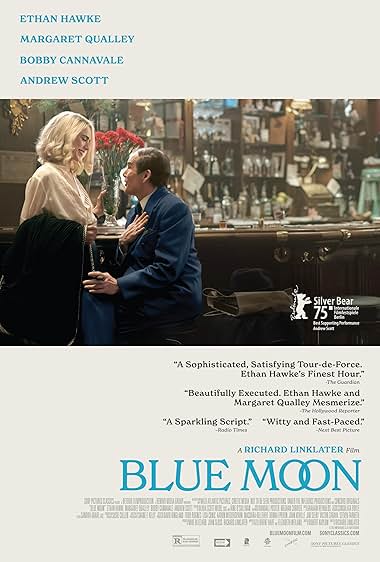

Conta a história da luta de Lorenz Hart contra o alcoolismo e a saúde mental enquanto ele tenta se salvar durante a estreia de "Oklahoma".Conta a história da luta de Lorenz Hart contra o alcoolismo e a saúde mental enquanto ele tenta se salvar durante a estreia de "Oklahoma".Conta a história da luta de Lorenz Hart contra o alcoolismo e a saúde mental enquanto ele tenta se salvar durante a estreia de "Oklahoma".
- Direção
- Roteiristas
- Estrelas
- Prêmios
- 12 vitórias e 35 indicações no total




Robert Kaplow
- Radio Announcer
- (narração)
- Direção
- Roteiristas
- Elenco e equipe completos
- Produção, bilheteria e muito mais no IMDbPro
Avaliações em destaque
"Blue Moon" is quintessentially Richard Linklater. A film with heavy dialogue but rich in character and depth.
Some might call this film boring, but what helps keep engagement levels is a strong performance by Ethan Hawke accompanied by a decently written screenplay.
The entire film feels like a theatre play brought to life on the big screen. It takes place in one bar but manoeuvers through conversations with different characters each with their own quirk.
I think what makes this film shine is Lorenz Harz (Hawke). A poor soul at the end of his time clinging to his past successes. A lonely man wanting love. As a film progresses, we learn more about our main character increasing our empathy and sadness for him.
In saying this, it is a film that struggles to reach the heights to call it a masterpiece. I feel like it's structure and style hinders it's ability in doing so.
I also will mention that I think Margaret Qualley was not strong enough in the female lead. With someone with not much dialogue, I felt like a stronger presence was needed to bring her character to life.
All in all, a decent movie but nothing to get too excited about.
7/10.
Some might call this film boring, but what helps keep engagement levels is a strong performance by Ethan Hawke accompanied by a decently written screenplay.
The entire film feels like a theatre play brought to life on the big screen. It takes place in one bar but manoeuvers through conversations with different characters each with their own quirk.
I think what makes this film shine is Lorenz Harz (Hawke). A poor soul at the end of his time clinging to his past successes. A lonely man wanting love. As a film progresses, we learn more about our main character increasing our empathy and sadness for him.
In saying this, it is a film that struggles to reach the heights to call it a masterpiece. I feel like it's structure and style hinders it's ability in doing so.
I also will mention that I think Margaret Qualley was not strong enough in the female lead. With someone with not much dialogue, I felt like a stronger presence was needed to bring her character to life.
All in all, a decent movie but nothing to get too excited about.
7/10.
Blue Moon (2025) is a biographical comedy drama movie directed by Richard Linklater and it follows a songwriter as he reflects on himself on the opening night of Oklahoma!, a new musical by his former colleague. This is a movie that I had my eye on for a while because of Richard Linklater and the movie was really good.
Positives for Blue Moon (2025): I like the initial setup and premise of the movie taking place in one setting and having characters talk about stuff. I also liked the costumes design and makeup to have these people look like they're from a different decade. The acting from the cast is really good specifically Ethan Hawke, Margaret Qualley, Bobby Cannavale and Andrew Scott. The pacing is really good and it feels like the movie is taking it's time with the storytelling. And finally, the old school music is really good.
Negatives for Blue Moon (2025): Aside from seeing these characters talk about music, nothing else really happens in the movie. I did enjoy seeing these people talk, but it was just that for 100 minutes. I also don't see this movie work for casual audiences at all. And finally, I was waiting for something big to happen and nothing happened.
Overall, Blue Moon (2025) is a great movie that will be enjoyed by fans of Richard Linklater, but casual fans will have a hard time getting invested which is fine because this movie isn't for them. I would recommend this if you're a fan of Richard Linklater and the story.
Positives for Blue Moon (2025): I like the initial setup and premise of the movie taking place in one setting and having characters talk about stuff. I also liked the costumes design and makeup to have these people look like they're from a different decade. The acting from the cast is really good specifically Ethan Hawke, Margaret Qualley, Bobby Cannavale and Andrew Scott. The pacing is really good and it feels like the movie is taking it's time with the storytelling. And finally, the old school music is really good.
Negatives for Blue Moon (2025): Aside from seeing these characters talk about music, nothing else really happens in the movie. I did enjoy seeing these people talk, but it was just that for 100 minutes. I also don't see this movie work for casual audiences at all. And finally, I was waiting for something big to happen and nothing happened.
Overall, Blue Moon (2025) is a great movie that will be enjoyed by fans of Richard Linklater, but casual fans will have a hard time getting invested which is fine because this movie isn't for them. I would recommend this if you're a fan of Richard Linklater and the story.
Greetings again from the darkness. Most everyone, especially lovers of Broadway musicals, knows the work of Rodgers and Hammerstein. And they should. Richard Rodgers and Oscar Hammerstein II are regarded among the most prolific musical production writers in history. Their projects include "The King and I", "Carousel", and "The Sound of Music". Their first collaboration, "Oklahoma!" is at the center of this latest from acclaimed director Richard Linklater (his NOUVELLE VAGUE coming out this year) and writer Robert Kaplow (ME AND ORSON WELLES, 2008). Yet we can't help but wonder why so few are familiar with the work of Rodgers and Hart. Together, composer Richard Rodgers and lyricist Lorenz Hart wrote more than one thousand songs, including "My Funny Valentine", "The Lady is a Tramp", and of course, "Blue Moon."
An opening title card provides quotes made about Lorenz Hart. The first describes him as "fun", while the second states, "he was the saddest man." The contrast is startling. We first see Ethan Hawke as Lorenz Hart as he stumbles and collapses in a dark alley. We then flash back seven months to March 31, 1943, the opening night of "Oklahoma!" on Broadway. Hart leaves the production before it's over and heads to Sardi's, where he plants himself at the bar, conversing with Eddie (Bobby Cannavale), his favorite bartender. This kicks off one of the more dialogue-heavy movies we will likely ever see ... fitting for a man who excelled at assembling words.
It takes little time for us to recognize Hart's bitterness and envy towards his former partner's (Rodgers) success with a new collaborator (Hammerstein). He's alternatingly condescending and profane ... until Richard Rodgers (Andrew Scott) shows up and Hart turns on the fake charm. For a single setting film (rare in movies, not so rare in live theater), this one is surprisingly complex. Hart's sexuality is hidden much better than his alcoholism. In fact, Rodgers offers to work with him again for a revival of their "A Connecticut Yankee" - but only if Hart stops drinking and behaves professionally towards their work. These are the issues that previously divided them.
Adding yet another layer is the presence of Elizabeth Weiland (Margaret Qualley). She has charmed 'Larry', who claims to love her ... although he states, "everybody loves her." Their relationship is askew, as he adores her and likely wants more, while she wants him to introduce her to the great Richard Rodgers. Also in the mix is a terrific sequence between Hart and the "Charlotte's Web" writer E. B. White (Patrick Kennedy). Their wordplay nears competition and ends with what would be a Stuart Little idea. Periodically drawn into the evening's progression is Sardi's house pianist (Jonah Lee), who idolizes the work of Rodgers and Hart. As if all that isn't enough, we get interactions with future director George Roy Hill (David Rawle), whom Hart counsels to concentrate on friendships (i.e., Butch and Sundance), and an obnoxiously whip smart young theater protégé named Stevie (Cillian Sullivan as teenage Stephen Sondheim).
Seemingly an odd casting decision for a short, Jewish, alcoholic man who is both miserable and talented, Ethan Hawke is absolutely terrific as Lorenz Hart. Alcoholism may destroy a partnership, and true love may constantly elude him, yet Hawke allows us to see the genius within. Hart would be dead just a few months after this painful (for him) opening night of "Oklahoma!" ... leaving little doubt that his all-time favorite line was fitting: "Nobody ever loved me that much." (from CASABLANCA) Opening nationwide on October 20, 2025.
An opening title card provides quotes made about Lorenz Hart. The first describes him as "fun", while the second states, "he was the saddest man." The contrast is startling. We first see Ethan Hawke as Lorenz Hart as he stumbles and collapses in a dark alley. We then flash back seven months to March 31, 1943, the opening night of "Oklahoma!" on Broadway. Hart leaves the production before it's over and heads to Sardi's, where he plants himself at the bar, conversing with Eddie (Bobby Cannavale), his favorite bartender. This kicks off one of the more dialogue-heavy movies we will likely ever see ... fitting for a man who excelled at assembling words.
It takes little time for us to recognize Hart's bitterness and envy towards his former partner's (Rodgers) success with a new collaborator (Hammerstein). He's alternatingly condescending and profane ... until Richard Rodgers (Andrew Scott) shows up and Hart turns on the fake charm. For a single setting film (rare in movies, not so rare in live theater), this one is surprisingly complex. Hart's sexuality is hidden much better than his alcoholism. In fact, Rodgers offers to work with him again for a revival of their "A Connecticut Yankee" - but only if Hart stops drinking and behaves professionally towards their work. These are the issues that previously divided them.
Adding yet another layer is the presence of Elizabeth Weiland (Margaret Qualley). She has charmed 'Larry', who claims to love her ... although he states, "everybody loves her." Their relationship is askew, as he adores her and likely wants more, while she wants him to introduce her to the great Richard Rodgers. Also in the mix is a terrific sequence between Hart and the "Charlotte's Web" writer E. B. White (Patrick Kennedy). Their wordplay nears competition and ends with what would be a Stuart Little idea. Periodically drawn into the evening's progression is Sardi's house pianist (Jonah Lee), who idolizes the work of Rodgers and Hart. As if all that isn't enough, we get interactions with future director George Roy Hill (David Rawle), whom Hart counsels to concentrate on friendships (i.e., Butch and Sundance), and an obnoxiously whip smart young theater protégé named Stevie (Cillian Sullivan as teenage Stephen Sondheim).
Seemingly an odd casting decision for a short, Jewish, alcoholic man who is both miserable and talented, Ethan Hawke is absolutely terrific as Lorenz Hart. Alcoholism may destroy a partnership, and true love may constantly elude him, yet Hawke allows us to see the genius within. Hart would be dead just a few months after this painful (for him) opening night of "Oklahoma!" ... leaving little doubt that his all-time favorite line was fitting: "Nobody ever loved me that much." (from CASABLANCA) Opening nationwide on October 20, 2025.
Watched at the 2025 Toronto International Film Festival.
A good charming and funny dialogue driven story about a self-destructive artist and character study with a wonderful performance from Ethan Hawke.
Richard Linklater is a master of dialogue driven storytelling and character study, and here, he continues to demonstrate and display his strong tactics with his direction for the atmosphere and tone. Alongside with the beautiful production designs and the setting, as usual, the dialogue is charming. The way characters interact with one another and the chemistry between the cast brings out a lot of funny moments, strong chemistry and energy. All thanks to the great performance from Hawke, Andrew Scott, Margaret Qualley and the rest of the cast.
The narrative, while admittedly it isn't the grandest story ever to be constructed, is a good observation about Lorenz Hart and his mental self-awarenwss crisis during the opening of his famous play. Understanding his emotions and the tension was pretty interesting and engaging to observe. The musicial score is good, the camera work is good, and the atmosphere is stunning. Although I do wish some of the pacing does improve especially towards the second act.
Overall, while it isn't the best work Linklater has made. Its a good hangout kind movie.
A good charming and funny dialogue driven story about a self-destructive artist and character study with a wonderful performance from Ethan Hawke.
Richard Linklater is a master of dialogue driven storytelling and character study, and here, he continues to demonstrate and display his strong tactics with his direction for the atmosphere and tone. Alongside with the beautiful production designs and the setting, as usual, the dialogue is charming. The way characters interact with one another and the chemistry between the cast brings out a lot of funny moments, strong chemistry and energy. All thanks to the great performance from Hawke, Andrew Scott, Margaret Qualley and the rest of the cast.
The narrative, while admittedly it isn't the grandest story ever to be constructed, is a good observation about Lorenz Hart and his mental self-awarenwss crisis during the opening of his famous play. Understanding his emotions and the tension was pretty interesting and engaging to observe. The musicial score is good, the camera work is good, and the atmosphere is stunning. Although I do wish some of the pacing does improve especially towards the second act.
Overall, while it isn't the best work Linklater has made. Its a good hangout kind movie.
Director Richard Linklater's "Blue Moon," a dramedy about Lorenz Hart, derives its name from the most famous song Hart ever wrote with composer Richard Rodgers. Writer Robert Kaplan's script is filled with crackling dialogue, sophisticated accent notes, rich undertones and an observant narrative style that celebrates Hart's brilliance with words while also sympathizing with the tragedy of his personal life.
It's March 31, 1943. Hart (Ethan Hawke) has arrived early at Sardi's to fête former writing partner Richard Rogers on the opening night of his new show "Oklahoma!" It's a melancholy night for Hart, who is agonizingly aware that his own unreliability has forced Rogers to find a new collaborator. As audience members, we know that Rodgers and Hammerstein will go on to become Broadway's most celebrated creative team, while Rodgers and Hart will never be equally appreciated.
Using Linklater's typically meandering narrative style, the film offers a slow-tempo celebration of Hart's humor, insight and intelligence. But it also excavates and explores the pain beneath his sardonic observations and clever wordplay and it foreshadowing the self-destructiveness that will end his life seven months later. Hart skewers "Oklahoma!" for its cornpone sensibility and heart-on-its-sleeve emotion, while simultaneously recognizing that the show will be adored by audiences and run for years. He has a conversation with EB White (author of "Charlotte's Web") and takes a couple of minutes to give White the inspiration to write "Stuart Little." More importantly, Hart's conversation with the erudite White provides a forum for deep discussion about art while offering glimpses of Hart's insecurity and humanity. Finally, there's considerable time devoted to Hart's wildly implausible (but true) infatuation with Elizabeth Weiland (Margaret Qualley - Andie McDowell's daughter), a 20-year-old Yale student on whom Hart lavishes gifts, rapt attention and unalloyed adoration, despite his general affinity for men. It's a story simultaneously confusing, crisply written, insightful, mournful, funny and tragic. For anyone with a soul, it's a film that will inspire thought and reflection well after the closing credits roll.
Andrew Scott has received critical attention for his portrayal of Richard Rodgers, whom he portrays as a character who is disgusted by Hart's alcoholic benders while still appreciative of Hart's skills and instincts as a wordsmith. There's also an undertone of condescension as Rodgers realizes he is moving onward and upward, without Hart. But for my money, it's Hawke and Qualley who steal the show here. There's a lot of camera wizardry (kudos to Cinematographer Shane F. Kelly) for Hawke's portrayal of Hart, who was balding, 4'10" and old well beyond his 47 years. Even so, Hawke disappears convincingly into the role. For Qualley, playing a gorgeous, self-absorbed twenty-something requires zero dramatic range. But she's so open, honest and thoughtful that she infuses believability into her role as the idealized love interest of a man more than twice her age.
The plot of "Blue Moon" is best summarized by its opening lyrics: "Blue moon, you saw me standin' alone, without a dream in my heart, without a love of my own." The film is a heartbreaking tribute to Lorenz Hart. It's also a cautionary note about the fragility of art and some of the artists who spend their lives creating it.
It's March 31, 1943. Hart (Ethan Hawke) has arrived early at Sardi's to fête former writing partner Richard Rogers on the opening night of his new show "Oklahoma!" It's a melancholy night for Hart, who is agonizingly aware that his own unreliability has forced Rogers to find a new collaborator. As audience members, we know that Rodgers and Hammerstein will go on to become Broadway's most celebrated creative team, while Rodgers and Hart will never be equally appreciated.
Using Linklater's typically meandering narrative style, the film offers a slow-tempo celebration of Hart's humor, insight and intelligence. But it also excavates and explores the pain beneath his sardonic observations and clever wordplay and it foreshadowing the self-destructiveness that will end his life seven months later. Hart skewers "Oklahoma!" for its cornpone sensibility and heart-on-its-sleeve emotion, while simultaneously recognizing that the show will be adored by audiences and run for years. He has a conversation with EB White (author of "Charlotte's Web") and takes a couple of minutes to give White the inspiration to write "Stuart Little." More importantly, Hart's conversation with the erudite White provides a forum for deep discussion about art while offering glimpses of Hart's insecurity and humanity. Finally, there's considerable time devoted to Hart's wildly implausible (but true) infatuation with Elizabeth Weiland (Margaret Qualley - Andie McDowell's daughter), a 20-year-old Yale student on whom Hart lavishes gifts, rapt attention and unalloyed adoration, despite his general affinity for men. It's a story simultaneously confusing, crisply written, insightful, mournful, funny and tragic. For anyone with a soul, it's a film that will inspire thought and reflection well after the closing credits roll.
Andrew Scott has received critical attention for his portrayal of Richard Rodgers, whom he portrays as a character who is disgusted by Hart's alcoholic benders while still appreciative of Hart's skills and instincts as a wordsmith. There's also an undertone of condescension as Rodgers realizes he is moving onward and upward, without Hart. But for my money, it's Hawke and Qualley who steal the show here. There's a lot of camera wizardry (kudos to Cinematographer Shane F. Kelly) for Hawke's portrayal of Hart, who was balding, 4'10" and old well beyond his 47 years. Even so, Hawke disappears convincingly into the role. For Qualley, playing a gorgeous, self-absorbed twenty-something requires zero dramatic range. But she's so open, honest and thoughtful that she infuses believability into her role as the idealized love interest of a man more than twice her age.
The plot of "Blue Moon" is best summarized by its opening lyrics: "Blue moon, you saw me standin' alone, without a dream in my heart, without a love of my own." The film is a heartbreaking tribute to Lorenz Hart. It's also a cautionary note about the fragility of art and some of the artists who spend their lives creating it.
Hot Takes From NYFF 2025
Hot Takes From NYFF 2025
A little known French-language thriller wound up being one of IMDb Editor Arno Kazarian's top picks from the 2025 New York Film Festival. See what else made the list.




Você sabia?
- CuriosidadesThe boy accompanying Oscar Hammerstein II is a young Stephen Sondheim. He derides Lorenz Hart's line "weighty affairs will just have to wait", which later became a lyric in the song Comedy Tonight from Sondheim's musical A Funny Thing Happened on the Way to the Forum.
- Erros de gravaçãoIn 1943, no man would open talk about being gay in a public place, even if only talking to a bartender. Homosexual acts were criminal in 1943 and gay people did not speak openly about their sex lives in public places.
- Citações
[repeated line]
Lorenz Hart: Oklahoma exclamation point!
Principais escolhas
Faça login para avaliar e ver a lista de recomendações personalizadas
Detalhes
- Data de lançamento
- Países de origem
- Central de atendimento oficial
- Idiomas
- Também conhecido como
- Блакитний місяць
- Empresas de produção
- Consulte mais créditos da empresa na IMDbPro
Bilheteria
- Faturamento bruto nos EUA e Canadá
- US$ 2.016.570
- Fim de semana de estreia nos EUA e Canadá
- US$ 65.593
- 19 de out. de 2025
- Faturamento bruto mundial
- US$ 2.497.435
- Tempo de duração
- 1 h 40 min(100 min)
- Cor
- Mixagem de som
- Proporção
- 2.39 : 1
Contribua para esta página
Sugerir uma alteração ou adicionar conteúdo ausente