AVALIAÇÃO DA IMDb
7,8/10
5,7 mil
SUA AVALIAÇÃO
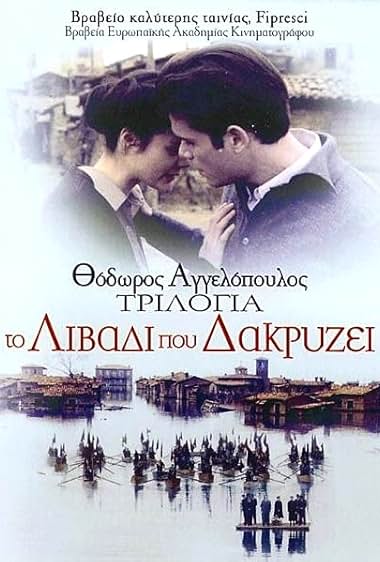
Adicionar um enredo no seu idiomaIn 1919, Greek refugees from Odessa settle in a Greek village, where an orphan named Eleni falls into a forbidden romance with her adoptive brother. Her flight from a forced marriage sparks ... Ler tudoIn 1919, Greek refugees from Odessa settle in a Greek village, where an orphan named Eleni falls into a forbidden romance with her adoptive brother. Her flight from a forced marriage sparks an odyssey across a landscape ravaged by war.In 1919, Greek refugees from Odessa settle in a Greek village, where an orphan named Eleni falls into a forbidden romance with her adoptive brother. Her flight from a forced marriage sparks an odyssey across a landscape ravaged by war.
- Direção
- Roteiristas
- Estrelas
- Prêmios
- 2 vitórias e 6 indicações no total
Avaliações em destaque
Anytime you sit down to a historical piece, especially a part of a trilogy, you must be prepared for an investment of time. In this case, it is 3 hours more or less, depending on the version.
The period that the first part of the Trilogy covers is 1919 -1949. Theodoros Angelopoulos presents 30 years of Greek history beginning with the return of the exiles from Odessa after WWI to the rise of the Colonels.
Eleni, who witnesses the history, is played by an unknown, Alexandra Aidini. He does not use her in the second film.
She is to marry Spyros (Vassilis Kolovos), but loves his son Alexis (Nikos Poursadinis), She runs off with him. They had two children that were taken and given to a rich woman. They managed to get them back after the village flooded. Alexis heads to America, while Eleni loses the children again after she is imprisoned. The war takes a toll on the family. There is much weeping among the women and those who didn't wear black, did so now.
But, the film is really not about the characters. It is about Greece, and the pain she has endured in this century.
It is a dark and dreary film with plenty of rain and cloudy skies. It is not meant to be joyful as the period is not joyful, as we watch dreams shattered, and people surviving, but just barely.
With music by Eleni Karaindrou and cinematography by Andreas Sinanos, you are not bored by the lack of dialog. In fact, you are left to enjoy and experience the time and the film.
Those who enjoy Bergman, Fellini, Kurosawa, and other great masters, will certainly enjoy Theodoros Angelopoulos. I hope he finished this trilogy, as he will be almost 80 when he does.
The period that the first part of the Trilogy covers is 1919 -1949. Theodoros Angelopoulos presents 30 years of Greek history beginning with the return of the exiles from Odessa after WWI to the rise of the Colonels.
Eleni, who witnesses the history, is played by an unknown, Alexandra Aidini. He does not use her in the second film.
She is to marry Spyros (Vassilis Kolovos), but loves his son Alexis (Nikos Poursadinis), She runs off with him. They had two children that were taken and given to a rich woman. They managed to get them back after the village flooded. Alexis heads to America, while Eleni loses the children again after she is imprisoned. The war takes a toll on the family. There is much weeping among the women and those who didn't wear black, did so now.
But, the film is really not about the characters. It is about Greece, and the pain she has endured in this century.
It is a dark and dreary film with plenty of rain and cloudy skies. It is not meant to be joyful as the period is not joyful, as we watch dreams shattered, and people surviving, but just barely.
With music by Eleni Karaindrou and cinematography by Andreas Sinanos, you are not bored by the lack of dialog. In fact, you are left to enjoy and experience the time and the film.
Those who enjoy Bergman, Fellini, Kurosawa, and other great masters, will certainly enjoy Theodoros Angelopoulos. I hope he finished this trilogy, as he will be almost 80 when he does.
What a spectacular film. If you don't have a good 162min free of your time, then make it a priority to change it. This movie was full of sensational scenery and the director had taken a photographer's approach in catching the atmosphere at hand. Coming from a Greek background and taking my 65 year old father to see this film, as he was resorted to tears, I came to realise that this is not just a fictional film, but that reality was close to home and to the heart for many Greek refugees who were forced to flee their country. It was full of nostalgia, music (inspiration by each instrument) and dedicated actors (Eleni as a mother, weeping from the loss of her children). The only thing I didn't like, was that the film was too long to fit on a tape and the movie was interrupted when the tape ran out, half way through. A 5min interval was then in place, as which many lost their passion and thought the movie was finished. However, once again, this movie made me so emotional, and gave me lots of empathy to humanity. It is so unfortunate that we were only shown the film as a "ONE OFF" in Australia at the world film festival. (both sessions sold out before time) Well done Angelopoulos!! Can't wait till it hits our shores, so it can be bought on DVD (that's if it ever gets here). I recommend it, go on, I dare you too to!
Angelopoulos again makes the most of an intellectual way of cinema, which is though full of poetry and with the stain of compassion. History and human relationships are emphasized through the symbolic order of ancient Greek tragedy and that is what makes the film have a more "heavy" character, which makes it a little harder to follow than a usual Hollywood production- do not misjudge me, I love it too. As long as it concerns the scenario the modern history of Greece becomes only the environment in which the man wrecks along with his fate. Angelopoulos recons the mechanizations of History upon man and tries to make a clear statement upon it. The film itself is the most mature of the Greek director and has all his personal characteristics bound together in an excellent work!
10nikkd
I viewed this movie at the TIFF in 2004. It was the first film I ever seen their and I have been going back every year since, hoping to see something that was as moving. By far one of the greatest films I have ever viewed. The cinematography, the acting, the script all worked hand in hand. At times when the dialogue was silent you were still captivated by what was being shown on the screen.
The movie is long, but I did not lose interest once. I was lucky enough to meet Mr. Angelopoulos at the premier of his film and believe me for a movie buff like me it was a great honor even thought I did not realize it at the time. I believe that this film should be on every bodies must watch list if you are looking for a movie that is deep.
I have since viewed a lot of movies and have yet to fond anything that I believe is as important.
The movie is long, but I did not lose interest once. I was lucky enough to meet Mr. Angelopoulos at the premier of his film and believe me for a movie buff like me it was a great honor even thought I did not realize it at the time. I believe that this film should be on every bodies must watch list if you are looking for a movie that is deep.
I have since viewed a lot of movies and have yet to fond anything that I believe is as important.
10zetes
I think anyone familiar with Angelopoulos knows what to expect with his films: long, drawn out, meticulously planned shots that slowly scan environments, with the image composed of not only the foreground but hundreds of yards into the background. I guess some are not impressed with the director's style, but that really astounds me. I definitely see the man as a master of his medium, and The Weeping Meadow is as good as any of his other films every one I've seen so far is a masterpiece or close to it. This film has a lot in common with the director's first big success, The Traveling Players. It follows a little girl, Eleni, from 1919 to the time of the Greek Civil War, at the end of WWII. And, as the title implies, it's a great tragedy. There is a lot of weeping. It may be long and slow, but it's always gripping. Angelopoulos' imagery is second to none in modern cinema. There are just so many jaw-dropping sequences. My favorite was the one where the camera explored its way through a maze of bed sheets drying on clotheslines, discovering various musicians hidden within. It's not a complaint, per se, but if you're going to watch the film beware of its chronological ellipses. The film can skip ahead years in just a second, when the pace usually makes each second feel like years (in a good way!). I hope New Yorker video, or some other company, digs up the Angelopoulos films that have been unavailable so far, and puts The Traveling Players on DVD, as well.
Você sabia?
- CuriosidadesOne of the key influences in the film being made was the death of Theodoros Angelopoulos's mother in 1998. Her life had spanned virtually the entire century so he wanted to make a film that did the same.
- ConexõesFollowed by Trilogia II: a poeira do tempo (2008)
Principais escolhas
Faça login para avaliar e ver a lista de recomendações personalizadas
- How long is Trilogy: The Weeping Meadow?Fornecido pela Alexa
Detalhes
- Data de lançamento
- Países de origem
- Idioma
- Também conhecido como
- Trilogy: The Weeping Meadow
- Locações de filme
- Empresas de produção
- Consulte mais créditos da empresa na IMDbPro
Bilheteria
- Faturamento bruto nos EUA e Canadá
- US$ 24.966
- Fim de semana de estreia nos EUA e Canadá
- US$ 6.015
- 18 de set. de 2005
- Faturamento bruto mundial
- US$ 64.424
Contribua para esta página
Sugerir uma alteração ou adicionar conteúdo ausente