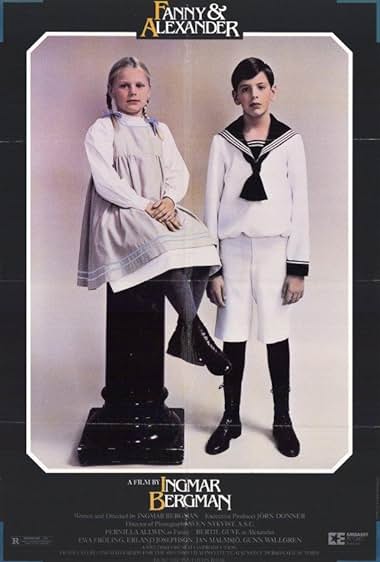
Duas crianças suecas vivenciam as muitas comédias e tragédias de sua família, os Ekdahls.Duas crianças suecas vivenciam as muitas comédias e tragédias de sua família, os Ekdahls.Duas crianças suecas vivenciam as muitas comédias e tragédias de sua família, os Ekdahls.
- Ganhou 4 Oscars
- 25 vitórias e 13 indicações no total
Patricia Gélin
- Staty - Ekdahlska huset
- (as Patricia Gelin)
Avaliações em destaque
Perhaps the most impressive feature of this wonderful film is the humility with which its creator presents it to the world, as if it were no grander than the old-fashioned Nativity-play shown in the early scenes at the Theatre.
At the end of this experience - to term it with any mere technical tag, like 'movie', would be inadequate - Bergman's profoundly grown-up disillusionment has transformed into the pure spirituality of abnegation and acceptance. His intellectual pilgrimage, through possibly the greatest career in films, finds the director arriving back where he began, with the great simplicities of life. But there is a difference with his return, which is that his prodigality over the years has burnt the rage out of him, and finally allowed him to 'enjoy what may be enjoyed' (as one of the Ekdahls says), without further fretting over the puzzle of human existence. From all this human folly (he clearly feels) comes the only wisdom, which is - simply - to be human.
It is, indeed, a film like no other for allowing the pieces of experience to settle into their appointed places. There is a beautiful quality of selfless resignation, in this last of his works for cinema, which finally and forever excels the sadistic disciplines of The Bishop.
This perverted creature confesses, to the new wife whom he has lost, how it is impossible to 'tear off the mask' as it is 'burned into my face': He is become an authoritarian '... a rite, a law, a custom - not a man'. [Shelley] Having put the notional love of God before that of humankind, there is nowhere for his personality to be re-enacted in the bosom of any kindly recollections that will survive him. Except in that of Alexander/Bergman, where his two, each-in-their-own-way terrifying, fathers, both the White and the Black opposites of an imagination flickering with the director's haunted vision, will project forever onto his Cinematic arena of stark absolutes the inner strife where each of us is locked away, struggling to endure the turmoil of these eternally irreconcilable truths.
The White Knight and The Black Bishop: These are phantom moves in our great game with Death, and pieces that will be returned into play for as long as humanity continues. How like Chess Life is: Just a game we play, with arbitrary rules, and yet whose progress is of supreme and abiding concern to each and every one of us.
This great work is a monument to play, in all its senses, not least the play of light and the play of ideas, both equally insubstantial and yet the essence of reality, eloquent as the silence of a great, roofless Cathedral. Out of the Ruin of Faith, Bergman has wrought a Peace that passeth understanding. And it is in this ultimate by-passing of the relentless structures of intellect that Bergman finally achieves the resolution of his productive neuroses, in a truly magical film whose every phase is as inevitable as breathing, or the changeable and unimpeded weather.
As the grandmother reflects. at last, 'I don't want to put Life together anymore. I just leave it broken. Strangely, it seems better that way.'
Death, in the end, is not a calamity, but the choice of all who have truly known Life. In other words, to choose Life is to accept its Dark partner, Death. And to accept each as part of the family group, even though they seem complete misfits there.
The old lady, with Strindberg's Dream-play in her lap, knows at last that the whole history of her family is only a personal reverie. And yet how much more real it seems than her son Carl's immature and somewhat absurd, angst-ridden railings against 'cruel Fate'!
Had he only accepted his patient wife's gently sympathetic injunction to 'Never mind' the Professor would have been both wiser and happier, enduring with patient fortitude the oceanic inconsequentialities of life's real Mystery, and attending far less to the trivial pseudo-mysteries of his solipsistic men's club. All his morbid rationalising is precisely as much use in real life as the usual state of alcoholic befuddlement which is the only serious pursuit of this club.
Reason as befuddlement; The sleep of reason as deliverance. With saint-like humility, Bergman gives us back our ordinary human life, as he surrenders his exceptional life in films. But he knows that the ghost of this life will always be with us. His anguished worldliness will haunt us - as the Ghost of Hamlet's father must haunt Alexander - forever.
At the end of this experience - to term it with any mere technical tag, like 'movie', would be inadequate - Bergman's profoundly grown-up disillusionment has transformed into the pure spirituality of abnegation and acceptance. His intellectual pilgrimage, through possibly the greatest career in films, finds the director arriving back where he began, with the great simplicities of life. But there is a difference with his return, which is that his prodigality over the years has burnt the rage out of him, and finally allowed him to 'enjoy what may be enjoyed' (as one of the Ekdahls says), without further fretting over the puzzle of human existence. From all this human folly (he clearly feels) comes the only wisdom, which is - simply - to be human.
It is, indeed, a film like no other for allowing the pieces of experience to settle into their appointed places. There is a beautiful quality of selfless resignation, in this last of his works for cinema, which finally and forever excels the sadistic disciplines of The Bishop.
This perverted creature confesses, to the new wife whom he has lost, how it is impossible to 'tear off the mask' as it is 'burned into my face': He is become an authoritarian '... a rite, a law, a custom - not a man'. [Shelley] Having put the notional love of God before that of humankind, there is nowhere for his personality to be re-enacted in the bosom of any kindly recollections that will survive him. Except in that of Alexander/Bergman, where his two, each-in-their-own-way terrifying, fathers, both the White and the Black opposites of an imagination flickering with the director's haunted vision, will project forever onto his Cinematic arena of stark absolutes the inner strife where each of us is locked away, struggling to endure the turmoil of these eternally irreconcilable truths.
The White Knight and The Black Bishop: These are phantom moves in our great game with Death, and pieces that will be returned into play for as long as humanity continues. How like Chess Life is: Just a game we play, with arbitrary rules, and yet whose progress is of supreme and abiding concern to each and every one of us.
This great work is a monument to play, in all its senses, not least the play of light and the play of ideas, both equally insubstantial and yet the essence of reality, eloquent as the silence of a great, roofless Cathedral. Out of the Ruin of Faith, Bergman has wrought a Peace that passeth understanding. And it is in this ultimate by-passing of the relentless structures of intellect that Bergman finally achieves the resolution of his productive neuroses, in a truly magical film whose every phase is as inevitable as breathing, or the changeable and unimpeded weather.
As the grandmother reflects. at last, 'I don't want to put Life together anymore. I just leave it broken. Strangely, it seems better that way.'
Death, in the end, is not a calamity, but the choice of all who have truly known Life. In other words, to choose Life is to accept its Dark partner, Death. And to accept each as part of the family group, even though they seem complete misfits there.
The old lady, with Strindberg's Dream-play in her lap, knows at last that the whole history of her family is only a personal reverie. And yet how much more real it seems than her son Carl's immature and somewhat absurd, angst-ridden railings against 'cruel Fate'!
Had he only accepted his patient wife's gently sympathetic injunction to 'Never mind' the Professor would have been both wiser and happier, enduring with patient fortitude the oceanic inconsequentialities of life's real Mystery, and attending far less to the trivial pseudo-mysteries of his solipsistic men's club. All his morbid rationalising is precisely as much use in real life as the usual state of alcoholic befuddlement which is the only serious pursuit of this club.
Reason as befuddlement; The sleep of reason as deliverance. With saint-like humility, Bergman gives us back our ordinary human life, as he surrenders his exceptional life in films. But he knows that the ghost of this life will always be with us. His anguished worldliness will haunt us - as the Ghost of Hamlet's father must haunt Alexander - forever.
10ColeSear
This film could never have been made in the United States. I realize when it was made Bergman had been around for a long time and had his own clout but it still has too much of a philosophical slant to be mainstream here. This film is amazing. The first hour moves at a slow pace but it really sets up the rest of the movie well and then it really picks up. The cinematography is breathtaking and while this story makes you think a lot you don't feel ambivalent towards the characters through the rest of the first film after having been slowly introduced to all the characters you have a certain identifcation that is purely emotional and blends wonderfully with the other aspects of the film. It's truly great and should be considered one of Bergman's best works.
10anton-6
I have wanted to see this film for years but I have missed it several times they were showing it on television.And also because of my father does not like Bergman(why??) but still think that this film is fantastic.I saw it yesterday just after having read Bergman´s autobiography and this film is much a autobiographical film.
I would like to say something about the cinematography and acting.But what is there more to say about Sven Nykvist´s cinematography then MASTERFUL.Before I saw the film I read in a newspaper that this is the best Swedish acting film ever made and it was actually picked as number two as the best Swedish film ever made for a couple of years ago(film fans voted).The WHOLE cast acts SUPERB,I am not sure if I have ever seen anything more perfect.
This is a chronicle over a family.It has a a great poetic script that combines just as it sad in a other comment:striking visuals.Bergman has really done this to a masterpiece.Now I want to see the five-hour version(i saw the 3 hour version).Colorful,perfect,frightening and sometimes even funny.What I guess I liked most was that they showed everything from the children´s eyes.One of Bergman´s best.5/5
I would like to say something about the cinematography and acting.But what is there more to say about Sven Nykvist´s cinematography then MASTERFUL.Before I saw the film I read in a newspaper that this is the best Swedish acting film ever made and it was actually picked as number two as the best Swedish film ever made for a couple of years ago(film fans voted).The WHOLE cast acts SUPERB,I am not sure if I have ever seen anything more perfect.
This is a chronicle over a family.It has a a great poetic script that combines just as it sad in a other comment:striking visuals.Bergman has really done this to a masterpiece.Now I want to see the five-hour version(i saw the 3 hour version).Colorful,perfect,frightening and sometimes even funny.What I guess I liked most was that they showed everything from the children´s eyes.One of Bergman´s best.5/5
It's the disclosure of disfunction to children's eyes, the discovery of a world not conceived, or indeed anticipated, a contract broken, of barriers erected and bolstered, mistrust, disbelief and, perhaps more importantly, the formation and flowering of the unique specimen you are likely to become as a result. Film making is not just an exploration of its characters and creators but, more usually, an exploration of you! and how you scale against its mirrors and answer its questions? Why else would you invest so much time into discovering your difference and why you're so resistant to change?
I am not one for putting up idols on pedestals; mostly Bergman's films leave me tepid or even cold. But Fanny och Alexander is a splendid production, beautifully made, so superb it even evokes feelings of having come from a novel. Excellent characterization throughout, all the way down the cast, lending that magic touch to the costuming of the early 1900s. Mesmerising throughout, the film is not a single minute too long. The development of the story-line is superbly handled in an absorbing and coherent manner, manifesting the great empathy between director and actors. If the cinematography is visual poetry, the script is philosophical and full of awareness or consciousness of things in life, but not at a pretentious, abstract and theoretical level, but at a real human dimension.
If you only have 10 videos in your collection, Fanny och Alexander should be one of them. My vote is a bit higher than the IMDb average.
These comments refer to the 3-hour version.
If you only have 10 videos in your collection, Fanny och Alexander should be one of them. My vote is a bit higher than the IMDb average.
These comments refer to the 3-hour version.
Top-Rated Christmas Movies to Stream This Season
See the very best Christmas movies streaming this season, according to IMDb fan ratings.
Você sabia?
- CuriosidadesAt the time, the largest film production ever in Sweden (with 60 speaking parts and over 1200 extras) and the most expensive, with a budget of $6 million.
- Erros de gravaçãoAmong the Christmas decorations in the Ekdahl house, there is a garland of miniature flags of the Nordic countries, including the Finnish flag. The Finnish flag was in fact only designed and adopted after Finnish independence in 1917, a decade after the events of the film.
- Citações
Ekdahlska huset - Helena Ekdahl: Everything can happen. Everything is possible and probable. Time and space do not exist. On a flimsy framework of reality, the imagination spins, weaving new patterns.
- Versões alternativasTheatrical version is 188 minutes long. The TV mini-series version is 312 minutes long.
- ConexõesEdited into Fanny e Alexander (1983)
Principais escolhas
Faça login para avaliar e ver a lista de recomendações personalizadas
Detalhes
- Data de lançamento
- Países de origem
- Idiomas
- Também conhecido como
- Fanny & Alexander
- Locações de filme
- Empresas de produção
- Consulte mais créditos da empresa na IMDbPro
Bilheteria
- Orçamento
- US$ 6.000.000 (estimativa)
- Faturamento bruto nos EUA e Canadá
- US$ 6.783.304
- Faturamento bruto mundial
- US$ 6.813.882
- Tempo de duração
- 3 h 8 min(188 min)
- Mixagem de som
- Proporção
- 1.66 : 1
Contribua para esta página
Sugerir uma alteração ou adicionar conteúdo ausente