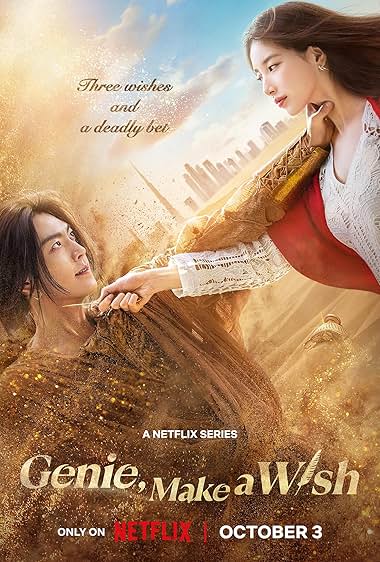
Jinn, un genio che si risveglia dopo mille anni, e Ka-young, il suo nuovo padrone impassibile.Jinn, un genio che si risveglia dopo mille anni, e Ka-young, il suo nuovo padrone impassibile.Jinn, un genio che si risveglia dopo mille anni, e Ka-young, il suo nuovo padrone impassibile.
Sfoglia gli episodi
Recensioni in evidenza
Genie, Make a Wish opens with a tantalizing fantasy premise and breathtaking visuals, but the first few episodes tread slowly, struggling to hook the viewer. Once the narrative finds its footing, though, the series blooms into an emotionally resonant, visually sumptuous romance powered by strong performances and undeniable on-screen chemistry.
Kim Woo-bin delivers a layered portrayal of a genie (or Iblis) caught between cynicism and longing, while Bae Suzy's Ka-young-quiet, emotionally closed-off-provides a perfect foil. Their dynamic evolves gradually from friction to gentle affinity, and when the sparks fly, they're lovely to watch. All supporting characters feel well cast and well used; none overstay their welcome, and each contributes meaningfully to the emotional tapestry.
The direction and cinematography are often gorgeous: mystical lighting, inventive CGI, thoughtful framing. The fantasy elements are handled with enough care to avoid feeling gimmicky, and the emotional arcs in the latter half reward your patience. However, pacing issues early on, occasional exposition-heavy sequences, and some predictable tropes keep it from being flawless.
Overall, Genie, Make a Wish is a rewarding slow burn. If you stick with it, the payoff feels earned-and the magic lingers.
Kim Woo-bin delivers a layered portrayal of a genie (or Iblis) caught between cynicism and longing, while Bae Suzy's Ka-young-quiet, emotionally closed-off-provides a perfect foil. Their dynamic evolves gradually from friction to gentle affinity, and when the sparks fly, they're lovely to watch. All supporting characters feel well cast and well used; none overstay their welcome, and each contributes meaningfully to the emotional tapestry.
The direction and cinematography are often gorgeous: mystical lighting, inventive CGI, thoughtful framing. The fantasy elements are handled with enough care to avoid feeling gimmicky, and the emotional arcs in the latter half reward your patience. However, pacing issues early on, occasional exposition-heavy sequences, and some predictable tropes keep it from being flawless.
Overall, Genie, Make a Wish is a rewarding slow burn. If you stick with it, the payoff feels earned-and the magic lingers.
Just finished this drama and want to ad my final thoughts. As fiction goes it was interesting and not too bad. The acting was really good for the most part. Unfortunately, they took a little bit from every religion that is out there, threw it in a pot, gave it quite a stir with a pen came up with somewhat of a mess of a script, this would easily upset many people.(I did not read the book if there was one). Although it kept you thinking, it did unravel disappointingly somewhat in the last episode. Asia is famous for fantasy dramas and this sort of was an attempt at that.
Although, for the most part it did have some entertaining moments the writers definitely had a hard time keeping it together.
INITIAL REVIEW I wondered the direction of this drama, initially I was somewhat confused, but by episode 6 things seemed to move as if it was showing some moral conviction and consequences. I just began episode 7 and will come back for a final review. If a show has intriguing story line and good acting and is not sexually perverted I like to try to see it through to the end before I make a final judgement so I will come back when I finish.
Although, for the most part it did have some entertaining moments the writers definitely had a hard time keeping it together.
INITIAL REVIEW I wondered the direction of this drama, initially I was somewhat confused, but by episode 6 things seemed to move as if it was showing some moral conviction and consequences. I just began episode 7 and will come back for a final review. If a show has intriguing story line and good acting and is not sexually perverted I like to try to see it through to the end before I make a final judgement so I will come back when I finish.
To those so quick to despise Genie, Make a Wish - not because they tried to understand it, but because they didn't want to - this is not a show meant for you. It was never designed to please those who skim, who fast-forward, or who mistake slowness for emptiness. It is a story that demands you wait, that you sit still long enough to hear what silence sounds like. That alone disqualifies the impatient.
What's disheartening, though, isn't disinterest - it's the noise made by those spreading disdain out of spite or ignorance, disguising their own lack of comprehension as critique. Many of the loudest detractors don't engage with what the drama actually says; they only react to what they assumed it said. They treat myth as misinformation, and metaphor as offense.
The inclusion of Iblis as a central figure has triggered arguments about blasphemy and insensitivity - a reaction that reveals more about the viewers' refusal to separate fiction from faith than about the drama's intent. Genie, Make a Wish does not mock religion; it mirrors it. It borrows the name of a figure from Islamic theology not to provoke, but to ponder. The show transforms Iblis from a symbol of evil into a study of moral fatigue, showing that even those burdened by eternity can learn humility. It's allegory, not apostasy - and it's tragic how few seem literate enough to tell the difference.
Art has always borrowed from belief, not to corrupt it, but to question humanity through it. Myth, religion, and morality are the raw materials of storytelling; they belong not to dogma, but to dialogue. Genie, Make a Wish belongs in that tradition. Its "divine wager" isn't about God's cruelty - it's about human frailty. It asks what happens when beings, divine or mortal, are forced to confront the consequences of their own desires. If that discomforts you, that's the point.
To those who accuse the show of sacrilege, I say this: fiction does not demand worship, only understanding. And understanding requires literacy - not the ability to read subtitles, but the humility to read subtext. This drama is not theology; it's reflection. It doesn't tell you what to believe - it asks whether belief still matters when desire outweighs conscience. That is not blasphemy. That is philosophy.
Every episode is a parable of greed, guilt, consequence, and the hunger for redemption. Every wish is a sermon on human weakness - a small study in what happens when longing outruns morality. The genie is not a god, and the human is not innocent; both are mirrors to each other's flaws. The show holds that mirror up to us too, asking if we can bear to look. Many viewers can't. So instead, they close their eyes and call it "boring."
But Genie, Make a Wish is not boring - it's unflattering. It doesn't entertain your attention span; it exposes it. It is not slow for the sake of pacing; it's slow because transformation is slow. It's about learning to feel again - and that, unlike a wish, takes time.
And then comes the loudest accusation - that the show "romanticizes Iblis." That claim is not just false; it's fear masquerading as literacy. Genie, Make a Wish does not glorify Iblis - it humanizes temptation. It doesn't ask you to love evil, but to recognize how easily you could fall into it. It's not a hymn to sin, but a confession of how near we all stand to it. The drama never seduces you toward darkness - it unveils how willingly humans chase it when it looks like mercy.
If you truly understood the show, you'd know it's not about the devil at all. It's about you. About how every wish we make is a quiet bargain with consequence, how every selfish desire leaves a trace on something sacred. The genie doesn't grant wishes - he reveals the cost of them. That's not romanticism; that's realism in its most spiritual form.
To mistake depiction for endorsement is the failure of an untrained mind - one that fears stories because it cannot tell symbol from sermon. Genie, Make a Wish does not tempt you to believe in Iblis; it forces you to confront how often you already do - when you choose desire over duty, pride over peace, comfort over conscience. That is the quiet, unnerving truth of the series: the devil doesn't have to appear if we keep summoning him ourselves.
So yes, to those who leave one-star reviews out of malice or mockery, this is your reflection: you hated what you did not understand. You scrolled past a mirror because you didn't like what you saw in it. You mistook allegory for arrogance, patience for pretension, and spirituality for offense. But that's not the show's failure. That's yours.
Because Genie, Make a Wish never once asked to be loved easily. It only asked to be understood patiently. And in that, it mirrors life itself: beautiful, slow, misunderstood - but waiting, always waiting, for those willing to look deeper.
If you couldn't, perhaps the problem was never the show's. It was your own inability to separate belief from metaphor, or impatience from meaning. This story does not bend to faith or fandom - it asks something far harder: that you listen.
And for those who did - who watched with open hearts and quiet attention - the lesson remains simple and sacred: fiction is not the opposite of belief. It is the language through which we try to understand it.
What's disheartening, though, isn't disinterest - it's the noise made by those spreading disdain out of spite or ignorance, disguising their own lack of comprehension as critique. Many of the loudest detractors don't engage with what the drama actually says; they only react to what they assumed it said. They treat myth as misinformation, and metaphor as offense.
The inclusion of Iblis as a central figure has triggered arguments about blasphemy and insensitivity - a reaction that reveals more about the viewers' refusal to separate fiction from faith than about the drama's intent. Genie, Make a Wish does not mock religion; it mirrors it. It borrows the name of a figure from Islamic theology not to provoke, but to ponder. The show transforms Iblis from a symbol of evil into a study of moral fatigue, showing that even those burdened by eternity can learn humility. It's allegory, not apostasy - and it's tragic how few seem literate enough to tell the difference.
Art has always borrowed from belief, not to corrupt it, but to question humanity through it. Myth, religion, and morality are the raw materials of storytelling; they belong not to dogma, but to dialogue. Genie, Make a Wish belongs in that tradition. Its "divine wager" isn't about God's cruelty - it's about human frailty. It asks what happens when beings, divine or mortal, are forced to confront the consequences of their own desires. If that discomforts you, that's the point.
To those who accuse the show of sacrilege, I say this: fiction does not demand worship, only understanding. And understanding requires literacy - not the ability to read subtitles, but the humility to read subtext. This drama is not theology; it's reflection. It doesn't tell you what to believe - it asks whether belief still matters when desire outweighs conscience. That is not blasphemy. That is philosophy.
Every episode is a parable of greed, guilt, consequence, and the hunger for redemption. Every wish is a sermon on human weakness - a small study in what happens when longing outruns morality. The genie is not a god, and the human is not innocent; both are mirrors to each other's flaws. The show holds that mirror up to us too, asking if we can bear to look. Many viewers can't. So instead, they close their eyes and call it "boring."
But Genie, Make a Wish is not boring - it's unflattering. It doesn't entertain your attention span; it exposes it. It is not slow for the sake of pacing; it's slow because transformation is slow. It's about learning to feel again - and that, unlike a wish, takes time.
And then comes the loudest accusation - that the show "romanticizes Iblis." That claim is not just false; it's fear masquerading as literacy. Genie, Make a Wish does not glorify Iblis - it humanizes temptation. It doesn't ask you to love evil, but to recognize how easily you could fall into it. It's not a hymn to sin, but a confession of how near we all stand to it. The drama never seduces you toward darkness - it unveils how willingly humans chase it when it looks like mercy.
If you truly understood the show, you'd know it's not about the devil at all. It's about you. About how every wish we make is a quiet bargain with consequence, how every selfish desire leaves a trace on something sacred. The genie doesn't grant wishes - he reveals the cost of them. That's not romanticism; that's realism in its most spiritual form.
To mistake depiction for endorsement is the failure of an untrained mind - one that fears stories because it cannot tell symbol from sermon. Genie, Make a Wish does not tempt you to believe in Iblis; it forces you to confront how often you already do - when you choose desire over duty, pride over peace, comfort over conscience. That is the quiet, unnerving truth of the series: the devil doesn't have to appear if we keep summoning him ourselves.
So yes, to those who leave one-star reviews out of malice or mockery, this is your reflection: you hated what you did not understand. You scrolled past a mirror because you didn't like what you saw in it. You mistook allegory for arrogance, patience for pretension, and spirituality for offense. But that's not the show's failure. That's yours.
Because Genie, Make a Wish never once asked to be loved easily. It only asked to be understood patiently. And in that, it mirrors life itself: beautiful, slow, misunderstood - but waiting, always waiting, for those willing to look deeper.
If you couldn't, perhaps the problem was never the show's. It was your own inability to separate belief from metaphor, or impatience from meaning. This story does not bend to faith or fandom - it asks something far harder: that you listen.
And for those who did - who watched with open hearts and quiet attention - the lesson remains simple and sacred: fiction is not the opposite of belief. It is the language through which we try to understand it.
I know this drama is getting criticisms for going against Islam or a certain religion, but let's just focus solely on the drama's story and the acting of the characters.
1st, the director or writer clearly said it's a Fantasy or Fictional genre drama. So you can't really compare with Islamic history or facts. Just some concepts were taken from Islam but still of course many things were shown as fictional for the flow of the story. If you keep on thinking about the real or logical thing then don't watch it. Just judge the story being a neutral observer. Then you'll see how much work the whole team had done. Kudos to the VFX team, the editings were so cool. Too much twist, mystery, and other things that you can't predict what will happen when.
Now the characters. All of them acted really well. But I loved Kim wo Bin. His acting was top class. Specially his expressive eyes uff👌👌 even his crying scenes are so realistic. Suzy was great too but still Kim was just the Star! The ending was sweet, something we the fans of Uncontrollably Fond craved.
Overall this drama was just like any other fantasy K dramas with little bit more extraordinary things, as it showed something more and brave, out of the typical stories.
1st, the director or writer clearly said it's a Fantasy or Fictional genre drama. So you can't really compare with Islamic history or facts. Just some concepts were taken from Islam but still of course many things were shown as fictional for the flow of the story. If you keep on thinking about the real or logical thing then don't watch it. Just judge the story being a neutral observer. Then you'll see how much work the whole team had done. Kudos to the VFX team, the editings were so cool. Too much twist, mystery, and other things that you can't predict what will happen when.
Now the characters. All of them acted really well. But I loved Kim wo Bin. His acting was top class. Specially his expressive eyes uff👌👌 even his crying scenes are so realistic. Suzy was great too but still Kim was just the Star! The ending was sweet, something we the fans of Uncontrollably Fond craved.
Overall this drama was just like any other fantasy K dramas with little bit more extraordinary things, as it showed something more and brave, out of the typical stories.
There have been thousands of tv shows & movies that used a similar format when it came to religion, so no, I do not agree with the people leading the heard mentality to boycott this. I've read most of the negative reviews, and majority did not watch passed episode 1. This is just a normal fantasy K Drama that happens to have the motif of religion. As most people say, turn off your brain and watch it. By no means is it a 10, but it is definitely not a 0 that should be boycotted. It is just an average fantasy K Drama with romance, comedy, and drama. Don't watch it if you are looking into it for religion purposes. It obviously is not actually trying to make it about that. That is just the fantasy world these characters come from, but in no way is it trying to make it about religion. So that should not be the reason you are turned off by it. I say watch it and make up your own mind. My only issue was that the main female character reminded me too much of the main character in It's Okay to Not Be Okay. Other than that, it was an easy binge watch for K Drama fans.
I più visti
Accedi per valutare e creare un elenco di titoli salvati per ottenere consigli personalizzati
Everything New on Netflix in December
Wake Up Dead Man: A Knives Out Mystery premieres! More "Stranger Things" is here! See the entire lineup of new and returning movies and series streaming on Netflix this month.
Dettagli
- Data di uscita
- Paese di origine
- Sito ufficiale
- Lingua
- Celebre anche come
- Genie, Make a Wish
- Aziende produttrici
- Vedi altri crediti dell’azienda su IMDbPro
- Tempo di esecuzione
- 1h(60 min)
- Colore
- Mix di suoni
- Proporzioni
- 16:9 HD
Contribuisci a questa pagina
Suggerisci una modifica o aggiungi i contenuti mancanti