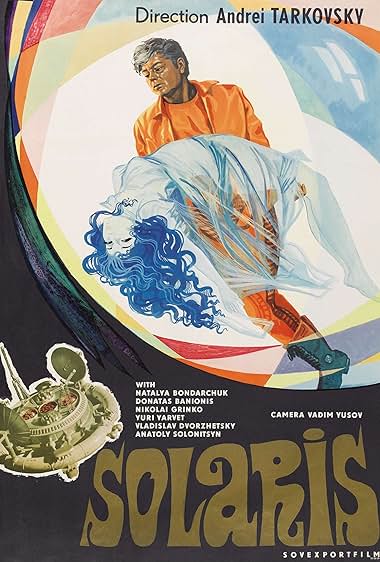

Un psychologue est envoyé dans une station spatiale en orbite autour d'une planète lointaine afin de découvrir pourquoi l'équipage a perdu la raison.Un psychologue est envoyé dans une station spatiale en orbite autour d'une planète lointaine afin de découvrir pourquoi l'équipage a perdu la raison.Un psychologue est envoyé dans une station spatiale en orbite autour d'une planète lointaine afin de découvrir pourquoi l'équipage a perdu la raison.
- Réalisation
- Scénaristes
- Vedettes
- Prix
- 2 victoires et 4 nominations au total


- Doktor Snaut, kibernetik
- (as Yuri Yarvet)


- Mat Krisa Kelvina
- (as O. Barnet)
- Syn Anri Bertona
- (as V. Kerdimun)

- Gostya doktora Gribaryana
- (as O. Kizilova)
- Plemyannitsa Krisa Kelvina
- (as T. Malykh)
- Shanakhan, predsedatel komissii Anri Bertona
- (as A. Misharin)
- Professor Tarkhe
- (as B. Oganesyan)
- Anna, tetka Krisa Kelvina
- (as T. Ogorodnikova)

- Doktor Gribaryan, fiziolog
- (as S. Sarkisyan)
- Predsedatel nauchnoy konferentsii
- (as Yu. Semyonov)
- Chlen uchenogo soveta
- (as V. Statsinskiy)

- Professor Messendzher
- (as G. Teykh)
Avis en vedette
I know that many friends to whom I've shown this move did not understand it. So I'm not saying you'll like it. But this is possibly the best (non-action) sci-fi movie ever made.
Watch it at night, alone, when everything out of your home is dark, silent, and cold.
It raises a lot of interesting questions about the nature of humanity, conscience, love, etc. which, honestly, I'd never thought to ask before, and don't care enough to answer now that they HAVE been asked. (Will Shame really save humanity? Who knows? Maybe. How will it do that? Haven't a clue. Now what's for lunch?) That's not to say I didn't like the movie. I did. It's very beautifully shot, such that I think it would be worth purchasing, even if I never sit through the whole thing again, just so that I can have scenes like "City of the Future" on hand as a reference for my own film-making endeavors.
Speaking of which: "City of the Future" is a very long scene consisting entirely of one character driving through the streets of Japan. It's supposed to look like, well, a city of the future, but to modern American audiences, it won't very much. It just looks like a guy driving his car through a series of tunnels, and past a series of skyscrapers, as day turns gradually into night. It goes on for five minutes.
But here's the thing, the paradox of this film: It didn't bother me that there is a five minute sequence consisting of nothing but shots of traffic. In fact, I loved it. It's an amazing scene, really quite beautiful in its own way. And a lot of the film is like that. It's slow and confusing, but still, it's never boring. Even once Kelvin gets aboard the Space Station, wherein 90% of the decor looks exactly the same. It's still fascinating to look at.
And the weird thing is, I can't figure out why. I mean, when I tried to watch 2001, another very long, beautifully shot movie set largely in space... I was bored literally to tears in the first 10 minutes, and had to shut it off. (No offense to fans of the film; I realize how incredibly crass I am for failing to recognize the genius of 2001. It's something I will just have to come to terms with on my own.) But for some reason, while watching Solaris, even when absolutely nothing was happening, I could not tear my eyes away. I have the strangest feeling that, if I were indeed to watch the movie again--without the subtitles--it could become one of my all-time favorites.
I don't know if I can recommend this film to others or not, because I have no idea if anyone else will share my sentiments. I don't know who will understand it and who won't, or who will even think it's worth trying to understand. There are, of course, some people who absolutely love it, and probably even some who understand it (or think they do), because... well, it's a classic, and a movie doesn't become a classic if nobody likes or understands it. But there are probably just as many people who hate it, because... well, it's a three-hour Russian movie.
At any rate, though, I think it's at least worth a look. If you find it boring, slow, incomprehensible, whatever... just turn it off. No big deal. But, on the other hand, if you find yourself inexplicably compelled to keep watching, unwilling or unable to tear yourself away for a single frame... well, then, you're welcome.
So comes December 2009, and Film 4 show both Solaris films. I sat transfixed by the Russian film. Visually it is a thing of beauty, and it is a rare thing - a film which requires input from the viewer. This movie requires you to think for yourself...and some people find that difficult.
I enjoy a rip-snorting entertaining action movie as much as most people, but rare films like Solaris leave me feeling so much more fulfilled. There are ambiguities, not so much loose ends untied as dots which the viewer is required to connect for himself.
Try Solaris. If you find yourself twiddling your thumbs after 15 minutes then its probably not for you. If you find yourself glued to the screen then you know how I feel about this film.
As with most movies that have been saddled with the word "greatness," I understand why "Solaris" is considered to be such a watershed movie and so revered by so many, but I have to admit that I didn't personally feel myself responding to it all that much. Maybe I would on a second (or third or fourth) viewing, but I can't say I'm very compelled to watch it again. It's cerebral and philosophical, which I expected, and a bit cold and emotionally uninvolving despite the fact that it's about almost nothing but human emotions and how we react to life's biggest mysteries. I didn't warm much to the characters or ever really think of them as individual human beings so much as necessary conduits for communicating the film's philosophical ruminations. Despite being set in the vast reaches of space, it's a claustrophobic movie, which I think is intentional. We never see space, only the cramped interiors of a spaceship, and that feels right, since the movie is more about the vast universe contained within Man's head than it is about the great physical universe beyond our solar system's borders.
What I liked most about "Solaris" is that it suggests that Man isn't really developed enough to handle breakthroughs in our understanding of the larger universe. Given the chance to explore space and engage with elements beyond our comprehension, the characters in the movie instead spend all of their time ruminating over and regretting the people they left behind on Earth and the mistakes they made there. It's almost like Mankind turns to solving giant huge mysteries as a distraction from the fact that we're not capable of cracking the lesser, more mundane mysteries of everyday life, like love, commitment, and dependence on one another.
"Solaris" does have one chilling and memorable ending, I'll give it that. If we go poking around in what we don't understand, it seems to say, we may very well find ourselves unable to return to what we do.
Grade: A-
As some other reviewer said, I had the feeling through the first one hour or so that some scenes went on for too long, or seemed a bit unnecessary and that it was too slow for the message to clearly be presented. But after a while, the slow pacing DID have a positive impact on the context of the film and on the "dialogue" between the film and the viewer. Anyway, after its plain & simple beginning, when the "action" is taken to the space station things get more and more interesting. No spoon-feeding here, as well. If you want all the mysteries in a film to be solved and explained, then you might not wanna see this, because the film is up to the viewer to think and dive in deep. Anyway, it ended up satisfying and leaving one in thoughts.
I am so glad I got to see this fabulous thoughtful movie. It's full of nice visuals and context. A recommendation to all who are fed up with Hollywood crap - but even Hollywood geeks could find many in this, if they can tolerate with the slow pace...





Le saviez-vous
- AnecdotesThis was the most widely seen of Andrei Tarkovsky's films outside of the Soviet Union. However, Tarkovsky himself reportedly considered it the least favorite of the films he directed. Not being a fan of the science fiction genre (which he criticized for its "comic book trappings and vulgar commercialism"), he was nevertheless persuaded to propose this adaptation of the eponymous and popular sci-fi novel 'Solaris' to appease the Soviet censors. However, he considered the film an artistic failure because of its need for technological dialogue and special effects, which prevented it from transcending its genre; something he believed his movie Stalker (1979) did better.
- GaffesAt the moment when the station attains zero gravity, the candlestick passes floating in the air, with the flames burning the same as in earth. Actually, with zero gravity, the fire doesn't go upward, candle flames would rather be spherical and very weak (blue).
- Citations
Dr. Snaut: Science? Nonsense! In this situation mediocrity and genius are equally useless! I must tell you that we really have no desire to conquer any cosmos. We want to extend the Earth up to its borders. We don't know what to do with other worlds. We don't need other worlds. We need a mirror. We struggle to make contact, but we'll never achieve it. We are in a ridiculous predicament of man pursuing a goal that he fears and that he really does not need. Man needs man!
- Autres versionsThe Region-4 DVD was released by Shock as part of its Distinction Series and runs at 2 hours and 49 minutes, with some noticeable cut scenes throughout the films. This 2-disc set doesn't contain any deleted/alternate scenes.
- ConnexionsEdited into Spisok korabley (2008)
- Bandes originalesThe Little Organ Book: Ich Ruf Zu Dir, Herr Jesu Christ - BWV 639
Composed by Johann Sebastian Bach (as I. S. Bakh)
Meilleurs choix
Détails
- Date de sortie
- Pays d’origine
- Sites officiels
- Langues
- Aussi connu sous le nom de
- Điều Tạo Nên Con Người
- Lieux de tournage
- Akasaka, Minato, Japon(Berton's car scenes)
- sociétés de production
- Consultez plus de crédits d'entreprise sur IMDbPro
Box-office
- Budget
- 1 000 000 RUR (estimation)
- Brut – États-Unis et Canada
- 22 168 $ US
- Fin de semaine d'ouverture – États-Unis et Canada
- 11 537 $ US
- 15 sept. 2002
- Brut – à l'échelle mondiale
- 230 989 $ US
- Durée
- 2h 47m(167 min)
- Couleur
- Mixage
- Rapport de forme
- 2.35 : 1