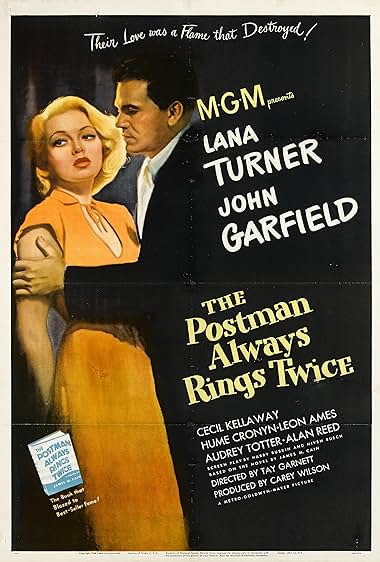
Une femme mariée et un vagabond tombent amoureux, puis complotent pour assassiner son mari. Une fois passés à l'acte, ils doivent vivre avec les conséquences de leurs agissements.Une femme mariée et un vagabond tombent amoureux, puis complotent pour assassiner son mari. Une fois passés à l'acte, ils doivent vivre avec les conséquences de leurs agissements.Une femme mariée et un vagabond tombent amoureux, puis complotent pour assassiner son mari. Une fois passés à l'acte, ils doivent vivre avec les conséquences de leurs agissements.
- Réalisation
- Scénaristes
- Vedettes
- Prix
- 3 victoires au total
- Photographer
- (uncredited)
- Photographer
- (uncredited)
- Orderly Pushing Wheelchair
- (uncredited)
- Judge
- (uncredited)
- Courtroom Spectator
- (uncredited)
- Customer
- (uncredited)
- Man
- (uncredited)
- Danielle - Ben's Twin Girl
- (uncredited)
- Yvette - Ben's Twin Girl
- (uncredited)
- Ben
- (uncredited)
Avis en vedette
Anyway, I like the film and think it's a great straight adaptation of the book, though the dialogue in the beginning seems a bit hurried (for the sake of the quick establishment of character and story) - the book does a better job of painting the hobo/gypsy lifestyle Frank embraces, and I think it's pretty central to the eventual conflict between him and Cora, so it's a shame it wasn't better depicted in the film.
Lana Turner is good, but probably just a bit mis-cast - she's a little too "glamorous" for Cora, which is also established immediately in the famous opening shot of her legs and lipstick (in contrast to the book, where she was introduced in an apron, working hard for the business like she always says she wants to.)
One note for femme-fatale buffs: Cora and Nick in the film are surnamed "Smith," which in the book was Cora's maiden name. (Nick in the book was Greek - "Papadakis") Is this a statement on marriage in general, or perhaps a desire to eliminate the racial implications in what happens? Seems unlikely; it is what it is, for smarter people than me to unravel.
"So long mister, thanks for the ride!"
James M. Cain's novel of the same title was adapted by Harry Ruskin and Niven Busch, two writers that clearly caught all the nuances of the book. Ty Garnett direction made this film a surprise and a star out of the gorgeous Lana Turner, who was at the height of her beauty when the movie was shot. The great camera work of Sidney Wagner made this movie a classic for its sensual look it focused on its female star.
Nick, the older owner of the roadside diner, has married Cora, a woman much too young for him. Cora, who clearly has found her meal ticket, is happy in the way her life has changed. When Frank Chambers arrive at the diner, Cora realizes the mistake she made in marrying Nick; Frank stands in sharp contrast with Nick. Cora's sexual needs awaken when Frank pays attention to her. As lovers, we realize they are doomed.
Because both Cora and Frank are amateurs, they botch the well laid plans they have for getting rid of Nick. Everything conspires against them because it's too clear what they have done. They will not be able to get away with the crime, or a life together because unknown to them everyone had seen through them from the beginning.
Lana Turner, whose whole wardrobe is white, made a great Cora. She is heartless, but she is all sexual whenever she is around Frank. This was perhaps was one of the best things Ms. Turner did in the movies. John Garfield, who is so sure of himself, at the start, loses all his will because Cora smolders him and he doesn't think rationally. Cecil Kellaway is good as the older Nick. Leon Ames, Hume Cronyn are seen in small roles.
"The Postman Always Ring Twice" is a classic of this genre thanks to Ty Garnett's direction and a brilliant appearance by an inspired Lana Turner.
Every scene she's in is captivating, mostly because she's hot enough to boil mercury. Her eyes alone are ample reason to watch this film. From the moment Frank Chambers (John Garfield) first sees Cora at the diner, we know he's doomed. As femme fatales go, Ms. Turner is in the upper echelon.
The story and setup are very effective, and Cecil Kellaway plays the perfect dupe as Cora's older, all-too-trusting husband. The Director manages to tow the censorship line while still allowing our minds to fry.
Leon Ames and Hume Cronyn perform admirably as District Attorney Kyle Sackett and sleazy defense lawyer, Arthur Keats, respectively.
A true classic of the subgenre...
A classic bit of noir light. Based on Cain's sexual novel this underplays the explicit references but turns the subtle stuff way up - the film opens with a `Man Wanted' sign, while Cora is so well played that there's no doubt what she's offering. Without the explicit sex of the remake this story is a lot freer to be interesting rather than explicit. The court case and the mistrust between the lovers is as good as the early desire giving rise to murder.
Lana Turner is excellent as the femme fatale, she is smouldering and very, very desirable. Garfield is also excellent as the man trapped in her web. The two are the very center of the film and are both superb. If the film has any weakness then it may be that modern audiences need more than very subtle stuff, but that's probably our problem rather than the film's.
Overall this is very enjoyable, it has a great sense of mood and builds well to the inevitable conclusion.
Le saviez-vous
- AnecdotesJames M. Cain was so impressed with Lana Turner's performance he presented her with a leather-bound copy of the book inscribed, "For my dear Lana, thank you for giving a performance that was even finer than I expected."
- GaffesWhen Cora opens the cash register to leave a note, the bill in the register is a Confederate one-dollar bill.
This is not an "Anachronism", as Confederate money certainly existed in the 1940s, though it might be considered odd that the proprietor accepted it.
- Citations
Cora Smith: It's too bad Nick took the car.
Frank Chambers: Even if it was here, we couldn't take it, unless we'd want to spend the night in jail. Stealing a man's wife, that's nothing, but stealing a man's car, that's larceny.
- Générique farfeluOpening and ending credits are shown over the hardcover book of the same name.
- Autres versionsAlso available in a computer colorized version.
- ConnexionsEdited into Les Cadavres ne portent pas de costard (1982)
- Bandes originalesShe's Funny That Way
(1928) (uncredited)
Music by Neil Moret
Lyrics by Richard A. Whiting
Played on guitar and Sung by Cecil Kellaway
Meilleurs choix
Détails
- Date de sortie
- Pays d’origine
- Langue
- Aussi connu sous le nom de
- The Postman Always Rings Twice
- Lieux de tournage
- Laguna Beach, Californie, États-Unis(beach scenes)
- société de production
- Consultez plus de crédits d'entreprise sur IMDbPro
Box-office
- Budget
- 1 683 000 $ US (estimation)
- Brut – à l'échelle mondiale
- 35 $ US
- Durée
- 1h 53m(113 min)
- Couleur
- Rapport de forme
- 1.37 : 1