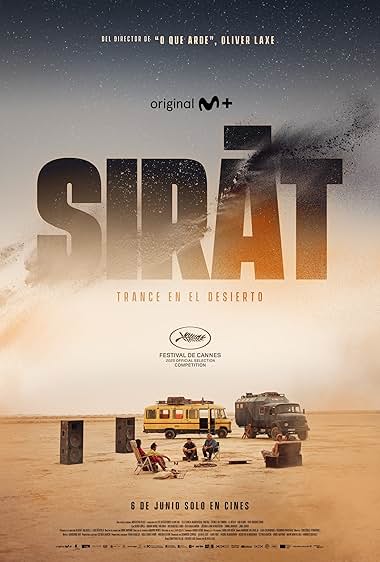

Un hombre y su hijo que llegan a una rave perdidos en medio de lo que se describen como las áridas y fantasmagóricas montañas del sur de Marruecos.Un hombre y su hijo que llegan a una rave perdidos en medio de lo que se describen como las áridas y fantasmagóricas montañas del sur de Marruecos.Un hombre y su hijo que llegan a una rave perdidos en medio de lo que se describen como las áridas y fantasmagóricas montañas del sur de Marruecos.
- Dirección
- Escritura
- Estrellas
- Premios
- 12 premios ganados y 68 nominaciones en total
![Trailer - [OV]](https://m.media-amazon.com/images/M/MV5BZTM5NWYyNWItNTZiMi00ZDgxLWE5NmUtMDcwNmFiNDRlNjJiXkEyXkFqcGdeQXRyYW5zY29kZS13b3JrZmxvdw@@._V1_QL75_UX1000_CR0,0,1000,563_.jpg)


- Dirección
- Escritura
- Todo el elenco y el equipo
- Producción, taquilla y más en IMDbPro
Opiniones destacadas
Sirat is a profound meditation on the fragility of the human condition and the illusions of safety embedded in the Western worldview. Oliver Laxe challenges our assumptions of stability, revealing how easily the structures we rely on-both physical and emotional-can be shaken by the randomness of life. Through its stripped-down narrative and haunting visual poetry, the film reminds us of our vulnerability and the urgent need for humility when confronting the unexpected. Sirat is not just a cinematic experience; it's a quiet, powerful wake-up call.
The film also fosters a deep sense of empathy toward those who live in regions marked by material hardship and constant insecurity. By immersing us in a reality so far removed from Western comfort, Sirat dismantles the distance between "us" and "them." It allows us to feel, however briefly, the weight of a life lived without guarantees. In doing so, it encourages a more compassionate and humble perspective toward those whose daily lives are shaped by instability, reminding us that resilience is often born from circumstances we can barely imagine.
The film also fosters a deep sense of empathy toward those who live in regions marked by material hardship and constant insecurity. By immersing us in a reality so far removed from Western comfort, Sirat dismantles the distance between "us" and "them." It allows us to feel, however briefly, the weight of a life lived without guarantees. In doing so, it encourages a more compassionate and humble perspective toward those whose daily lives are shaped by instability, reminding us that resilience is often born from circumstances we can barely imagine.
"Oh, it's a new concept, a rave movie, you have to feel the vibe." But what kind of vibe does this movie actually give us? In the beginning, I was expecting a strong plot development: a father and his son desperately searching for a missing daughter. That setup had potential for suspense and emotional depth. Instead, the movie suddenly derails into nonsensical filmography filled with random, poorly executed deaths that add nothing to the story. The supposed "rave vibe" is just chaotic editing, flashing lights, and hollow noise that never manages to immerse you. And then it all ends abruptly, with no resolution, no explanation, and no sense of closure.
This "road movie" speaks of more than just a simple trip: it's the chronicle of an inner journey disguised as a dusty route, a path where decisions weigh more than the miles and where the unexpected becomes a permanent co-pilot. It's an exciting and dangerous crossing in which reaching that party is barely an excuse -almost an afterthought- while the desert dust becomes the only loyal companion, supplies and fuel turn into treasures of great value, and LSD opens the door to a fleeting refuge where inner scars are neither seen nor felt.
The result is a blend of genres that shifts between family drama, western, adventure, and thriller, as if the film itself needed to get lost in order to find its way. Because, in the end, this sensory journey to nowhere speaks precisely of that: moving forward, even without knowing where to, hoping that-for once-the destination matters less than the road.
The result is a blend of genres that shifts between family drama, western, adventure, and thriller, as if the film itself needed to get lost in order to find its way. Because, in the end, this sensory journey to nowhere speaks precisely of that: moving forward, even without knowing where to, hoping that-for once-the destination matters less than the road.
This is one of those movies where multiple characters just keep making poor decisions. You want them to come to their senses, but their journey is the point.
Here's a group of broken people dealing with trauma in a way most of us would find alarming (to say the least).
But it's not just that. There's a hypnotic, pulsating energy throughout due to the amazing score and tight pacing. The desert of Morocco, which is the setting for the entire film, is unassuming until it's not.
You're left wondering about these people, what came before and what comes after. There are no easy explanations here, but the sense of danger certainly makes you feel alive.
Here's a group of broken people dealing with trauma in a way most of us would find alarming (to say the least).
But it's not just that. There's a hypnotic, pulsating energy throughout due to the amazing score and tight pacing. The desert of Morocco, which is the setting for the entire film, is unassuming until it's not.
You're left wondering about these people, what came before and what comes after. There are no easy explanations here, but the sense of danger certainly makes you feel alive.
The road movie-or road story-has been a device used by storytellers since the first fictional tale was inscribed onto a tablet with The Epic of Gilgamesh. There is something about traversing space that reflects the movement and growth of a character, offering a tidy structure to present challenges for the hero to overcome and learn from. Yet the use of the mythical journey-a descent into an otherworldly realm-is far less common today than it was for the Ancient Greeks, with stories like Orpheus or The Odyssey. Instead, contemporary cinema often opts for a more literal exploration of self-discovery, as seen in Nomadland (2020). Oliver Laxe, the Franco-Hispanic director, revives the ancient mythic descent in his latest Cannes-winning film, Sirat (2025).
Sirat follows a Spanish father, Luis (Sergi López), who is searching for his missing daughter, Mar, with his young son Esteban (Bruno Núñez Arjona), amid a techno rave in the Moroccan desert. They fall in with a group of partygoers headed to a second rave across the barren landscape, where Mar may be. Luis and Esteban embark on a treacherous journey across the unforgiving land, questioning whether they can trust their punkish companions-and whether the ominous feeling gnawing at their gut is a warning worth heeding.
Sirat refers to the mythical bridge between paradise and hell-said to be thinner than a strand of hair. Laxe immerses viewers in a techno-soaked atmosphere through patient, detail-oriented framing, with hypnotic images of the wide-open desert that evoke David Lean's Lawrence of Arabia (1962). He lulls us with the pulsing dance scenes while building a creeping sense of unease, as Luis observes odd yet plausibly dismissible behavior from their fellow travelers. As the hero's journey unfolds, we begin to wonder: Are the characters crossing the Sirat from paradise or from hell-and is the answer waiting for them at the end?
This tonal and visual tightrope is held aloft by the exceptional collaboration between cinematographer Mauro Herce and the pulsating techno score by Kangding Ray. The entire experience is orchestrated with confident aplomb by Laxe's steady hand.
In many ways, Sirat recalls Laxe's earlier film Fire Will Come (2019): it begins with a structured plot, only to slowly shed narrative momentum in favor of aesthetic and liminal exploration. What starts as a simple missing-person thriller gradually morphs into something dreamlike and uncanny. By the third act, we feel less like Sherlock Holmes and more like Dante Alighieri, crossing through a strange and fearsome world with nothing but our curiosity and dread to guide us.
This descent into the opaque and magical will enthrall some viewers-those attuned to the sensibilities of Gaspar Noé or the Mad Max films. But Laxe's choice to begin with a more conventional setup may leave others feeling betrayed when the story abandons its initial promises. A more consistent tone from the outset might have delivered a stronger narrative throughline and greater emotional payoff.
The cast is uniformly strong. Veteran actor Sergi López anchors the film with quiet intensity, while young Bruno Núñez Arjona is commanding as Esteban. The punk group-played by Stefania Gadda, Joshua Liam Henderson, Richard Bellamy, Tonin Janvier, and Jade Oukid-bring an impressive ability to sketch distinct, layered characters. Remarkably, Laxe gives us no backstories. Instead, through small quotidian moments, the characters accrue a depth that no exposition-heavy monologue could ever hope to achieve.
In the end, Sirat is both a mesmerizing trip and an unsettling descent. Laxe once again reveals his fascination with liminal and mystical spaces, especially in how they intersect with our relationship to a harsh natural world. One can only hope he continues to lead us through these hypnotic, fearsome landscapes in his future films.
Sirat follows a Spanish father, Luis (Sergi López), who is searching for his missing daughter, Mar, with his young son Esteban (Bruno Núñez Arjona), amid a techno rave in the Moroccan desert. They fall in with a group of partygoers headed to a second rave across the barren landscape, where Mar may be. Luis and Esteban embark on a treacherous journey across the unforgiving land, questioning whether they can trust their punkish companions-and whether the ominous feeling gnawing at their gut is a warning worth heeding.
Sirat refers to the mythical bridge between paradise and hell-said to be thinner than a strand of hair. Laxe immerses viewers in a techno-soaked atmosphere through patient, detail-oriented framing, with hypnotic images of the wide-open desert that evoke David Lean's Lawrence of Arabia (1962). He lulls us with the pulsing dance scenes while building a creeping sense of unease, as Luis observes odd yet plausibly dismissible behavior from their fellow travelers. As the hero's journey unfolds, we begin to wonder: Are the characters crossing the Sirat from paradise or from hell-and is the answer waiting for them at the end?
This tonal and visual tightrope is held aloft by the exceptional collaboration between cinematographer Mauro Herce and the pulsating techno score by Kangding Ray. The entire experience is orchestrated with confident aplomb by Laxe's steady hand.
In many ways, Sirat recalls Laxe's earlier film Fire Will Come (2019): it begins with a structured plot, only to slowly shed narrative momentum in favor of aesthetic and liminal exploration. What starts as a simple missing-person thriller gradually morphs into something dreamlike and uncanny. By the third act, we feel less like Sherlock Holmes and more like Dante Alighieri, crossing through a strange and fearsome world with nothing but our curiosity and dread to guide us.
This descent into the opaque and magical will enthrall some viewers-those attuned to the sensibilities of Gaspar Noé or the Mad Max films. But Laxe's choice to begin with a more conventional setup may leave others feeling betrayed when the story abandons its initial promises. A more consistent tone from the outset might have delivered a stronger narrative throughline and greater emotional payoff.
The cast is uniformly strong. Veteran actor Sergi López anchors the film with quiet intensity, while young Bruno Núñez Arjona is commanding as Esteban. The punk group-played by Stefania Gadda, Joshua Liam Henderson, Richard Bellamy, Tonin Janvier, and Jade Oukid-bring an impressive ability to sketch distinct, layered characters. Remarkably, Laxe gives us no backstories. Instead, through small quotidian moments, the characters accrue a depth that no exposition-heavy monologue could ever hope to achieve.
In the end, Sirat is both a mesmerizing trip and an unsettling descent. Laxe once again reveals his fascination with liminal and mystical spaces, especially in how they intersect with our relationship to a harsh natural world. One can only hope he continues to lead us through these hypnotic, fearsome landscapes in his future films.




¿Sabías que…?
- TriviaSpain's candidate for the Oscars in the 98th edition of 2025.
Selecciones populares
Inicia sesión para calificar y agrega a la lista de videos para obtener recomendaciones personalizadas
2025 TIFF Festival Guide
2025 TIFF Festival Guide
See the current lineup for the 50th Toronto International Film Festival this September.

Detalles
- Fecha de lanzamiento
- Países de origen
- Idiomas
- También se conoce como
- Sirat
- Locaciones de filmación
- Bouarfa, Oriental, Morocco(ending sequence on a train)
- Productoras
- Ver más créditos de la compañía en IMDbPro
Taquilla
- Total en EE. UU. y Canadá
- USD 34,057
- Fin de semana de estreno en EE. UU. y Canadá
- USD 34,057
- 16 nov 2025
- Total a nivel mundial
- USD 9,399,158
- Tiempo de ejecución
- 1h 55min(115 min)
- Color
- Mezcla de sonido
- Relación de aspecto
- 1.85 : 1
Contribuir a esta página
Sugiere una edición o agrega el contenido que falta