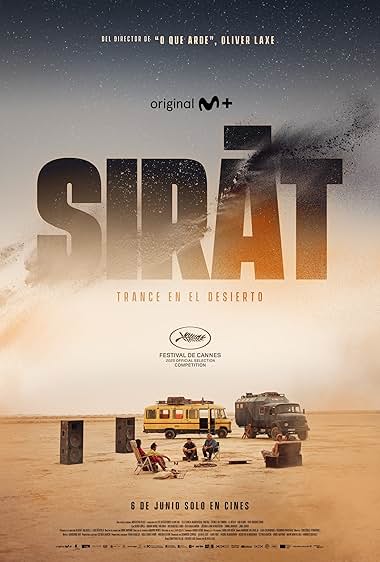

Un hombre y su hijo que llegan a una rave perdidos en medio de lo que se describen como las áridas y fantasmagóricas montañas del sur de Marruecos.Un hombre y su hijo que llegan a una rave perdidos en medio de lo que se describen como las áridas y fantasmagóricas montañas del sur de Marruecos.Un hombre y su hijo que llegan a una rave perdidos en medio de lo que se describen como las áridas y fantasmagóricas montañas del sur de Marruecos.
- Dirección
- Escritura
- Estrellas
- Premios
- 12 premios ganados y 66 nominaciones en total
![Trailer - [OV]](https://m.media-amazon.com/images/M/MV5BZTM5NWYyNWItNTZiMi00ZDgxLWE5NmUtMDcwNmFiNDRlNjJiXkEyXkFqcGdeQXRyYW5zY29kZS13b3JrZmxvdw@@._V1_QL75_UX1000_CR0,0,1000,563_.jpg)


- Dirección
- Escritura
- Todo el elenco y el equipo
- Producción, taquilla y más en IMDbPro
Opiniones destacadas
Married coupled with hectic lives and busy agendas might recognize this scenario. My wife and I unexpectedly had the occasion to go to the cinema without our children, but it was very last-minute on a Saturday night. The only reasonably comfortable seats that were still available were for either an undemanding but nasty horror flick ("Clown in a Cornfield") or for the undoubtedly superior but obviously anti-entertaining and mentally devastating "Sirât". The partner doesn't want to see any spooky clowns on the big screen, so we went for Cannes' Jury Prize winning drama "Sirât".
Evidently, "Sirât" is a great film. It even is a marvelous, mesmerizing, and truly unforgettable film, but - oh dear God - how miserable and depressed can just one film make you feel?!? Of course you know from beforehand it won't be a feelgood comedy, but still I wasn't sufficiently prepared for the type of uncomfortably slow-paced, painfully realistic, and emotionally exhausting movie we watched. And yet, it's also one of the most beautiful (in terms of locations & cinematography) and rhythmically pounding (the techno soundtrack) movies we watched in a long time.
"Sirât" begins with a long - very long - sequence at an illegal rave in Morocco, on the border of the Sahara Desert. The preparation for the event, and the rave itself, are depicted without any dialogue but the music and the extended footage of approximately 100-150 people dancing puts you right in the middle. Strolling through the masses, a middle-aged father and his son are looking for their daughter/sister who's been missing for five months. When the rave is rudely ended by army forces, the father (Louis) and son (Esteban) join the organizers of the rave on their trip to the opposite side of the desert, to Mauretania, where another illegal party will be held. Louis' vehicle is clearly not fit for the trip. Louis and Esteban themselves are clearly not fit for the trip. The pack of ravers clearly also underestimated the unpredictability and hazards of the trip... And did I mention that ominous news bulletins on the radio in the background suggest that World War III broke out?
Like an impeccable master, writer/director Oliver Laxe messes and toys around with the viewers' patience, emotions, and deepest fears. It's the kind of film where nothing relevant happens for long periods of time, just vehicles driving or characters staring into the unknown, but your brain nevertheless remains alert and your senses work overtime. It's also the type of film where you squirm in your seat because you sense something tragic is about to happen, but then ... doesn't. Yet, when you least suspect it, something far worse than you could have imagined happens! Laxe pulls off this trick three, four times until you're left behind utterly shocked & perplexed when the end credits start rolling. "Sirât" is a unique film. Beautiful, haunting, thought-provoking, saddening, ... unforgettable. Perhaps not the type of motion picture you wish to see after a long and stressful week, or in case you're already in agony with regards to everything that is happening in this miserable world, but a masterwork nonetheless.
Evidently, "Sirât" is a great film. It even is a marvelous, mesmerizing, and truly unforgettable film, but - oh dear God - how miserable and depressed can just one film make you feel?!? Of course you know from beforehand it won't be a feelgood comedy, but still I wasn't sufficiently prepared for the type of uncomfortably slow-paced, painfully realistic, and emotionally exhausting movie we watched. And yet, it's also one of the most beautiful (in terms of locations & cinematography) and rhythmically pounding (the techno soundtrack) movies we watched in a long time.
"Sirât" begins with a long - very long - sequence at an illegal rave in Morocco, on the border of the Sahara Desert. The preparation for the event, and the rave itself, are depicted without any dialogue but the music and the extended footage of approximately 100-150 people dancing puts you right in the middle. Strolling through the masses, a middle-aged father and his son are looking for their daughter/sister who's been missing for five months. When the rave is rudely ended by army forces, the father (Louis) and son (Esteban) join the organizers of the rave on their trip to the opposite side of the desert, to Mauretania, where another illegal party will be held. Louis' vehicle is clearly not fit for the trip. Louis and Esteban themselves are clearly not fit for the trip. The pack of ravers clearly also underestimated the unpredictability and hazards of the trip... And did I mention that ominous news bulletins on the radio in the background suggest that World War III broke out?
Like an impeccable master, writer/director Oliver Laxe messes and toys around with the viewers' patience, emotions, and deepest fears. It's the kind of film where nothing relevant happens for long periods of time, just vehicles driving or characters staring into the unknown, but your brain nevertheless remains alert and your senses work overtime. It's also the type of film where you squirm in your seat because you sense something tragic is about to happen, but then ... doesn't. Yet, when you least suspect it, something far worse than you could have imagined happens! Laxe pulls off this trick three, four times until you're left behind utterly shocked & perplexed when the end credits start rolling. "Sirât" is a unique film. Beautiful, haunting, thought-provoking, saddening, ... unforgettable. Perhaps not the type of motion picture you wish to see after a long and stressful week, or in case you're already in agony with regards to everything that is happening in this miserable world, but a masterwork nonetheless.
The road movie-or road story-has been a device used by storytellers since the first fictional tale was inscribed onto a tablet with The Epic of Gilgamesh. There is something about traversing space that reflects the movement and growth of a character, offering a tidy structure to present challenges for the hero to overcome and learn from. Yet the use of the mythical journey-a descent into an otherworldly realm-is far less common today than it was for the Ancient Greeks, with stories like Orpheus or The Odyssey. Instead, contemporary cinema often opts for a more literal exploration of self-discovery, as seen in Nomadland (2020). Oliver Laxe, the Franco-Hispanic director, revives the ancient mythic descent in his latest Cannes-winning film, Sirat (2025).
Sirat follows a Spanish father, Luis (Sergi López), who is searching for his missing daughter, Mar, with his young son Esteban (Bruno Núñez Arjona), amid a techno rave in the Moroccan desert. They fall in with a group of partygoers headed to a second rave across the barren landscape, where Mar may be. Luis and Esteban embark on a treacherous journey across the unforgiving land, questioning whether they can trust their punkish companions-and whether the ominous feeling gnawing at their gut is a warning worth heeding.
Sirat refers to the mythical bridge between paradise and hell-said to be thinner than a strand of hair. Laxe immerses viewers in a techno-soaked atmosphere through patient, detail-oriented framing, with hypnotic images of the wide-open desert that evoke David Lean's Lawrence of Arabia (1962). He lulls us with the pulsing dance scenes while building a creeping sense of unease, as Luis observes odd yet plausibly dismissible behavior from their fellow travelers. As the hero's journey unfolds, we begin to wonder: Are the characters crossing the Sirat from paradise or from hell-and is the answer waiting for them at the end?
This tonal and visual tightrope is held aloft by the exceptional collaboration between cinematographer Mauro Herce and the pulsating techno score by Kangding Ray. The entire experience is orchestrated with confident aplomb by Laxe's steady hand.
In many ways, Sirat recalls Laxe's earlier film Fire Will Come (2019): it begins with a structured plot, only to slowly shed narrative momentum in favor of aesthetic and liminal exploration. What starts as a simple missing-person thriller gradually morphs into something dreamlike and uncanny. By the third act, we feel less like Sherlock Holmes and more like Dante Alighieri, crossing through a strange and fearsome world with nothing but our curiosity and dread to guide us.
This descent into the opaque and magical will enthrall some viewers-those attuned to the sensibilities of Gaspar Noé or the Mad Max films. But Laxe's choice to begin with a more conventional setup may leave others feeling betrayed when the story abandons its initial promises. A more consistent tone from the outset might have delivered a stronger narrative throughline and greater emotional payoff.
The cast is uniformly strong. Veteran actor Sergi López anchors the film with quiet intensity, while young Bruno Núñez Arjona is commanding as Esteban. The punk group-played by Stefania Gadda, Joshua Liam Henderson, Richard Bellamy, Tonin Janvier, and Jade Oukid-bring an impressive ability to sketch distinct, layered characters. Remarkably, Laxe gives us no backstories. Instead, through small quotidian moments, the characters accrue a depth that no exposition-heavy monologue could ever hope to achieve.
In the end, Sirat is both a mesmerizing trip and an unsettling descent. Laxe once again reveals his fascination with liminal and mystical spaces, especially in how they intersect with our relationship to a harsh natural world. One can only hope he continues to lead us through these hypnotic, fearsome landscapes in his future films.
Sirat follows a Spanish father, Luis (Sergi López), who is searching for his missing daughter, Mar, with his young son Esteban (Bruno Núñez Arjona), amid a techno rave in the Moroccan desert. They fall in with a group of partygoers headed to a second rave across the barren landscape, where Mar may be. Luis and Esteban embark on a treacherous journey across the unforgiving land, questioning whether they can trust their punkish companions-and whether the ominous feeling gnawing at their gut is a warning worth heeding.
Sirat refers to the mythical bridge between paradise and hell-said to be thinner than a strand of hair. Laxe immerses viewers in a techno-soaked atmosphere through patient, detail-oriented framing, with hypnotic images of the wide-open desert that evoke David Lean's Lawrence of Arabia (1962). He lulls us with the pulsing dance scenes while building a creeping sense of unease, as Luis observes odd yet plausibly dismissible behavior from their fellow travelers. As the hero's journey unfolds, we begin to wonder: Are the characters crossing the Sirat from paradise or from hell-and is the answer waiting for them at the end?
This tonal and visual tightrope is held aloft by the exceptional collaboration between cinematographer Mauro Herce and the pulsating techno score by Kangding Ray. The entire experience is orchestrated with confident aplomb by Laxe's steady hand.
In many ways, Sirat recalls Laxe's earlier film Fire Will Come (2019): it begins with a structured plot, only to slowly shed narrative momentum in favor of aesthetic and liminal exploration. What starts as a simple missing-person thriller gradually morphs into something dreamlike and uncanny. By the third act, we feel less like Sherlock Holmes and more like Dante Alighieri, crossing through a strange and fearsome world with nothing but our curiosity and dread to guide us.
This descent into the opaque and magical will enthrall some viewers-those attuned to the sensibilities of Gaspar Noé or the Mad Max films. But Laxe's choice to begin with a more conventional setup may leave others feeling betrayed when the story abandons its initial promises. A more consistent tone from the outset might have delivered a stronger narrative throughline and greater emotional payoff.
The cast is uniformly strong. Veteran actor Sergi López anchors the film with quiet intensity, while young Bruno Núñez Arjona is commanding as Esteban. The punk group-played by Stefania Gadda, Joshua Liam Henderson, Richard Bellamy, Tonin Janvier, and Jade Oukid-bring an impressive ability to sketch distinct, layered characters. Remarkably, Laxe gives us no backstories. Instead, through small quotidian moments, the characters accrue a depth that no exposition-heavy monologue could ever hope to achieve.
In the end, Sirat is both a mesmerizing trip and an unsettling descent. Laxe once again reveals his fascination with liminal and mystical spaces, especially in how they intersect with our relationship to a harsh natural world. One can only hope he continues to lead us through these hypnotic, fearsome landscapes in his future films.
Oliver Laxe presents his latest work, written in collaboration with Santiago Fillol, a film that delivers a powerful emotional impact in its second half and invites profound philosophical reflection. An intriguing director who is definitely not for the faint of heart.
Starring the talented Sergi López and a cast of non-professional actors, the story follows a man (Sergi López) and his son (Bruno Núñez) who arrive at a remote rave in Morocco. They are searching for Mar, their daughter and sister, who disappeared months ago at one of those endless parties. Surrounded by electronic music and a kind of freedom unknown to them, they distribute her photo repeatedly. Along the way, they meet a group of ravers and decide to follow them to one last party in the desert, hoping to find the missing young woman.
Sirât is a peculiar film, good but peculiar, that shocks with a second half that mentally shatters you with relentless cruelty, fragmenting your mind into tiny, breathless moments. Its director manipulates your emotions and your ability to concentrate in front of the screen with impressive cunning, ensuring that you never lose the thread built in the first half.
It's an unsettling film in its narrative, and while it doesn't particularly resolve its plot points, it goes far beyond that. It's a work that invites constant reflection and poses a challenge about how much we are willing to endure. It also stands out for its manipulation of its protagonists, who are gradually destroyed in their own minds, thanks to an impeccable script that, while not structurally satisfying, proves to be a truly interesting exercise in visual philosophy.
A peculiar undertaking, perhaps not for all audiences, and certainly a film you'll either love or hate with no middle ground. Its strength lies in offering a fascinating sensory experience, where sound is its greatest asset, but its weakness is a somewhat unfinished script that may leave you completely bewildered. Nevertheless, it's an interesting film that takes big risks, with a director of extraordinary intelligence capable of making you feel and then shattering you without warning.
In conclusion...
It's Spain's Oscar submission, and that's quite an achievement. It's an interesting film, not perfect, not for everyone, but it's definitely a work that will leave you stunned, breathless, and unable to laugh. It's a cruel film in every sense, showing no mercy to the viewer in its second half, but it offers many interesting elements to win you over, beyond its invitation to visual philosophy.
Starring the talented Sergi López and a cast of non-professional actors, the story follows a man (Sergi López) and his son (Bruno Núñez) who arrive at a remote rave in Morocco. They are searching for Mar, their daughter and sister, who disappeared months ago at one of those endless parties. Surrounded by electronic music and a kind of freedom unknown to them, they distribute her photo repeatedly. Along the way, they meet a group of ravers and decide to follow them to one last party in the desert, hoping to find the missing young woman.
Sirât is a peculiar film, good but peculiar, that shocks with a second half that mentally shatters you with relentless cruelty, fragmenting your mind into tiny, breathless moments. Its director manipulates your emotions and your ability to concentrate in front of the screen with impressive cunning, ensuring that you never lose the thread built in the first half.
It's an unsettling film in its narrative, and while it doesn't particularly resolve its plot points, it goes far beyond that. It's a work that invites constant reflection and poses a challenge about how much we are willing to endure. It also stands out for its manipulation of its protagonists, who are gradually destroyed in their own minds, thanks to an impeccable script that, while not structurally satisfying, proves to be a truly interesting exercise in visual philosophy.
A peculiar undertaking, perhaps not for all audiences, and certainly a film you'll either love or hate with no middle ground. Its strength lies in offering a fascinating sensory experience, where sound is its greatest asset, but its weakness is a somewhat unfinished script that may leave you completely bewildered. Nevertheless, it's an interesting film that takes big risks, with a director of extraordinary intelligence capable of making you feel and then shattering you without warning.
In conclusion...
It's Spain's Oscar submission, and that's quite an achievement. It's an interesting film, not perfect, not for everyone, but it's definitely a work that will leave you stunned, breathless, and unable to laugh. It's a cruel film in every sense, showing no mercy to the viewer in its second half, but it offers many interesting elements to win you over, beyond its invitation to visual philosophy.
"Sirât" is my this years favourite, for sure. It's not good just because of the seemingly usual road trip story but also because of the music, the power, the atmosphere, the characters - it's literally an audiovisual masterpiece!!
I haven't seen much movies with this kind of hold on me. It guides you to all the characters and when you least expect it, it let's go of your hand. The whole cinema in Cannes was on edge while watching this movie. And for a good reason.
It brings up a wide range of emotions and themes which give room for so many different shades of feelings for every person that experiences this movie.
I haven't seen much movies with this kind of hold on me. It guides you to all the characters and when you least expect it, it let's go of your hand. The whole cinema in Cannes was on edge while watching this movie. And for a good reason.
It brings up a wide range of emotions and themes which give room for so many different shades of feelings for every person that experiences this movie.
This "road movie" speaks of more than just a simple trip: it's the chronicle of an inner journey disguised as a dusty route, a path where decisions weigh more than the miles and where the unexpected becomes a permanent co-pilot. It's an exciting and dangerous crossing in which reaching that party is barely an excuse -almost an afterthought- while the desert dust becomes the only loyal companion, supplies and fuel turn into treasures of great value, and LSD opens the door to a fleeting refuge where inner scars are neither seen nor felt.
The result is a blend of genres that shifts between family drama, western, adventure, and thriller, as if the film itself needed to get lost in order to find its way. Because, in the end, this sensory journey to nowhere speaks precisely of that: moving forward, even without knowing where to, hoping that-for once-the destination matters less than the road.
The result is a blend of genres that shifts between family drama, western, adventure, and thriller, as if the film itself needed to get lost in order to find its way. Because, in the end, this sensory journey to nowhere speaks precisely of that: moving forward, even without knowing where to, hoping that-for once-the destination matters less than the road.




¿Sabías que…?
- TriviaSpain's candidate for the Oscars in the 98th edition of 2025.
Selecciones populares
Inicia sesión para calificar y agrega a la lista de videos para obtener recomendaciones personalizadas
2025 TIFF Festival Guide
2025 TIFF Festival Guide
See the current lineup for the 50th Toronto International Film Festival this September.

Detalles
- Fecha de lanzamiento
- Países de origen
- Idiomas
- También se conoce como
- Sirat
- Locaciones de filmación
- Bouarfa, Oriental, Morocco(ending sequence on a train)
- Productoras
- Ver más créditos de la compañía en IMDbPro
Taquilla
- Total en EE. UU. y Canadá
- USD 34,057
- Fin de semana de estreno en EE. UU. y Canadá
- USD 34,057
- 16 nov 2025
- Total a nivel mundial
- USD 9,396,867
- Tiempo de ejecución
- 1h 55min(115 min)
- Color
- Mezcla de sonido
- Relación de aspecto
- 1.85 : 1
Contribuir a esta página
Sugiere una edición o agrega el contenido que falta