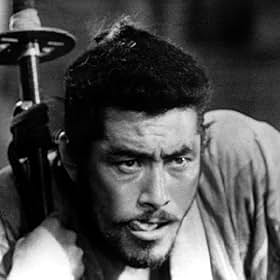
Un astuto samurái ronin llega a un pueblo dividido por dos bandas criminales y decide enfrentar a una contra otra para liberar el pueblo.Un astuto samurái ronin llega a un pueblo dividido por dos bandas criminales y decide enfrentar a una contra otra para liberar el pueblo.Un astuto samurái ronin llega a un pueblo dividido por dos bandas criminales y decide enfrentar a una contra otra para liberar el pueblo.
- Dirección
- Escritura
- Estrellas
- Nominado a 1 premio Óscar
- 5 premios ganados y 2 nominaciones en total
- Dirección
- Escritura
- Todo el elenco y el equipo
- Producción, taquilla y más en IMDbPro
Resumen
Reviewers say 'Yojimbo' is celebrated for Kurosawa's masterful direction, Mifune's compelling performance, and its innovative blend of genres. The film is lauded for its suspenseful narrative, dark humor, and impactful action. Critics praise Kurosawa's dynamic camera work and the film's influence on Spaghetti Westerns. Audiences appreciate its timeless appeal and intricate storytelling. Some note minor pacing issues and underdeveloped characters, but overall, it's a seminal work in world cinema.
Opiniones destacadas
I just figured out why Toshirô Mifune is so mesmerizing to watch. It's just the way he expresses himself. This guy's amazing!
I've been exploring the halls of Kurosawa and it's getting hard to leave. Yojimbo is a FUN film to watch. Toshiro as the samurai steals almost every scene he is in and I think the epitome of his character is when he's in Gonji's place lying on the floor. He doesn't brag, but when he goes into action, that's it! As soon as he enters the chaotic town, he doesn't seem fazed at all and actually enjoys it. His demeanor is really amusing and it's great watching his plan unfold; how he manipulates both groups to get his way (it's really funny). Great thing too is he's not really a hero and he's not entirely a villain. He doesn't hesitate to kill, but does so methodically. You also have "characters" including Gonji, the thugs from both sides, and Unosuke with an ace up his sleeve (or robe?) which makes things really interesting.
Yojimbo's mix of dark humor, action, and a great performance from Mifune make for a Kurosawa classic.
I've been exploring the halls of Kurosawa and it's getting hard to leave. Yojimbo is a FUN film to watch. Toshiro as the samurai steals almost every scene he is in and I think the epitome of his character is when he's in Gonji's place lying on the floor. He doesn't brag, but when he goes into action, that's it! As soon as he enters the chaotic town, he doesn't seem fazed at all and actually enjoys it. His demeanor is really amusing and it's great watching his plan unfold; how he manipulates both groups to get his way (it's really funny). Great thing too is he's not really a hero and he's not entirely a villain. He doesn't hesitate to kill, but does so methodically. You also have "characters" including Gonji, the thugs from both sides, and Unosuke with an ace up his sleeve (or robe?) which makes things really interesting.
Yojimbo's mix of dark humor, action, and a great performance from Mifune make for a Kurosawa classic.
If I had to choose only one movie for film students to learn from, this would be it. Other films may be more profound, or their imagery more groundbreaking, but this one is so tightly constructed that nothing - not a frame, word, or gesture - is extraneous.
Toshiro Mifune, one of the world's most charismatic actors, is perfection as a tough loner of a samurai who takes it upon himself to clean up a town corrupted by two gambling clans. Swirling through and around him is a story that is both technically flawless and profoundly moving.
Kurosawa meticulously infuses every detail with meaning; there's a purpose behind every shot, and aspiring directors should pay close attention (why is the camera slightly tilted? why are there concubines in the background?). His economy of style was never more amazing; watch as the samurai rides into town, and the director establishes the atmosphere with exactly one jaw-dropping shot. And the story is equally well-crafted, with no plot holes and no inconsistencies.
A wonderful tale that rolls beautifully from start to finish. See it, see it, see it!!
Toshiro Mifune, one of the world's most charismatic actors, is perfection as a tough loner of a samurai who takes it upon himself to clean up a town corrupted by two gambling clans. Swirling through and around him is a story that is both technically flawless and profoundly moving.
Kurosawa meticulously infuses every detail with meaning; there's a purpose behind every shot, and aspiring directors should pay close attention (why is the camera slightly tilted? why are there concubines in the background?). His economy of style was never more amazing; watch as the samurai rides into town, and the director establishes the atmosphere with exactly one jaw-dropping shot. And the story is equally well-crafted, with no plot holes and no inconsistencies.
A wonderful tale that rolls beautifully from start to finish. See it, see it, see it!!
10Peach-2
Only a handful of directors know atmosphere the way Akira Kurosawa does, only a handful. Yojinbo opens with a tracking shot of a ronin samurai walking down a dusty road. The camera wisely stays behind the samurai, played by Toshiro Mifune, so we cannot see his face or expressions. This samurai is desperate. Mifune has no master and no money. Kurosawa doesn't let you see his desperation, instead focusing on the back of his head and his profile to set up one of the most memorable characters in cinema history. The film has been copied many times, its practically the most influential film of the modern action genre. Yojinbo isn't action packed however, Kurosawa takes his time setting up characters and plot. The fact that this masterless samurai has deep compassion for strangers is different than most modern action movies alone. Toshiro Mifune is magical in the lead role. His presence is felt all throughout the film even when he isn't on camera. All film buffs should watch this film, it is a perfect example of a director and actor with confidence in their craft.
Yojimbo is one of Akira Kurosawa's most celebrated films in his career and was remade by Sergio Leone into A Fistful of Dollars. It is considered an essential film and a classic in the samurai genre. Toshiro Mifune was excellent as the nameless ronin who sets out to protect the town, being a man of few words. Kurosawa is of course excellent at setting up the conflict in the town and how it affects the people whilst also delivering on fine samurai sword fights (a man even has his hand cut off). Kurosawa wonderfully lets his scenes play out with plenty of long shots and small camera movements. Kurosawa and his actors also inject some occasional moments of humours to help lighten the mood when need be. But for the most Yojimbo is a serious drama with some very dark elements. Out of the Kurosawa films I have seen I personally prefer Seven Samurai for its scale and Rashomon for its ambition, but Yojimbo is still a worthy film and true film buffs need to watch it.
10funkyfry
Classic samurai action pic; often imitated but never equalled. Mifune creates a memorable character (who appeared in a sequel) in the Ronin who decides the course of his life on the toss of a stick, and ends up risking his life to save a village full of peasants he finds revolting. It's possible to see "Yojimbo's" actions as either heroic or as the game of a bored warrior in need of amusement -- as often in Kurosawa's films, the fact that the characters' motives remain open to interpretation adds depth to the film.
Wonderful images, and skillful direction that keeps the pace of the storytelling tight and tells most of the story through images -- this is the kind of film that is so good it can be watched a silent film without losing too much of its impact or meaning.
I think that if Kurosawa had spent more of his time in litigation and less making movies, he might have made a living for the rest of his life off all the movies that have ripped off this movie. Certainly Eastwood's "Man with No Name" character owes a lot to Mifune's contribution; not only in Leone's films (the first of which borrows its entire plot from Kurosawa; a court settlement ensued which made sure Kurosawa made most of the profits from "Fistful of Dollars" in Asia his own) but also in Eastwood's best film as a director -- "High Plains Drifter", which borrows scenes such as Eastwood's rebuke of the villagers from "Yojimbo".
The really funny thing about all this, and what not too many American critics or audiences have noted, is that "Yojimbo" is itself a western. All the ingredients for a western are here, and the film's plot and style obviously owe a debt to Zinnemann's "High Noon". "Yojimbo" even borrows the device of time, setting up a confrontation at 3:00 a.m. as shouted by the town crier. I like "Yojimbo" better than "High Noon", so I don't want to go too far into this line of thought....
Wonderful images, and skillful direction that keeps the pace of the storytelling tight and tells most of the story through images -- this is the kind of film that is so good it can be watched a silent film without losing too much of its impact or meaning.
I think that if Kurosawa had spent more of his time in litigation and less making movies, he might have made a living for the rest of his life off all the movies that have ripped off this movie. Certainly Eastwood's "Man with No Name" character owes a lot to Mifune's contribution; not only in Leone's films (the first of which borrows its entire plot from Kurosawa; a court settlement ensued which made sure Kurosawa made most of the profits from "Fistful of Dollars" in Asia his own) but also in Eastwood's best film as a director -- "High Plains Drifter", which borrows scenes such as Eastwood's rebuke of the villagers from "Yojimbo".
The really funny thing about all this, and what not too many American critics or audiences have noted, is that "Yojimbo" is itself a western. All the ingredients for a western are here, and the film's plot and style obviously owe a debt to Zinnemann's "High Noon". "Yojimbo" even borrows the device of time, setting up a confrontation at 3:00 a.m. as shouted by the town crier. I like "Yojimbo" better than "High Noon", so I don't want to go too far into this line of thought....
¿Sabías que…?
- TriviaAkira Kurosawa told Toshirô Mifune that his character was like a wolf or a dog and told Tatsuya Nakadai that his character was like a snake. Inspired by this direction, Mifune came up with Sanjuro's trademark shoulder twitch, similar to the way a dog or wolf tries to get off fleas.
- ErroresIn the initial fight scene, The Samurai cuts the first two adversaries in the mid-section, then slices the last man's arm off. That last man is first seen from behind holding the sword in his right arm above his head, but the arm holding the sword shown moments later is a left arm.
- Versiones alternativasThe initial US release ran only 75 minutes, 35 minutes shorter than the original version at 110 minutes.
- ConexionesFeatured in 62nd Annual Academy Awards (1990)
Selecciones populares
Inicia sesión para calificar y agrega a la lista de videos para obtener recomendaciones personalizadas
Detalles
Taquilla
- Total en EE. UU. y Canadá
- USD 46,808
- Fin de semana de estreno en EE. UU. y Canadá
- USD 15,942
- 28 jul 2002
- Total a nivel mundial
- USD 68,196
- Tiempo de ejecución
- 1h 50min(110 min)
- Color
- Relación de aspecto
- 2.35 : 1
Contribuir a esta página
Sugiere una edición o agrega el contenido que falta