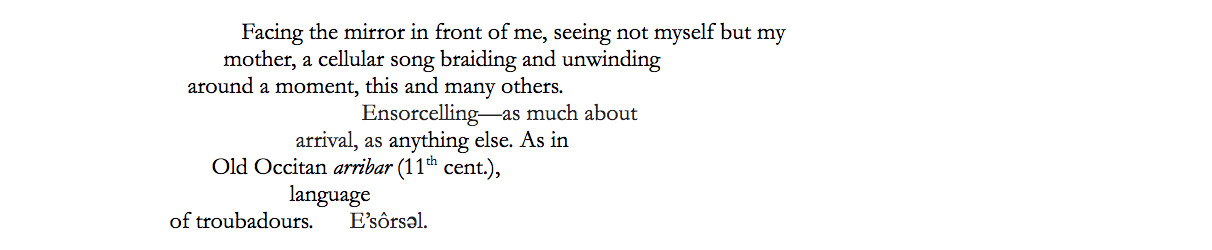
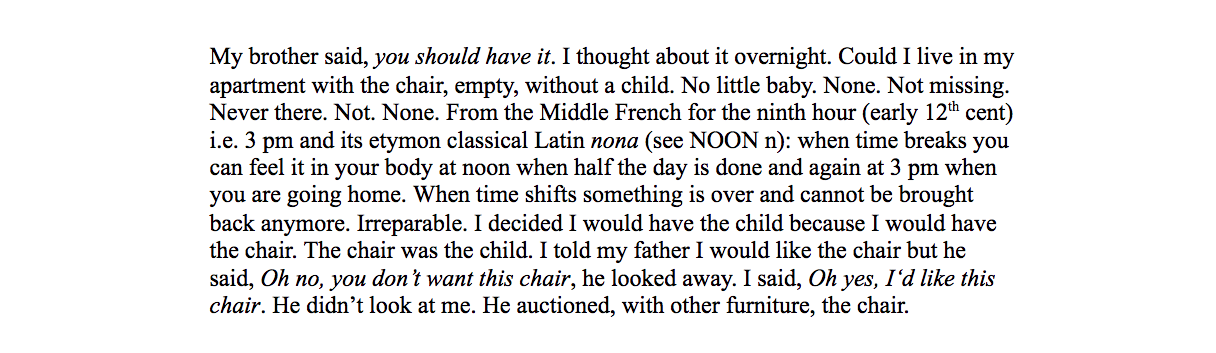
The sonogram, the specula, and the man, can answer none of these questions, of course. Each line requests a different channel of sensory inquiry; her questions pile up. Her project is epistemological, and Starzinger is always zooming in and out, her observations granular – of her body, flowers, fish roe, words themselves. Most striking in “Specula” are the poet’s radical shifts in tone, signaling new frames of perception. A voice cratered by loss, “This is where all my children would have sprung,” abruptly becomes meticulous, dutiful, the voice of a lexicographer: “alea, meaning dice/ as in aleatoric music: Mozart.” We’re confronted with these strange etymologies throughout the collection, each probing of a word’s history reassess the image held in front of us. In this case, the meaning of alea, the Latin word for dice, transforms the image of the ovary into a game of chance, each dot, each egg, a probability. The purpose of such etymological excavations, and there are many throughout the collection (noon, pileus, entrayage, asperitas, Nevron, flake, Norwich, the list goes on.) is the method by which Starzinger scours the flaws in our language, like the flaws in our bodies, to arrive at a clearer, more honest, image of the self. “I am full of faults,” she writes. Yet “Fun/ fact: A fault under the Himalayan peaks/ pushes them up by a centimeter each year.” As in the aleatoric music of the dice, Starzinger’s pun wants us to see faults neither as randomness or fate, but as sequence of notes – probability as song and energy. She also disarms us with her paranomasia (puns appear again and again), the casualness of “Fun Fact.” Like James Merrill or Elizabeth Bishop, Starzinger expands and contracts her frames of perception – through competing tones – to expose the rifts in her self-perception, to make music of this dissonance. “Did you know the earth hums?” She asks.