<?xml version="1.0" encoding="utf-8"?><feed xmlns="http://www.w3.org/2005/Atom" ><generator uri="https://jekyllrb.com/" version="4.4.1">Jekyll</generator><link href="https://www.beh.uk/feed.xml" rel="self" type="application/atom+xml" /><link href="https://www.beh.uk/" rel="alternate" type="text/html" /><updated>2025-06-11T21:33:16+00:00</updated><id>https://www.beh.uk/feed.xml</id><title type="html">Benjamin Edward Howe</title><author><name>Benjamin Howe</name></author><entry><title type="html">Conservative Party Websites: Made In Britain?</title><link href="https://www.beh.uk/2024/conservative-party-websites" rel="alternate" type="text/html" title="Conservative Party Websites: Made In Britain?" /><published>2024-06-29T00:00:00+00:00</published><updated>2024-06-29T00:00:00+00:00</updated><id>https://www.beh.uk/2024/conservative-party-websites</id><content type="html" xml:base="https://www.beh.uk/2024/conservative-party-websites"><![CDATA[<p><img src="/assets/img/bluetree-made-in-britain-97982749011bab1ccd39f34d1adf9d85.png" alt="The Made in Britain mark shown in the footer of a website promoting a Conservative Prospective Parliamentary candidate" title="The Made in Britain mark shown in the footer of a website promoting a Conservative Prospective Parliamentary candidate" class="float-right" /></p>

<p>When I was reviewing the website of my local Conservative <a href="https://en.wikipedia.org/wiki/Prospective_parliamentary_candidate">Prospective Parliamentary candidate</a>, I noticed that they were using the <a href="https://www.madeinbritain.org/about/the-collective-mark">Made in Britain collective mark</a>.
This surprised me, and it made me wonder: how much of a typical Conservative website is actually “Made in Britain”?
<a href="https://www.madeinbritain.org/apply/eligibility">The eligibility criteria mandated by Made in Britain</a> state that “you must be a manufacturer making a finished digital product for which all of the development; the concept, the coding, quality control and maintenance takes place in Great Britain or Northern Ireland”.
They go on to clarify that “One hundred per cent (100%) of the labour or human resource that makes the finished product that will carry the official trademark, is in Great Britain or Northern Ireland”.</p>

<p>I discovered that approximately 1,000 websites affiliated with the Conservative Party were pointing to IPv4 address <code class="language-plaintext highlighter-rouge">83.138.188.248</code>.
This IP address is allocated to a global technology firm called <a href="https://www.rackspace.com/">Rackspace</a>.
<a href="https://atlas.ripe.net/measurements/74525979">A measurement using RIPE Atlas suggests that the server allocated this IP address is within the UK</a>, however Rackspace is headquartered in Texas, US, and the maintenance on this server and network is probably carried out by staff globally.</p>

<p>I found that the vast majority of these websites were using the <a href="https://www.drupal.org/">Drupal Content Management System</a>.
It’s not clear how much of Drupal is developed in Great Britian or Northern Ireland, however <a href="https://git.drupalcode.org/project/drupal/activity">the activity for the code repository</a> shows contributors from around the world.
<a href="https://www.drupal.org/about/trademark">Drupal is a registered trademark</a> of <a href="https://dri.es/">Dries Buytaert</a> who lives in Boston, US.</p>

<p>For typography the websites use <a href="https://fonts.google.com/">Google Fonts</a> and <a href="https://fonts.adobe.com/">Adobe Fonts (formerly Typekit)</a>.
These are both global services.
The specific fonts used are <a href="https://fonts.google.com/specimen/Open+Sans">Open Sans</a> designed by <a href="https://mattesontypographics.com/">Steve Matteson of Matteson Typographics</a> (Colorado, US) and <a href="https://fonts.adobe.com/fonts/proxima-nova">Proxima Nova</a> designed by <a href="https://www.marksimonson.com/">Mark Simonson of Mark Simonson Studio</a> (Minnesota, US).</p>

<p>As part of their strategy to improve loading times, nearly all of the websites use a JavaScript library called <a href="https://github.com/aFarkas/lazysizes">lazysizes</a>.
It was developed by <a href="https://github.com/aFarkas">Alexander Farkas</a>, who lives in Berlin, Germany.</p>

<p>Around half of the websites use <a href="https://leafletjs.com/">Leaflet</a>, a JavaScript library for displaying interactive web maps.
Similar to Drupal, <a href="https://github.com/Leaflet/Leaflet">Leaflet’s code repository</a> features contributions from hundreds of individuals who come from various countries around the world.
Leaflet was originally created by <a href="https://agafonkin.com/">Volodymyr Agafonkin</a> who lives in Kyiv, Ukraine.</p>

<p>To comply with <a href="https://ico.org.uk/for-organisations/direct-marketing-and-privacy-and-electronic-communications/guide-to-pecr/cookies-and-similar-technologies/">the cookie rules which are part of the Privacy and Electronic Communications Regulations</a> the websites use <a href="https://www.drupal.org/project/eu_cookie_compliance">a Drupal module called <code class="language-plaintext highlighter-rouge">eu_cookie_compliance</code></a>.
The <a href="https://git.drupalcode.org/project/eu-cookie-compliance/activity">code repository includes contributions</a> from around the world.</p>

<p>I hope this blog post shows that great websites are usually built by a global team – it’s difficult to create a website which is exclusively made in a single country.</p>

<p>I reported this issue to the Made in Britain Campaign on 9th June 2024.
Since then around half of the websites have had the “Made in Britain” mark removed from the footer, although a number still display it.</p>

<p>Since I started writing this article <a href="https://www.madeinbritain.org/members?q=Bluetree">Bluetree has been added to Made in Britain’s public membership directory</a>.
I shared this article with both the Made in Britain Campaign and Bluetree Website Services (Websites for the Conservative Party) and offered them the oppotunity to comment, neither have yet replied.</p>]]></content><author><name>Benjamin Howe</name></author><category term="politics" /><summary type="html"><![CDATA[]]></summary></entry><entry><title type="html">Power Outages 9 &amp;amp; 12 March 2023: Retrospective (Part 1)</title><link href="https://www.beh.uk/2023/power-outage-retro-part-1" rel="alternate" type="text/html" title="Power Outages 9 &amp;amp; 12 March 2023: Retrospective (Part 1)" /><published>2023-03-10T00:00:00+00:00</published><updated>2023-03-10T00:00:00+00:00</updated><id>https://www.beh.uk/2023/power-outage-retro-part-1</id><content type="html" xml:base="https://www.beh.uk/2023/power-outage-retro-part-1"><![CDATA[<p><strong>Update 14 March</strong>: <a href="https://web.archive.org/web/20230314142048/https://www.ukpowernetworks.co.uk/incident-detail/haywards-heath-and-burgess-hill">UK Power Networks have published a page on their website providing some additional information</a>.</p>

<p><strong>Update 13 March</strong>: added details from events on 12 March.</p>

<p>This post represents the first of a two part mini-series retrospecting on <a href="https://www.bbc.co.uk/news/uk-england-sussex-64933050">the widespread power outages in Sussex on 9 and 12 March 2023, which affected over 35,000 homes</a> (including mine!).
Specifically I’ll be thinking about at how it affected me and how I could reduce the personal impact of a future outage.</p>

<h2 id="timeline-of-events">Timeline of events</h2>

<p>All times are Greenwich Mean Time, and written using the 24 hour clock.</p>

<h3 id="thursday-9-march">Thursday 9 March</h3>

<p>0336: Sensors in my home stopped sending data over the internet. These sensors do not have any power backup, so stop working immedately when a power outage occurs.</p>

<p>0356: Sensors resume sending data (i.e. power is restored).</p>

<p>1001: Sensors again stop sending data.</p>

<p>1024: <a href="https://updown.io/r/AeUB9">updown.io</a> reports that my home internet connection is offline (i.e. the Uninterruptable Power Supply protecting the connection has run out of power).</p>

<p>1258: updown.io reports that my home internet connection is back online.</p>

<p>1300: Sensors resume sending data.</p>

<h3 id="sunday-12-march">Sunday 12 March</h3>

<p>1246: Sensors again stop sending data.</p>

<p>1315: Internet connection goes offline (UPS runs out of power).</p>

<p>1616: Sensors resume sending data.</p>

<h2 id="brief-summary">Brief Summary</h2>

<p>My UPS systems acted as expected – nothing went offline as a result of the first outage.
During the second outage I was actually on a video call – the call was uninterrupted and I was able to share the situation with my colleague (and investigate how long the outage was likely to last).
I was a little surprised how quickly the UPS ran out of power, but my expectations may have been too high.</p>

<p>I was disappointed to discover that mobile signal throughout the town vanished within minutes of the power outage – I expected mobile masts to have some sort of battery backup, with more critical masts possibly also having diesel generators.
<a href="https://www.ofcom.org.uk/__data/assets/pdf_file/0030/238962/unofficial-consolidated-general-conditions-dec-2022.pdf">Ofcom’s general condition A3.2</a> obliges networks to ensure that their services maintain “the fullest possible availability […] in the event of catastrophic network breakdown or in cases of force majeure”, and from my observations EE, Three, and O2 failed in this respect.
I’ve written to my MP to request this be investigated.
I think this is especially important given more people are relying on mobiles to make emergency calls in the event on a power outage, because <a href="https://business.bt.com/why-choose-bt/insights/digital-transformation/uk-pstn-switch-off/">the traditional “landline” network is being switched off in 2025</a>.</p>]]></content><author><name>Benjamin Howe</name></author><category term="networking" /><summary type="html"><![CDATA[Update 14 March: UK Power Networks have published a page on their website providing some additional information.]]></summary></entry><entry><title type="html">Swish Fibre: An Early Review</title><link href="https://www.beh.uk/2023/swish-fibre-early-review" rel="alternate" type="text/html" title="Swish Fibre: An Early Review" /><published>2023-02-21T00:00:00+00:00</published><updated>2023-02-21T00:00:00+00:00</updated><id>https://www.beh.uk/2023/swish-fibre-early-review</id><content type="html" xml:base="https://www.beh.uk/2023/swish-fibre-early-review"><![CDATA[<p>My home was recently connected to <a href="https://www.swishfibre.com/locations/haywards-heath">Swish Fibre’s new network in Haywards Heath</a>, so I thought I’d share my thoughts on their product.</p>

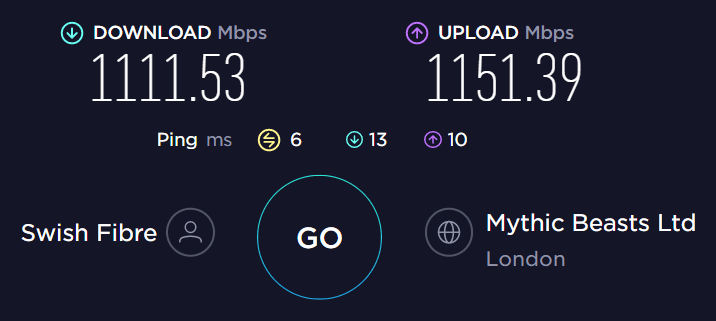
<p>I took their “Swish 900” residential package which promises download <em>and upload</em> speeds of 900Mbps.
As expected I get speeds in excess of 900Mbps when testing with <a href="https://www.speedtest.net/">Ookla’s Speedtest.net</a>.
This isn’t just against Swish’s own server, but also other nearby servers (e.g. <a href="https://www.mythic-beasts.com/">Mythic Beasts</a>).
Initially I measured speeds of 946Mbps, matching up with the <a href="https://rickardnobel.se/actual-throughput-on-gigabit-ethernet/">expected throughput on gigabit ethernet</a>.
I then decided to try upgrading the SFP+ WAN interface on my router from one gigabit to ten gigabits and I was surprised to see even faster speeds of over 1,100Mbps!
Swish’s symmetrical speeds are refreshing as internet connections from Openreach-based providers and Virgin Media are heavily asymmetrical – for example, at the time of writing the fastest broadband connection offered by Virgin only had an upload speed of 52Mbps.</p>

<p><a href="https://www.speedtest.net/result/14427350669"><img src="https://cdn.beh.uk/img/speedtest-swish.png" alt="Speedtest.net result indicating speeds to Mythic Beasts of over 1,100Mbps" class="centred" /></a></p>

<p>Internet connections aren’t just about speed though – latency is important too (ask gamers or people trying to use remote desktop software, for example).
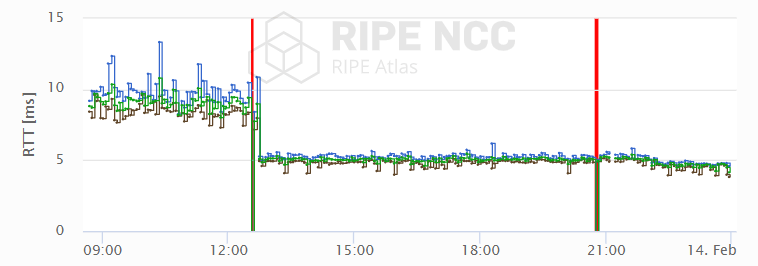
I host a <a href="https://atlas.ripe.net/">RIPE Atlas</a> probe (<a href="https://atlas.ripe.net/probes/1002782">ID 1002782</a>) on my network.
It takes independent measurements of the wider internet from the perspective of my internet provider.
Swish’s network is superior in this aspect too: when I switched my network connection from <a href="https://www.idnet.com/">IDNet</a> (using Openreach) to Swish, I saw reductions in latency across the board.
For example, the latency to the <a href="http://d.root-servers.org/">d-root nameserver</a> reduce from a median of 9.1ms to a median of 4.6ms.</p>

<p><a href="https://stat.ripe.net/widget/atlas-ping-measurements#w.mode=condensed&amp;w.measurement_id=1012&amp;w.probe_id=1002782&amp;w.starttime=2023-02-13T08%3A39%3A06&amp;w.endtime=2023-02-14T00%3A00%3A27&amp;w.resolution=0"><img src="https://cdn.beh.uk/img/latency-swish.png" alt="RIPE Atlas measurement showing latency to the &quot;d&quot; root nameserver on the day that the Swish internet connection was installed" class="centred" /></a></p>

<p>Swish provide two pieces of equipment to facilitate connection to their network: an Optical Network Terminal (I got a Swish-branded <a href="https://portal.adtran.com/pub/Library/Data_Sheets/International_/I61287842Fx-8A_ADTRAN_622v.pdf">Adtran 622v</a>) and a <a href="https://www.swishfibre.com/swish-home-wi-fi">Plume SuperPod router</a> (you don’t need to pay Plume’s membership fee).
That said, I don’t use their router as I’ve already fitted my home with ceiling-mounted wireless access points from Ubiquiti.
Using my own router couldn’t be easier as Swish use DHCP (no PPPoE or other configuration required).
The engineers who completed the installation did a great job – I was able to have everything hidden in the cupboard with my other networking equipment, and the fibre optic cable was run neatly above the door frames.
I didn’t cancel my old broadband connection until I’d tested that the new connection was working – this gave me peace of mind during the switchover process.</p>

<p>So far I’ve been very positive – and with good reason, overall I’m impressed with Swish’s service.
That said, I think there’s a significant (if not somewhat nerdy) area where their service could be enhanced.
By default Swish use Carrier-Grade NAT for IPv4, and charge £3 per month for a public IP address.
This isn’t unreasonable as <a href="https://www.ripe.net/manage-ips-and-asns/ipv4/ipv4-run-out">IPv4 addresses are running out</a>, however <a href="https://twitter.com/SwishFibre/status/1369323345163018255">Swish do not offer IPv6</a>, the long term solution to IPv4 exhaustion.
In my opinion this is poor – <a href="https://www.rfc-editor.org/rfc/rfc1883">the first IPv6 specification</a> was published in 1995 so any new internet provider should support it immediately.</p>

<p>In summary I think Swish’s service is an excellent upgrade from services offered by Openreach-based providers or Virgin Media.
I look forward to seeing how the market evolves, both as <a href="https://www.ispreview.co.uk/index.php/2023/02/fern-consolidates-uk-isps-jurassic-fibre-swish-fibre-giganet-and-allpoints-fibre.html">Swish is consolidated as part of Fern Fibre’s family of networks</a> and as more providers build throughout the UK.</p>]]></content><author><name>Benjamin Howe</name></author><category term="networking" /><summary type="html"><![CDATA[My home was recently connected to Swish Fibre’s new network in Haywards Heath, so I thought I’d share my thoughts on their product.]]></summary></entry><entry><title type="html">Full Fibre Internet FAQs</title><link href="https://www.beh.uk/2022/full-fibre-faq" rel="alternate" type="text/html" title="Full Fibre Internet FAQs" /><published>2022-07-04T00:00:00+00:00</published><updated>2022-07-04T00:00:00+00:00</updated><id>https://www.beh.uk/2022/full-fibre-faq</id><content type="html" xml:base="https://www.beh.uk/2022/full-fibre-faq"><![CDATA[<p>I’ve written this blog post because I’ve had several people ask me about “Full Fibre” internet. It answers some common questions and might help readers to think about things they hadn’t previously considered.</p>

<h2 id="openreach-are-installing-full-fibre-in-my-area--what-does-this-mean-for-me">Openreach are installing “full fibre” in my area – what does this mean for me?</h2>

<p>Full fibre networks, built by BT Openreach and other companies, are the first large-scale networks designed for connecting homes to the internet. Although most homes already have internet connections, these commonly use lines from BT Openreach or Virgin Media. Most of Openreach’s lines were originally designed for telephones and Virgin’s cable for TV. In the March 2021 measurement period, <a href="https://www.ofcom.org.uk/research-and-data/telecoms-research/broadband-research/broadband-speeds/uk-home-broadband-performance-march-2021">Ofcom found that the average (median) download speed was 50.4Mb/s</a> – whereas most consumer full fibre services are capable of speeds exceeding 1,000Mb/s.</p>

<p><a href="https://www.ispreview.co.uk/index.php/2021/05/bt-raise-fttp-broadband-target-to-25-million-uk-premises.html">Openreach are aiming to cover 25 million premises by the end of 2026</a>. This is an ambitious target given that their telephone network was built incrementally over several decades, so you’ll likely notice an increase in roadworks as Openreach ensure their ducts are clear and install the new fibres.</p>

<h2 id="dont-i-already-have-fibre">Don’t I already have fibre?</h2>

<p>Most homes use some sort of “fibre to the cabinet” technology, with a copper cable of some description connecting the home. These connections are often marketed as “fibre”, in line with <a href="https://www.asa.org.uk/news/asa-concludes-review-of-fibre-broadband.html">the ASA’s policy that part-fibre broadband internet may be described as “fibre”</a>. I think this is misleading because practically any internet connection, including dial-up, could be described as “part-fibre” as the majority of internet exchanges and backhaul providers often exclusively interconnect using fibre.</p>

<p>Unfortunately, the part-fibre services available to most UK premises have a maximum theoretical speed of 80Mb/s, degrading with distance. Full fibre does not materially degrade with distance and is capable of going much faster – <a href="https://www.nokia.com/about-us/news/releases/2021/02/02/nokia-and-vodafone-showcase-record-breaking-100-gigabit-fiber-broadband/">Nokia and Vodafone have trialled 100,000Mb speeds</a> using the same full fibre technology as is being installed today, the only change being the equipment on either end of the fibre.</p>

<h2 id="where-will-the-fibre-go">Where will the fibre go?</h2>

<p>In most cases, the fibre will follow the same route as your existing copper cables – using your existing underground duct or telegraph pole. In rare cases your telephone line might be buried “direct in ground” (i.e. not inside a duct) – in this case a new duct might be dug, or telegraph poles could be used. If the fibre will be brought to your property underground, then a “toby box” will sometimes be installed at the edge of the pavement, ready to bring the fibre to your home when you place an order.</p>

<p>“Multi-Dwelling Units” (MDUs) such as apartment blocks have an added complication: fibres need to travel through common areas to access the individual apartments. The owner, usually a freeholder, grants permission using a “wayleave”. Sometimes the freeholder is the collective of leaseholders (apartment owners), and other times the freeholder is an investor who bought the freehold to profit from the ground rent. Part of the wayleave agreement includes agreeing how the fibre will connect between the street and the individual apartment; often the existing ducts can be used.</p>

<h2 id="where-will-the-fibre-appear-in-my-property">Where will the fibre appear in my property?</h2>

<p>In most cases, the fibre will enter your property in the same place as your BT master socket. This is probably where your router is plugged in. If the fibre is not using a pre-existing duct it will likely appear on a wall towards the front of the property, although you should have the opportunity to discuss locations with the engineer before they start work.</p>

<p>Your internet provider has the option of ordering <a href="https://www.openreach.co.uk/cpportal/products/fibre-broadband/installation-options">“standard” or “premium” installation from Openreach</a>. Standard installation allows for up to 10 metres of internal fibre (to the nearest electrical socket), whereas premium installation allows for up to 30 metres of internal fibre. An “Optical Network Terminal” (ONT) will then be wall-mounted and connected to your router using a short ethernet cable (this can be replaced with a longer one after the installation if required, up to the standard ethernet cable length limit of 90 metres).</p>

<h2 id="how-does-full-fibre-affect-my-landline-telephone">How does full fibre affect my landline telephone?</h2>

<p>Full fibre does not come with a telephone line by “default”. That being said, telephone services will stop being available via your “standard” telephone socket by 2025 at the latest, when <a href="https://business.bt.com/why-choose-bt/insights/digital-transformation/uk-pstn-switch-off/">the UK’s Public-Switched Telephone Network (PSTN) will be switched off</a>. This will happen regardless of whether you have full fibre available; your telephone socket will only be used for an internet connection (and your internal telephone wiring may no longer function unless an engineer installs “Voice Reinjection”, sometimes called VRI). For customers who only want telephone service, a 0.5Mb/s internet option will be available – this is enough capacity for approximately 4 simultaneous voice calls.</p>

<p>After the PSTN has been switched off, there are a few options for telephone services: using a mobile service, taking a service from your internet provider, or using an independent “Voice over Internet Protocol” (VoIP) service. Unless you’re planning on using a mobile, you’ll likely be able to keep your existing landline number, although <strong>this may require you to order your full fibre as a “new” connection rather than “upgrading” your existing connection</strong>.</p>

<p>Most mobile phone deals come with a large number of included minutes, so the first option would be to rely on mobile phones. If you want to use a “traditional” phone interface then you can use a device like the <a href="https://www.tendacn.com/product/4G06.html">Tenda 4G06</a> along with a suitable SIM card. I’d suggest 1pMobile as they charge 1p per minute or offer a “bundle” including unlimited calls for £36 per year – plus if you visit <a href="https://www.1pmobile.com/friends/">their “Friends” page</a> and enter code H198286B then you’ll get £5 of free credit.</p>

<p>A second option for a “landline telephone” would be to ask for your internet provider to also provide a telephone service. Many internet providers offer this, for example, at the time of writing BT charged £5 per month for a “pay-as-you-go” service or £16 per month for unlimited minutes. This service is often provided by plugging your telephone into your router. Note that this service will usually require you to use the router given to you by your internet provider, and the “bundling” of your internet and telephone services might make it more difficult to switch to a provider which doesn’t offer telephone service in future.</p>

<p>The third option is to use a VoIP telephone service, such as from <a href="https://www.sipgate.co.uk/">Sipgate</a> or <a href="https://www.aa.net.uk/voice-and-mobile/voip-information/use-cases/home-user/">Andrews &amp; Arnold</a>. I think this option is most elegant, as you can independently control your telephone and internet services. You can also choose how you use your phone service: using a “soft” phone on a computer or smartphone, using a phone which is compatible with the “SIP” VoIP system, or using an adapter box compatible with the “SIP” VoIP system along with a conventional phone. Most VoIP services will allow you to use connect multiple separate phones (including soft phones), with them all ringing at the same time when a call comes in.</p>

<h2 id="why-are-different-companies-digging-up-the-roads-to-install-fibre">Why are different companies digging up the roads to install fibre?</h2>

<p>While Openreach are the largest network installing full fibre to homes, other networks are offering the same services. The largest “alternative networks” are probably <a href="https://cityfibre.com/about-us/rollout">CityFibre</a> and <a href="https://www.gigaclear.com/our-network">Gigaclear</a>, but there are <a href="https://www.ofcom.org.uk/phones-telecoms-and-internet/information-for-industry/policy/electronic-comm-code/register-of-persons-with-powers-under-the-electronic-communications-code">over 100 smaller networks that have been granted “code powers” by Ofcom</a>.</p>

<p>While this might be slightly inconvenient while the building work is taking place, overall it’s great news for making sure that consumers can order innovative products at affordable prices – a substantial number of alternative networks offer lower prices and/or faster speeds than Openreach-based internet providers. A particular feature which is common among alternative networks is “symmetrical speeds”; this means that you can send data to the internet as quickly as you can receive it. Symmetrical speeds are helpful for things like working from home or online backups. They aren’t available with standard  products from providers using Openreach or Virgin Media.</p>

<p>To minimise expensive and inconvenient roadworks, a substantial number of networks use <a href="https://www.openreach.co.uk/cpportal/products/passive-products/physical-infrastructure-access(PIA)">Openerach’s Physical Infrastructure Access (PIA) product</a>. This allows networks to place their own fibres (or sub-ducts) inside Openreach’s existing ducts, reducing or preventing the need to dig.</p>

<p>Longer term, the market is likely to consolidate to a smaller number of networks, as was the case with <a href="https://en.wikipedia.org/wiki/Timeline_of_cable_television_in_the_United_Kingdom">the cable television companies</a>.</p>

<h2 id="i-dont-need-more-speed--why-should-i-care-about-full-fibre">I don’t need more speed – why should I care about full fibre?</h2>

<p>Full fibre has many benefits over part-fibre internet, even if you plan to continue with the same package speed:</p>

<ul>
  <li>You’ll get the speed that you’re paying for, even if you’re a long way from your nearest cabinet or telephone exchange.</li>
  <li>You won’t be at risk of electrical surges coming via the telephone line, as fibre optic cables are made from plastic or glass and don’t conduct electricity.</li>
  <li>Full fibre internet has reduced latency and jitter, improving your internet experience, especially for video calls or online gaming.</li>
  <li>Full fibre connections typically suffer fewer faults, as the technology is purpose-built to deliver a reliable internet connection.</li>
</ul>

<h2 id="which-speed-should-i-order">Which speed should I order?</h2>

<p>Full fibre internet connections offer a range of speeds and, unlike with part fibre, distance from the cabinet or exchange is not a limiting factor.</p>

<p>The standard speeds that Openreach offer on their network are:</p>

<ul>
  <li>0.5Mb/s (symmetrical)</li>
  <li>40Mb/s down &amp; 10Mb/s up</li>
  <li>80Mb/s down &amp; 20Mb/s up</li>
  <li>115Mb/s down and 20Mb/s up</li>
  <li>160Mb/s down and 30Mb/s up</li>
  <li>220Mb/s down and 30Mb/s up</li>
  <li>330Mb/s down and 50Mb/s up</li>
  <li>550Mb/s down and 75Mb/s up</li>
  <li>1,000Mb/s down and 115Mb/s up</li>
  <li>550Mb/s down and 165Mb/s up (business-focussed product, expensive)</li>
  <li>1,000Mb/s down and 220Mb/s up (business-focussed product, expensive)</li>
</ul>

<p>The above is a comprehensive list of the options available to internet providers using the Openreach network, but they typically don’t offer all of these options. <a href="https://www.ispreview.co.uk/index.php/2022/06/openreach-still-coy-on-plan-to-fix-330mbps-capped-uk-fttp-lines.html">A small number (less than 50,000) of older Openreach full fibre connections are limited to 330Mb/s</a>. Alternative internet networks (such as <a href="https://cityfibre.com/about-us/rollout">CityFibre</a> and <a href="https://www.hyperoptic.com/map/?residential">Hyperoptic</a>) offer different speed tiers, and often offer symmetrical speeds (i.e. the same speed down and up).</p>

<p>As a general rule of thumb, I suggest allowing 40Mb/s of download speed per person and 10Mb/s of upload speed per person. This means you should consider:</p>

<ul>
  <li>The 40Mb/s package for single-person households</li>
  <li>The 80Mb/s package for two-person households</li>
  <li>The 160Mb/s package for three-person households</li>
  <li>The 330Mb/s package for four-person households</li>
  <li>The 550Mb/s package for larger households</li>
</ul>

<p>It may also be wise to select a speed faster than 80Mb/s to “force” the internet provider to use full fibre.</p>

<p>It’s worth highlighting that 1,000Mb speeds will only be available if you can connect your device to the router using an ethernet cable – it’s difficult to exceed 300Mb/s via WiFi. This may impact your choice of speed.</p>

<h2 id="does-full-fibre-help-with-working-from-home">Does full fibre help with working from home?</h2>

<p>The increased speed and reliability of full fibre broadband internet is useful when working from home, but it’s worth highlighting that full fibre is <strong>not</strong> equivalent to a leased line.</p>

<ul>
  <li>Broadband connections typically have an SLA for repairing faults of 40 hours, whereas the SLAs for leased lines are lower.</li>
  <li>Broadband connections are typically (relatively) heavily contended (e.g. Openreach full fibre typically shares 2,400Mb/s of capacity between up to 32 users; internet providers often only guarantee 50% of the maximum speed), whereas leased lines are sold as uncontended.</li>
  <li>Leased lines typically offer symmetrical speeds, whereas Openreach-based broadband connections have slower upload speeds than download speeds.</li>
</ul>

<p>The reliability of an internet connection can be enhanced by adding “redundancy”, such as using a router with automatic 4G failover (such as the <a href="https://www.asus.com/Networking-IoT-Servers/Modem-Routers/All-series/4G-AX56/">Asus 4G-AX56</a>), or a second leased line using “Resilience Option 2” to ensure that the lines follow diverse routes wherever possible.</p>

<h2 id="is-full-fibre-more-expensive-than-my-current-internet">Is full fibre more expensive than my current internet?</h2>

<p>No. Full fibre is often the same price as the equivalent part fibre package, as the cost of operating a full fibre network is less than operating a network using copper cabling. For example, the power consumption is reduced, and <a href="https://www.ispreview.co.uk/index.php/2022/05/openreach-cable-theft-knocks-out-broadband-in-part-of-wrexham.html">unlike copper, fibre optic cable has no value to thieves</a>. As a result of this, Openreach offeres internet providers substantial discounts under their <a href="https://www.ispreview.co.uk/index.php/2021/07/openreach-unveil-major-fttp-pricing-offer-for-uk-broadband-isps.html">“Equinox Offer”</a> provided that 80% or more of an internet provider’s customers take full fibre products (where these products are available).</p>

<p>Furthermore, some households have access to alternative networks, which are often cheaper than Openreach-based networks. For example, at the time of writing Vodafone were charging £40 per month for their 500Mb package using Openreach’s network, but only £33 per month for their (symmetrical) 500Mb package using CityFibre’s network.</p>

<h2 id="conclusion">Conclusion</h2>

<p>I hope this article has been be useful when thinking about full fibre internet, and I welcome <a href="https://www.beh.uk/contact">feedback via my contact form</a>.</p>]]></content><author><name>Benjamin Howe</name></author><category term="networking" /><summary type="html"><![CDATA[I’ve written this blog post because I’ve had several people ask me about “Full Fibre” internet. It answers some common questions and might help readers to think about things they hadn’t previously considered.]]></summary></entry><entry><title type="html">Language for Autism</title><link href="https://www.beh.uk/2021/language-for-autism" rel="alternate" type="text/html" title="Language for Autism" /><published>2021-03-26T00:00:00+00:00</published><updated>2021-03-26T00:00:00+00:00</updated><id>https://www.beh.uk/2021/language-for-autism</id><content type="html" xml:base="https://www.beh.uk/2021/language-for-autism"><![CDATA[<p><em>Disclaimer: the autistic community is a diverse collection of individuals – although I am <a href="https://autism.wikia.org/wiki/ActuallyAutistic">#ActuallyAutistic</a> and I believe the contents of this post are generally applicable, please give precedence to other individuals or groups where applicable.</em></p>

<p>As we approach <a href="https://www.autism.org.uk/get-involved/raise-money/world-autism-awareness-week">World Autism Awareness Week</a> I’m aware that some people aren’t sure what words they should use when talking about autistic people. In this post I’ll address a few common questions and explain why some language choices are preferred. I’ve written this post to supplement, not replace, the <a href="https://www.autism.org.uk/what-we-do/help-and-support/how-to-talk-about-autism">National Autistic Society’s guidance on how to talk and write about autism</a>.</p>

<h2 id="neurodivergent--neurotypical">Neurodivergent / Neurotypical</h2>

<p>Neurodivergent people are individuals who have neurological differences such as Autism, Dyslexia, or ADHD. Conversely, neurotypical people do not have these differences, although sometimes the term “neurotypical” is used to indicate the lack of a specific difference – for example, an autistic community may use “neurotypical” for a non-autistic person who may, however, may have other neurological differences. These differences may be detected through tests for things like verbal and non-verbal reasoning, information processing speed, and executive function, however these tests are not always conclusive.</p>

<h2 id="identity-first--person-first-language">Identity-first / Person-first Language</h2>

<p>“Identity-first” language puts the condition first – “autistic people”. “Person-first” language puts the person first – “people with autism”. People who prefer person-first language generally do so because they consider their personhood more important then their condition, whereas people who prefer identity-first language generally do so because they view their autism as a core part of their person which they cannot separate or “remove”. Although both descriptions are valid, autistic people generally prefer identity-first language (i.e. “autistic people” not “people with autism”), however this can be a very individual choice. The <a href="https://autisticadvocacy.org/">Autistic Self Advocacy Network</a> has an excellent <a href="https://autisticadvocacy.org/about-asan/identity-first-language/">post explaining identity-first and person-first language in more detail</a>.</p>

<h2 id="treatment--cures">Treatment / “Cures”</h2>

<p>Autism is a permanent disability, not an illness that people “suffer” from.. There is no known “cure” and many autistic people see their autism as a core part of who they are, and therefore do not seek a “cure”. Autistic people won’t “grow out” of their autism, although as they get older they may become better at masking some of their traits to in order to fit into a generally unaccommodating world. When talking about supporting autistic people, think about “adjustments” or “accommodations” which neurotypical people (and society as a whole) can make, not “treatments” to “fix” the autistic person.</p>

<p>The <a href="https://www.autism.org.uk/advice-and-guidance/topics/employment/employing-autistic-people/employers">National Autistic Society has a list containing examples of adjustments</a> which may be suitable, however it’s usually best to ask the individual if any accommodations would be helpful.</p>

<h2 id="causes">Causes</h2>

<p>It is not clear what causes autism – although it has a strong genetic basis, the genetics of autism are complex and environmental factors may play a role. However, we know that autism is not caused by:</p>
<ul>
  <li>bad parenting</li>
  <li>vaccines, such as the MMR vaccine</li>
  <li>diet</li>
  <li>an infection you can spread to other people</li>
  <li>gluten</li>
  <li>a lack of hugs</li>
</ul>

<p>(source: <a href="https://www.nhs.uk/conditions/autism/what-is-autism/">NHS “What is Autism?”</a>)</p>

<p>Autistic people find the suggestion that autism may be caused by the MMR vaccine (or vaccines in general) particularly offensive due to the implication that being autistic but immune to measles, mumps, and rubella is worse than being <a href="https://www.who.int/immunization/newsroom/MI_Fact%20Sheet_17_jan_2007.pdf">susceptable to one of the leading causes of vaccine-preventable death</a>.</p>

<h2 id="functioning-labels">“Functioning” Labels</h2>

<p>Historically, autistic people were described as “high functioning” and “low functioning”, however this over-simplifies the autistic spectrum. <a href="https://the-art-of-autism.com/understanding-the-spectrum-a-comic-strip-explanation/">Rebecca Burgess’ comic “Understanding the Spectrum”</a> is an excellent explanation, but in short the autistic spectrum is more complicated than a linear range and more like a spectrum of colours. Additionally, autistic people may struggle more or less on different occasions due to a variety of factors, such as how well they slept recently and what accommodations are offered to them. For the same reasons describing autism as “mild” or “severe” is often frowned upon – in most cases it is better to focus on the specific trait that is relevant (e.g. personally I would describe myself as relatively tolerant to sensory stimuli yet having poor <a href="https://en.wikipedia.org/wiki/Fine_motor_skill">fine motor skills</a>).</p>

<h2 id="aspergers--autism">Aspergers / Autism</h2>

<p>Aspergers was the term historically used to describe “autistic people with average or above average intelligence”, however the term is no longer used – it was <a href="https://www.theguardian.com/society/2012/dec/02/aspergers-syndrome-dropped-psychiatric-dsm">removed from Diagnostic and Statistical Manual of Mental Disorders in 2013</a> and will be <a href="https://www.spectrumnews.org/opinion/viewpoint/people-mourn-asperger-syndromes-loss-diagnostic-manuals/">removed from the 2022 (11th) edition of the WHO’s International Statistical Classification of Diseases and Related Health Problems</a>. There are <a href="https://www.spectrumnews.org/opinion/viewpoint/why-fold-asperger-syndrome-into-autism-spectrum-disorder-in-the-dsm-5/">a variety of reasons for abolishing the term “Aspergers”</a>, especially <a href="https://molecularautism.biomedcentral.com/articles/10.1186/s13229-018-0208-6">Hans Asperger’s problematic association wth Nazism</a>.</p>

<h2 id="symbols">Symbols</h2>

<p>Various symbols are used to represent autism and autism awareness. Perhaps the most common symbol is the puzzle piece, however a number of autistic people disapprove of this due to the suggestion that autistic people are “a puzzle to be solved” or “a puzzle missing a piece”. Another issue with the puzzle piece symbol is that it is used as the logo for Autism Speaks, a <a href="https://www.washingtonpost.com/outlook/2020/02/14/biggest-autism-advocacy-group-is-still-failing-too-many-autistic-people/">problematic autism advocacy group</a>.</p>

<p>A better symbol to use when promoting autism awareness (and acceptance) is a <a href="https://autisticuk.org/going-gold-for-autism-acceptance/">golden infinity symbol</a> (the chemical symbol for gold is Au, and the infinity symbol represents the infinite diversity among autistic people). Alternatively the <a href="https://autisticuk.org/neurodiversity/">rainbow infinity symbol</a> can be used to represent general neurodiversity.</p>

<h2 id="conclusion">Conclusion</h2>

<p>I hope this article will be useful in choosing the right words and expressions to use when talking about autistic people. If you’re not sure what terminology to use when talking about someone, please ask them! I welcome <a href="https://www.beh.uk/contact">feedback via my contact form</a>.</p>]]></content><author><name>Benjamin Howe</name></author><category term="neurodiversity" /><summary type="html"><![CDATA[Disclaimer: the autistic community is a diverse collection of individuals – although I am #ActuallyAutistic and I believe the contents of this post are generally applicable, please give precedence to other individuals or groups where applicable.]]></summary></entry><entry><title type="html">New Website! (2021)</title><link href="https://www.beh.uk/2021/new-website" rel="alternate" type="text/html" title="New Website! (2021)" /><published>2021-03-06T00:00:00+00:00</published><updated>2021-03-06T00:00:00+00:00</updated><id>https://www.beh.uk/2021/new-website</id><content type="html" xml:base="https://www.beh.uk/2021/new-website"><![CDATA[<p>For what feels like the millionth time, I’ve redesigned my website. In this blog post I’ll discuss some of the changes and the reasoning behind them.</p>

<h2 id="a-blog">A Blog</h2>

<p>I’ve made a few attempts at keeping a blog, and every time so far I’ve failed. I can’t promise that I’ll be more successful at writing regularly this time around, but I’m going to give it a try. A word of warning for potential followers: I make no promises that my blog posts will be focussed on a single subject area. I anticipate that most of my blog posts will be on technology, travel, or countryside walks, but who knows!</p>

<h2 id="completely-custom">Completely Custom</h2>

<p>Conventionally I would start building a website from a template of some sort, or at least <a href="https://getbootstrap.com/">Bootstrap</a>. While there’s nothing wrong with this approach, in this instance I wanted to start from scratch. I’m not sure if I got this idea because I started a new role as a full stack software engineer or if I did it as a challenge (probably both), but either way it’s been fun getting re-aquanted with CSS layouts and updating my knowledge with the latest technologies that work in all the mainstream browsers.</p>

<h3 id="aesthetics">Aesthetics</h3>

<p><img src="/assets/img/lowercase-a-a81905e3a9694b0726c9eaebae3ca331.svg" alt="A graphic showing the difference between double-storey and single-storey lowercase a" title="Image credit: Wikipedia/Raistuumum" class="float-right" />
I’ve always been a fan of red so I retained the red colour scheme from <a href="https://2017.beh.uk/">my previous (2017) website</a>. I also liked the social icons from my previous website so have kept them (using icons from <a href="https://fontawesome.com/">Font Awesome</a>), although I may relegate them from the header to the footer or some other less prominent location. I had some quite specific goals for typography – I wanted a sans-serif font which was lightweight, open source, and properly formed the letter “a” (i.e. <a href="https://en.wikipedia.org/wiki/A#Typographic_variants">single-storey not double-storey</a>) – so I selected <a href="https://fonts.google.com/specimen/Mulish">Mulish</a>.</p>

<p>I also re-used the background image from the previous version of my website (a <a href="https://pixabay.com/photos/laptop-keyboard-notebook-trackpoint-1864126/">photograph of a ThinkPad laptop</a> as I’ve always been a fan of their high-quality keyboards and rugged construction), which I display on the <a href="/">home page</a>. I make it (appear to) load quickly by initially loading an inlined and heavily compressed version of the image weighing less than 3kB and then loading the “proper” version (~50kB) after the rest of the page has loaded. In the future I may use <a href="https://blurha.sh/">BlurHash</a> as an alternative to the inlined JPEG, although this will add an additional JavaScript library.</p>

<h2 id="still-static">Still Static</h2>

<p>While this website has more content than the previous version it’s still fundamentally a bunch of static HTML pages. I used to be a strong advocate for <a href="https://wordpress.org/">WordPress</a> and while it still has its place I think that static, pre-generated websites are generally better from a technical perspective (e.g. they’re much easier to cache). This version of my website is generated by <a href="https://jekyllrb.com/">Jekyll</a>, globally deployed on <a href="https://www.netlify.com/">Netlify</a>, and (as always) 100% <a href="https://github.com/BenjaminEHowe/beh.uk">open source on GitHub</a>.</p>

<p>I use the <a href="https://github.com/tkareine/jekyll-minibundle">Jekyll Minibundle plugin</a> to manage the assets for the website. Specifically, at build-time it:</p>
<ul>
  <li>adds an MD5 digest to the file name of each asset (image, CSS file, JavaScript file, PDF, etc.) as a “fingerprint” so that assets can be cached indefinitely</li>
  <li>bundles CSS into a single file</li>
  <li>minifies the CSS using <a href="https://www.npmjs.com/package/uglifycss">UglifyCSS</a></li>
</ul>

<p>For additional performance I place Cloudflare in front of Netlify as a cache. This should slightly improve performance as Cloudflare use more datacentres than Netlify, especially given my fingerprinted assets can be cached indefinitely. In future I may migrate this website to <a href="https://pages.cloudflare.com/">Cloudflare Pages</a>, but I think Cloudflare pages is missing a few features which I’d want before leaving Netlify. Ordinarily Cloudflare would break Netlify’s HTTPS, but I get around this by using a wildcard <a href="https://developers.cloudflare.com/ssl/origin-configuration/origin-ca">Cloudflare origin certificate</a>.</p>

<h2 id="closing-thoughts">Closing Thoughts</h2>

<p>I’ve learned a lot developing my personal website from scratch, and I’m looking forward to learning more! I’m hoping that I’ll succeed in regularly writing on this blog, so please stay tuned via <a href="/feed.xml">Atom</a> or <a href="https://blogtrottr.com/?subscribe=https://www.beh.uk/">subscribe to email updates</a> for future posts. At this stage there’s no comment facility on the blog, although readers are welcome to send me comments or feedback via <a href="/contact">my contact page</a>. It looks like there are <a href="https://talk.jekyllrb.com/t/what-is-the-recommended-way-to-add-comment-sections-to-your-jekyll-blog/3330">numerous ways to add comments to a Jekyll blog</a>, so perhaps this will be the next major technical update?</p>]]></content><author><name>Benjamin Howe</name></author><category term="technology" /><summary type="html"><![CDATA[For what feels like the millionth time, I’ve redesigned my website. In this blog post I’ll discuss some of the changes and the reasoning behind them.]]></summary></entry></feed>