[go: up one dir, main page]

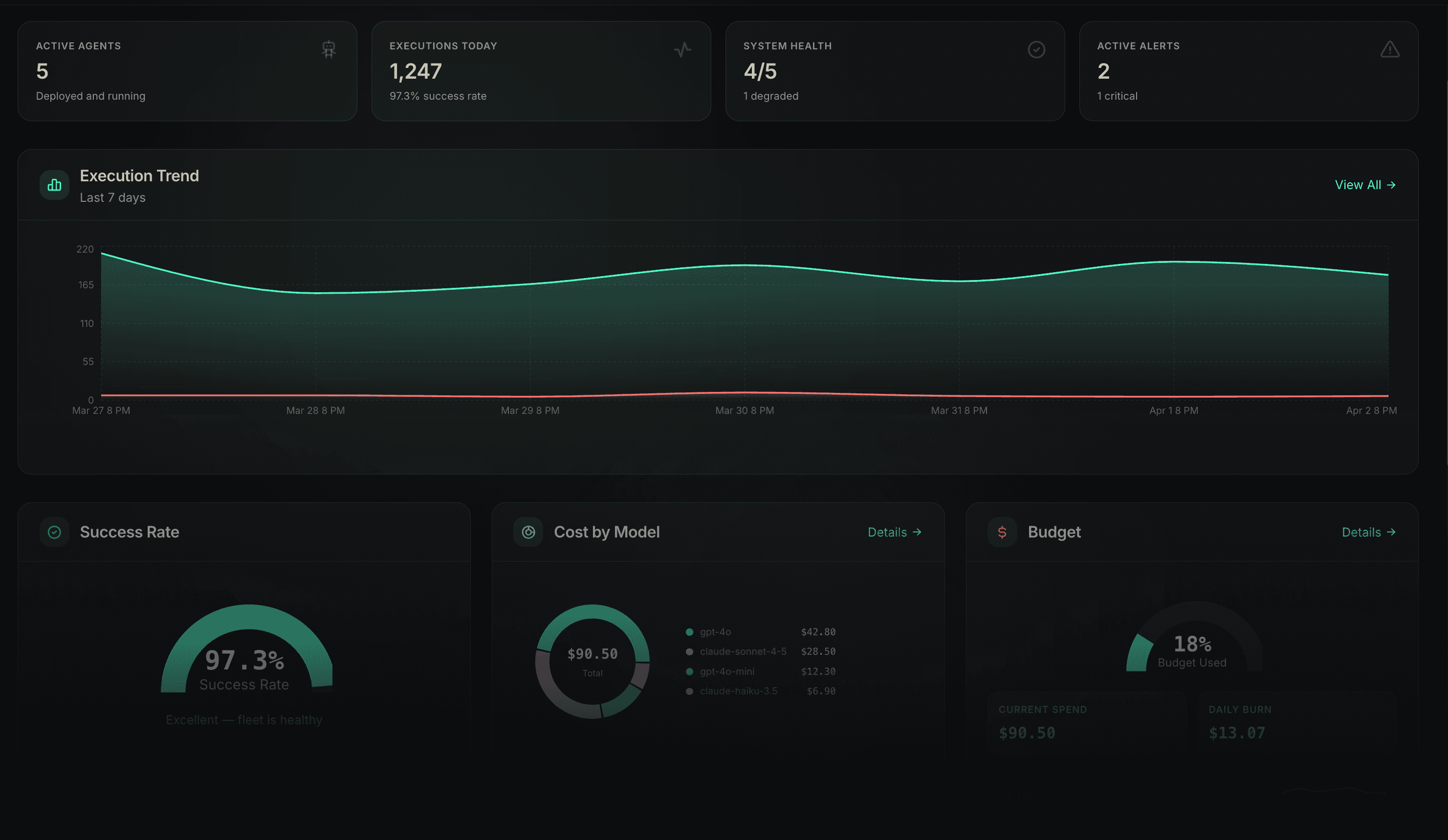
Image of Waxell dashboard, including executions, model types, and success graphs
Your agents are already running.
Does anyone know what they're actually doing?

Waxell is the governance and observability layer for AI agents — whether you built them yourself or your team just started using Claude Code last Tuesday.

I build agents

I manage teams that use agents

Free to start. 2-line setup.

SOC 2 Ready

Waxell is a governance and observability platform for AI agent deployments — it enforces runtime policies, tracks cost and token usage, and records every agent decision, across agents your engineers build and agents your team uses but didn't write.

Instruments 177 frameworks, LLMs, and vector DBs — zero config.
What problems do teams face when deploying AI agents?

"What are our agents doing?"

With no visibility into tool calls, costs, decisions, or failures. When something breaks, you find out afterward — if at all.

"How do we control them?"

No policy enforcement. No approval workflows. No audit trail. The agent did what the agent wanted to do.

"How do we run them safely at scale?"

No governed execution environment for high-stakes automation. Hope is not an operations strategy.


Waxell answers all three — across agents you didn't build and agents you're running in production.

Two products. One problem.

If you write agent code, Waxell Observe gives you production-grade observability and governance from the first run. If your team runs agents you didn't build — Claude Code, Cursor, custom GPT workflows — Waxell Connect brings them into a governed workspace with zero code changes.

Observe

Instrument agents you build.

Add waxell.init() before your imports. Everything after that line is observed and governed — automatically. No wrapper classes. No changes to your agent logic.

Features:

  • Auto-instruments 200+ libraries: LangChain, CrewAI, LlamaIndex, OpenAI, Anthropic, and more.

  • Full trace trees — LLM reasoning → tool calls → sub-agent delegation, cost attribution at every node.

  • 25+ policy categories enforced during execution: cost budgets, PII detection, kill switches, rate limits, HIPAA / SOC2 / PCI-DSS compliance profiles.

  • Human-in-the-loop approvals for high-stakes actions.

  • Works with any Python framework, sync or async.


Connect

Govern agents you don't control.

Your team is already running Claude Code, Cursor, and custom agents. Connect brings them into a governed workspace — no SDK, no code changes, no engineering ticket required.


Agents get an inbox. You get an audit trail. Decisions that need a human get routed to one.

Features:

  • Agent coordination mesh — register, discover, and govern any third-party or internally built agent.

  • Inbox and delegation — human-in-the-loop routing for decisions that need a person.

  • Rug pull detection alerts when tool descriptions change unexpectedly.

  • Slack integration — agent activity surfaced directly in your team's existing workflows.

  • MCP governance layer — policy checks, PII scanning, and audit trails on every MCP tool call.

Observe

Instrument agents you build.

Add waxell.init() before your imports. Everything after that line is observed and governed — automatically. No wrapper classes. No changes to your agent logic.

Features:

  • Auto-instruments 200+ libraries: LangChain, CrewAI, LlamaIndex, OpenAI, Anthropic, and more.

  • Full trace trees — LLM reasoning → tool calls → sub-agent delegation, cost attribution at every node.

  • 25+ policy categories enforced during execution: cost budgets, PII detection, kill switches, rate limits, HIPAA / SOC2 / PCI-DSS compliance profiles.

  • Human-in-the-loop approvals for high-stakes actions.

  • Works with any Python framework, sync or async.


Connect

Govern agents you don't control.

Your team is already running Claude Code, Cursor, and custom agents. Connect brings them into a governed workspace — no SDK, no code changes, no engineering ticket required.


Agents get an inbox. You get an audit trail. Decisions that need a human get routed to one.

Features:

  • Agent coordination mesh — register, discover, and govern any third-party or internally built agent.

  • Inbox and delegation — human-in-the-loop routing for decisions that need a person.

  • Rug pull detection alerts when tool descriptions change unexpectedly.

  • Slack integration — agent activity surfaced directly in your team's existing workflows.

  • MCP governance layer — policy checks, PII scanning, and audit trails on every MCP tool call.

Observe

Instrument agents you build.

Add waxell.init() before your imports. Everything after that line is observed and governed — automatically. No wrapper classes. No changes to your agent logic.

Features:

  • Auto-instruments 200+ libraries: LangChain, CrewAI, LlamaIndex, OpenAI, Anthropic, and more.

  • Full trace trees — LLM reasoning → tool calls → sub-agent delegation, cost attribution at every node.

  • 25+ policy categories enforced during execution: cost budgets, PII detection, kill switches, rate limits, HIPAA / SOC2 / PCI-DSS compliance profiles.

  • Human-in-the-loop approvals for high-stakes actions.

  • Works with any Python framework, sync or async.


Connect

Govern agents you don't control.

Your team is already running Claude Code, Cursor, and custom agents. Connect brings them into a governed workspace — no SDK, no code changes, no engineering ticket required.


Agents get an inbox. You get an audit trail. Decisions that need a human get routed to one.

Features:

  • Agent coordination mesh — register, discover, and govern any third-party or internally built agent.

  • Inbox and delegation — human-in-the-loop routing for decisions that need a person.

  • Rug pull detection alerts when tool descriptions change unexpectedly.

  • Slack integration — agent activity surfaced directly in your team's existing workflows.

  • MCP governance layer — policy checks, PII scanning, and audit trails on every MCP tool call.

Other tools show you what happened. Waxell controls what happens next.

Every observability platform logs, traces, and dashboards. When something goes wrong, you find out afterward.


A dashboard after the fact is not governance. It's an autopsy.


Waxell enforces what's allowed to happen next — in real time, at the moment of execution. Not a notification. An enforcement.


Observability tells you what your agents did. Governance ensures they only do what they should.

Why do AI teams need agent governance now?

Companies aren't debating whether to deploy agents. They're already deployed. The governance conversation starts 6–12 months later. Waxell needs to be in the building before that conversation begins.

For a full feature-by-feature breakdown against LangSmith, Datadog LLM Obs, Arize, and MintMCP, see the Waxell comparison page.

Shadow AI is the new shadow IT.

Developers are running Claude Code, Cursor, and custom agents with no organizational oversight.

Regulation is arriving.

EU AI Act enforcement is underway. US executive orders on AI safety are driving enterprise compliance requirements.

The cost surprises are real.

Companies are finding $50K/month LLM bills with no attribution.

MCP adoption is accelerating.

Anthropic, OpenAI, and Google have all adopted MCP.

Start today. Grow as you need to.

Waxell is built to grow with your deployment. Each product delivers value on its own — and the path to the next one is direct.

01 CONNECT

Get visibility into agents you didn't build. Zero friction, zero code changes. Solve the shadow AI problem your CISO is already asking about.

02 OBSERVE

As you build your own agents, instrument them with production-grade observability and governance from day one. The problem gets worse the more agents you deploy — Observe scales with it.

03 RUNTIME

For high-risk workflows — financial transactions, healthcare, infrastructure automation — run agents in a fully governed execution environment with isolated execution, durable workflows, and kill switches at every level.

01 CONNECT

Get visibility into agents you didn't build. Zero friction, zero code changes. Solve the shadow AI problem your CISO is already asking about.

02 OBSERVE

As you build your own agents, instrument them with production-grade observability and governance from day one. The problem gets worse the more agents you deploy — Observe scales with it.

03 RUNTIME

For high-risk workflows — financial transactions, healthcare, infrastructure automation — run agents in a fully governed execution environment with isolated execution, durable workflows, and kill switches at every level.

A dashboard after the fact is not governance. It's an autopsy.

Every observability platform logs, traces, and dashboards. When something goes wrong, you find out afterward. Waxell enforces what's allowed to happen next — before the next step executes.

Every observability platform logs, traces, and dashboards. When something goes wrong, you find out afterward. Waxell enforces what's allowed to happen next — before the next step executes.

vs. Datadog / New Relic

APM tools see HTTP requests. Waxell sees agent reasoning. Datadog tells you a call happened — Waxell tells you why the agent made it, what policy evaluated it, and what happened next.

APM tools see HTTP requests. Waxell sees agent reasoning. Datadog tells you a call happened. Waxell tells you why the agent made it, what policy evaluated it, and what happened next.


vs. LangSmith

LangChain-only. If your stack goes beyond it — and most do — LangSmith goes dark. Waxell sees everything.

vs. Building it yourself

Logging is table stakes. Governance isn't. A 25+ category policy engine with compliance profiles, human-in-the-loop approvals, PII scanning, and full cost attribution across a patent-pending runtime platform is months of engineering — before the UI, the audit trail, or multi-tenant isolation.

vs. "We'll add governance later"

Companies that skip governance during initial deployment spend significantly more fixing it later. Connect makes "early" mean "today, with no code changes.

Ready to see what your agents are actually doing?

2-line setup. Works with any Python agent framework.

FAQ
What is AI agent governance?

AI agent governance is the practice of controlling, monitoring, and enforcing policy over AI agents running in production — covering what they're allowed to do, how much they're allowed to spend, what data they can access, and who can override or halt them. Waxell implements AI agent governance through a runtime policy engine that evaluates agent behavior before each execution step and returns structured enforcement: retry, escalate, or halt.

What's the difference between AI agent observability and AI agent governance?

AI agent observability is the ability to see what an agent did — capturing traces, LLM calls, tool invocations, token usage, and decision points. AI agent governance is the ability to control what an agent can do — enforcing policies, blocking actions, routing decisions to humans, and maintaining an audit trail. Waxell provides both: Waxell Observe captures full execution telemetry, and the governance engine enforces policy in real time before the next step runs.

How do you govern Claude Code or Cursor without changing any code?

Waxell Connect lets teams bring third-party agents — including Claude Code, Cursor, and custom GPT workflows — into a governed workspace with no code changes and no SDK required. Connect works at the coordination layer: registering agents, surfacing their activity, routing decisions to an inbox, and applying MCP governance policies to tool calls. There is no instrumentation step and no engineering work needed to start.

What is MCP governance?

MCP (Model Context Protocol) governance is the practice of applying policy, audit, and access controls to the tool calls made by AI agents through the MCP layer. Because MCP tool calls happen at the agent's discretion — not through a human-initiated request — they introduce new attack surface: tool description changes (rug pulls), PII leakage through tool inputs, and unauthorized capability access. Waxell Connect's MCP governance layer monitors every MCP tool call, checks it against active policies, scans for PII, and logs it to the audit trail.

How does Waxell compare to LangSmith for AI agent monitoring?

LangSmith is an observability tool for LangChain applications — it captures traces and runs for LangChain-based agents. Waxell instruments 200+ libraries across every major LLM provider, vector database, and agent framework, not just LangChain. More importantly, Waxell adds a governance layer that LangSmith does not have: runtime policy enforcement, human-in-the-loop approvals, cost budgets, PII detection, and kill switches — enforced during execution, not reviewed after. For teams not 100% on LangChain, or teams that need governance rather than just observability, Waxell is the broader solution.

Ready to see what your agents are actually doing?

FreE. Works with any Python agent framework.

FAQ
What is AI agent governance?

AI agent governance is the practice of controlling, monitoring, and enforcing policy over AI agents running in production — covering what they're allowed to do, how much they're allowed to spend, what data they can access, and who can override or halt them. Waxell implements AI agent governance through a runtime policy engine that evaluates agent behavior before each execution step and returns structured enforcement: retry, escalate, or halt.

What's the difference between AI agent observability and AI agent governance?

AI agent observability is the ability to see what an agent did — capturing traces, LLM calls, tool invocations, token usage, and decision points. AI agent governance is the ability to control what an agent can do — enforcing policies, blocking actions, routing decisions to humans, and maintaining an audit trail. Waxell provides both: Waxell Observe captures full execution telemetry, and the governance engine enforces policy in real time before the next step runs.

How do you govern Claude Code or Cursor without changing any code?

Waxell Connect lets teams bring third-party agents — including Claude Code, Cursor, and custom GPT workflows — into a governed workspace with no code changes and no SDK required. Connect works at the coordination layer: registering agents, surfacing their activity, routing decisions to an inbox, and applying MCP governance policies to tool calls. There is no instrumentation step and no engineering work needed to start.

What is MCP governance?

MCP (Model Context Protocol) governance is the practice of applying policy, audit, and access controls to the tool calls made by AI agents through the MCP layer. Because MCP tool calls happen at the agent's discretion — not through a human-initiated request — they introduce new attack surface: tool description changes (rug pulls), PII leakage through tool inputs, and unauthorized capability access. Waxell Connect's MCP governance layer monitors every MCP tool call, checks it against active policies, scans for PII, and logs it to the audit trail.

How does Waxell compare to LangSmith for AI agent monitoring?

LangSmith is an observability tool for LangChain applications — it captures traces and runs for LangChain-based agents. Waxell instruments 200+ libraries across every major LLM provider, vector database, and agent framework, not just LangChain. More importantly, Waxell adds a governance layer that LangSmith does not have: runtime policy enforcement, human-in-the-loop approvals, cost budgets, PII detection, and kill switches — enforced during execution, not reviewed after. For teams not 100% on LangChain, or teams that need governance rather than just observability, Waxell is the broader solution.

Waxell

Waxell provides observability and governance for AI agents in production. Bring your own framework.

© 2026 Waxell. All rights reserved.

Patent Pending.

Waxell

Waxell provides observability and governance for AI agents in production. Bring your own framework.

© 2026 Waxell. All rights reserved.

Patent Pending.

Waxell

Waxell provides observability and governance for AI agents in production. Bring your own framework.

© 2026 Waxell. All rights reserved.

Patent Pending.