John Martin: Apocalypse – Reviewed by Andrew M Butler

This review will appear in Vector 269. I encourage you, if you’re able, to go see the show before it closes in mid-January!

John Martin: Apocalypse

Tate Britain 21 September 2011  –  15 January 2012

Reviewed by Andrew M. Butler
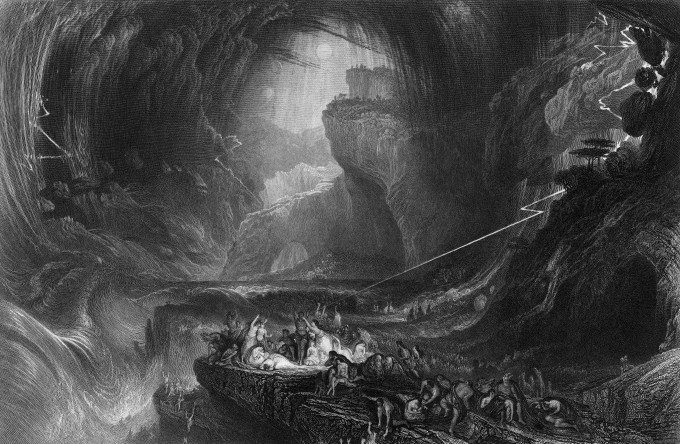
The Deluge, engraving by William Miller after the painting by John Martin

There is a moment in a mid-1820s etching by John Martin when Biblical narrative collides with archaeology, and with market economics — in The Expulsion of Adam and Eve From Paradise the couple are running out of the Garden of Eden through a rocky landscape, a tongue of lightning in the background. Down to their right is some sort of prehistoric creature, almost certainly depicted with the latest theories of what dinosaurs would have looked like, at a time when such palaeontology was in its infancy — the word dinosaur being coined by Richard Owen in 1842. In Martin’s earlier oil painting of the same title, dated about 1813, the image is broadly similar, but lacks the creature. The addition would help him sell the print. This was no one-off — he illustrated for Gideon Mantell’s The Wonders of Geology (1838), in the form of The Country of the Iguanodon, and Thomas Hawkins’s The Book of the Great Sea-Dragons (1840) [PDF], as well producing other images of antediluvian fauna. Such depictions suggest that Martin is one of the first science-fiction artists, and his paintings of Biblical, historical and mythological scenes, often featuring disasters and tumultuous landscapes, reinforce this sense. His uneasy status as a provincial outsider having to earn a living from a metropolitan élite also anticipates the struggles for mainstream respect of genre writers.

Martin was born in 1789 in Haydon Bridge, Hexham, Northumbria, the youngest of four sons. Apprenticed to a coachmaker, he intended to learn heraldic painting, but after a dispute about terms his indenture was cancelled and instead he went to work with Italian artist Boniface Musso. Musso had already given him lessons in drawing and oil techniques in Newcastle; now Martin learnt to paint plates and glass as part of a commercial operation. In 1806, he moved to London, where he supplemented his income by producing watercolours and, in time, became a professional artist. The key place to be exhibited was the annual Royal Academy of Arts summer show, then held at Somerset House, although his first painting was rejected in 1810. The same painting, retitled, hung the following year; the breakthrough came when a member of the board of governors of the Bank of England, William Manning MP, offered fifty guineas to buy Sadak in Search of the Waters of Oblivion (1812). This painting had been inspired by James Ridley’s Oriental fantasy Tales of the Genii (1764), where the hero Sadak crawls across a mountainous landscape toward amnesia-causing waters. Further large canvases followed over the next forty years, with Martin in search of wealthy and influential patrons. But Martin also found popular acclaim, with the Biblical painting Joshua Commanding the Sun to Stand Still upon Gibeon (1816), and was to both show his work in London exhibitions and to tour them around the world — it is thought that two million people saw his Day of Judgement triptych (1849-53) in the UK, the USA and Australia.

Martin’s paintings typically invoked a sense of the sublime. Longinus, writing about rhetoric in the first century, argued that “the true sublime uplifts our souls; we are filled with a proud exaltation and a sense of vaunting joy”, whereas the eighteenth-century Edmund Burke argued that “delightful horror […] is the truest test of the sublime”. In Martin’s case, the feeling is invoked by vast landscapes containing tiny figures in the fore- to midground to give a sense of scale — and his canvases tend to be portrait in orientation, allowing for the composition to tower above the viewer. The terrain is often bowl-shaped, with cliffs and trees taking up the left and right sides of the frame, and then, further back, rivers, lakes, seas and classical cities in the haze of the background. Sometimes the sky forms an answering semicircle, perhaps with clouds of fire, and in some canvases the patina of the painting is cracked in concentric circles. Frequently, the sky is scarred with lightning, scratches across the canvas. In The Deluge (1826), the sea curves around the bottom of the canvas, sweeping the boat clockwise, with storm clouds completing a circuit around the top of the composition, an oval of fairer weather and a glimpse of cities in the distance between them.

The Deluge is one of several paintings Martin made of the Biblical flood, alongside The Eve of the Deluge (1840) and The Assuaging of the Waters (1840); the painting of The Expulsion of Adam and Eve From Paradise, alongside The Garden of Eden (1821), The Fall of Babylon (1819), Belshazzer’s Feast (1820), Adam and Eve Entertaining the Angel Raphael (1823) and The Destruction of Sodom and Gomorrah (1852), suggests an Old Testament theme running through his work, especially the sense of a powerful, destructive, vengeful God. The success of Belshazzer’s Feast, which was reproduced in several versions, clearly suggested that there was a market for such apocalyptic thrills, in a Britain which in the process of being changed forever by the industrial revolution and a network of railways threading its way between mines and factories and ports, and between London and the provinces. The aristocracy and the upper middle classes could go on Grand Tours across Europe, to the Matterhorn, the Alps, Venice, Sicily and beyond, but Martin had been on no such journey and locates such landscapes within England. It is tempting to see the valley of the Tyne with Newcastle perched above it as one inspiration for his topography.

It was apparently a journey through the industrialised Black Country which pointed him to the New Testament subject of The Great Day of His Wrath, a book of Revelation style destruction of Babylon in which volcanic powers rip open a landscape, and vast boulders — on which ruined cities can be glimpsed — are thrown through the air. A second painting, The Last Judgement (1849-53), has a landscape riven in two, beneath Christ and the Angels sitting in court at the top of the picture against a more heavenly sky. On the left of the canvas are the saved, including a range of politicians, poets and artists from antiquity to the present day, on the right, across a chasm filling with corpses, are the damned. Before the painting was damaged, there was a train being driven towards the abyss. The trilogy is completed by The Plains of Heaven (1851-3), a gentler pastoral of the era after the Second Coming, the green of grass and trees surrounding a rich azure of sky and sea. But Martin also looked to Pompeii and Herculaneum for his subjects, and its destruction by volcano (1822, 1822-6), and a classical story of Marcus Curtius being swallowed up by a chasm in a city street.

From the 1820s onwards he was developing plans for canals across London to provide a water supply for London and Westminster, for a sewage system to improve London’s hygiene (and to provide fertiliser for farms) and for a network of railways circling central London and along the banks of the Thames. In this work he anticipated Joseph Bazalgette’s improvements to the London drains and the Embankment and the piecemeal engineering of the London Underground network and overground lines, then in its infancy. Funds were never quite available to translate Martin’s plans into practice. He was also friends with Isambard Kingdom Brunel, Michael Faraday, Charles Babbage and other scientists such as Georges Cuvier, a French palaeontologist. In the painting Arthur and Aegle in the Happy Valley (1841), inspired by a Sir Edward Bulwer-Lytton poem, Martin insists that the background constellations are accurate in astronomical terms, even if the topic was fictional. He drew on the latest science and engineering.

Martin also knew Charles Barry, who won the competition to design the neo-gothic yet classical new Houses of Parliament, and it is likely this architecture also fed into his work. One could scale his painting of Balshazzer’s Feast to discover how many miles long his palace interior was — or so Martin argued — and contemporary archaeology was another source of inspiration and publicity. Pamphlets and handbills listed details of the people painted in crowd scenes and drew attention to details. All of this contributes to the showmanship which Martin clearly possessed in spades — but also, perhaps, to the sense of insecurity from being an outsider, a working-class artist with little training. Conspicuous testimony to his sense of pride is a piece of furniture, shown in Apocalypse: a bureau with drawers labelled for Martin’s various projects and honours. At the 1851 Great Exhibition, he presented himself as an engineer rather than as an artist.

Salespitches remained necessary, as the art market ebbed and flowed in the era of J.M.W. Turner and John Constable, the former artist stopping at nothing to gain advantage and positioning in the Royal Academy summer exhibitions. Whilst it was possible to sell similar paintings in several sizes, this undercut their exclusiveness, so Martin made a virtue of copying through the comparatively mass medium of the mezzotint. But the mezzotints enabled Martin to revise his earlier compositions — hence the appearance of a prehistoric creature alongside Adam and Eve. Martin employed other engravers to make plates of his images, although he was not always happy with their work and would sometimes reject it. Other times he would do his own engraving, and for a period set up a state of the art press in his own home where he supervised the production of mezzotints by professional printers.

One series of mezzotints were commissioned in 1824 by Septimus Prowett as illustrations to John Milton’s Paradise Lost (1667), returning to Old Testament scenes, but also paving the way for scenes from Revelation and the New Testament in general. The most striking of these depict Satan, especially Satan in Council, whose composition seems to anticipate the council chamber in the Star Wars prequel trilogy (and Lucas apparently was inspired by Martin’s work; the empty landscape of Solitude (1843) is echoed in the climax of THX 1138 (1971) or the deserts of Tatooine). Martin went on to work on illustrations of the Bible, a less successful project than he had hoped, as was his attempt to sell direct to customers, bypassing the established English network of print emporia. Worse, he undercut himself by designing cheaper plates to be printed by Edward Churton. Nevertheless Martin still made more money from his mezzotints than his paintings — Michael Campbell, a Martin collector and scholar, suggests up to £25,000 — although the market declined through the 1830s.

Perhaps such mentions of money are vulgar — but I see in Martin a kindred spirit of today’s science-fiction writers. He might not have quite been competing for the reader’s beer money, but he knew how to exploit a successful image in more than one format, and he knew how to bring showmanship to his exhibitions. In the lack of official recognition from membership of the Royal Academy nor was he knighted — although the Belgians honoured him — we might also think of the anxieties over the injustices of the Booker Prize or snootiness about the Granta Best of Young Novelists lists. But mostly it is in his fusion of science and art, his use of the sublime, and his creation of apocalyptic imagery that never quite feels reducible to allegory or political parable. (His painting The Last Man (1833) is inspired by an 1823 Thomas Campbell poem rather than Mary Shelley’s 1826 novel, but his accommodation of Jane Loudon as a house guest might put him somewhere in the genesis of The Mummy! Or A Tale of the Twenty-Second Century (1827).)

His work remains sublimely astounding. If you want to see the inspiration for a hundred ends of the world, or be inspired yourself, immerse yourself in Martin’s art, which is, in the words of curator Martin Myrone, “suspended or caught between mass production and the unique, the popular and the rarefied, the industrialised and the artistic, the sensationalist and the scholastic.” And that, after all, is the place where we often find sf.

Reading List

Adams, Max (2010) The Prometheans: John Martin and the Generation That Stole the Future, London: Quercus.

Aristotle/Horace/Longinus (1965) Classical Literary Criticism, trans. T.S. Dorsch, Harmondsworth: Penguin.

Burke, Edmund (2008) A Philosophical Enquiry into the Origin of Our Ideas of the Sublime and Beautiful, Oxford: Oxford World’s Classics.

Feaver, William (1975) The Art of John Martin. Oxford: Clarendon Press.

Martin, John (2011) Sketches of My Life, ed. Martin Myrone, London: Tate.

Myrone, Martin (ed.) (2011) John Martin: Apocalypse, London: Tate.

Looking ahead

We’ve gotten a bit behind with plans here at Torque Control. I’ve had a busy end-of-semester, and Niall and Tony both ended up over-committed, which is why you haven’t seen the end (or in one case, beginning) of discussions of Farthing and The Carhullan Army. I can’t tell you when those posts will be along, but I can tell you the following…

I have a special preview of the next Vector for you tomorrow. The issue itself was as waylaid as this blog, but you should still have it before the end of January. In the meantime, tomorrow I’ll be posting an article which will appear in the print issue when it comes out, but which you really need to read much sooner than that: Andrew Butler’s writeup of the John Martin: Apocalypse show which is currently at the Tate in London, but closes January 15th.

Next week, I’ll be posting on Lavinia.

Then, two weeks later, in January, I’ll post about Gwyneth Jones’ Spirit. Shortly after which, you should be receiving the next BSFA mailing, about which much more anon.

End-of-the-year books

The best-of-2011 lists are coming out and, as every year, they make me feel sorry for any book published in the last few weeks of the calendar year. They don’t make it onto best-of lists published before the year is over. They’re out after the brightest glow of holiday-season publicity. As a result, they don’t do as well on awards lists.

From Locus: New Books Dec 6, Dec 13, Dec 20. (Post by week received, so not all December books.) Here are some of December’s, listed by Kirkus. Here are some of the fantasy novels out this month, by date.

There’s work there from Emma Bull, Connie Willis, Bruce Sterling, Rob Sawyer, and the BSFA’s own Ian Whates. For non-fiction, there’s Jessica Langer’s Postcolonialism and Science Fiction in the UK (out in Jan 2012 in the US).

Which December books do you think need a higher profile than they might otherwise receive? Which of these do you most hope won’t be overshadowed by being left off of the end-of-year profusion of best-of lists?

The Carhullan Army/Daughters of the North – City vs. country in dystopia

Rather later than originally planned, for which I apologise profusely, I begin the discussion of Sarah Hall’s Tiptree-winning The Carhullan Army (published in the US as Daughters of the North, and that’s the last time I’m going to use that title – it’s not a bad one, but it’s not Hall’s).  It’s a novel that provoked a wide range of responses, and it’s worth going and reading some of the reviews that Niall Harrison lists here, as well as Nick Hubble’s excellent piece from Vector 258.

When I first read this novel, in 2008 in the wake of its nomination for the Arthur C. Clarke award, I wrote the following:

This has been often compared to Margaret Atwood’s The Handmaid’s Tale, and one can see why. There is the same notion of an anti-feminist dystopia, in which women have no rights over their own reproductive processes. But it’s very English as well. It has the same sense of place as to be found in Alan Garner (I could easily picture where the novel is set). There’s also more than a hint of John Wyndham’s ‘cosy catastrophes’. I also admire the way Hall constructs her narrative presentation in order to skip over the boring bits (and I have realized from a comment somewhere else in the blogosphere that the framing device employed is, like the historical section at the end of Nineteen Eighty-Four, a means of signalling that this oppression will not last). It’s very well-written (and refreshingly short), but in the end it’s just not quite as good as two other novels on the shortlist.

In the light of a comment made by Hall towards the end of this interview, I would probably modify the comment about the framing device – the fact that  the novel is supposedly a recovered but corrupted interrogation file (though as others have pointed out, it doesn’t read like that) implies something has happened in the wake of the events of the novel, but doesn’t necessarily imply what.  (In my mind, that the Carhullan army’s call for revolution was heeded elsewhere, though it may not have been successful.)

But here I want to pick up the issue of the ‘cosy catastrophe’, Brian Aldiss’ term for a certain type of British disaster novel.  As many have pointed out since, even Wyndham isn’t that cosy, but there is a strain in British dystopian novels in which they explore the collapse of British (or more often English) society, and the attempt to preserve values in the face of catastrophe.  The Carhullan Army fits into that tradition, whilst placing a few spins on it.  It is a novel that seems rooted in past sf traditions.  Cheryl Morgan talks about the ‘real date’ of the novel being around 2005, and there is something to that – Hall herself has talked about the importance of the 2005 Carlisle floods as a spur to the novel.  But much of the rest, as a number of critics have noted, to varying degrees of approbation or not, seems rooted in social attitudes of the 1970s.

The work that The Carhullan Army now most resonates with for me is Alan Moore and David Lloyd’s 1980s graphic novel V For Vendetta (which I didn’t mention in the passage above, but which plenty of others have).  Both works feature the rise of an authoritarian (in V explicitly Fascist) government in England, in response to disaster.  (Karen Burnham attacks the plausibility of this in The Carhullan Army, but that disaster rapidly precipitates extreme authoritarianism remains a regular topos of British dystopian fiction; it is something Russell T. Davies is obsessed with, as shown in the Doctor Who episode ‘Turn Left’ and the two most recent Torchwood stories, Children of Earth and Miracle Day.)

But V is very much set at the core of this government – bar a few flashbacks, almost all the action takes place in London.  The Carhullan Army almost presents the provincial mirror to this – it explores how the authoritarian regime plays out in the regions.

But what region this plays out in is important.  ‘Cosy catastrophe’ novels often take place in the south-east of England.  The Carhullan Army is set in the north-west, in Cumbria (as, it should be noted, does the climax of John Christopher’s The Death of Grass).  It actually seems slightly jarring to see the setting referred to as ‘rural England’, with the connotations that has for me of Kent or Somerset.  Hall’s is not that landscape (I’ll discuss Hall’s sense of place in more detail tomorrow).

The rural stronghold, a place of safety that remains nevertheless vulnerable, has always played an important role in the British disaster novel – think of Bill Masen’s Sussex farm in The Day of the Triffids, the potato farm that is John Custance’s objective in The Death of Grass, or the community set up in Terry Nation’s 1970s tv series Survivors.  But what is less often seen is the provincial city. When a post-apocalyptic city is visited, it is often, as in Day of the Triffids, or the Survivors episode ‘The Lights of London’, the nation’s capital (the recent Survivors reboot filmed in Manchester and Birmingham, but in both cases the city seems intended to stand in for London).  The Carhullan Army begins and ends in Penrith (here renamed Rith), and shows a provincial city at work (or not) after the apocalypse.  London is too remote to play any significant role – it is the seat of government, and supplies occasionally come from the south, but most people’s horizons have shrunk.  This exploration of the post-apocalyptic city is little commented upon, but may well be one of The Carhullan Army‘s more novel features.

Coming up: Lavinia

Next up in reading the Future Classics is a novel set in ancient Latium.

For November, what’s left of it, I’ll be looking at Lavinia, Ursula Le Guin’s retelling of part of the Aeneid from the perspective of a character who, in the original, has no lines. The book was contentious as science fiction at the time: does it even count as part of that genre? Whether or not it does – we’ll reconsider the arguments – it’s certainly a fascinating and admirable book. It won the Locus Award for Best Fantasy Novel, and was shortlisted for the BSFA Award.

Lavinia was published in 2008 (meaning we’ve skipped 2007). In that year, Fidel Castro resigned as president of Cuba, Bill Gates as chairman of Microsoft, the island of Sark lost its distinction for preserving feudalism, the summer Olympics were held in Beijing, and the Large Hadron Collider was officially opened. Arthur C Clarke died, and Terry Pratchett announced that he was in the early stages of Alzheimer’s. The BSFA began its experiment with running Matrix as an online magazine.

I can promise you a discussion of Lavinia before the end of the month. I’ll be posting on it starting a week from today.

P.S. These year recaps paid off at the BristolCon quiz for me, when, thanks to doing them, I knew in which year Pluto lost its planetary status.

Science Fiction Foundation SF Criticism Masterclass 2012

Class Leaders:
Edward James
M. John Harrison
Kari Sperring

The Science Fiction Foundation (SFF) will be holding the sixth annual Masterclass in sf criticism in 2012.

Dates: June 22nd, 23rd, 24th 2012.

Location: Middlesex University, London (the Hendon Campus, nearest underground, Hendon).
Delegate costs will be £190 per person, excluding accommodation.
Accommodation: students are asked to find their own accommodation, but help is available from the administrator (farah.sf@gmail.com)

Applicants should write to Farah Mendlesohn at farah.sf@gmail.com. Applicants are asked to provide a CV and a writing sample; these will be assessed by an Applications Committee consisting of Farah Mendlesohn, Graham Sleight and Andy Sawyer. Completed applications must be received by 28th February 2012.

BSFA Event Nov 23rd: STEPHEN BAXTER interviewed by Paul Cornell

On Wednesday 23rd November 2011* from around 7pm:

STEPHEN BAXTER (President, British Science Fiction Association)

will be interviewed by Paul Cornell (Writer of books, tv, comics, etc.)

Location
Upstairs Room, The Antelope Tavern
22 Eaton Terrace, Belgravia
London, United Kingdom


View Larger Map
Nearest Tube: Sloane Square (District/Circle)

All welcome! (No entry fee or tickets. Non-members welcome.)
Interview will commence at 7.00 pm, but the room is open from 6.00 (and fans in the downstairs bar from 5).
There will be a raffle (£1 for five tickets), with a selection of sf novels as prizes.

FUTURE EVENTS:

(No meeting in December.)

25th January 2012 – CHRISTOPHER PRIEST interviewed by Paul Kincaid

22nd February 2012* – LIZ WILLIAMS interviewed by Ian Whates

28th March 2012 – BSFA Awards Meeting

(Please note that future events will not take place in the Antelope.  A new venue will be announced soon.)

* Note that this is a month with five Wednesdays.  The meeting will be on the fourth, not the last, Wednesday of the month.

Vector 268

The latest BSFA mailing arrived with the post this morning! I’d been expecting it any day now for the last week or so, after it been sent off to the black box of the publisher. And here it is, Focus (TOC) and Vector both.

This quarter’s Vector is primarily devoted to Diana Wynne Jones, who died in March this year. When I started putting the issue together, I’d hoped she would be with us for years to come, that she would be able to see the issue for herself. Instead, it became a memorial issue to a much-missed author whose influence was formative for many (including me).

Vector 268 contains…

2011 BSFA Awards – Donna Scott
An Excerpt from a Conversation with Diana Wynne Jones – Charlie Butler
Translating Diana Wynne Jones – Gili Bar-Hillel Semo
Diana Wynne Jones in the Context of Children’s Fantasy – Jessica Yates
The Mistress of Magic – Meredith MacArdle
On Screen: Two Filmed Versions of Books by Diana Wynne Jones – Gill Othen
Diana Wynne Jones: A BSFA Discussion – Farah Mendlesohn & Charlie Butler, transcribed by Shana Worthen
Infertility in Science Fiction as a Consequence of Warfare – Victor Grech with Clare Thake-Vassallo & Ivan Callus

Resonances – Stephen Baxter
Kincaid in Short: The Heat Death of the Universe – Paul Kincaid
Foundation Favourites: Forbidden Planet – Andy Sawyer
Now and Then: Invisible Words – Terry Martin

The BSFA Review – edited by Martin Lewis 

My apologies to Meredith, whose first name is missing an ‘h’ in the table of contents.

October BSFA London Meeting: SF Gateway discussion – 26th October 2011 – Free entry

On Wednesday 26th October 2011 from around 7pm:

DARREN NASH (Orion Books) and GRAHAM SLEIGHT (Science Fiction Encyclopedia) will discuss the Gollancz Science Fiction Gateway with Tom Hunter (Arthur C. Clarke Award Administrator).

Tanith Lee is unfortunately unable to attend.  Her interview has been rearranged for 27th June 2012.

Venue:

Upstairs Room
The Antelope Tavern
22, Eaton Terrace
Belgravia
London
SW1W 8EZ

Nearest Tube: Sloane Square (District/Circle)
Map:here.

All welcome! (No entry fee or tickets. Non-members welcome.)
Interview will commence at 7.00 pm, but the room is open from 6.00 (and fans in the downstairs bar from 5).
There will be a raffle (£1 for five tickets), with a selection of sf novels as prizes.

FUTURE EVENTS:

23rd November 2011* – STEPHEN BAXTER interviewed by Paul Cornell

(No meeting in December.)

25th January 2012 – CHRISTOPHER PRIEST interviewd by Paul Kincaid

22nd February 2012* – LIZ WILLIAMS interviewd by Ian Whates

* Note that this is a month with five Wednesdays. The meeting will be on the fourth, not the last, Wednesday of the month.